
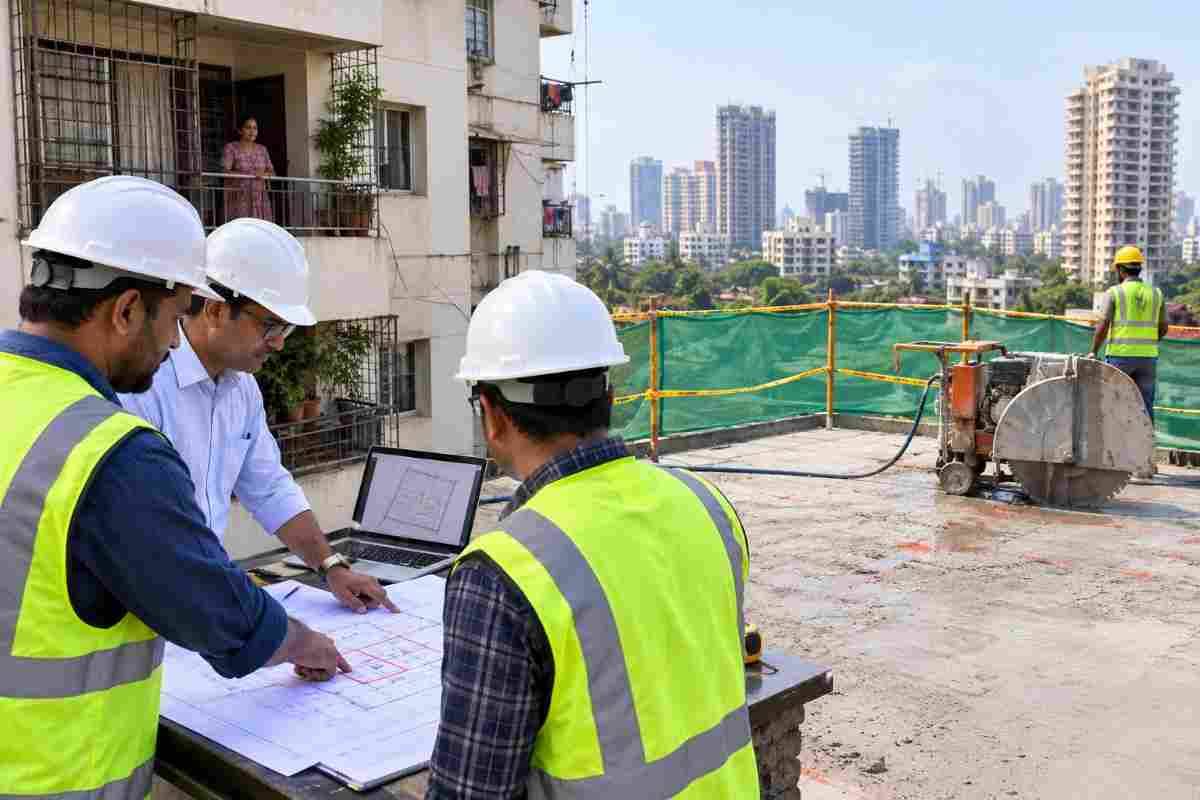
Modifying a roof slab in an occupied Mumbai high-rise or housing society is one of the most demanding engineering tasks in urban renovation. Whether creating access for a new duplex staircase, installing sky-deck amenities, cutting HVAC/plumbing duct shafts, or retrofitting lift wells, cutting through heavily reinforced concrete (RCC) demands meticulous planning.
In a densely populated metropolis like Mumbai—where residents live directly below, beside, and around the work site—traditional jackhammers and aggressive breaking techniques are strictly out of the question. Vibration can cause structural micro-fractures, noise leads to immediate society complaints, and airborne concrete dust poses health risks.
To execute such complex modifications without disturbing occupants or compromising building stability, professional concrete cutting contractors follow a highly structured engineering protocol. Here is an inside look at how expert contractors plan and execute roof slab cutting in occupied Mumbai buildings.
1. Structural Audits & Non-Destructive Testing (NDT)
Before any saw touches concrete, contractors conduct a comprehensive structural assessment. In older Mumbai structures (such as those in Dadar, South Mumbai, or Chembur) as well as modern high-rises in Western Suburbs, structural drawings may be outdated or missing.
       [ Structural Audit & NDT Scanning ]
                        │
                        ▼
       [ Propping & Crash Deck Installation ]
                        │
                        ▼
    [ Municipal Permits & Society NOC Clearance ]
                        │
                        ▼
       [ Wet Diamond Sawing / Wire Cutting ]
                        │
                        ▼
     [ Controlled Rigging & Debris Chute Removal ]
Key Steps in the Assessment Stage:
-
Ground Penetrating Radar (GPR) & Rebar Scanners: Contractors use electromagnetic rebar locators and GPR to map the internal skeleton of the slab. This reveals main tension bars, distribution steel, embedded electrical conduits, and post-tensioned (PT) cables.
-
Load Path Analysis: A structural engineer calculates how removing a specific slab segment will redistribute loads to adjacent beams and columns.
-
Core Sample Testing: Taking small core samples allows contractors to verify compressive concrete strength (M25, M40, etc.) to calibrate blade selection and feed rates.
2. Temporary Support Systems and Load Transfer
In an occupied building, a cut section of concrete cannot simply fall or cause floor deflection on the level below. Heavy shoring and propping systems are designed to safely hold both the dead load of the cut slab section and the live load of cutting machinery.
| Support Component | Function | Application in Occupied Structures |
| Heavy-Duty Acrow Props | Telescopic steel props installed underneath the slab. | Transfers load directly to lower structural floors. |
| Crash Decks & Catch Platforms | Protective wooden and steel barricades directly beneath the cut area. | Catches slurry, water, and debris, preventing damage to lower occupied flats. |
| Tie-Rod & Crane Suspension | Anchor bolts fixed into the cut slab block connected to overhead gantry cranes. | Prevents the severed concrete block from falling when the final cut completes. |
3. Regulatory Clearances and Society Coordination
Planning in Mumbai requires navigating local administrative rules and society regulations.
-
Brihanmumbai Municipal Corporation (BMC) & Structural Stability Certificates: Structural alterations in registered housing societies frequently require structural stability reports signed by a chartered structural engineer.
-
Society NOC (No Objection Certificate): The Co-operative Housing Society (CHS) management committee usually enforces strict working hours (typically 10:00 AM to 5:00 PM on weekdays) to minimize nuisance to residents.
-
Neighboring Unit Protection: Below-floor residents are informed in advance, and protective dust membranes are fitted over shared shafts or drainage lines.
4. Advanced Low-Vibration Cutting Technologies
To maintain peace in occupied spaces, contractors abandon impact tools in favor of diamond-tool technology. These tools slice cleanly through concrete and rebar without transmitting shockwaves through the building frame.
                     +----------------------------------+
                     | Diamond Tool Cutting Technologies |
                     +----------------------------------+
                                      |
         +----------------------------+----------------------------+
         |                                                         |
         v                                                         v
+-------------------------------+                       +-------------------------------+
|     Diamond Floor Sawing      |                       |      Diamond Wire Sawing      |
|  - Precise straight line cuts |                       |  - Ideal for thick / PT slabs |
|  - Depth-controlled           |                       |  - Ultra low vibration        |
|  - Continuous water cooling   |                       |  - Flexible pulley layout     |
+-------------------------------+                       +-------------------------------+
         |                                                         |
         +----------------------------+----------------------------+
                                      |
                                      v
                        +---------------------------+
                        |   Diamond Core Drilling   |
                        |  - Corner relief holes    |
                        |  - Duct/pipe penetrations |
                        |  - Zero structural shock  |
                        +---------------------------+
Key Cutting Methods Used:
A. Diamond Track-Mounted Wall & Floor Sawing
High-power electric or hydraulic saws travel on fixed aluminum tracks anchored to the slab.
-
Precision: Delivers razor-sharp, smooth edges that eliminate the need for costly plaster patching.
-
Controlled Depth: Blade sizes are chosen based on exact slab thickness (from 150 mm up to 500 mm).
B. Diamond Wire Sawing
For heavily reinforced or extra-thick concrete slabs, diamond wire saws are the gold standard. A multi-strand steel cable infused with industrial diamond beads wraps around the concrete section. Driven by high-speed hydraulic pulleys, it cuts through dense rebar grids with virtually zero vibration.
C. Continuous Core Drilling for Relief & Stitching
To cut rounded corners or create starting points for saw blades, diamond core drills make circular cuts ranging from 25 mm to 500 mm in diameter. Stitch drilling (overlapping core holes) is used in confined corners where large saw blades cannot fit.
5. Noise, Dust, and Water Slurry Management
Working in an occupied building requires strict environmental controls. Concrete cutting generates silica dust and wet slurry that must be contained on site.
Safety & Environmental Protocol:
All diamond blades require continuous water feeds to prevent thermal wear and capture fine concrete particles at the point of contact. Contractors deploy industrial wet-vacuum extractors directly behind the saw blade to swallow slurry before it leaks through floor expansion joints or drainage lines.
-
Dust Containment Tanks: Temporary polythene wall enclosures (containment pods) surround the active workspace under negative pressure.
-
Acoustic Insulation Enclosures: Portable sound-dampening baffles surround power generators and hydraulic pump units to meet local noise limits.
6. Block Segmenting and Crane-Assisted Debris Lowering
Once a roof slab section is severed, removing massive concrete blocks (often weighing between 500 kg and 3 tons) from top floors poses a logistical challenge.
+-----------------------------------------------------------------------+
|                       DEBRIS DISPOSAL PROTOCOL                        |
+-----------------------------------------------------------------------+
|  1. BLOCK SEGMENTATION: Large slabs divided into manageable pieces    |
|  2. RIGGING: Fixed eye-bolts and lifting slings attached to block     |
|  3. CRANE HOISTING: External mobile crane or floor gantry lowers block|
|  4. C&D TRANSPORT: Sealed trucks transport debris to C&D facility     |
+-----------------------------------------------------------------------+
-
Sectional Grid Cutting: Slabs are pre-cut into smaller, manageable rectangular blocks matching the load capacity of hoisting equipment.
-
Anchor Eye-Bolts & Rigging: Steel expansion anchors are drilled into each block segment to attach high-tensile lifting slings.
-
External Hoisting vs. Internal Chutes: On roof levels, contractors use external mobile cranes or modular floor-mounted A-frame derricks to hoist concrete blocks out and lower them to ground level. Fine debris is routed through enclosed dust-proof chutes directly into C&D (Construction and Demolition) waste trucks.
How Core Cutting India Delivers Safe Structural Slab Cutting Services
Executing high-rise concrete slab cutting demands technical skill, high-grade machinery, and hands-on site experience. Core Cutting India provides engineered slab cutting, wire sawing, and core drilling services across Mumbai and surrounding regions.
Why Project Owners Trust Core Cutting India:
-
Advanced Equipment: Utilizing Hilti and hydraulic track saws, diamond wire cutters, and heavy-duty floor saws for precise cuts.
-
Zero Structural Damage: Low-vibration wet-cutting methods safeguard adjacent beams, columns, and neighboring apartments.
-
Turnkey Safety Execution: From initial structural rebar scanning to propping, slurry extraction, and block lifting, every step complies with strict site safety norms.
For professional engineering consultations, site surveys, and cost estimates, contact Core Cutting India:
-
Website: https://corecuttingindia.com/
-
Phone / WhatsApp: +91 7009679903
-
Email: [email protected]
Frequently Asked Questions (PAA)
Q1. Is it safe to cut a roof slab in an occupied residential building in Mumbai?
Yes. When executed by qualified contractors using non-impact diamond cutting techniques (like floor sawing or wire sawing) under structural engineering supervision, it is safe. Low-vibration tools ensure nearby structural elements remain uncompromised.
Q2. What permits or society NOCs are required before cutting a concrete slab?
You typically require a No Objection Certificate (NOC) from the building’s Co-operative Housing Society (CHS), along with a Structural Stability Certificate signed by a registered structural engineer. Depending on the scope, municipal notifications or approvals from the BMC may also be required.
Q3. How do contractors control dust and noise during slab cutting on upper floors?
Contractors use wet diamond saw cutting, where continuous water feeds suppress dust into a liquid slurry. Industrial slurry vacuums pick up liquid waste instantly. Acoustic containment curtains and scheduled working hours help manage noise levels in residential settings.
Q4. What machinery is used to cut reinforced concrete (RCC) roof slabs cleanly?
Contractors use diamond floor saws for flat straight cuts, track-mounted wall saws for high-precision edges, diamond wire saws for deep/thick sections, and core drills for corner relief holes and utility penetrations.
Q5. How do contractors prevent structural collapse while cutting slab sections?
Before cutting begins, heavy steel props (Acrow props) and crash decks are installed on the floor directly beneath the target area to catch and support loads. Individual concrete blocks are rigged with eye-bolts and secured to cranes or lifting gantries before the final perimeter cuts are completed.