
Introduction
Core cutting has become an essential part of modern construction, renovation, and infrastructure maintenance. Whether it's creating an opening for plumbing pipes, electrical conduits, HVAC ducts, or elevator shafts, core cutting offers a precise and efficient way to cut through concrete, brick, and reinforced structures. However, while the process may seem straightforward, it can have significant implications for a building's structural integrity if not planned and executed correctly.
At Core Cutting India ([email protected]), we understand that every cut made into a concrete structure is not just a hole — it's an intervention into the load-bearing framework of a building. This blog explores how core cutting can affect structural integrity, the science behind it, common risks, and best practices to ensure safety and durability.
What is Core Cutting?
Core cutting, also known as core drilling, is a technique used to create precise, circular or shaped openings in concrete, masonry, or reinforced structures. It employs diamond-tipped drill bits or saws that cut through hard materials with minimal vibration, dust, and noise compared to traditional demolition methods.
Core cutting is widely used for:
- Installing plumbing and drainage pipes
- Running electrical cables and conduits
- Creating openings for HVAC ducts
- Installing elevators, staircases, or skylights
- Conducting structural inspections and testing
- Retrofitting older buildings with modern utilities
Because of its precision, core cutting is often preferred over jackhammering or manual breaking, which can cause unpredictable cracks and unnecessary structural damage. Still, precision does not eliminate risk — it simply changes how that risk must be managed.
Why Structural Integrity Matters
Structural integrity refers to a building's ability to withstand its intended loads — including its own weight, occupants, furniture, environmental forces like wind and seismic activity, and additional stresses over time — without experiencing failure, deformation, or collapse.
Every element within a structure, from beams and columns to slabs and walls, works together as an interconnected system. When one element is compromised, even slightly, the load distribution across the entire system can shift, sometimes in ways that are not immediately visible but manifest over months or years as cracks, sagging, or in extreme cases, structural failure.
This is why core cutting must never be treated as a purely cosmetic or utilitarian task. Every cut has the potential to alter the way loads travel through a structure.
How Core Cutting Affects Structural Integrity
1. Disruption of Load Paths
Concrete structures are engineered so that loads travel through specific paths — from the roof, through beams and columns, down to the foundation. When a core is cut into a beam, slab, or load-bearing wall, it can interrupt this load path. If the cut removes too much material or intersects with critical reinforcement, the structure may no longer be able to carry loads the way it was originally designed to.
For example, cutting a core through the middle of a beam can significantly reduce its bending capacity, even if the opening seems small relative to the beam's overall size. This is because the location of material removal matters as much as the amount removed.
2. Damage to Reinforcement Bars (Rebar)
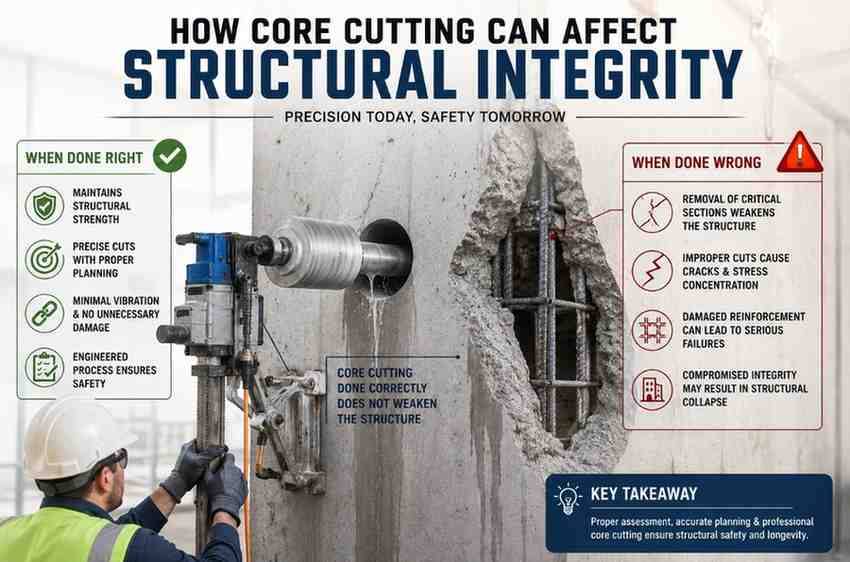
Reinforced concrete relies on steel rebar to provide tensile strength, since concrete alone is strong in compression but weak in tension. Uncontrolled or poorly planned core cutting can sever or damage rebar, weakening the concrete's ability to resist tension and bending forces.
Cutting through even a single primary reinforcement bar in a critical location — such as a beam-column joint — can create a localized weak point that compromises the entire structural system, particularly under dynamic loads like earthquakes or heavy wind.
3. Micro-Cracking and Vibration Damage
Even when using controlled diamond core cutting techniques, vibrations generated during the process can cause micro-cracks in the surrounding concrete. Over time, these micro-cracks can propagate, allowing moisture ingress, corrosion of embedded steel, and gradual weakening of the material — a phenomenon known as concrete spalling.
While diamond core cutting is far less damaging than jackhammering, it is not entirely vibration-free, and repeated or improperly executed cuts in close proximity to each other can compound this effect.
4. Altered Load Distribution in Slabs
In slab cutting, especially for elevator shafts, staircases, or large service openings, removing a section of the slab changes how loads are distributed across the remaining structure. Without proper reinforcement or structural support during and after the cutting process, the surrounding slab area may experience increased stress concentrations, leading to deflection or cracking.
5. Impact on Seismic Performance
In earthquake-prone regions, structural elements are often designed with specific ductility and load-sharing characteristics to absorb seismic forces. Core cutting that disrupts these carefully engineered elements — particularly shear walls or moment-resisting frames — can reduce a building's ability to perform safely during seismic events, even if the building appears structurally sound under normal, static conditions.
6. Long-Term Durability Concerns
Beyond immediate structural risks, poorly executed core cutting can create long-term durability issues. Exposed rebar at cut edges can corrode if not properly sealed, and unsupported openings can gradually widen due to repeated stress cycles, leading to costly repairs or structural retrofitting years down the line.
Factors That Determine the Impact of Core Cutting
Not all core cutting carries the same level of risk. The actual impact on structural integrity depends on several factors:
- Location of the cut – Cuts near beam-column joints, mid-span of beams, or load-bearing walls are far riskier than cuts in non-structural partition walls.
- Size and shape of the opening – Larger openings remove more material and are more likely to intersect critical reinforcement.
- Structural design and age of the building – Older buildings may have less redundancy in their design, making them more vulnerable to modifications.
- Presence and type of reinforcement – The density and pattern of rebar affects how much can be safely cut without compromising strength.
- Cutting method and equipment used – Diamond core cutting with proper vibration control minimizes collateral damage compared to manual or percussive methods.
- Post-cutting support and reinforcement – Whether temporary shoring or permanent reinforcement (like steel plates or carbon fiber wraps) is used after cutting.
Best Practices to Protect Structural Integrity During Core Cutting
1. Conduct a Structural Assessment First
Before any core cutting begins, a structural engineer should assess the drawings, identify load-bearing elements, and determine safe zones for cutting. This step is non-negotiable for any cut near beams, columns, or shear walls.
2. Use Non-Destructive Testing (NDT)
Techniques like Ground Penetrating Radar (GPR) or rebar scanning help identify the exact location of embedded reinforcement and utilities before cutting, reducing the risk of accidentally severing critical steel.
3. Choose the Right Cutting Technique
Diamond core drilling is generally the safest method for concrete, offering precision, minimal vibration, and clean edges compared to traditional breaking methods.
4. Plan Opening Size and Location Carefully
Openings should be as small as structurally feasible and positioned away from high-stress zones such as mid-span of beams or near supports.
5. Provide Temporary Support When Needed
For larger openings, especially in slabs and load-bearing walls, temporary shoring should be installed before cutting to redistribute loads safely during the process.
6. Reinforce After Cutting
Depending on the size and location of the opening, post-cutting reinforcement — such as steel lintels, carbon fiber wrapping, or additional support beams — may be necessary to restore structural capacity.
7. Hire Experienced Professionals
Core cutting should always be performed by trained and experienced contractors who understand both the technical cutting process and the structural implications of their work.
Why Professional Expertise Matters
Core cutting sits at the intersection of construction skill and structural engineering knowledge. A contractor may be excellent at operating diamond cutting equipment, but without understanding load paths, reinforcement patterns, and structural design principles, even a technically clean cut can create serious hidden risks.
This is why professional core cutting companies work closely with structural engineers, especially for cuts in critical structural elements. It's not just about making a hole — it's about making the right hole, in the right place, with the right precautions.
At Core Cutting India, every project begins with careful evaluation of the structure, followed by the use of advanced diamond core cutting technology to ensure minimal vibration, dust, and disruption. Our approach prioritizes both precision and structural safety, ensuring that every cut supports the long-term durability of the building.
Signs That Core Cutting May Have Affected Structural Integrity
Property owners and facility managers should watch for these warning signs after any core cutting work:
- Visible cracks radiating from the cut opening
- Sagging or deflection in slabs or beams near the cut
- Water seepage or staining around the opening
- Unusual sounds like creaking or popping in the structure
- Doors or windows near the cut area becoming misaligned
If any of these signs appear, a structural engineer should be consulted immediately to assess the extent of the issue and recommend remedial action.
Conclusion
Core cutting is a valuable and often necessary technique in modern construction and renovation, enabling the installation of utilities and services without extensive demolition. However, its impact on structural integrity should never be underestimated. From disrupting load paths and damaging reinforcement to creating micro-cracks and altering seismic performance, improper core cutting can compromise a building's safety over both the short and long term.
The key to safe core cutting lies in careful planning, structural assessment, the right equipment, and skilled professionals who understand the engineering behind every cut. When done correctly, core cutting can be performed with minimal risk, preserving both the functionality and structural safety of a building.
For structural core cutting services that prioritize safety, precision, and engineering best practices, reach out to Core Cutting India at [email protected]. Our team combines technical expertise with structural awareness to ensure that every project is completed safely and efficiently.
This article is for informational purposes. For any core cutting project involving load-bearing walls, beams, columns, or slabs, always consult a qualified structural engineer before proceeding.