
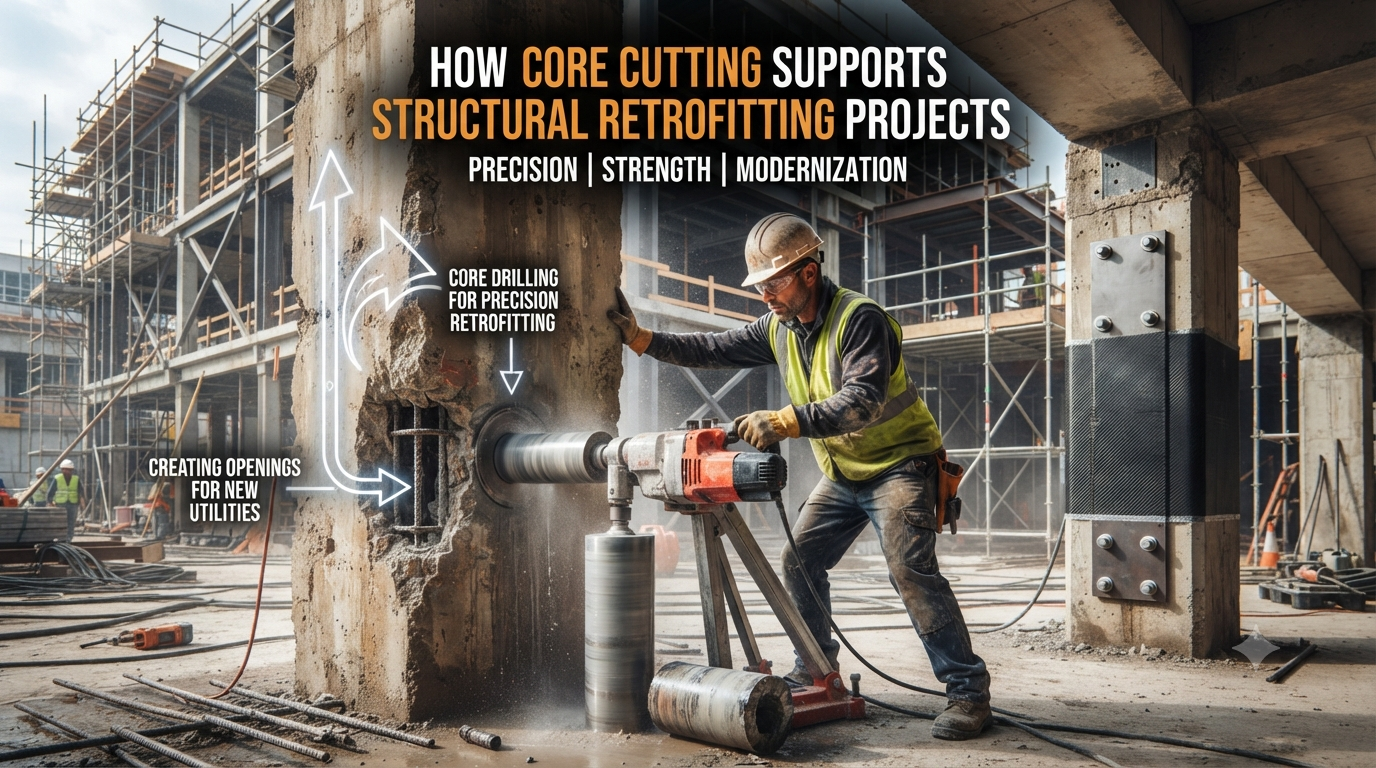
India's built environment is aging fast. From colonial-era buildings in Kolkata and Mumbai to mid-century government complexes in Delhi and industrial structures across Gujarat and Maharashtra, thousands of structures now need strengthening to meet current safety codes, seismic requirements, or simply to support a use change. Structural retrofitting has become one of the most active segments of India's construction and infrastructure repair industry — and at the heart of nearly every retrofitting project lies a precise, controlled technique: core cutting.
Core cutting, sometimes called core drilling, is the process of using diamond-tipped drill bits to cut circular holes or precise openings through concrete, masonry, or reinforced cement concrete (RCC) structures. Unlike traditional demolition methods that rely on hammering, chiselling, or jackhammering, core cutting is a controlled, vibration-free, and highly accurate technique. This makes it indispensable when working on structures that are already weakened, historically sensitive, or occupied and functioning during the retrofit process.
In this article, we look at why core cutting has become essential to structural retrofitting in India, the techniques involved, and real examples from Indian infrastructure and building projects where core cutting made retrofitting possible.
Target-Related Searches: core cutting services near me, concrete core cutting contractors India, structural retrofitting companies India, diamond core drilling for buildings, seismic retrofitting techniques, core cutting for beam and column strengthening, RCC core cutting cost India, core cutting vs demolition, non-destructive concrete cutting, retrofitting of old buildings India
What Is Structural Retrofitting, and Why Does India Need It?
Structural retrofitting refers to the process of strengthening or modifying an existing structure to improve its load-bearing capacity, seismic resistance, durability, or functional performance. Retrofitting is typically required when:
- A structure was built to older, less stringent codes and needs to meet current Indian seismic zoning requirements (particularly relevant in Zones III, IV, and V, which cover large parts of North and Northeast India)
- A building's use has changed — for example, converting a residential structure into a commercial one, which increases live load requirements
- Structural distress has developed due to corrosion, water ingress, or age-related degradation
- Additional floors or extensions are being added to an existing structure
- Utilities, ducts, elevators, or staircases need to be introduced into an existing building
India's National Building Code and the Bureau of Indian Standards (BIS) seismic guidelines have pushed many public and private structures — schools, hospitals, government offices, and heritage buildings — toward mandatory retrofitting programs, especially after earthquakes in Bhuj (2001), Sikkim (2011), and Nepal-border regions (2015) highlighted the vulnerability of older construction.
This is where core cutting becomes a critical enabling technology.
Why Core Cutting Is Essential to Retrofitting Work
1. Precision Without Structural Shock
Traditional breaking methods — hammering, wrecking balls, or pneumatic breakers — generate vibration and impact stress that can propagate micro-cracks through an already weakened structure. In a retrofitting context, where the goal is to strengthen a structure, introducing new stress fractures defeats the purpose entirely.
Core cutting uses rotary diamond drilling rather than impact force. The diamond-embedded bit shears through concrete and rebar with minimal vibration, which is exactly what's needed when working on:
- Structures already showing signs of distress
- Heritage buildings with lime mortar or older construction techniques
- Occupied buildings where residents or staff remain on site during work
2. Creating Openings for Structural Strengthening Elements
Many retrofitting techniques require new structural elements to be threaded through, bolted to, or bonded with existing concrete. This includes:
- Installing new steel jacketing around columns
- Inserting FRP (fibre-reinforced polymer) wrapping anchors
- Creating openings for new shear walls or bracing systems
- Running post-tensioning cables through existing beams and slabs
- Installing base isolators in seismic retrofitting of critical structures
Each of these interventions requires holes or openings cut to exact dimensions and locations — tolerances that manual breaking simply cannot achieve. Core cutting delivers holes accurate to a few millimeters, which is essential when structural engineers have calculated exact anchor bolt positions or cable alignments.
3. Enabling Utility and MEP Integration During Retrofit
Retrofitting projects frequently double as renovation projects, where electrical, plumbing, HVAC, and fire safety systems are upgraded alongside structural work. Core cutting allows contractors to create clean, precise penetrations through slabs and walls for pipes, conduits, and ducts without compromising the surrounding structure's integrity — something particularly important in high-rise retrofits where every floor slab is load-bearing.
4. Reduced Noise, Dust, and Disruption
Core cutting machines, especially wet-cutting diamond drills, produce significantly less dust and noise compared to jackhammers. This matters enormously in Indian cities where retrofitting is often carried out on occupied buildings — hospitals that cannot shut down, schools in session, or commercial complexes with active tenants. Wet core cutting also suppresses silica dust, improving worker safety on site.
Core Cutting Techniques Used in Indian Retrofitting Projects
Diamond Core Drilling: The most common method, using hollow cylindrical drill bits embedded with industrial diamonds to bore circular holes through concrete and reinforced steel. Used for anchor bolt installation, utility penetrations, and sampling.
Wall Sawing: Used to cut straight, precise openings in walls — often for new doorways, windows, or structural openings — using a track-mounted circular diamond blade.
Wire Sawing: Used for cutting thick or heavily reinforced concrete sections, particularly in bridge retrofitting and large structural elements, where a diamond-embedded wire loop cuts through mass concrete.
Slab Sawing: Employed for horizontal cutting of floor slabs, useful when introducing new staircases, elevator shafts, or service risers into existing buildings.
Each technique is selected based on the structural engineer's retrofit design, the type of concrete and reinforcement present, and site access constraints — all factors that an experienced core cutting contractor evaluates before starting work.
Indian Examples: Core Cutting in Action
Metro Rail Retrofitting and Station Integration
As Indian cities expand their metro networks — Delhi, Mumbai, Bangalore, Chennai, Pune, and Kochi among them — many new metro corridors intersect with existing buildings, flyovers, and utility infrastructure. Core cutting is routinely used to create openings in existing structures for utility diversions, foundation works near heritage precincts, and structural tie-ins where new metro pillars connect with existing road infrastructure. The precision required near century-old structures, such as those around Delhi's Chandni Chowk metro corridor, makes vibration-free core cutting the only viable option.
Heritage Building Strengthening in Mumbai and Kolkata
Mumbai's Fort district and Kolkata's colonial core contain hundreds of heritage-listed structures built with lime mortar, brick masonry, and early RCC. Retrofitting these buildings for seismic safety or fire code compliance often involves inserting steel reinforcement, FRP wraps, or new structural ties — all requiring precisely cut openings that don't disturb adjacent decorative facades or load paths. Core cutting contractors working on heritage retrofits typically use low-vibration diamond coring combined with careful load monitoring to protect these irreplaceable structures.
Industrial Structure Retrofitting in Gujarat and Maharashtra
India's industrial belt — including chemical plants, refineries, and manufacturing units across Gujarat, Maharashtra, and Tamil Nadu — frequently requires retrofitting of RCC structures to accommodate new machinery foundations, increased load capacities, or updated fire and safety codes. Core cutting is used extensively here to create openings for new equipment anchoring, cable trenches, and pipe rack supports without shutting down adjacent operational units, since wet diamond cutting minimizes dust in environments where flammable materials may be present.
School and Hospital Seismic Retrofitting
Government-led seismic retrofitting programs for schools and hospitals in Himalayan states like Uttarakhand and Himachal Pradesh, as well as parts of the Northeast, have relied heavily on core cutting to install steel jacketing and FRP wrapping around columns. Because these buildings often remain in use during retrofit work, low-noise, low-dust core cutting methods allow contractors to carry out structural upgrades in phases without disrupting classes or patient care.
Residential and Commercial High-Rise Retrofits
In cities like Bangalore, Hyderabad, and Pune, ageing residential societies and commercial towers frequently retrofit their structures to add elevator shafts, fire staircases, or additional floors under updated municipal norms. Core cutting enables clean slab penetrations for new elevator shafts and stair openings, avoiding the structural damage that would result from manual breaking through post-tensioned or heavily reinforced slabs.
Choosing the Right Core Cutting Partner for Retrofitting Projects
Not every core cutting job is equal — retrofitting work demands contractors who understand structural drawings, can coordinate with structural engineers, and use equipment calibrated for accuracy rather than speed alone. When evaluating a core cutting contractor for a retrofitting project, consider:
- Experience working alongside structural consultants and adherence to engineer-approved cutting plans
- Availability of both diamond core drilling and wall/wire sawing capabilities
- Track record on sensitive structures — heritage buildings, occupied premises, or industrial sites
- Compliance with safety protocols, including dust suppression and vibration monitoring
- Ability to work within tight tolerances specified by retrofit design drawings
Conclusion
Structural retrofitting is only as good as the precision with which it's executed, and core cutting has become the technique that makes modern retrofitting possible without compromising the very structures being strengthened. From metro corridors in Delhi to heritage buildings in Mumbai, industrial plants in Gujarat, and seismic-vulnerable schools in the Himalayan states, core cutting allows engineers to introduce new structural elements, utilities, and reinforcement systems with millimeter-level accuracy and minimal disturbance to existing structures.
As India continues to invest in retrofitting its ageing infrastructure to meet modern safety standards, the demand for skilled, precise core cutting services will only grow.
For structural retrofitting projects that demand precision, safety, and experience, Core Cutting India offers professional core cutting, wall sawing, and concrete cutting services tailored to retrofitting requirements across India. Reach out at [email protected] to discuss your project.