
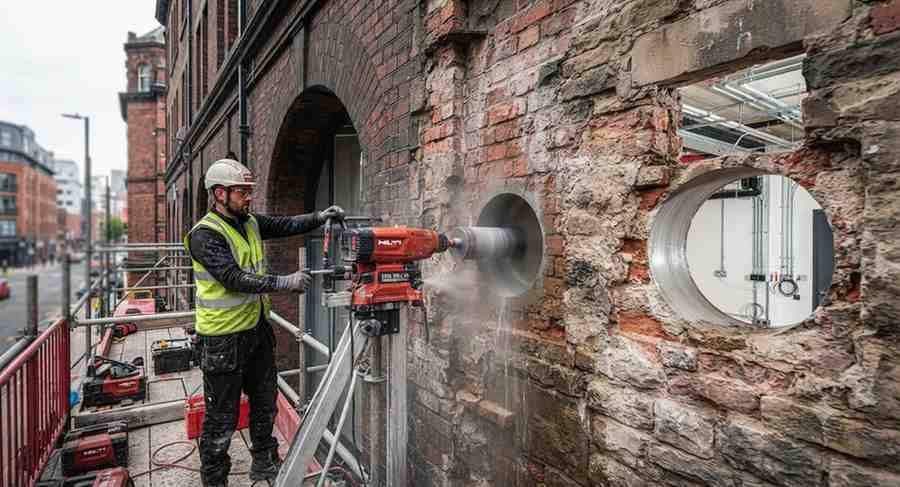
India’s urban landscape is a fascinating mosaic. Alongside soaring contemporary skyscrapers stand decades-old residential apartments, colonial-era heritage structures, and early post-independence institutional buildings. While these aging structures carry immense architectural and emotional value, they often struggle to keep pace with modern lifestyle demands.
Today’s occupants expect centralized air conditioning, high-speed fiber-optic data cabling, advanced fire suppression systems, and modernized plumbing lines. Integrating these complex mechanical, electrical, and plumbing (MEP) systems into a structure designed decades ago is a massive engineering hurdle. Traditional breakout methods—like manual hammering or heavy chiseling—send violent shockwaves through aging concrete, triggering structural cracks and destabilizing the foundation.
Enter concrete core drilling. As a precise, vibration-free, and clean technology championed by specialists such as [email protected], core drilling has revolutionized how Indian structural engineers approach building modernization and retrofitting.
Understanding Concrete Core Drilling in the Context of Building Upgrades
Concrete core drilling involves using specialized diamond-impregnated cylindrical drill bits powered by hydraulic or electric motors to cut clean, circular openings through reinforced cement concrete (RCC), brick masonry, and stone.
Unlike crude demolition tools that shatter material indiscriminately, a diamond core drill cleanly slices through both the concrete matrix and embedded steel rebar simultaneously. It leaves behind smooth-walled holes ranging anywhere from small anchor-pin diameters to massive utility ducts over 500mm wide—all without causing micro-cracks in the surrounding matrix.
+------------------------------------------------------------+
|             TRADITIONAL VS. CORE DRILLING                  |
+----------------------------+-------------------------------+
| Traditional Hammering      | Diamond Core Drilling         |
+----------------------------+-------------------------------+
| High vibration & cracking  | 100% vibration-free  |
| Heavy dust & debris        | Wet cutting with slurry control|
| Compromises integrity      | Preserves structural load     |
| Unpredictable openings     | Mathematically precise cuts   |
+----------------------------+-------------------------------+
Key Ways Core Drilling Modernizes Aging Indian Buildings
1. Seamless Integration of Modern MEP (Mechanical, Electrical, Plumbing) Systems
Older buildings in metropolitan hubs like Mumbai, Delhi, and Kolkata typically lack the spatial infrastructure required for modern cabling and centralized cooling. Retrofitting central HVAC systems, fire sprinkler networks, and concealed electrical conduits requires running thousands of meters of pipes and wires vertically and horizontally.
Core drilling allows contractors to punch precise apertures through thick RCC floor slabs and deep load-bearing beams to route these utilities safely. Because the cuts are smooth and structurally contained, buildings can be upgraded without relocating residents or halting commercial operations completely.
2. Structural Strengthening and Seismic Retrofitting
India falls under various seismic zones, and many legacy structures fail to meet modern earthquake-resistant building codes. Modernizing an old building often requires seismic retrofitting, which involves adding new shear walls, steel bracings, or concrete column jackets.
Core drilling facilitates this through chemical rebarring and anchoring. Technicians drill precise blind holes into existing columns and footings, clean them thoroughly, inject high-strength epoxy grouts, and insert steel rebar dowels. This creates a monolithic bond between old concrete elements and new strengthening components, drastically improving the building's load-bearing capacity.
3. Core Sampling for Structural Health Audits
Before any modernization blueprint can be approved, structural consultants must evaluate the actual health and compressive strength of the aging concrete.
Using core drilling rigs, technicians extract cylindrical concrete specimens (cores) from non-critical zones of beams, columns, and slabs. These samples undergo laboratory crushing tests to determine the residual strength of the concrete, carbonation depth, and internal distress. This diagnostic data enables engineers to design targeted, cost-effective rehabilitation strategies.
Real-World Applications Across India
-
Heritage Restorations in South Mumbai: British-era structures undergoing adaptive reuse into modern corporate hubs require hidden networking cables and advanced fire safety lines. Diamond core drilling ensures that historic stone and lime-mortar masonry facades remain untouched and structurally sound while interiors are completely modernized.
-
Delhi-NCR High-Rise Apartment Retrofits: Many cooperative group housing societies built in the 1990s are upgrading their drainage and rainwater harvesting pipelines. Core drilling through multi-floor RCC slabs allows plumbers to install vertical risers cleanly and swiftly.
-
Industrial Plant Overhauls: Across manufacturing belts in Gujarat and Tamil Nadu, aging factories frequently replace heavy legacy machinery with automated robotic assembly lines. Core drilling creates exact foundation pockets and anchor points to bolt down new, high-vibration industrial units.
Why Professional Execution Matters
Building modernization is not a DIY task. Attempting to modify structural components of an old building without structural mapping (such as Profometer testing to locate existing rebar and tendons) can trigger catastrophic structural failure.
Partnering with certified experts ensures that:
-
Structural Integrity is Maintained: Calculations are verified to ensure critical load paths are undisturbed.
-
Noise and Dust are Minimized: Advanced wet-drilling setups suppress airborne silica dust and keep noise levels compliant with urban environmental norms.
-
Time and Cost Efficiency: Jobs are completed rapidly with minimal waste, protecting project budgets.
For professional consultation and execution of complex structural modifications, reach out to industry experts via [email protected] to ensure your building modernization project meets the highest standards of safety and engineering excellence.
Conclusion
Modernizing India's aging real estate portfolio is essential for sustainable urban growth. Instead of opting for environmentally costly and wasteful complete demolition, building owners can breathe new life into heritage and legacy structures through precise retrofitting. By leveraging advanced technologies like diamond core drilling, engineers can seamlessly weave 21st-century comfort and safety infrastructure into 20th-century concrete, preserving our architectural history while building a safer future.
This video provides a visual demonstration of professional concrete cutting and core drilling techniques used on-site in Indian construction projects.