
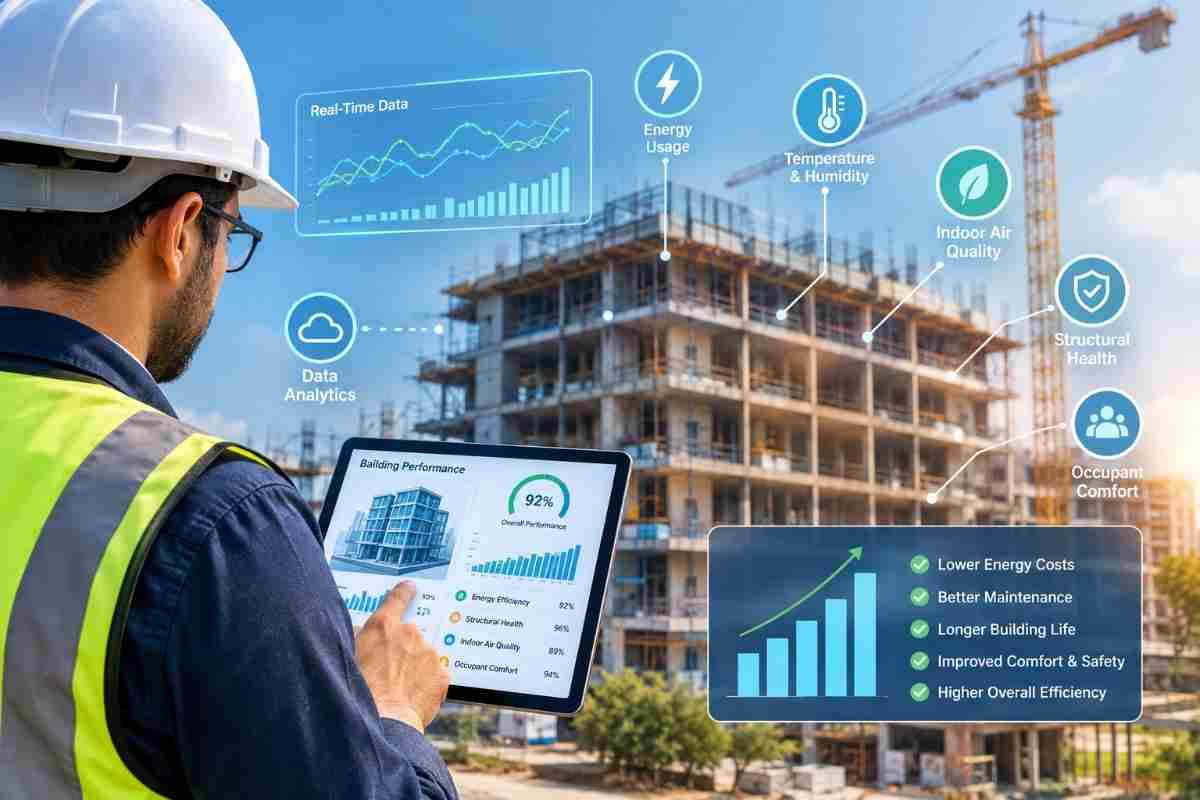
Buildings are no longer managed only through periodic inspections, manual readings, and routine maintenance schedules. Modern buildings generate enormous amounts of information through electricity meters, HVAC systems, sensors, security systems, occupancy controls, equipment monitoring platforms and building management systems.
When this information is collected and analysed properly, it can help owners, facility managers, architects, engineers and contractors understand how a building is actually performing.
This is where building performance data becomes important.
Data can reveal unusual energy consumption, equipment inefficiencies, changing occupancy patterns, indoor environmental conditions, maintenance requirements and operational problems. Instead of waiting for a system to fail, building teams can use information to identify potential issues earlier and make more informed decisions.
The U.S. Department of Energy describes building energy data as increasingly valuable for connecting energy use with building assets and activities, while noting that the challenge has increasingly shifted from simply measuring data to managing and analysing it effectively.
In India, data-driven building management is also becoming increasingly relevant as demand for cooling, efficient energy use, automation and sustainable construction grows. Research focused on India has highlighted the importance of consistent and comprehensive commercial-building energy data for tracking performance and making better decisions.
For businesses such as Core Cutting India, the broader shift toward data-driven construction is particularly relevant. Accurate information can support better planning for concrete cutting, core drilling, RCC modifications, service openings and other construction activities.
What Is Building Performance Data?
Building performance data is information that describes how a building, its equipment and its occupants interact over time.
This may include:
- Electricity consumption
- HVAC performance
- Temperature and humidity
- Indoor air-quality readings
- Water consumption
- Equipment operating hours
- Occupancy levels
- Lighting usage
- Maintenance records
- Equipment faults
- Solar energy generation
- Peak electricity demand
- Building operating schedules
- Construction and inspection information
Data can be collected manually, through sensors, smart meters, Building Management Systems (BMS), Building Automation Systems (BAS), Internet of Things (IoT) devices and software platforms.
The important point is that data by itself does not improve a building. Its value comes from analysing the information and turning it into practical action.
For example, if an office building consistently consumes excessive electricity during low-occupancy periods, the data may indicate that HVAC or lighting systems are operating unnecessarily. Facility managers can then investigate the cause and adjust operating schedules.
Why Data Matters for Building Performance
Traditional building management often relies on fixed schedules.
A maintenance team may inspect equipment once a month. Electricity consumption may be reviewed after the monthly bill arrives. Problems may only become obvious after occupants complain.
Data allows building teams to move toward continuous monitoring.
Instead of asking:
“Did something go wrong?”
facility managers can ask:
“Is the building showing signs that something may go wrong?”
This difference is significant.
Performance monitoring can help teams identify trends, compare actual performance against expected performance and prioritise areas requiring attention. The Department of Energy notes that standardised performance metrics can help evaluate energy-efficiency measures and identify opportunities for improvement.
1. Data Helps Reduce Unnecessary Energy Consumption
Energy is one of the most important areas where building data can create measurable value.
A building may consume electricity through:
- Air-conditioning systems
- Pumps
- Fans
- Lighting
- Elevators
- Water-heating systems
- Servers
- Appliances
- Ventilation equipment
- Other mechanical systems
Without detailed information, it can be difficult to determine which systems are responsible for excessive consumption.
Smart meters and sub-metering can provide more detailed information about where electricity is being used.
For example, a commercial building may discover that an HVAC system continues operating at high capacity after most employees have left. Data can reveal this pattern and allow the operating schedule to be reviewed.
Data-driven energy management can therefore support:
- Energy benchmarking
- Load monitoring
- Peak-demand management
- HVAC optimisation
- Lighting optimisation
- Equipment scheduling
- Energy-efficiency projects
India-focused research and projects are already exploring analytics for optimising energy consumption while balancing occupant comfort and renewable-energy availability.
2. Smart Sensors Create Real-Time Visibility
Sensors are an important component of modern smart buildings.
Depending on the application, sensors can monitor:
- Temperature
- Humidity
- Occupancy
- Motion
- Air quality
- Light levels
- Energy consumption
- Equipment status
- Water flow
- Pressure
- Vibration
Instead of relying entirely on periodic inspections, facility managers can receive continuous information.
For example, an unusual temperature pattern in one area could indicate an HVAC balancing issue. A sudden change in equipment vibration could warrant inspection. An unexpected increase in electricity consumption could indicate an operational problem.
This does not mean every sensor reading automatically identifies the cause. Human expertise remains important. However, data provides a stronger starting point for investigation.
3. Data Supports Predictive Maintenance
Traditional maintenance often follows one of two approaches:
Reactive maintenance: Repair equipment after failure.
Preventive maintenance: Service equipment according to a predefined schedule.
Data makes a third approach possible:
Predictive maintenance: Use operating information and trends to identify potential problems before failure.
For example, equipment data can show:
- Increasing operating temperature
- Unusual vibration
- Longer operating cycles
- Higher energy consumption
- Repeated fault codes
- Reduced performance
Analytics can help identify abnormal behaviour and prioritise inspection.
Research on IoT-enabled building energy management in an Indian university case study demonstrated how monitored energy data and machine learning can be used for building energy optimisation.
Predictive maintenance can help reduce unexpected downtime, although the actual benefits depend on data quality, equipment type, analytics accuracy and how quickly maintenance teams respond.
4. AI Is Making Building Data More Useful
Artificial intelligence and machine learning can analyse large volumes of building data faster than manual review.
AI-based systems can identify patterns that may not be obvious from individual readings.
For example, an AI model may analyse:
- Historical electricity consumption
- Weather conditions
- Occupancy
- HVAC operation
- Equipment status
- Time of day
- Previous faults
It can then help identify unusual consumption patterns or forecast future energy requirements.
Machine learning can also support demand forecasting and equipment optimisation.
However, AI should not be treated as a replacement for engineering knowledge. Poor-quality data can produce poor conclusions. Building teams still need appropriate sensors, accurate measurements, suitable models and experienced professionals.
5. Occupancy Data Can Improve Comfort and Efficiency
Buildings are not used in exactly the same way every day.
Occupancy may vary between:
- Weekdays and weekends
- Morning and evening
- Different seasons
- Different floors
- Meeting rooms
- Retail areas
- Residential spaces
If HVAC and lighting systems operate according to fixed assumptions rather than actual occupancy, energy can be wasted.
Occupancy data can help building operators understand which spaces are being used and when.
For example, a meeting room that remains empty for several hours may not require the same lighting and cooling level as a fully occupied area.
This creates an opportunity to balance energy efficiency with occupant comfort.
6. Data Improves HVAC Performance
Heating, ventilation and air-conditioning systems are often major contributors to building energy consumption.
Data can help monitor:
- Supply and return temperatures
- Operating hours
- Cooling loads
- Fan performance
- Temperature differences
- Setpoints
- Energy consumption
- Occupancy conditions
If an HVAC system is consuming more energy than expected, the data can help engineers investigate possible causes.
Possible issues could include:
- Incorrect scheduling
- Poor temperature settings
- Dirty filters
- Equipment degradation
- Poor system balancing
- Excessive cooling
- Simultaneous heating and cooling
- Changing occupancy patterns
The goal is not simply to reduce energy use. A successful building-performance strategy must also maintain appropriate indoor conditions.
7. Data Helps Compare Building Performance
Benchmarking allows building owners to compare performance over time or against relevant peer groups.
For example, a company may compare:
- One building against another
- Current consumption against previous years
- Actual energy use against a target
- Different floors or zones
- Equipment performance before and after upgrades
The U.S. Department of Energy describes benchmarking as a way to compare measured performance with itself over time, with peers or with established norms.
This can help answer important questions:
Is the building improving?
Which systems require attention?
Did an efficiency upgrade deliver the expected result?
Where should investment be prioritised?
8. Data Improves Construction and Renovation Planning
Building performance data is not limited to completed buildings.
Data can also support construction, renovation and retrofit projects.
Before modifying an existing building, project teams may need information about:
- Existing services
- Structural elements
- HVAC routes
- Electrical systems
- Plumbing
- Fire-fighting services
- Drainage
- Building usage
- Equipment locations
- Previous modifications
This information can help reduce uncertainty during renovation.
For example, before creating an opening in an RCC wall or slab for an HVAC, plumbing or electrical installation, contractors need to understand the existing structure and services.
Professional core cutting and core drilling can provide controlled openings for various MEP applications. At Core Cutting India, such construction requirements can include RCC core cutting, concrete openings, wall cutting and related structural modification work.
Data and digital documentation can also help teams coordinate construction activities with building operations, particularly when work is being carried out in occupied buildings.
9. Data Helps Detect Building Problems Earlier
One of the biggest advantages of continuous monitoring is early detection.
A building may gradually develop performance problems without an obvious visible sign.
Examples include:
- Increasing energy consumption
- Irregular temperature patterns
- Repeated equipment faults
- Abnormal water usage
- Increasing equipment runtime
- Reduced ventilation performance
- Unexpected peak loads
Trend analysis can help identify these changes.
Early identification does not automatically mean that a problem has been diagnosed. Instead, it gives engineers and facility managers an opportunity to investigate before a small issue becomes a major operational problem.
10. Data Supports Sustainable Buildings
Sustainability is becoming an important consideration in modern construction and building operations.
Data can help organisations understand:
- Energy consumption
- Carbon-related impacts
- Renewable-energy production
- Water usage
- Operational efficiency
- Equipment performance
- Waste patterns
The International Energy Agency's 2026 analysis of efficient grid-interactive buildings in India highlights the role of energy efficiency, digital technologies and demand-side flexibility in improving building energy performance and supporting the wider electricity system.
Data therefore supports a transition from simply designing a “green” building to continuously measuring whether the building actually performs efficiently.
11. Digital Building Data Creates Better Decision-Making
One of the biggest benefits of data is improved decision-making.
Instead of relying entirely on assumptions, building owners can use measurable information.
For example, before replacing an HVAC system, an owner may analyse:
- Current energy consumption
- Equipment age
- Maintenance history
- Operating hours
- Performance trends
- Occupancy
- Peak loads
This can provide a stronger foundation for evaluating upgrade options.
The same principle applies to construction modifications.
Before carrying out structural or MEP-related modifications, accurate information about the existing building can help teams plan work more carefully.
12. Data Quality Is Critical
Collecting large quantities of information does not automatically produce better results.
Bad data can lead to bad decisions.
Common data-quality challenges include:
- Incorrect sensor readings
- Missing information
- Poor calibration
- Inconsistent formats
- Incomplete maintenance records
- Incorrect equipment identification
- Data silos
- Lack of standardisation
The Department of Energy has emphasised the importance of standardised definitions and consistent procedures for collecting and reporting building-performance information.
Therefore, a successful data strategy should focus on quality, consistency, security and usability, not simply quantity.
The Future of Data-Driven Buildings
The next generation of buildings will increasingly combine sensors, IoT devices, automation, cloud platforms, analytics and AI.
Future building systems may increasingly be able to:
- Collect information continuously.
- Detect unusual operating conditions.
- Forecast energy requirements.
- Recommend maintenance actions.
- Optimise equipment operation.
- Track performance against targets.
- Support sustainability reporting.
- Connect building operations with renewable energy.
- Provide better information for renovation projects.
- Help facility teams make faster decisions.
Energy Management Information Systems are already designed around functions such as centralising, normalising and visualising data from multiple sources.
The long-term opportunity is to create buildings that are not only automated but measurable, adaptable and continuously improving.
How Construction Companies Can Prepare
Construction companies can benefit from adopting data-driven practices from the beginning of a project.
Useful steps include:
1. Document Existing Conditions
Before renovation or modification work, document existing structural and service conditions.
2. Use Digital Project Records
Maintain organised records of drawings, inspections, modifications and equipment information.
3. Coordinate MEP Services
Accurate service information can help reduce conflicts during construction.
4. Monitor Project Performance
Track progress, quality, safety and resource usage using measurable indicators.
5. Use Technology for Inspections
Digital tools can make inspection records easier to organise and review.
6. Preserve Building Information
After project completion, maintain accurate records that future facility teams can use.
For concrete cutting, core drilling or RCC modification projects, accurate planning is particularly important because structural elements may contain reinforcement and embedded services.
Conclusion
Data is changing the way buildings are designed, constructed, operated and maintained.
Instead of relying only on periodic inspections or assumptions, building owners and facility teams can use real-time and historical information to understand actual performance.
Data can help identify energy waste, improve HVAC operation, support predictive maintenance, monitor occupancy, compare performance and guide renovation decisions. AI and IoT can further expand these capabilities by analysing large volumes of information and identifying patterns.
At the same time, technology is only one part of the solution. Accurate data, qualified professionals, good engineering practices and appropriate corrective action remain essential.
For India's rapidly developing construction and real-estate sector, data-driven building management can become an important part of creating efficient, reliable and sustainable buildings.
As construction becomes increasingly connected and digital, companies involved in concrete cutting, RCC modification, core drilling and MEP-related openings also have an opportunity to use better project information and planning to deliver more controlled work.
To learn more about professional concrete cutting and core drilling solutions, visit Core Cutting India.
Frequently Asked Questions
1. How does data improve building performance?
Data helps building teams understand energy consumption, equipment operation, occupancy, environmental conditions and maintenance trends. Analysing this information can help identify inefficiencies and guide corrective actions.
2. What is building performance monitoring?
Building performance monitoring is the continuous or periodic measurement and analysis of building systems such as HVAC, lighting, electricity, water and indoor environmental conditions.
3. How can IoT improve building management?
IoT sensors can collect information from building equipment and environments in real time. This information can support monitoring, automation, fault detection and energy-management decisions.
4. Can AI reduce building energy consumption?
AI can analyse historical and real-time building information to identify patterns, forecast demand and support optimisation. Actual savings depend on the quality of the data, system design and implementation.
5. What data is collected in smart buildings?
Smart buildings can collect data related to energy, temperature, humidity, occupancy, lighting, HVAC systems, equipment status, water use and other operational conditions.
6. Why is building performance data important?
It provides measurable information that can help owners and facility managers understand how a building actually operates and where improvements may be needed.
7. How does data support predictive maintenance?
Monitoring equipment conditions over time can reveal abnormal patterns or changes in performance. Maintenance teams can use these signals to investigate potential problems before equipment failure.
8. How can construction companies use data?
Construction companies can use data for project planning, quality control, site monitoring, service coordination, equipment management, documentation and renovation planning.
9. Does data replace engineers and facility managers?
No. Data provides information and analytical support, but professional judgement is still required to interpret findings, diagnose problems and decide on appropriate actions.
10. How does data help during building renovation?
Data can provide information about existing structures, services, equipment and building usage. This can help project teams plan modifications and coordinate construction activities more effectively.