
Reinforced concrete is one of the toughest materials in modern construction. It is made to carry heavy loads, resist cracking, and last for decades. That durability becomes a problem when you need to create an opening for a staircase, install a drainage line, extend a utility shaft, or remove a damaged section of floor. Hammers and breakers are noisy and messy, and they can crack the surrounding slab.
This is where diamond slab cutting comes in. It uses industrial diamond-tipped blades to cut through concrete and steel reinforcement with precision, minimal vibration, and clean edges. This guide from Core Cutting India explains how the process works, what equipment is used, how rebar is handled, and what to consider before starting a project.
What Is Diamond Slab Cutting?
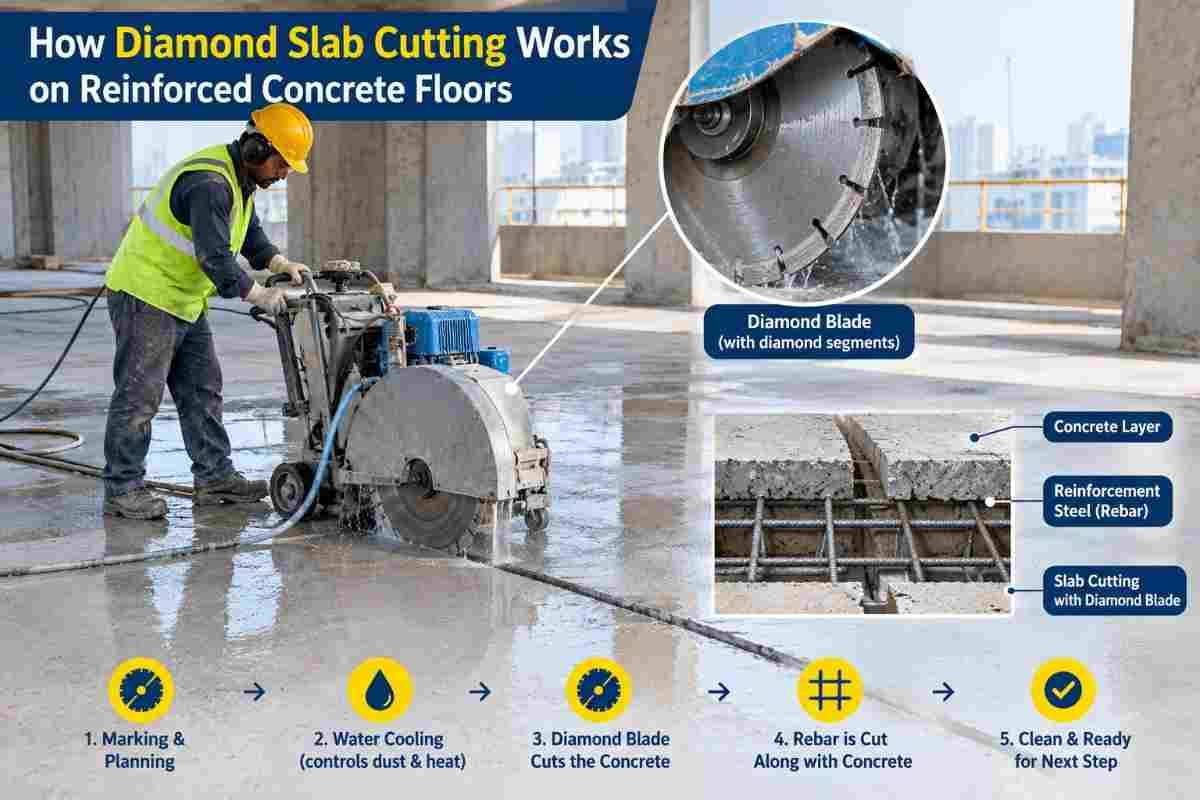
Diamond slab cutting, also called slab sawing or floor sawing, is a method of cutting horizontal concrete surfaces such as floors, slabs, bridge decks, and pavements. A powerful saw spins a circular blade whose cutting edge is embedded with synthetic diamond particles.
Diamond is the hardest known material, so it grinds through concrete, aggregate, and steel rather than chipping it away. The result is a straight, accurate cut that leaves the surrounding structure largely undisturbed.
The method is widely used because it offers:
- Precision: cuts follow marked lines with tight tolerances.
- Low vibration: the structure and nearby workers are not subjected to heavy impact.
- Clean edges: no jagged breaks, so patching and finishing are easier.
- Flexibility: cuts can be made straight, at depth, or in controlled patterns.
- Reduced debris and noise compared with conventional breaking methods.
Why Reinforced Concrete Is Hard to Cut
Plain concrete is hard but relatively uniform. Reinforced concrete (RCC) is a composite: concrete for compressive strength and embedded steel bars, mesh, or cables for tensile strength. A cutting tool must handle both.
The main challenges are:
- Steel reinforcement: rebar can range from thin mesh to thick bars at several spacings, and the blade must cut through them without binding.
- Aggregate hardness: granite and quartzite aggregates wear blades faster than softer limestone.
- Slab thickness: thicker slabs need larger blades and more power.
- Hidden elements: conduits, pipes, and post-tension cables may lie inside the slab.
- Structural safety: cutting changes how loads travel through the floor, so the cut sequence matters.
A diamond blade, correctly matched to the material, deals with all of these far better than percussive tools.
The Equipment Used in Diamond Slab Cutting
Floor Saws (Slab Saws)
The standard tool for horizontal cuts is the walk-behind floor saw. These machines run on petrol, diesel, electric, or hydraulic power and carry a large blade, often 300 mm to 1,000 mm or more in diameter. The operator pushes the saw along a guide line while the blade lowers to a set depth. Larger blades can cut deeper, and some machines handle depths beyond 400 mm.
Hand-Held Ring Saws and Cut-Off Saws
For corners, tight spaces, and over-cuts, operators use hand-held ring saws or hydraulic saws. A ring saw can reach deeper than its size suggests, which helps finish cut corners that a floor saw cannot reach.
Wire Saws
For very thick or oddly shaped sections, diamond wire saws use a bead-studded cable looped around the concrete. These are common in heavy demolition and industrial jobs where blades cannot reach.
Core Drills
Core drilling often goes hand in hand with slab cutting. Circular diamond core bits cut cylindrical holes for pipes, ducts, and anchor points. They are also used to drill the corners of a cutout so the saw can finish without overcutting.
Supporting Equipment
A complete setup usually includes a water supply and slurry vacuum, scanning equipment such as ground-penetrating radar (GPR), guide rails, lifting gear for removing cut sections, and personal protective equipment.
How a Diamond Blade Actually Cuts
A diamond blade is a steel core with segments around its edge. Each segment holds tiny industrial diamonds in a metal matrix, usually a bronze or cobalt-based bond.
Cutting works through controlled abrasion, not slicing:
- The exposed diamonds grind against the concrete, removing material microscopically.
- As diamonds dull or fracture, the metal bond slowly wears away, exposing fresh diamonds. This is called “self-sharpening.”
- The bond hardness is matched to the material. A soft bond suits hard, abrasive aggregate because it releases diamonds quickly. A hard bond suits softer, less abrasive material because it holds diamonds longer.
For reinforced concrete, blades are specified for steel-heavy cutting. They have the right diamond concentration and segment design to cut through rebar without glazing, which is when the diamonds go dull and stop cutting. Choosing the wrong blade leads to slow progress, overheating, and premature wear.
Step-by-Step: How Slab Cutting Is Done
Step 1: Site Assessment and Planning
Every project starts with understanding the slab: thickness, reinforcement layout, age, load paths, and the purpose of the cut. Drawings are reviewed where available, and a structural engineer should approve cuts that affect load-bearing elements.
Step 2: Scanning for Hidden Services
Before any cut, the slab is scanned with GPR or similar equipment to locate rebar, electrical conduits, water lines, and especially post-tensioned cables. Cutting a stressed cable can be dangerous and extremely costly, so this step is never skipped.
Step 3: Marking the Cut Lines
Operators mark the cut lines with chalk or paint, often including a guide line for the saw’s pointer. For openings, they also plan the order of cuts and how each piece will be lifted out.
Step 4: Setting Up Water and Safety Controls
Water supply is connected to the blade for cooling and dust suppression. Slurry control is arranged, with wet vacuums or containment so the muddy runoff does not spread. The area is cordoned off and personnel are briefed.
Step 5: Making the Cut
The operator starts the saw, lowers the blade into the concrete, and advances at a steady pace. The blade cuts through concrete and rebar in one pass or in multiple passes for deep slabs. Pushing too fast overloads the blade, while moving too slowly can glaze it. Experienced operators listen to the machine and adjust the feed rate.
Step 6: Finishing the Corners
A floor saw cannot cut perfect square corners because the round blade leaves an arc. Operators finish corners with hand-held ring saws or core drills. This avoids overcutting, which can weaken the slab.
Step 7: Removing the Cut Sections
Cut pieces are lifted using slings, lifting anchors, or cranes, depending on size and weight. For large slabs, the section is often cut into smaller blocks for safer handling.
Step 8: Cleanup and Finishing
Slurry is collected and disposed of properly, edges are inspected, and the opening is ready for the next phase, whether that is a new staircase, plumbing run, or structural repair.
Wet Cutting vs Dry Cutting
Wet cutting is the standard for reinforced concrete. Water cools the blade, reduces friction, extends blade life, and keeps silica dust out of the air. It requires slurry management but delivers faster, cleaner results.
Dry cutting is used where water is not practical, such as electrical-sensitive areas, but it produces hazardous dust and generates high heat. It typically needs dust extraction systems and specially designed blades, and it is generally limited to shallower or lighter cuts.
For most reinforced slab work, wet cutting is safer and more efficient.
Handling Rebar and Post-Tensioned Slabs
Standard reinforced slabs contain passive steel that carries load only when the slab deflects. Diamond blades cut through this steel readily. The cut does remove part of the reinforcement locally, so openings may need additional support such as trimmer bars, beams, or lintels. This is a structural design decision.
Post-tensioned slabs are different. They contain high-tension steel cables that are stressed after the concrete cures. Cutting one by mistake can release enormous stored energy. Scanning and engineering review are essential. In many cases, post-tensioned slabs need specialist methods or detensioning before any cutting.
Where Diamond Slab Cutting Is Used
- Staircase, lift, and shaft openings in existing buildings
- Plumbing and drainage trenches through floor slabs
- Floor expansion joints and control joints to prevent random cracking
- Removal of damaged slab sections for repair
- Industrial floor modifications for machinery foundations or pits
- Bridge deck and pavement cutting
- Demolition and building alteration projects
- HVAC and cable penetrations through floors
Safety Considerations
Concrete cutting is skilled work with real hazards. Good practice includes:
- Using trained, experienced operators
- Wearing eye, ear, respiratory, hand, and foot protection
- Checking for hidden services before every cut
- Securing the slab section so it cannot fall when cut free
- Controlling slurry to prevent slips and drainage problems
- Following structural engineer recommendations on cut sequence and propping
- Keeping the area clear of non-essential personnel
A section of floor that is cut free without support can drop, so lifting plans matter as much as the cut itself.
Advantages Over Conventional Demolition
| Factor | Diamond Cutting | Hammer / Breaker |
|---|---|---|
| Accuracy | High | Low |
| Vibration | Minimal | High |
| Noise | Moderate | Very high |
| Dust (wet method) | Controlled | Heavy |
| Edge quality | Clean | Rough and cracked |
| Damage to surroundings | Minimal | Often significant |
For occupied buildings, hospitals, factories, and heritage structures, diamond cutting is often the only practical option.
What Affects the Cost of Slab Cutting?
Pricing varies from project to project. The main factors are:
- Slab thickness and depth of cut
- Total linear metres to be cut
- Rebar density and aggregate hardness
- Access and site conditions, such as upper floors or confined areas
- Scanning requirements
- Slurry removal and disposal
- Removal and lifting of cut sections
- Project timeline and working hours
A site visit is the best way to get an accurate quote, since conditions can differ greatly even within one building.
Why Hire a Professional Concrete Cutting Company?
Hiring specialists matters for several reasons. Professionals have the right blades, saws, and scanning tools. They understand structural implications and work to agreed cutting plans. They also manage dust, water, and safety systems properly and complete jobs faster with fewer mistakes. Core Cutting India provides diamond cutting services that combine modern equipment with experienced crews, helping clients complete floor openings, modifications, and repairs accurately and safely.
Frequently Asked Questions
How deep can a diamond saw cut into a concrete slab?
Depth depends on blade size. Standard walk-behind floor saws commonly cut from around 100 mm to 400 mm. Larger machines, ring saws, and multi-pass methods can go deeper.
Can diamond blades cut through rebar?
Yes. Diamond blades designed for reinforced concrete cut through steel bars and mesh as part of the normal process, although heavy reinforcement slows the cut and increases blade wear.
Is slab cutting safe for the building structure?
When planned properly, yes. Structural review, correct cut sequencing, and temporary support keep the building safe. Cutting without assessment can compromise load paths.
Is wet or dry cutting better for reinforced concrete?
Wet cutting is generally better. It cools the blade, extends its life, and suppresses hazardous silica dust.
What is the difference between slab cutting and core cutting?
Slab cutting makes straight linear cuts in floors and slabs, while core cutting drills round holes using hollow diamond bits. The two are often combined on the same job.
How do you find rebar before cutting?
Contractors use GPR scanners or electromagnetic detectors to map reinforcement, conduits, and cables before marking the cut lines.
Can post-tensioned slabs be cut?
Only with great care. Post-tensioned cables are highly stressed, so scanning, engineering approval, and specialist methods are required.
Does diamond cutting create a lot of dust?
Wet cutting greatly reduces airborne dust. The runoff is slurry, which is collected and disposed of properly.
Conclusion
Diamond slab cutting is the most precise and controlled way to open, modify, or repair reinforced concrete floors. It relies on diamond-segment blades that grind through concrete and steel, guided by careful scanning, planning, and structural judgment. Done right, it avoids the vibration, damage, and mess of traditional demolition and gives clean, accurate openings ready for the next stage of construction.
If you are planning a floor opening, joint cutting, or slab modification, consult an experienced team early. Visit Core Cutting India to discuss your project and get expert support with professional diamond concrete cutting.