
Target-Related Searches: digital twin technology in construction, structural drilling companies in India, core cutting and drilling services, digital twin for building structural health, concrete core drilling process, BIM and digital twin integration, structural investigation drilling, drilling automation in construction, digital twin for infrastructure projects, structural retrofitting drilling techniques
People Also Ask:
- What is a digital twin in construction?
- How does digital twin technology improve drilling accuracy?
- What is structural drilling used for?
- Is digital twin technology expensive to implement?
- Can digital twins predict structural damage before it happens?
- What is the difference between BIM and a digital twin?
- How is core cutting different from structural drilling?
Introduction
Walk onto any modern construction or retrofitting site today and you will notice something has changed. Engineers are no longer relying only on blueprints, tape measures, and experience. Increasingly, they are working alongside a virtual counterpart of the very structure they are drilling into — a digital twin. For an industry like structural drilling, where a single miscalculated hole can compromise the integrity of a beam, damage embedded utilities, or delay an entire project, this shift is more than a technology trend. It is a fundamental rethink of how drilling decisions get made.
At Core Cutting India, we have watched structural drilling evolve from purely manual expertise to a discipline increasingly guided by data, sensors, and predictive modeling. Digital twins sit right at the center of this evolution. In this article, we explore what digital twins actually are, why they matter for structural drilling and core cutting, and how they are likely to reshape the way contractors, structural engineers, and drilling specialists approach every project in the years ahead.
What Exactly Is a Digital Twin?
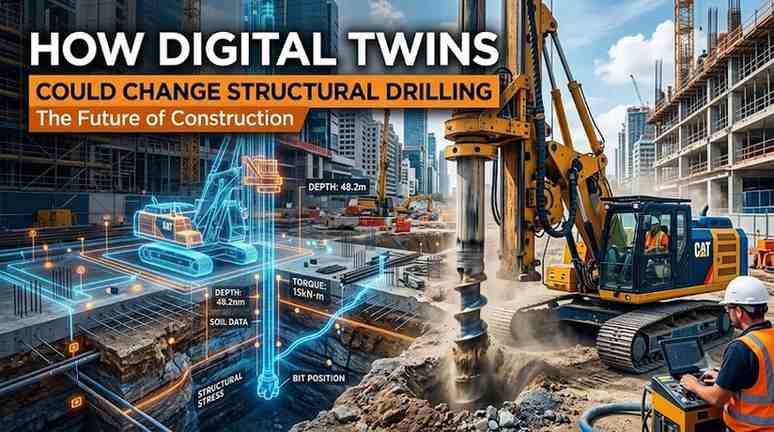
A digital twin is a dynamic, data-driven virtual replica of a physical asset — in this case, a building, bridge, tunnel, or industrial structure. Unlike a static 3D model or a traditional architectural drawing, a digital twin is continuously updated with real-world data collected from sensors, scans, drilling logs, and monitoring equipment embedded in or around the structure.
The concept originated in aerospace and manufacturing, where engineers needed to simulate the behavior of complex machinery before committing to physical changes. It has since found its way into oil and gas drilling, where physics-informed digital twins are already being used to predict drilling dysfunctions, optimize rig performance, and reduce non-productive time in real time. The construction and structural drilling industry is now catching up, adapting these same principles to buildings, foundations, and reinforced concrete structures.
In simple terms: instead of drilling blind and hoping the structural drawings are accurate, a digital twin gives drilling teams a living, breathing map of what lies beneath the surface — rebar placement, post-tensioned cables, embedded conduits, load paths, and material fatigue — updated continuously as new data comes in.
Why Structural Drilling Needs This Kind of Precision
Structural drilling and core cutting are unforgiving disciplines. Every hole drilled into a slab, wall, or column interacts with the structural system in ways that are not always visible from the surface. Errors can lead to several serious consequences:
- Accidentally cutting through post-tensioned cables or main reinforcement bars, weakening load-bearing capacity
- Damaging embedded electrical, plumbing, or fire safety conduits
- Introducing micro-cracks that propagate over time and affect long-term structural health
- Costly rework, project delays, and safety hazards on site
Traditionally, drilling teams have relied on ground-penetrating radar (GPR), rebar scanners, and as-built drawings to avoid these issues. These tools are useful but often operate in isolation, offering a single snapshot in time rather than a continuously updated, holistic view of the structure. This is precisely the gap that digital twin technology is positioned to close.
How Digital Twins Could Transform Structural Drilling
1. Pre-Drilling Simulation and Risk Mapping
Before a single drill bit touches concrete, a digital twin allows engineers to simulate the drilling operation virtually. By feeding in scan data, structural drawings, and material properties, teams can identify the safest drilling points, predict how the structure will respond to the intervention, and flag high-risk zones where reinforcement or utilities are densely packed. This reduces the guesswork that has historically made structural drilling a high-stakes activity.
2. Real-Time Feedback During Drilling
Sensors integrated into modern drilling rigs and core cutting equipment can feed live data — vibration levels, torque, temperature, and penetration rate — back into the digital twin. If the drilling parameters start to deviate from the simulated model, the system can alert operators immediately, allowing them to pause or adjust before damage occurs. This mirrors what is already happening in oil and gas drilling, where digital twins are used to continuously monitor rig performance and flag anomalies as they happen rather than after the fact.
3. Structural Health Monitoring After Drilling
The value of a digital twin does not end once drilling is complete. Sensors left in place, or periodic scans fed back into the model, allow engineers to monitor how the structure behaves after modification. This is particularly valuable for retrofitting projects, seismic strengthening work, or heritage structures where long-term stability after intervention is a major concern. Over time, the digital twin becomes a historical record of every drilled hole, every core sample removed, and every structural change made to the building.
4. Better Coordination Across Teams
Structural drilling rarely happens in isolation. MEP contractors, structural engineers, architects, and site supervisors all need to agree on where holes can safely be drilled. A shared digital twin acts as a single source of truth, reducing the miscommunication that often arises when different teams are working from outdated or conflicting drawings. Everyone — from the design office to the person operating the core cutting machine on site — can reference the same live model.
5. Predictive Maintenance and Longevity Planning
Digital twins are increasingly capable of using historical and real-time data to predict how a structure will age. For structural drilling specifically, this means being able to forecast how a series of drilled penetrations, over years of retrofitting and utility upgrades, might cumulatively affect the load-bearing capacity of a building. This kind of predictive insight was simply not possible with static documentation.
The Role of BIM in This Transition
Building Information Modeling (BIM) has already changed how structures are designed and documented. Digital twins take BIM a step further by making the model dynamic rather than static. While BIM provides the initial as-designed or as-built representation of a structure, a digital twin layers live sensor data, drilling history, and real-time monitoring on top of that foundation. For structural drilling companies, this means BIM models can eventually evolve into functioning digital twins that guide every drilling decision made on that structure for its entire service life.
Practical Benefits for Contractors and Structural Drilling Companies
For companies operating in the structural drilling and core cutting space, the practical benefits of adopting digital twin thinking include:
- Fewer costly errors — avoiding accidental damage to rebar, cables, or utilities
- Faster project turnaround — less time spent on manual scanning and verification for every single hole
- Improved safety — reduced risk of structural weakening or on-site accidents
- Stronger client trust — the ability to show clients a data-backed record of exactly what was drilled, where, and why
- Long-term asset value — building owners gain a living record of structural interventions that can inform future renovations or safety assessments
Challenges on the Road Ahead
Digital twin adoption in structural drilling is not without hurdles. Smaller contractors may find the upfront cost of sensors, scanning equipment, and software integration difficult to justify, especially for one-off projects. There is also a data quality challenge: a digital twin is only as reliable as the information feeding it, and older buildings without accurate as-built documentation may require extensive scanning before a usable twin can even be created.
Interoperability between different software platforms, sensor manufacturers, and BIM systems remains another obstacle. The industry is still working toward common standards that would allow digital twin data to move seamlessly between design, construction, and facility management teams. Skilled personnel who can interpret digital twin data and translate it into on-site drilling decisions are also in short supply, meaning training and capability-building will be essential as adoption grows.
Despite these challenges, industry analysts studying well construction and large infrastructure projects suggest that the coming years will see wider adoption of true, end-to-end digital twins for complex assets, as automation moves from individual tasks toward fully integrated, data-driven workflows. Structural drilling is a natural extension of that same trajectory.
What This Means for the Future of Core Cutting and Structural Drilling
Looking ahead, structural drilling is likely to become less of a manual craft guided purely by experience and more of a hybrid discipline where human expertise is supported by continuously updated digital intelligence. Drilling teams will not need to abandon their hands-on skill — if anything, the digital twin will make that skill more effective by removing much of the uncertainty that currently surrounds every drilling decision.
For structural engineers, digital twins offer a way to model the cumulative effect of drilling interventions across a building's lifespan rather than assessing each project in isolation. For contractors, they offer a competitive advantage: the ability to plan more accurately, execute more safely, and document work in a way that builds long-term trust with clients and building owners.
At Core Cutting India, we see this shift as a natural evolution of a field that has always demanded precision, safety, and technical judgment. Digital twins do not replace the expertise that goes into structural drilling and core cutting; they sharpen it. As sensor technology becomes more affordable and BIM adoption grows across Indian construction projects, digital twin-enabled drilling is likely to move from a niche innovation to a standard part of how structural work gets planned and executed.
Conclusion
Digital twins represent one of the most meaningful shifts to reach structural drilling in years. By combining real-time sensor data, historical drilling records, and predictive simulation, they give engineers and contractors a far more complete picture of the structures they are working on. The result is safer drilling, fewer costly mistakes, and a long-term digital record that adds value well beyond the immediate project.
As this technology matures, companies that begin integrating digital twin practices into their structural drilling and core cutting workflows today will be better positioned to deliver safer, faster, and more reliable outcomes tomorrow.
For expert structural drilling, core cutting, and diagnostic services backed by precision and experience, reach out to Core Cutting India at [email protected].