
Target-Related Search Keywords:
- safe core drilling locations
- core drilling safety procedures
- concrete scanning before drilling
- GPR scanning for core drilling
- rebar detection before drilling
- core cutting services India
- structural drawings for core drilling
- core drilling risk assessment
- diamond core drilling company
- post-tensioned slab drilling precautions
People Also Ask (PAA):
- Why is site survey important before core drilling?
- What tools do engineers use to detect rebar and utilities before drilling?
- Can core drilling damage a building's structure?
- How deep can core drilling go safely?
- What is the difference between core cutting and core drilling?
- How do engineers avoid hitting electrical cables during drilling?
Introduction
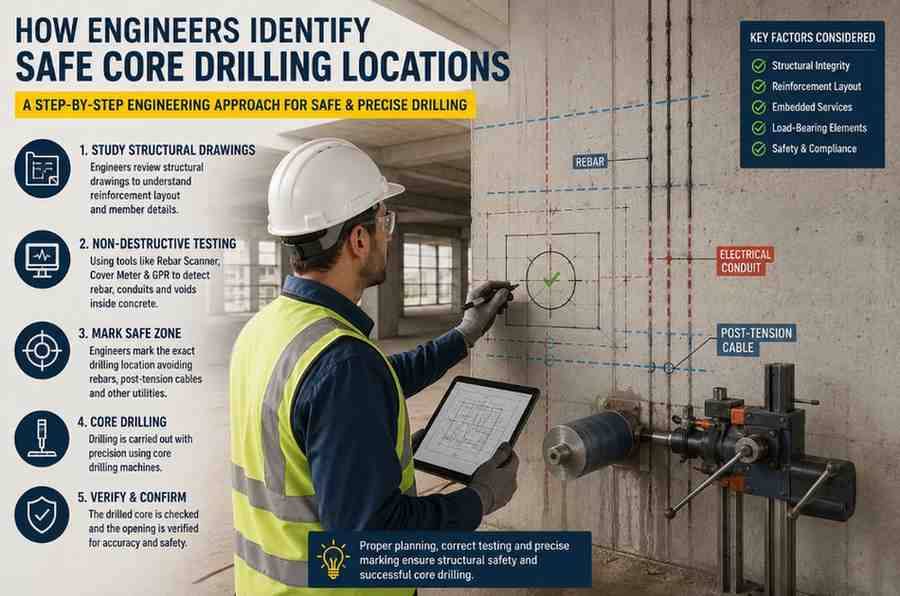
Core drilling is one of the most precise and technically demanding processes in modern construction and infrastructure work. Whether it's for installing plumbing lines, electrical conduits, HVAC ducts, or structural inspections, the ability to cut clean, accurate holes through concrete, brick, or stone is essential to countless projects. But behind every successful core drilling operation lies a critical, often overlooked step: identifying a safe drilling location.
Drilling into concrete without proper planning can lead to serious consequences — severed electrical lines, ruptured water pipes, damaged post-tensioned cables, or even structural failure. This is why professional engineers and core cutting specialists, such as the team at Core Cutting India, follow a rigorous, multi-step process before a single drill bit touches the surface.
In this blog, we'll walk through exactly how engineers identify safe core drilling locations, the technologies involved, and why this process is non-negotiable for safety and structural integrity.
Why Identifying a Safe Drilling Location Matters
Concrete structures are rarely just concrete. They are often reinforced with steel rebar, embedded with post-tensioned cables, and threaded with electrical wiring, plumbing, and gas lines. Drilling blindly into these structures can result in:
- Structural weakening — cutting through load-bearing rebar or tensioned cables can compromise the integrity of a slab, wall, or column.
- Utility damage — accidentally striking live electrical cables, water pipes, or gas lines can cause outages, leaks, flooding, or even fires and explosions.
- Safety hazards to workers — unexpected cable strikes or structural collapses can injure or kill personnel on site.
- Costly repairs and project delays — fixing damaged utilities or structural elements is expensive and can halt construction schedules.
Given these risks, engineers treat the site assessment phase with the same seriousness as the drilling operation itself.
Step 1: Reviewing Structural and As-Built Drawings
The first step in identifying a safe core drilling location is always a documentation review. Engineers examine:
- Structural drawings — these reveal the layout of beams, columns, slabs, and load-bearing walls.
- As-built drawings — unlike original design drawings, as-built documents reflect what was actually constructed, including any changes made during construction.
- MEP (Mechanical, Electrical, Plumbing) drawings — these show the routing of pipes, ducts, and cables within walls, floors, and ceilings.
By cross-referencing these documents, engineers can identify general zones where drilling is likely safe and zones that require extra caution, such as areas near structural columns or main utility risers.
However, drawings alone are rarely sufficient. Buildings are frequently modified over time, and as-built documentation isn't always accurate or complete. This is why physical, on-site verification is essential.
Step 2: Conducting a Visual Site Inspection
Before any scanning equipment comes out, engineers perform a detailed visual inspection of the proposed drilling area. This includes:
- Checking for visible cracks, patches, or repairs that might indicate underlying structural issues.
- Identifying the proximity of the drilling point to walls, columns, expansion joints, and existing openings.
- Noting any visible conduits, junction boxes, or plumbing fixtures nearby that hint at what may lie beneath the surface.
- Assessing the age and condition of the concrete, since older structures may have different reinforcement standards or hidden repairs.
This step helps engineers form an initial hypothesis about what might be inside the slab or wall, which is then confirmed or corrected using non-destructive testing methods.
Step 3: Ground Penetrating Radar (GPR) Scanning
Ground Penetrating Radar, or GPR, is one of the most widely used technologies for identifying safe core drilling locations. It works by sending electromagnetic pulses into the concrete and analyzing the reflected signals to detect changes in material density.
GPR scanning allows engineers to detect:
- Rebar and reinforcement mesh — GPR can map the exact position, depth, and spacing of steel reinforcement within the slab.
- Post-tensioned (PT) cables — these high-tension steel cables are extremely dangerous to cut, and GPR helps engineers locate them precisely to avoid catastrophic failure.
- Conduits and utility lines — many electrical conduits and plumbing lines can also be detected through density variations.
- Voids and honeycombing — GPR can reveal hidden air pockets or weak spots in the concrete that could affect drilling stability.
One of the biggest advantages of GPR is that it is non-destructive and provides real-time imaging, allowing engineers to mark safe zones directly on the surface before drilling begins.
Step 4: X-Ray or Radiographic Scanning for Precision
For projects requiring extremely high precision — such as drilling near critical structural elements or in high-rise buildings — engineers may use concrete X-ray scanning (radiography) in addition to or instead of GPR.
X-ray scanning offers:
- Higher resolution imaging compared to GPR, especially in densely reinforced concrete.
- Clear differentiation between rebar, PT cables, and utility conduits.
- Depth accuracy, which is crucial when drilling near the surface of a slab where cables may be closely spaced.
While X-ray scanning requires more safety precautions (since it involves radiation) and area evacuation during the scan, it is often considered the gold standard for high-risk drilling locations, such as post-tensioned slabs in commercial towers.
Step 5: Electromagnetic and Utility Locating Tools
In addition to GPR and X-ray, engineers often use electromagnetic locators and utility detection tools to specifically trace live electrical cables and metallic pipes. These tools send a signal along known utility lines and detect their path through walls and floors, helping engineers avoid:
- Live electrical circuits
- Metallic water and gas pipelines
- Fire suppression system pipes
- Communication and data cabling
This step is particularly important in older buildings where utility documentation may be outdated or missing entirely.
Step 6: Cross-Verification and Marking Safe Zones
Once scanning is complete, engineers cross-verify the data from multiple sources — structural drawings, GPR results, and utility locating scans — to build a comprehensive picture of what lies beneath the surface. This is a critical quality-control step, as relying on a single method increases the risk of missing something important.
After verification, the safe drilling zone is physically marked on the surface, often with color-coded markings indicating:
- Confirmed safe drilling points
- Areas to avoid due to rebar, cables, or utilities
- Minimum safe distances from structural elements
This visual marking system ensures that the drilling team has clear, unambiguous guidance before operations begin.
Step 7: Selecting the Right Drilling Method and Equipment
Identifying a safe location isn't just about avoiding obstacles — it also involves choosing the right drilling technique based on the site conditions. Engineers consider:
- Diamond core drilling for precision cuts through reinforced concrete with minimal vibration.
- Wet vs. dry drilling depending on dust control requirements and the presence of nearby electrical equipment.
- Drill bit diameter and depth based on the intended use of the hole (plumbing, electrical conduit, structural inspection, etc.).
- Drilling angle and orientation, especially for coring through sloped or curved surfaces.
Matching the right equipment to the verified safe zone minimizes vibration-related risks and ensures a clean, accurate cut.
Step 8: Structural Engineer Sign-Off for High-Risk Projects
For projects involving load-bearing walls, post-tensioned slabs, or heritage structures, many companies — including Core Cutting India — require a structural engineer's review and sign-off before drilling proceeds. This adds an additional layer of safety by ensuring that:
- The proposed drilling location will not compromise structural load paths.
- Any necessary temporary supports or reinforcements are put in place if required.
- The drilling plan complies with local building codes and safety regulations.
This step is especially important in commercial buildings, hospitals, and industrial facilities where structural failure could have severe consequences.
Step 9: On-Site Safety Protocols During Drilling
Even after a safe location is identified, engineers implement strict safety protocols during the actual drilling process, including:
- Continuous monitoring for unusual vibrations or resistance that might indicate an unexpected obstruction.
- Immediate stoppage procedures if drilling behavior suggests contact with an unmarked utility or cable.
- Dust and debris control measures to maintain visibility and air quality.
- Personal protective equipment (PPE) for all personnel involved.
These protocols act as a final safeguard, catching any issues that scanning technology may have missed.
The Role of Experience and Expertise
While technology plays a huge role in identifying safe core drilling locations, human expertise remains irreplaceable. Experienced engineers develop an intuitive understanding of how buildings are typically constructed, common utility routing patterns, and the subtle signs that indicate hidden risks. This combination of advanced scanning technology and skilled interpretation is what separates a professional core drilling service from a risky, uninformed drilling job.
At Core Cutting India, every project begins with this comprehensive safety-first approach — combining documentation review, advanced scanning technologies, and experienced engineering judgment to ensure that every core drilling operation is executed safely and precisely.
Conclusion
Identifying a safe core drilling location is a meticulous process that blends documentation review, advanced non-destructive testing technologies like GPR and X-ray scanning, utility locating tools, and hands-on engineering expertise. Skipping or rushing through this process can lead to costly damage, safety hazards, and structural risks that far outweigh any time saved.
For contractors, builders, and facility managers, partnering with an experienced and safety-focused core drilling company is essential. If you're planning a core drilling or core cutting project and want to ensure it's done safely and accurately, reach out to the experts at Core Cutting India at [email protected] for a professional site assessment and consultation.
Core Cutting India specializes in diamond core drilling, core cutting, and concrete scanning services for residential, commercial, and industrial projects across India. Contact us at [email protected] to discuss your project requirements.