
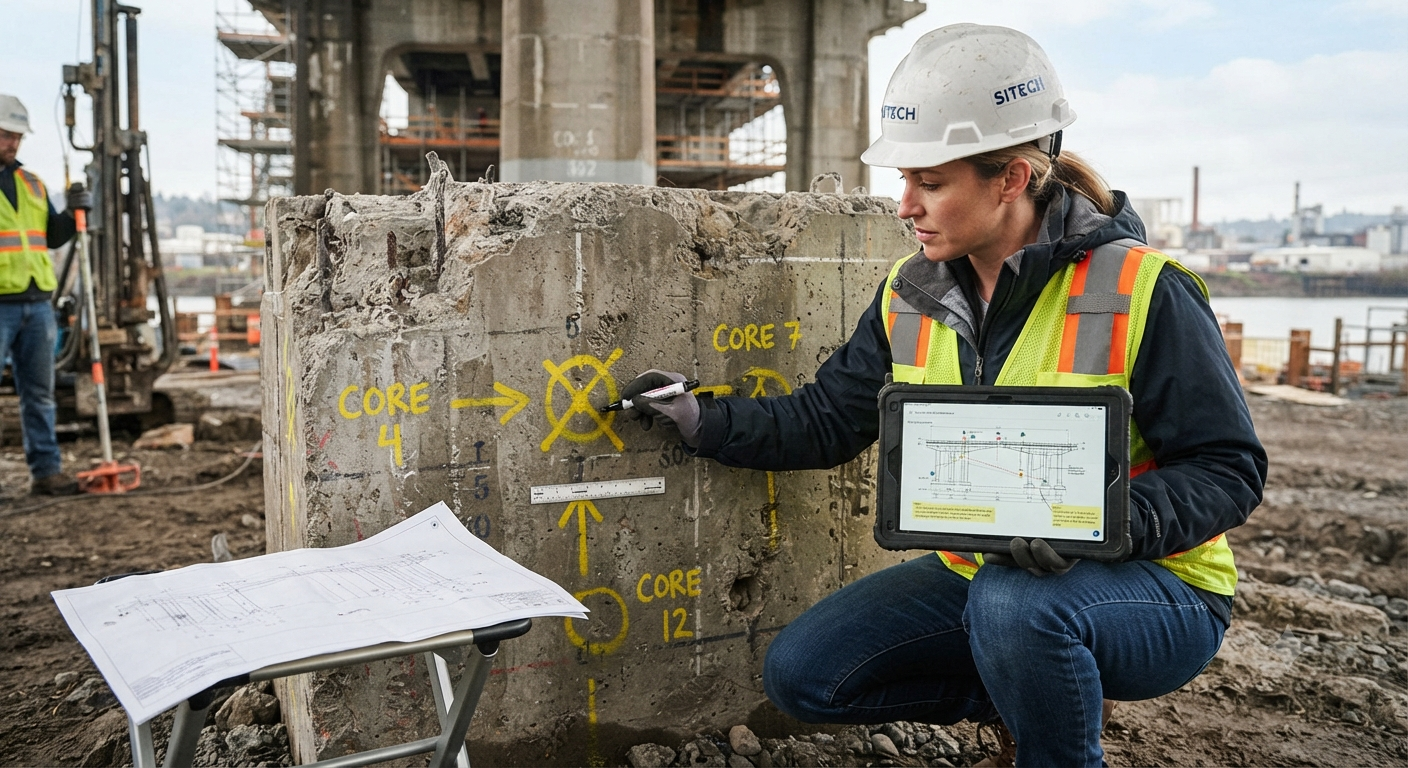
When a newly constructed flyover in Mumbai falls short of its 28-day cube strength, or when a decades-old residential heritage building in Kolkata undergoes a mandatory structural audit, civil engineers rely on a definitive diagnostic tool: concrete core sampling.
While non-destructive testing (NDT) methods like Rebound Hammer or Ultrasonic Pulse Velocity (UPV) tests offer quick preliminary insights, they only scratch the surface. To uncover the true in-situ compressive strength, density, and internal composition of hardened concrete, engineers must extract physical cylindrical specimens.
However, drilling into a load-bearing structural member is a delicate operation. Choosing the wrong spot can compromise structural safety or yield distorted, unrepresentative data. At [email protected], precision and safety dictate every operational step. This guide explores the rigorous engineering principles, Indian Standard codes, and field strategies governing how experts select concrete core sampling locations.
Why Concrete Core Sampling is Critical in Construction
Concrete core sampling is a semi-destructive test used when standard site-cured cube test results fail, or when evaluating the structural integrity of aging infrastructure. Driven by rapid urbanization across hubs like Delhi, Bengaluru, and Mumbai, construction quality must match stringent regulatory frameworks.
Engineers mandate core drilling for several key reasons:
-
Disputed Cube Strengths: When standard concrete cubes fail compression benchmarks, cores verify if the actual structural member has achieved target strength.
-
Structural Audits of Aging Structures: Assessing heritage or distressed buildings to measure material degradation over time.
-
Post-Fire or Distress Investigation: Determining residual strength after fire hazards, chemical attacks, or seismic activity.
-
Verification of Layer Thickness: Checking structural slab or pavement thickness against design blueprints.
Governing Standards in India for Core Sampling
Engineers do not pick sample locations randomly. The entire process follows strict protocols established by the Bureau of Indian Standards (BIS):
-
IS 516 (Part 4): 2018: Outlines the specific procedures for sampling, preparing, and testing concrete cores from hardened structures.
-
IS 456: 2000: Specifies that core extraction locations must be chosen at the discretion of the Engineer-in-Charge to accurately represent the concrete zone in question. It mandates that a minimum of three cores must be tested.
Key Criteria for Selecting Core Sampling Locations
To ensure data accuracy without triggering structural failure, engineers evaluate several parameters before marking a spot for core cutting.
1. Low Stress Zones vs. High Stress Zones
The golden rule of core placement is to avoid areas subjected to maximum compressive or shear stress.
-
Avoid: The immediate mid-span of heavily loaded beams, zones close to column-beam junctions, or areas experiencing high-intensity bending moments.
-
Preferred: Low-stress regions, such as areas near the neutral axis of beams or central zones of massive shear walls where structural margins can safely absorb minor localized section loss.
2. Avoiding Reinforcement Interference (Rebar Mapping)
Cutting through main reinforcement bars ruins the core sample and severely weakens the structural element. Before any diamond-tipped drill touches a wall or slab, engineers utilize advanced Rebar Locators (Pachometers) or Ground Penetrating Radar (GPR).
-
The Goal: Locate a “sweet spot” with absolute minimum rebar density.
-
Handling Rebar: If a rebar runs parallel to the core axis, the sample is rejected because the steel alters the compressive load path entirely. Cores with perpendicular rebars are only accepted if the reinforcement ratio is minimal and correction factors can be accurately applied per IS guidelines.
3. Structural Member Selection Hierarchy
Different structural components carry different safety implications. Engineers prioritize members based on redundancy and accessibility:
-
Columns: Cores are rarely taken from primary columns unless structural safety is heavily compromised, as columns are critical vertical load-paths. If necessary, samples are taken near the base or middle third under strict structural propping.
-
Slabs and Shear Walls: These are the most common and safest zones for core extraction. Slabs offer uniform thickness profiles, making them ideal for assessing concrete placement quality and consolidation.
-
Beams: Selected only under extreme engineering oversight, typically restricted to zones close to supports where shear stresses can be managed.
Step-by-Step Field Execution by [email protected]
Translating design drawings to on-site execution requires disciplined methodology:
[Site Review & Structural Drawing Study]
       ↓
[Rebar Locator & GPR Scan to Map Steel]
       ↓
[Marking Low-Stress / Safe Core Zones]
       ↓
[Rigid Anchoring of Diamond Core Drill]
       ↓
[Precision Wet Drilling & Sample Extraction]
       ↓
[High-Strength Non-Shrink Epoxy Grouting]
-
Non-Destructive Scanning: Technicians scan the designated grid using electromagnetic cover meters to map internal rebar layouts.
-
Rigid Equipment Anchoring: Hydraulic or heavy-duty anchor-mounted core drilling rigs are secured tightly to prevent bit wobble, which causes jagged, uninterpretable core edges.
-
Controlled Wet Cutting: Water-cooled diamond bits slice through the concrete smoothly, keeping temperatures low and preventing micro-cracking from thermal stress.
-
Immediate Remediation: Leaving an open hole compromises structural durability. Immediately after extraction, the cavity is cleaned and meticulously refilled using high-strength, non-shrink structural epoxy grouts or micro-concrete matching the grade of the host structure.
Summary Table: Core Sampling Considerations
| Parameter | Engineering Consideration | Standard Reference |
| Minimum Sample Count | At least 3 cores must be extracted and tested per zone | IS 456 / IS 516 (Part 4) |
| Length-to-Diameter ($L/D$) Ratio | Ideally maintained between $1.9$ and $2.1$; correction factors applied if lower | ASTM C42 / IS 516 |
| Rebar Obstruction | Avoid main steel bars; perpendicular bars require strength correction | IS 516 (Part 4) |
| Post-Test Action | Mandatory high-strength non-shrink epoxy/micro-concrete grouting | Best Engineering Practice |
Conclusion
Selecting locations for concrete core sampling is a meticulous balance between structural science and practical field execution. By strictly abiding by Indian Standards like IS 516 and IS 456, and utilizing high-tech rebar mapping tools, professional civil engineering teams ensure that structural assessments yield accurate data without threatening building safety.
For reliable, precise, and certified structural diagnostic services, expert intervention is essential. Reach out to [email protected] for professional core cutting and comprehensive structural testing solutions tailored to modern Indian infrastructure requirements.