
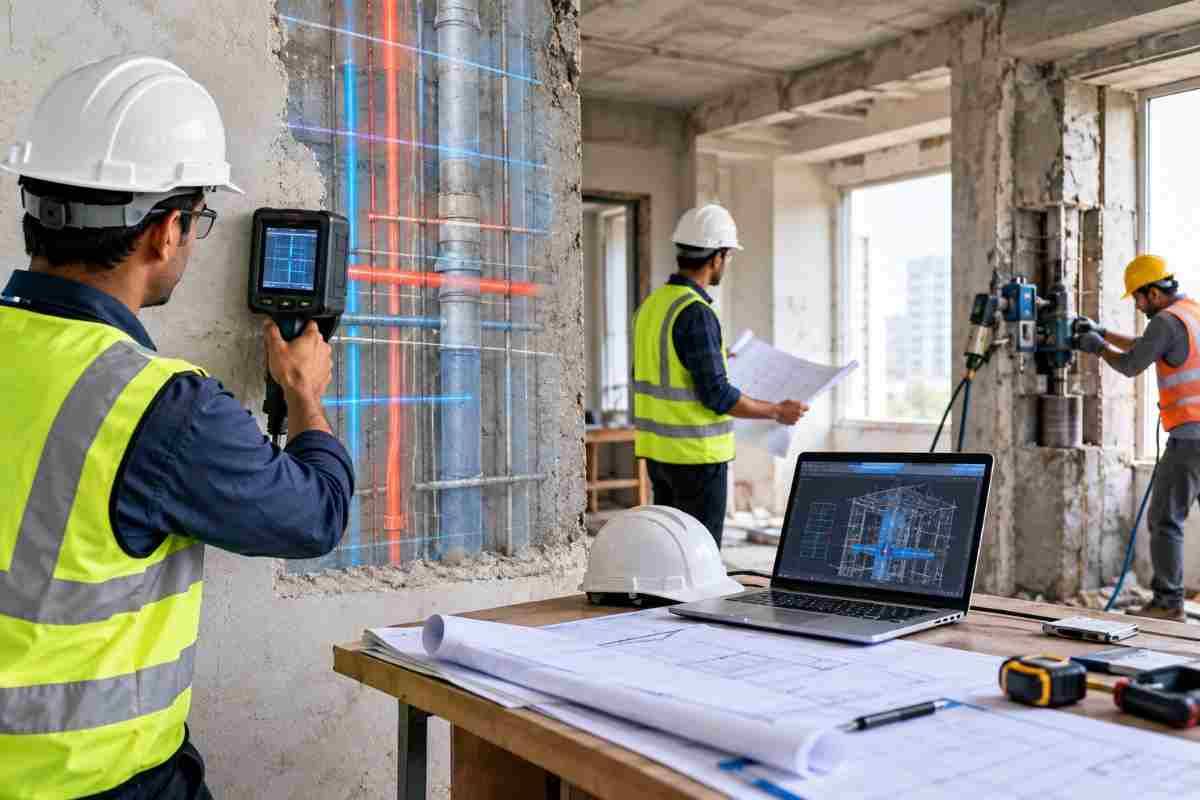
Every building has two lives. There is the one you can see — the walls, the floors, the ceilings, the finished surfaces that make a space feel complete. And there is the one you cannot see — the tangle of steel reinforcement, electrical conduits, plumbing lines, post-tension cables, and structural stress points buried inside concrete and masonry. When something goes wrong inside a building, the visible surface rarely tells the whole story. That is where engineers step in, using a mix of science, specialized tools, and precise cutting techniques to diagnose and fix problems that are completely invisible to the naked eye.
At Core Cutting India, this is the world we work in every day. Whether it is a crack that keeps reappearing, a wall that needs an opening but might be hiding a live cable, or a slab that needs strengthening decades after it was poured, the process of solving a hidden building problem is a careful blend of detective work and precision engineering. This article walks through exactly how that process unfolds, from the first signs of trouble to the final repair.
Why Buildings Hide Their Problems
Concrete and masonry are not transparent, and that is precisely what makes structural troubleshooting so challenging. A building's structural skeleton — steel rebar, tensioned cables, embedded conduits — is deliberately encased inside concrete for strength and protection. This means the very features that keep a building standing also keep its inner workings hidden from view.
Over time, several things can go wrong beneath the surface:
- Reinforcement steel can corrode due to moisture ingress, leading to cracking and spalling.
- Post-tension cables can lose tension or suffer damage, weakening structural capacity.
- Utility lines can be mispositioned relative to as-built drawings, creating risk during renovation.
- Voids or honeycombing can form during the original concrete pour, leaving weak spots.
- Water seepage can travel along hidden paths, causing damage far from the original leak source.
None of these problems announce themselves clearly. A hairline crack on a wall might be cosmetic, or it might be the only visible sign of a corroding rebar cage several inches beneath the surface. This is why engineers never rely on visual inspection alone when something more serious is suspected.
Step One: Reading the Symptoms
The process almost always begins with symptoms — cracks, dampness, uneven floors, sagging beams, or unusual sounds. Engineers start by documenting these symptoms carefully: where they appear, how they have changed over time, and whether they correlate with specific events like heavy rainfall, seismic activity, or recent construction nearby.
This stage is less about tools and more about pattern recognition. A vertical crack near a window corner suggests something different from a horizontal crack running along a beam-column joint. Engineers compare these patterns against known failure modes to form an initial hypothesis about what might be happening inside the structure.
Step Two: Non-Destructive Testing (NDT)
Once a hypothesis is formed, engineers turn to non-destructive testing methods that let them look inside a structure without damaging it. These technologies have transformed structural diagnostics over the past two decades, and they are central to how modern engineering firms — including Core Cutting India — approach hidden building problems.
Ground Penetrating Radar (GPR) Scanning
GPR is one of the most widely used tools for seeing inside concrete. It sends radar pulses into the material and reads the reflections that bounce back from embedded objects like rebar, conduits, post-tension cables, and voids. The result is a real-time map of what lies beneath the surface, accurate to within a few millimeters in most cases.
This is especially critical before any core cutting or drilling work begins. Cutting into a slab without knowing what is inside can sever a live electrical cable, rupture a plumbing line, or cut a structural tendon — any of which can be dangerous and expensive to fix. A proper GPR scan removes that guesswork entirely.
Rebar and Cover Meters
For simpler jobs, engineers use rebar locators or cover meters, which use electromagnetic induction to detect the position and depth of steel reinforcement. These are faster and more portable than GPR, making them useful for smaller-scale drilling or anchoring work where the risk profile is lower.
Ultrasonic Pulse Velocity Testing
To assess the internal quality of concrete — checking for voids, cracks, or inconsistent density — engineers use ultrasonic pulse velocity testing. Sound waves are passed through the concrete, and the speed at which they travel reveals information about the material's internal condition. Slower wave speeds often indicate cracking, honeycombing, or deterioration.
Infrared Thermography
Infrared cameras detect temperature variations on a building's surface, which can reveal moisture intrusion, insulation gaps, or delamination beneath render and plaster. Because damp or hollow areas retain heat differently than solid, dry material, thermal imaging can pinpoint problem zones that would otherwise stay hidden until they cause visible damage.
Corrosion Mapping
For structures where steel corrosion is suspected — common in coastal buildings or older parking structures — engineers use half-cell potential testing to map corrosion activity across a concrete surface. This produces a visual chart showing which areas are actively corroding, guiding targeted repair rather than blanket demolition.
Step Three: Confirming the Diagnosis with Precision Access
Scanning technologies are powerful, but sometimes engineers need physical confirmation — a direct look or sample from inside the structure. This is where controlled core cutting becomes essential, not as a repair method yet, but as a diagnostic one.
A small-diameter diamond core is extracted from a suspect area, allowing engineers to physically examine the concrete's internal condition, check reinforcement corrosion up close, or verify wall thickness and material composition. Because diamond core drilling is precise and vibration-free compared to traditional breaking methods, it does not introduce new cracks or stress into the surrounding structure, preserving the integrity of the diagnostic sample and the building itself.
This step matters because instruments like GPR give strong indications but not absolute certainty. A core sample provides direct physical evidence that either confirms or refines the engineering team's hypothesis before any major repair work begins.
Step Four: Engineering the Fix
Once the hidden problem is fully understood, engineers move to designing a solution. The fix depends entirely on what was found:
Corroded reinforcement often requires removing the affected concrete cover, treating the exposed steel, and applying corrosion-inhibiting repair mortars before resurfacing.
Structural cracks may need epoxy injection to restore load-bearing continuity, or in more serious cases, external strengthening using steel plates or fiber-reinforced polymer (FRP) wraps.
Weakened slabs or beams are sometimes reinforced using additional rebar accessed through precisely cut openings, followed by high-strength grout or concrete overlay.
Utility conflicts discovered during scanning are resolved by rerouting the new opening or adjusting the drilling path to avoid live services entirely — something only possible because the scanning was done first.
Water ingress paths are traced back to their source, which is often not where the visible damage appears, and sealed using injection grouting or waterproofing membranes applied at the actual entry point.
Step Five: Precision Cutting for Access and Repair
When structural openings are genuinely needed — for new doorways, service risers, HVAC ducts, or staircases — engineers rely on controlled cutting methods rather than demolition. This is where the real craftsmanship of core cutting and concrete sawing comes into play.
Diamond core drilling creates clean, circular openings for pipes, cables, or structural inspections with minimal disturbance to surrounding material. Wall sawing produces precise rectangular or linear cuts for doorways, windows, or structural modifications. Wire sawing is used for larger, more complex cuts, particularly in thick structural elements or when working in tight spaces. Floor sawing allows controlled slab openings for utility access without cracking the surrounding floor.
Every one of these techniques depends entirely on the diagnostic work done earlier. Without knowing exactly where reinforcement, cables, and voids are located, precision cutting would be guesswork rather than engineering. This is the core philosophy behind how Core Cutting India approaches every project: scan first, understand fully, then cut with precision.
Step Six: Verification and Long-Term Monitoring
After repairs are complete, engineers do not simply walk away. Verification testing — repeating the same NDT methods used during diagnosis — confirms that the fix has addressed the underlying issue and that no new problems have emerged. For critical structures, sensors or periodic monitoring may be installed to track crack movement, corrosion rates, or structural deflection over time, ensuring that hidden problems do not quietly return.
Why This Process Matters
Skipping any of these steps creates real risk. A contractor who drills without scanning might strike a live cable or sever a structural tendon. A repair team that patches a crack without understanding its root cause might see the same problem reappear within a year. The value engineers bring to hidden building problems is not just technical skill with tools, but a disciplined sequence: observe, scan, confirm, design, execute, and verify.
This is also why choosing an experienced concrete cutting and structural diagnostics partner matters so much for renovation, retrofitting, and infrastructure projects. The right process protects not just the immediate area of work, but the safety and longevity of the entire structure.
Conclusion
Buildings are far more complex beneath the surface than they appear, and the problems hiding inside them — corroding steel, misplaced utilities, internal voids, or slow-moving water damage — require more than guesswork to solve. Modern engineering combines non-destructive scanning technologies with precise cutting techniques to diagnose issues accurately and repair them without compromising structural integrity.
At Core Cutting India, this scan-first, cut-precisely approach is central to every project, whether it is a routine utility opening or a complex structural retrofit. By understanding exactly what lies hidden inside a building before any tool touches concrete, engineers protect both the structure and the people who depend on it every day.
Frequently Asked Questions
1. How do engineers find hidden problems in buildings? Engineers combine visual inspection with non-destructive testing methods like GPR scanning, ultrasonic testing, and infrared thermography to detect issues such as corrosion, voids, and moisture without damaging the structure.
2. What is concrete scanning and why is it important? Concrete scanning uses tools like ground-penetrating radar to map rebar, cables, conduits, and voids inside a concrete structure before any cutting or drilling begins, preventing accidental damage to hidden elements.
3. Can core cutting damage a building's structure? When performed correctly with proper scanning and diamond core drilling equipment, core cutting is precise and vibration-controlled, minimizing stress on surrounding concrete and preserving structural integrity.
4. How do engineers detect rebar and cables before drilling? Engineers use rebar locators, cover meters, and GPR scanning to identify the exact position and depth of embedded steel and utility lines before any drilling or cutting work starts.
5. What tools are used for non-destructive testing in construction? Common NDT tools include ground-penetrating radar, ultrasonic pulse velocity testers, infrared thermal cameras, rebar locators, and half-cell potential meters for corrosion mapping.