
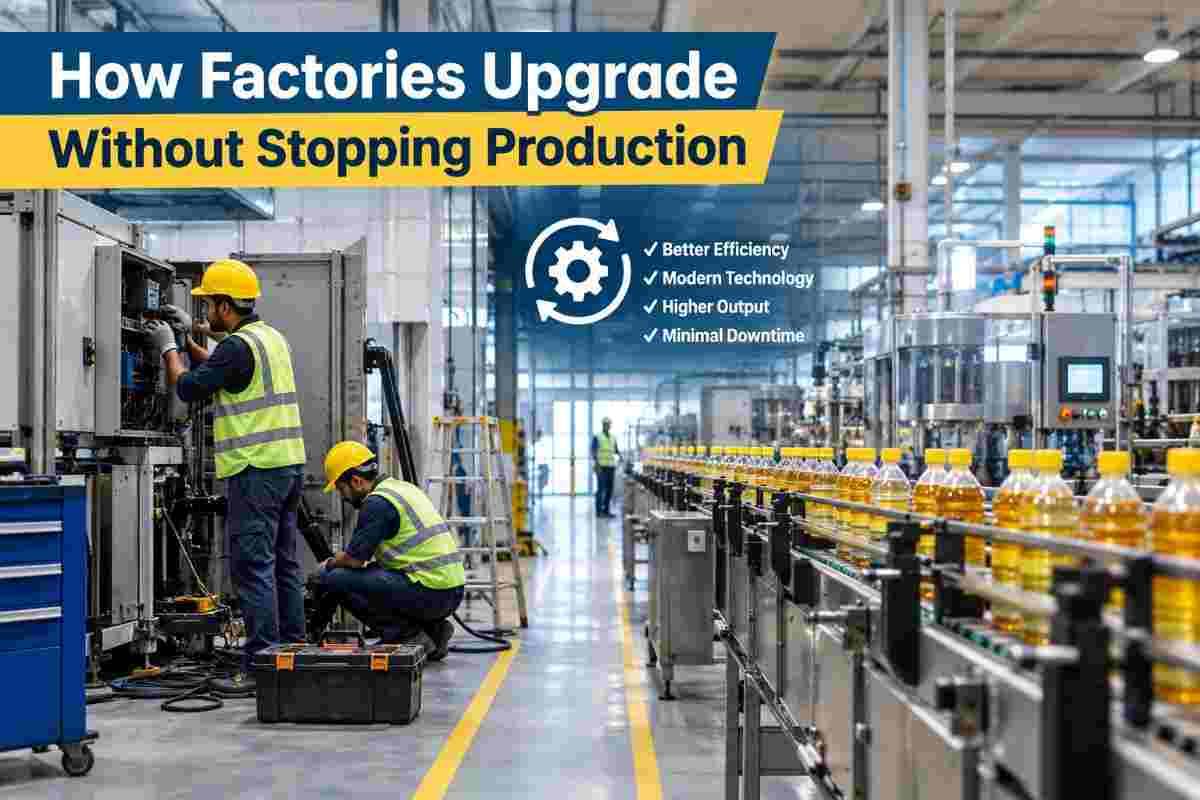
Every manufacturer eventually reaches the same crossroads: the machines that once drove efficient output are now the reason output is slowing down. Ageing cutting equipment, outdated control systems, and manual processes start to show their limits, while competitors quietly move ahead with faster, smarter, and more precise production lines. The obvious answer is to upgrade — but the question that keeps plant managers awake at night is simpler and far more urgent: how do you upgrade a factory without stopping the very production it depends on?
For most manufacturing businesses, downtime is not just an inconvenience; it is a direct hit to revenue, delivery commitments, and customer trust. A single day of halted production on a busy cutting or fabrication line can cost lakhs in lost output, penalty clauses, and idle labour. This is why "zero downtime" or "minimal downtime" upgrades have become one of the most searched and most sought-after strategies in industrial modernization today.
At Core Cutting India (corecuttingindia.com), we work with manufacturers who face this exact dilemma every day — factories that need sharper, faster, more reliable cutting technology, but simply cannot afford to shut their lines down for weeks to get it. This article breaks down exactly how factories successfully upgrade equipment, processes, and technology while keeping production running.
Why Factories Can't Afford to Stop
Before looking at solutions, it's worth understanding why continuous operation matters so much in modern manufacturing.
- Revenue continuity — Production lines are directly tied to sales commitments. A stalled line means missed shipment dates and possible contract penalties.
- Workforce stability — Idle machines often mean idle or underutilized labour, which affects morale and payroll efficiency.
- Customer trust — In competitive industries like metal fabrication, automotive components, and construction materials, delivery reliability is a major differentiator.
- Compound losses — Downtime doesn't just cost the hours lost; it also creates a backlog that takes additional time and resources to clear once production resumes.
Given these stakes, "how factories upgrade without stopping production" isn't just a technical question — it's a business survival question.
The Core Principle: Upgrade in Layers, Not in One Leap
The single biggest mistake manufacturers make is trying to replace an entire system at once. A full-line shutdown for a complete overhaul might look efficient on paper, but in practice it creates enormous risk: if something goes wrong during installation, the entire plant sits idle until it's fixed.
Successful factories instead follow a layered upgrade approach — breaking a large modernization project into smaller, independent phases that can each be completed with minimal disruption. This is the foundation of nearly every zero-downtime upgrade strategy used across industries today.
Step-by-Step: How Factories Upgrade Without Stopping Production
1. Conduct a Full Operational Audit Before Touching Anything
Every successful upgrade starts with a detailed audit of existing machinery, workflows, and bottlenecks. This includes:
- Mapping which machines are critical to daily output and which have redundancy
- Identifying underused capacity that can absorb extra load during transition
- Reviewing maintenance logs to predict where failures are most likely
- Understanding shift patterns to identify natural downtime windows (e.g., between shifts, weekends, or low-demand periods)
This audit tells engineers exactly where an upgrade can be inserted with the least impact on overall throughput.
2. Prioritize Modular and Retrofit-Friendly Equipment
One of the most effective ways to upgrade without stopping production is choosing equipment designed for retrofitting rather than complete replacement. Modern cutting machines, blades, and control systems are increasingly built with modular components — meaning a factory can swap out a control panel, upgrade a blade system, or add automation features without dismantling the entire machine.
This is a core philosophy behind the equipment and solutions offered by Core Cutting India: instead of forcing manufacturers into disruptive full-system replacements, retrofit-compatible cutting technology allows plants to modernize specific components — such as blade precision systems, feed mechanisms, or safety controls — while the rest of the line continues operating.
3. Use Parallel Line Installation
Where budget and floor space allow, factories install the new equipment alongside the existing line rather than in place of it. The new machine is tested, calibrated, and validated while the old one continues production. Once the new line proves stable and meets quality benchmarks, operations shift over — often within a single shift change — and the old equipment is decommissioned or repurposed.
This "parallel run" method eliminates the riskiest phase of any upgrade: the uncertain gap between shutting down the old system and confirming the new one works.
4. Schedule Upgrades Around Natural Production Cycles
Smart plant managers time upgrades to coincide with:
- Planned maintenance windows
- Seasonal demand dips
- Weekend or off-peak shifts
- End-of-batch cycles, where a product run naturally concludes before the next one begins
By aligning the upgrade schedule with these existing pauses, factories avoid creating new downtime — they simply extend a break that was already built into the operational calendar.
5. Train Operators Before the Switch, Not After
A common cause of post-upgrade slowdowns isn't the machinery — it's the people. If operators aren't trained on new controls, safety protocols, or maintenance routines before the switch, the "upgrade" ends up creating new downtime through operator errors or hesitation.
Leading manufacturers run simulation-based or supervised training sessions on the new equipment before it goes live, often using the parallel installation phase (Step 3) as a live training ground.
6. Leverage Predictive Maintenance to Choose the Right Moment
Predictive maintenance tools — sensors that monitor vibration, temperature, and wear on existing machinery — help plant managers time an upgrade precisely. Instead of waiting for a machine to break down (forced, unplanned downtime) or replacing it too early (wasted capital), predictive data identifies the optimal window where the upgrade causes the least disruption and captures the most value from the old equipment before retiring it.
7. Partner With Vendors Who Understand Phased Delivery
Not every equipment supplier is built for gradual, non-disruptive upgrades. Manufacturers should look for partners who can:
- Deliver and install components in phases rather than a single bulk shipment
- Offer on-site commissioning support to minimize testing time
- Provide remote diagnostics and after-sales support to catch issues early
- Design equipment with backward compatibility, so new components integrate with existing systems
This is precisely the approach Core Cutting India takes with its clients — supplying cutting solutions and components that are engineered to integrate into existing production environments, reducing the need for disruptive full-line replacements.
Real-World Scenarios: What This Looks Like on the Floor
Scenario A — Blade and Cutting System Upgrade: A metal fabrication unit needs faster, more precise cutting blades to meet tighter tolerances. Instead of replacing the entire cutting machine, the plant retrofits the existing frame with an upgraded blade and control system. The changeover happens during a scheduled two-hour maintenance window, and production resumes the same shift.
Scenario B — Automation Integration: A factory wants to add automated material feeding to reduce manual handling. Engineers install the automation module on a secondary, low-traffic line first, validate it over two weeks, then replicate the setup across the main lines one at a time — each swap taking a single off-peak shift.
Scenario C — Full Line Modernization: A larger plant undertaking a complete equipment overhaul builds a parallel line in an adjacent bay. Both lines run simultaneously for a trial period, output is cross-checked for quality and speed, and the switch-over happens only once the new line consistently outperforms the old one.
In each case, the common thread is the same: break the upgrade into pieces small enough that no single step requires stopping the whole plant.
The Role of Technology in Enabling Continuous Upgrades
Modern industrial technology has made non-disruptive upgrades far more achievable than they were a decade ago:
- IoT sensors allow real-time monitoring of both old and new equipment during transition periods.
- Digital twins let engineers simulate an upgrade virtually before touching the physical line, catching potential issues in advance.
- Modular machine design (a growing standard among cutting equipment manufacturers, including Core Cutting India) means components can be swapped without full disassembly.
- Remote diagnostics allow vendors to troubleshoot installation issues without needing an on-site visit, cutting delay time significantly.
Common Mistakes That Cause Unplanned Downtime
Even well-intentioned upgrade projects can backfire if certain pitfalls aren't avoided:
- Skipping the audit phase and assuming all machines can be upgraded the same way
- Underestimating training time, leading to slow ramp-up after installation
- Choosing incompatible equipment that isn't designed for retrofitting into existing systems
- Failing to plan for spare parts during the transition, leaving no backup if something fails
- Rushing the parallel-run validation period to save time, only to face quality issues after full switchover
Avoiding these mistakes is often less about the technology itself and more about disciplined planning and the right vendor partnership.
Conclusion: Upgrading Is a Process, Not an Event
The idea that a factory must "shut down to level up" is outdated. With careful planning, modular equipment, predictive maintenance, and a phased approach, manufacturers can modernize their cutting and production systems while keeping output steady. The factories that thrive in competitive markets aren't the ones that avoid upgrades — they're the ones that have mastered upgrading without ever letting the line go quiet.
For manufacturers exploring how to modernize their cutting equipment without the risk and cost of extended downtime, Core Cutting India offers retrofit-friendly, precision cutting solutions designed to integrate smoothly into existing production environments. Explore more at corecuttingindia.com.
Frequently Asked Questions
1. How can a factory upgrade machinery without stopping production? By using a phased or modular approach — auditing operations first, retrofitting compatible components, running new equipment in parallel with the old, and scheduling switchovers during natural downtime windows like shift changes or low-demand periods.
2. What is the cost of factory downtime during an upgrade? Costs vary by industry and scale, but downtime typically includes lost output value, idle labour costs, missed delivery penalties, and the extra time needed to clear backlogs once production resumes. This is why minimizing downtime during upgrades is a financial priority, not just an operational one.
3. How long does it take to modernize a factory? It depends on the scope. A single-component retrofit might take hours to a few days, while a full-line modernization using a phased or parallel-run approach can take weeks to months — but critically, without requiring the plant to stop production entirely during that period.
4. What is a phased upgrade in manufacturing? A phased upgrade breaks a large modernization project into smaller stages — upgrading one machine, line, or component at a time — so that only a small part of operations is affected at any given point, rather than shutting down the entire facility at once.
5. How does predictive maintenance reduce downtime? Predictive maintenance uses sensor data (vibration, temperature, wear patterns) to forecast when equipment is likely to fail or need replacement, allowing plant managers to schedule upgrades proactively rather than reacting to sudden breakdowns.
6. What industries benefit most from continuous-operation upgrades? Industries with high-volume, time-sensitive production — such as metal fabrication, automotive components, construction materials, and industrial cutting operations — benefit the most, since even short unplanned stoppages can disrupt tightly scheduled supply chains.