
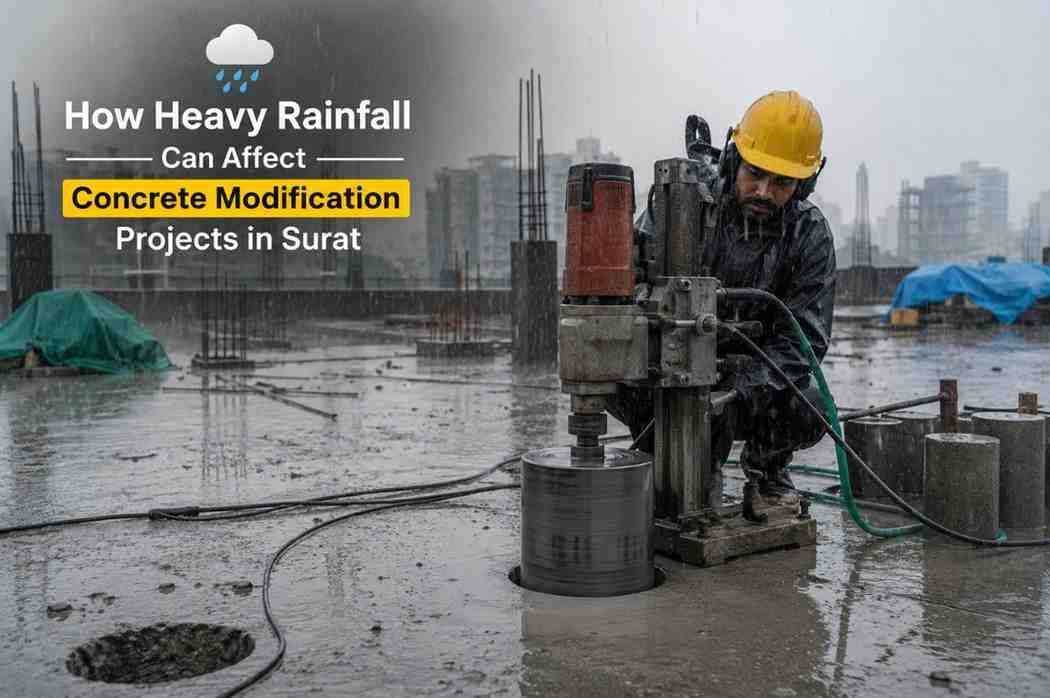
Surat is one of Gujarat's fastest-growing cities, and with rapid urban expansion comes a constant demand for concrete cutting, core drilling, demolition, and structural modification work. Whether it's a residential renovation, a commercial retrofit, or an industrial expansion, concrete modification projects are the backbone of the city's construction activity. But Surat also sits close to the Tapi River basin and experiences a strong southwest monsoon every year, typically from June through September, bringing intense and often unpredictable rainfall.
For contractors, engineers, and property owners managing concrete modification projects, heavy rainfall isn't just an inconvenience — it can directly affect timelines, safety, material quality, and long-term structural performance. At Core Cutting India ([email protected]), we've worked on countless projects across Surat during every season, and we've seen firsthand how monsoon conditions can make or break a project's success. This article breaks down exactly how heavy rainfall impacts concrete modification work, and what can be done to manage it effectively.
Understanding Concrete Modification Work
Before diving into the effects of rainfall, it's worth clarifying what "concrete modification" actually involves. This category of work includes:
- Concrete cutting – using diamond blades or wall saws to cut openings, slots, or joints in existing concrete structures.
- Core drilling – creating precise circular holes for plumbing, electrical conduits, HVAC ducts, or structural inspections.
- Demolition and dismantling – removing sections of concrete for renovation, expansion, or repair.
- Surface preparation – grinding, scarifying, or chipping concrete surfaces before resurfacing or waterproofing.
- Structural retrofitting – reinforcing or modifying existing concrete elements to meet new load requirements.
Each of these processes depends on specific environmental and material conditions to be executed safely and accurately. Rainfall disrupts nearly every one of them in different ways.
Why Surat's Monsoon Poses Unique Challenges
Surat receives an average of over 1,200 mm of rainfall annually, with the bulk concentrated in a short four-month window. Unlike gradual, low-intensity rain patterns seen in some regions, Surat's monsoon is often characterized by sudden, high-intensity downpours, occasional waterlogging in low-lying areas, and high humidity levels even between rain spells. This combination creates a construction environment that shifts rapidly — a dry morning can turn into a flooded site by afternoon.
For concrete modification contractors, this unpredictability means plans must be flexible, and safety protocols must account for sudden weather changes rather than a steady, predictable pattern.
Key Ways Heavy Rainfall Affects Concrete Modification Projects
1. Reduced Equipment Traction and Site Safety
Diamond cutting saws, core drilling rigs, and wall saws rely on stable footing and controlled operator movement. Wet surfaces significantly increase the risk of slips, equipment slippage, and loss of cutting precision. Water pooling around cutting zones can also seep into electrical connections on powered equipment, creating serious electrocution hazards — a critical concern given that most professional cutting tools are electrically powered or hydraulically driven.
At elevated work sites or upper floors of under-construction buildings, wet scaffolding and slippery walkways compound the risk further, often forcing crews to halt work entirely until conditions improve.
2. Compromised Cutting and Drilling Accuracy
Precision is everything in concrete modification. A core hole that's off by even a few millimeters can misalign plumbing or electrical routing. Heavy rain interferes with visibility, marking accuracy (chalk lines and markers wash away), and the stability of guide tracks used for wall saws. Even light drizzle can be enough to blur laser-guided measurement tools, leading to costly rework.
3. Water Infiltration During Wet-Cutting Processes
Ironically, many concrete cutting techniques already use water — to cool diamond blades and suppress dust. However, this is a controlled, metered water flow, not uncontrolled rainfall. Excess rainwater mixing with cutting slurry can overwhelm containment systems, leading to slurry runoff that may violate environmental regulations regarding wastewater discharge, particularly relevant in a densely populated city like Surat where stormwater drains connect directly to natural water bodies.
4. Impact on Freshly Modified or Repaired Concrete
When concrete modification includes patching, resurfacing, or partial recasting after cutting, freshly placed concrete is highly vulnerable to rain. Concrete typically needs at least 24 to 48 hours of protection from direct water exposure to avoid surface erosion, and heavy rainfall during the initial curing window can wash away cement paste from the surface, weakening the top layer and leading to a phenomenon known as surface scaling or dusting. This directly affects long-term durability and can require costly resurfacing.
5. Increased Humidity Affecting Material Performance
Even without direct rainfall, the high humidity that accompanies Surat's monsoon season affects the performance of bonding agents, epoxy injections, and sealants often used in concrete modification and repair work. Many epoxy and polymer-based products have strict humidity thresholds for proper curing — when exceeded, adhesion strength drops, potentially compromising structural repairs.
6. Project Delays and Scheduling Disruptions
Perhaps the most immediate and visible effect of heavy rainfall is scheduling disruption. Concrete cutting and drilling crews often work with tight project windows, especially in occupied buildings or commercial spaces where downtime needs to be minimized. Sudden downpours can halt work for hours or entire days, pushing back dependent trades like electrical, plumbing, and finishing work. In multi-phase renovation projects, a single day's delay in the concrete modification phase can cascade into weeks of delay across the broader project timeline.
7. Site Accessibility and Logistics Issues
Heavy rainfall in Surat frequently causes localized waterlogging, particularly in low-lying pockets near the Tapi River and older parts of the city. This can restrict access for heavy equipment such as core drilling rigs, generators, and material transport vehicles, delaying not just the cutting work itself but the delivery of essential materials and debris removal.
8. Dust Suppression Becomes Inconsistent
While it might seem like rain would help with dust control, uncontrolled rainfall actually makes dust suppression harder to manage consistently. Contractors typically use calibrated water flow systems for dust suppression during dry-cutting alternatives; sudden rain can flood these systems, wash out debris collection trays, or create muddy slurry that's harder to clean up and dispose of properly than dry dust.
How Core Cutting India Manages Monsoon-Related Challenges
Having executed numerous concrete modification projects across Surat through multiple monsoon seasons, our team follows a structured approach to keep projects on track without compromising safety or quality:
- Weather-adaptive scheduling – We monitor short-term forecasts closely and plan high-precision cutting or drilling tasks during predicted dry windows, reserving flexible tasks for uncertain weather periods.
- Temporary weatherproofing – For outdoor or semi-exposed work areas, we use tarpaulins, temporary roofing, and enclosure systems to protect both equipment and freshly cut or patched concrete surfaces.
- Enhanced electrical safety protocols – All equipment is checked for proper grounding, waterproof casing, and RCD (residual current device) protection before any work begins during the monsoon months.
- Curing protection measures – For any concrete repair or patching work, we apply curing compounds and protective covers immediately after modification to shield surfaces from unexpected rain exposure.
- Site drainage management – Before starting work, our teams assess and improve temporary site drainage to reduce water pooling around cutting and drilling zones.
- Humidity-appropriate material selection – We select bonding agents, epoxies, and sealants rated for high-humidity application whenever monsoon-season repair work is unavoidable.
Tips for Property Owners and Contractors Planning Projects During Monsoon
If you're planning a concrete modification project in Surat during the rainy season, consider the following:
- Build buffer time into your schedule. Add at least 15–20% additional time to your project timeline to account for possible rain delays.
- Prioritize indoor or covered work first. Schedule outdoor cutting and drilling tasks for early monsoon lulls, and shift indoor tasks to peak rainy periods.
- Confirm your contractor's safety protocols. Ask about grounding, waterproofing, and emergency stoppage procedures before work begins.
- Avoid rushed curing. Never approve a shortened curing period just to meet a deadline — this compromises long-term durability.
- Choose experienced local contractors. Companies familiar with Surat's specific monsoon patterns, like Core Cutting India, are better equipped to anticipate and manage weather-related risks than out-of-town crews unfamiliar with local conditions.
Long-Term Considerations for Structural Integrity
Beyond the immediate disruptions, it's worth noting that rain-affected concrete modification work — if not properly managed — can have long-term consequences. Poorly cured patches may develop cracks or scaling within months. Weakened bonding at repair joints can lead to water seepage over time, potentially affecting reinforcement steel and leading to corrosion. This is why choosing a contractor who understands both the technical cutting process and the environmental conditions specific to Surat is essential — not just for meeting deadlines, but for ensuring the structural work stands the test of time.
Conclusion
Heavy rainfall is an unavoidable reality for anyone undertaking concrete modification projects in Surat. From safety hazards and reduced precision to curing complications and scheduling delays, the monsoon season introduces a unique set of challenges that require careful planning, the right equipment, and experienced execution. Rather than viewing monsoon season as a roadblock, a well-prepared team treats it as a factor to be planned around — with adaptive scheduling, proper weatherproofing, and material choices suited to high-humidity conditions.
If you're planning a concrete cutting, drilling, or demolition project in Surat and want a team experienced in navigating the city's monsoon conditions, reach out to Core Cutting India at [email protected]. Our team combines technical precision with weather-smart planning to keep your project safe, on schedule, and built to last.