
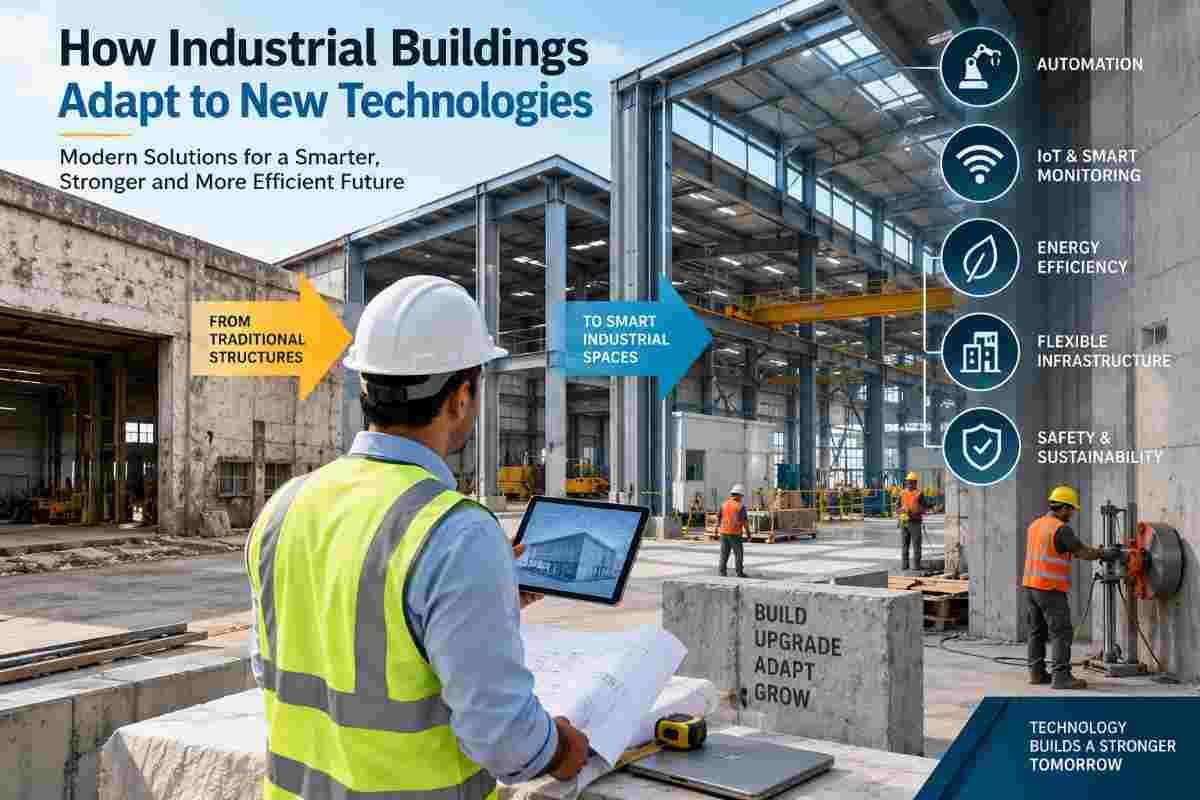
Industrial buildings were once designed with a single purpose: to house heavy machinery and support manufacturing processes for decades with little change. Today, that assumption no longer holds. Automation, robotics, IoT-enabled monitoring systems, renewable energy integration, and advanced HVAC systems are reshaping how factories, warehouses, and processing plants operate. The challenge is that most industrial buildings were never designed for this level of technological complexity — which means they must be physically adapted, not just digitally upgraded.
This is where structural modification services, particularly core cutting and drilling, play a central role. Adapting a decades-old concrete structure to support fiber-optic cabling, sensor networks, new ventilation systems, or heavy automated equipment requires precision work that respects the building's structural integrity while creating space for the future. In this article, we explore how industrial buildings are evolving to meet the demands of new technology, and why professional core cutting services, like those offered by Core Cutting India, are becoming indispensable to this transformation.
The Growing Pressure on Industrial Infrastructure
Manufacturing and industrial facilities are under constant pressure to modernize. Competitive markets demand faster production cycles, better energy efficiency, and tighter quality control — all of which depend on technology that didn't exist when many of these buildings were constructed. A factory built in the 1980s or 1990s, for instance, was designed around analog machinery, manual labor processes, and basic electrical wiring. Retrofitting such a facility to accommodate programmable logic controllers, robotic arms, or centralized building management systems is not simply a matter of installing new equipment. It requires physical changes to walls, floors, and ceilings to route cables, install sensors, and create pathways for new mechanical systems.
This pressure is compounded by regulatory requirements around safety, energy consumption, and emissions. Many industrial facilities must now install advanced fire suppression systems, energy monitoring equipment, or emissions control technology to remain compliant. Each of these upgrades typically requires precise structural work — cutting through concrete slabs, walls, or foundations to create openings for pipes, ducts, or cable runs, without compromising the building's load-bearing capacity.
Why Core Cutting Is Central to Technology Adaptation
Core cutting and drilling is one of the most critical, though often overlooked, components of industrial modernization. Whenever a building needs to accommodate new plumbing, electrical conduits, HVAC ductwork, or data cabling, someone has to create a precise opening in concrete, brick, or masonry without damaging the surrounding structure. This is a highly specialized task that combines engineering knowledge with technical execution.
Unlike traditional demolition, core cutting is a controlled, low-vibration process that uses diamond-tipped tools to cut clean, accurate holes or channels through concrete and other hard materials. This precision is essential in industrial settings, where imprecise cutting could damage embedded rebar, disrupt structural integrity, or create safety hazards. Professional core cutting companies use specialized equipment to assess the structure first, identify the safest cutting points, and then execute the work with minimal disruption to ongoing operations.
For industrial buildings undergoing technology upgrades, core cutting typically supports:
- Cable and data infrastructure routing — creating pathways for fiber-optic networks, sensor wiring, and automation control cables.
- HVAC and ventilation upgrades — cutting openings for new ductwork required by advanced climate control and air filtration systems.
- Plumbing and utility modifications — accommodating new water lines, drainage systems, or gas lines needed for updated machinery.
- Equipment foundation work — creating precise openings or reinforcements for the installation of heavy automated equipment or robotics.
- Safety system installation — enabling the placement of fire suppression piping, emergency systems, and sensor-based monitoring equipment.
Because this work happens inside operational facilities, minimizing dust, noise, and vibration is just as important as achieving structural precision — which is why experienced providers matter.
Structural Retrofitting: Balancing Old and New
One of the biggest challenges in adapting industrial buildings to new technology is preserving structural integrity while introducing modifications the original architects never anticipated. Older industrial buildings were often built with specific load calculations in mind, based on the machinery and processes of their era. Introducing new equipment — particularly heavier automated systems or dense server racks for on-site data processing — can shift those load requirements significantly.
Structural engineers and core cutting specialists work together during these projects to evaluate where modifications can safely occur. This typically involves reviewing original architectural drawings, conducting non-destructive testing to locate rebar and utility lines, and using scanning technology like ground-penetrating radar before any cutting begins. This careful planning phase prevents costly mistakes, protects worker safety, and ensures that the retrofit doesn't compromise the building's long-term durability.
Integrating Smart Technology Into Legacy Buildings
Smart building technology — including IoT sensors, automated climate control, and predictive maintenance systems — has become a priority for many industrial facility owners looking to reduce operational costs and downtime. However, integrating this technology into legacy buildings poses unique challenges.
Sensor networks, for example, need power and data connectivity throughout a facility, often requiring cabling to be routed through concrete floors and walls that were never designed with such systems in mind. Predictive maintenance systems rely on sensors placed at specific points on machinery and structural elements, which may require precise openings in flooring or walls for wiring and mounting hardware.
This is where the combination of core cutting expertise and careful project planning becomes essential. Rather than treating technology integration as a purely electrical or IT project, forward-thinking facility managers now involve structural specialists from the earliest planning stages. This ensures that the physical modifications needed to support new technology are executed safely, efficiently, and in a way that doesn't disrupt daily operations more than necessary.
Energy Efficiency and Sustainability Upgrades
Sustainability has become a major driver of industrial building adaptation. Many facilities are retrofitting to include solar panel systems, energy-efficient HVAC systems, LED lighting infrastructure, and rainwater harvesting systems. Each of these upgrades typically requires structural modifications — from cutting rooftop openings for solar conduit routing to creating channels for updated electrical systems that support energy-efficient lighting throughout a facility.
Water conservation technology, increasingly important in industrial operations, similarly relies on structural adaptation. Installing new water recycling systems, for instance, often requires cutting into existing concrete flooring to install new piping networks connected to filtration and storage systems. Precision core cutting minimizes the disruption to the building's existing plumbing infrastructure while enabling these sustainability upgrades to be installed correctly.
Automation and Robotics: A Structural Challenge
The rise of industrial automation and robotics has introduced entirely new structural demands on industrial buildings. Automated guided vehicles (AGVs), robotic arms, and conveyor systems often require reinforced flooring, specific foundation work, and precise cable routing for control systems. Unlike traditional manufacturing equipment, robotics frequently need continuous power and data connections integrated seamlessly into the floor or overhead structure to avoid safety hazards on the production floor.
This has made core cutting and structural modification services critical partners for facilities transitioning toward automated production lines. Installing a robotic welding cell, for example, may require creating precise openings for power conduits, coolant lines, and safety sensor wiring — all while maintaining the structural integrity of the surrounding floor slab. Getting this wrong can lead to costly downtime, equipment misalignment, or safety risks on the factory floor.
Renovation Without Disrupting Operations
A defining characteristic of modern industrial retrofitting is the need to complete structural work without shutting down operations entirely. Unlike new construction, where a building is empty and undergoing development from the ground up, industrial retrofits often happen in facilities that continue running production lines during the upgrade process.
This requires careful project sequencing, often executed in phases during off-peak hours or planned maintenance windows. Core cutting teams experienced in industrial environments understand how to work around active machinery, coordinate with facility managers to minimize downtime, and implement dust and vibration control measures that protect sensitive equipment nearby. This operational awareness is often what separates a specialized industrial core cutting provider from a general contractor unfamiliar with factory environments.
The Role of Professional Core Cutting Services
As industrial buildings continue adapting to new technology, the demand for precise, safe, and efficient structural modification services continues to grow. Companies like Core Cutting India specialize in providing the structural cutting and drilling expertise that modern industrial retrofits require — from small-scale cable routing projects to large structural modifications supporting full facility modernization.
Choosing an experienced provider matters because industrial retrofitting isn't just about cutting through concrete; it's about understanding how each modification interacts with the building's overall structural system, safety requirements, and ongoing operational needs. Providers with industrial-specific experience bring the right equipment, safety protocols, and planning expertise to ensure that technology upgrades happen smoothly and without compromising the building's long-term stability.
Looking Ahead: The Future of Industrial Building Adaptation
As technology continues to evolve at a rapid pace, industrial buildings will need to remain flexible structures capable of ongoing adaptation rather than static facilities designed for a single era of operation. This shift is already influencing how new industrial buildings are designed, with architects increasingly incorporating modular structural elements and accessible utility pathways to make future upgrades easier.
For existing buildings, however, adaptive reuse through professional structural modification services will remain the primary path toward modernization. Whether it's preparing a facility for robotics integration, installing advanced climate control systems, or creating pathways for next-generation data infrastructure, the physical transformation of industrial buildings will continue to rely heavily on precision core cutting and drilling expertise.
Conclusion
Industrial buildings are no longer static structures — they are evolving ecosystems that must continuously adapt to new technological demands. From automation and robotics to sustainability upgrades and smart building systems, the physical infrastructure of industrial facilities plays a foundational role in enabling this transformation. Precision core cutting and structural modification services are at the heart of this process, allowing facility owners to introduce new technology safely, efficiently, and without compromising the structural integrity that keeps operations running.
As industries continue to modernize, partnering with experienced structural specialists becomes essential. Core Cutting India offers the technical expertise and industrial-specific experience needed to help facility owners navigate this transformation — ensuring that every structural modification supports, rather than hinders, the technology-driven future of industrial operations.