
Introduction
Construction sites run on heavy machinery — excavators, cranes, bulldozers, loaders, and concrete mixers that represent some of the largest capital investments a construction company makes. Yet for decades, tracking the health, location, and performance of this equipment relied on manual logs, scheduled inspections, and guesswork. A single unexpected breakdown could delay a project by days and cost thousands of dollars in repairs and lost productivity.
The Internet of Things (IoT) is changing that reality. By embedding sensors, GPS modules, and connected devices into construction machinery, companies can now monitor equipment health, location, fuel consumption, and usage patterns in real time. This shift from reactive to proactive equipment management is one of the most significant technological advancements in the construction industry today.
In this blog, we explore how IoT is reshaping construction equipment monitoring, the specific benefits it delivers, real-world applications, and what the future holds for smart construction sites — brought to you by Core Cutting India ([email protected]), a name trusted for precision and innovation in the construction equipment space.
What Is IoT in Construction Equipment Monitoring?
IoT in construction refers to a network of interconnected sensors, devices, and software platforms installed on machinery that collect and transmit data continuously. These sensors track parameters such as engine temperature, fuel levels, hydraulic pressure, vibration, idle time, and GPS location. The data is sent to a centralized dashboard or cloud platform, where site managers and equipment owners can view real-time analytics from anywhere — whether they're on-site, in the office, or halfway across the country.
Unlike traditional monitoring, which depends on periodic manual checks, IoT-enabled monitoring works around the clock. It flags anomalies the moment they occur, allowing teams to respond before a small issue becomes a costly failure.
Why Traditional Equipment Monitoring Falls Short
Before diving deeper into IoT's advantages, it's worth understanding the limitations of conventional monitoring methods:
- Manual inspections are infrequent — Operators or supervisors might check equipment once a day or once a week, missing early warning signs.
- Paper-based logs are error-prone — Handwritten maintenance records can be incomplete, lost, or inaccurate.
- No real-time visibility — Without live data, managers only learn about a breakdown after it has already halted work.
- Reactive maintenance costs more — Fixing equipment after it fails is almost always more expensive than routine, planned maintenance.
- Equipment theft and misuse go undetected — Without location tracking, stolen or misused machinery can go unnoticed for days.
These gaps directly translate into lost time, higher repair bills, and reduced project profitability — problems that IoT is specifically designed to solve.
Key Ways IoT Improves Construction Equipment Monitoring
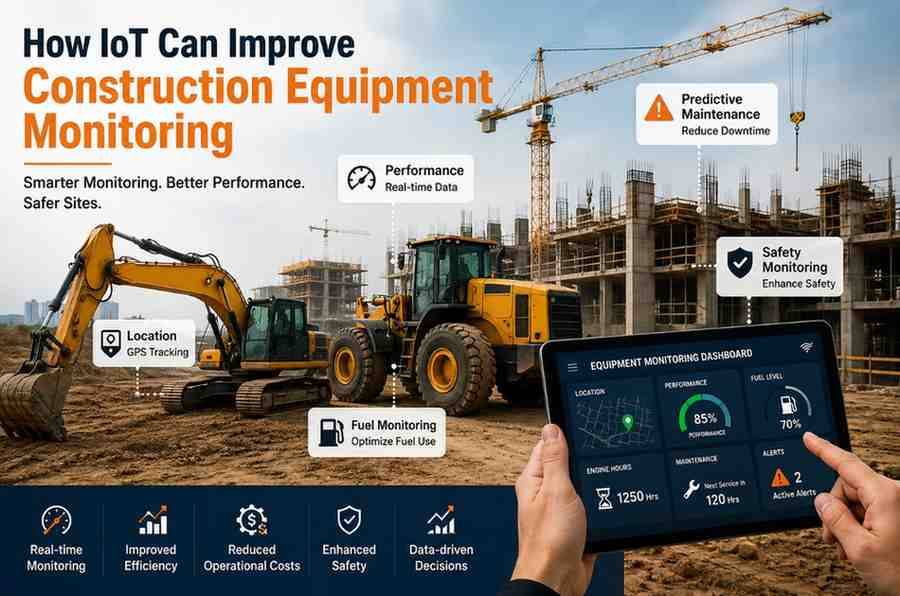
1. Real-Time Location Tracking
GPS-enabled IoT sensors allow construction companies to track the exact location of every piece of equipment across multiple job sites. This is particularly valuable for companies managing large fleets spread across different locations. Real-time tracking helps:
- Prevent equipment theft, which is a widespread issue on construction sites.
- Optimize equipment allocation across projects, ensuring machinery isn't sitting idle at one site while another site is short-staffed on equipment.
- Provide accurate records for billing and utilization reports, especially for rented or leased machinery.
2. Predictive Maintenance
Perhaps the most transformative benefit of IoT is predictive maintenance. Sensors continuously monitor engine health, oil levels, hydraulic pressure, vibration patterns, and temperature. Using this data, IoT platforms can predict when a component is likely to fail — often weeks in advance.
Instead of following a fixed maintenance schedule (which may service equipment too early or too late), companies can service machinery exactly when it needs attention. This approach:
- Reduces unplanned downtime significantly.
- Extends the lifespan of expensive machinery.
- Cuts unnecessary maintenance costs from over-servicing.
- Minimizes the risk of catastrophic failures that could injure workers.
3. Fuel Monitoring and Efficiency
Fuel is one of the largest operating expenses in construction. IoT sensors track fuel consumption patterns, detect fuel theft or leakage, and identify excessive idling. With this data, fleet managers can:
- Identify machines that are consuming more fuel than expected due to mechanical inefficiencies.
- Reduce idle time by coaching operators on best practices.
- Forecast fuel budgets more accurately across projects.
4. Usage and Utilization Analytics
Many companies don't have a clear picture of how much each machine is actually used versus how much it sits idle. IoT sensors log engine hours, load cycles, and operational patterns, giving managers data-driven insight into:
- Which machines are overutilized and at risk of premature wear.
- Which machines are underutilized and could be reallocated or sold.
- Whether purchasing additional equipment is truly necessary or if existing assets can be better distributed.
5. Enhanced Safety Monitoring
Safety is a top priority on any construction site, and IoT plays a growing role here too. Sensors can detect:
- Unsafe operating conditions, such as excessive tilt angles on cranes or excavators.
- Operator behavior issues, like harsh braking, speeding, or unauthorized equipment use.
- Proximity alerts that warn operators when workers or other machinery are too close.
These safety features not only protect workers but also reduce liability and insurance costs for construction firms.
6. Remote Diagnostics
When equipment shows a fault code or unusual reading, IoT systems allow technicians to run remote diagnostics before dispatching a repair crew. This means:
- Faster identification of the actual problem.
- Fewer unnecessary site visits.
- The right parts and tools can be brought on the first visit, reducing repeat trips.
7. Data-Driven Decision Making
Perhaps the broadest benefit of IoT is the sheer volume of actionable data it generates. Over time, this data helps construction companies make smarter decisions about:
- Fleet expansion or downsizing.
- Equipment replacement timing based on actual wear rather than age alone.
- Vendor and rental agreements, informed by real utilization data.
- Insurance negotiations, supported by documented safety and maintenance records.
Real-World Applications of IoT in Construction
Smart Cranes
Modern tower cranes now come equipped with IoT sensors that monitor load weight, wind speed, and structural stress in real time, automatically alerting operators when conditions approach unsafe thresholds.
Connected Excavators and Loaders
Fleet management platforms integrated with excavators and loaders track engine diagnostics and send automatic alerts when maintenance is due, helping avoid mid-project breakdowns.
Concrete Monitoring Sensors
IoT sensors embedded in concrete mixers and even within poured concrete itself can monitor curing temperature and moisture levels, ensuring quality control and reducing structural risks.
Wearable IoT for Workers
Beyond machinery, wearable IoT devices are being used to monitor worker fatigue, location, and exposure to hazardous conditions, adding another layer of site-wide safety.
Benefits Summary for Construction Businesses
| Benefit | Impact |
|---|---|
| Reduced downtime | Fewer project delays and lost labor hours |
| Lower maintenance costs | Predictive servicing instead of reactive repairs |
| Improved safety | Fewer accidents and lower insurance premiums |
| Better fuel management | Reduced fuel waste and theft |
| Theft prevention | Real-time location tracking of assets |
| Smarter fleet decisions | Data-backed purchasing and allocation |
Challenges to Consider
While the benefits are substantial, companies should be aware of a few challenges when adopting IoT for equipment monitoring:
- Initial investment — Installing sensors and subscribing to monitoring platforms requires upfront cost, though the long-term savings typically outweigh this.
- Connectivity issues — Remote construction sites may have limited network coverage, requiring robust cellular or satellite connectivity solutions.
- Data management — Large fleets generate significant data, so companies need the right software and personnel to interpret it effectively.
- Training — Operators and site managers need training to make the most of IoT dashboards and alerts.
Working with an experienced equipment and technology partner, like Core Cutting India, can help construction firms navigate these challenges smoothly and implement IoT solutions that fit their specific fleet size and project needs.
The Future of IoT in Construction Equipment Monitoring
As 5G connectivity expands and sensor technology becomes more affordable, IoT adoption in construction is expected to accelerate rapidly. Emerging trends include:
- AI-powered predictive analytics that go beyond basic alerts to forecast equipment failure with even greater precision.
- Integration with Building Information Modeling (BIM), connecting equipment data directly with project planning software.
- Autonomous and semi-autonomous machinery that relies heavily on IoT sensors for safe, self-regulated operation.
- Digital twins of construction sites, where every machine's real-time data feeds into a virtual model of the entire project for better planning and simulation.
Construction companies that adopt IoT early will have a significant competitive advantage — lower costs, safer sites, and more predictable project timelines.
Conclusion
IoT is no longer a futuristic concept for construction — it's a practical, results-driven technology that is actively reducing downtime, cutting costs, and improving safety across job sites today. From predictive maintenance to real-time location tracking and fuel monitoring, the applications are vast and the return on investment is measurable.
For construction businesses looking to modernize their equipment monitoring practices, now is the time to explore IoT-enabled solutions. Partnering with the right experts ensures a smooth transition and long-term value from your investment.
To learn more about smart construction equipment solutions, reach out to Core Cutting India at [email protected]. Our team can help you understand how IoT-based monitoring can be tailored to your fleet and project requirements.
This article is brought to you by Core Cutting India — your trusted partner for construction equipment and industry insights. For inquiries, contact us at [email protected].