
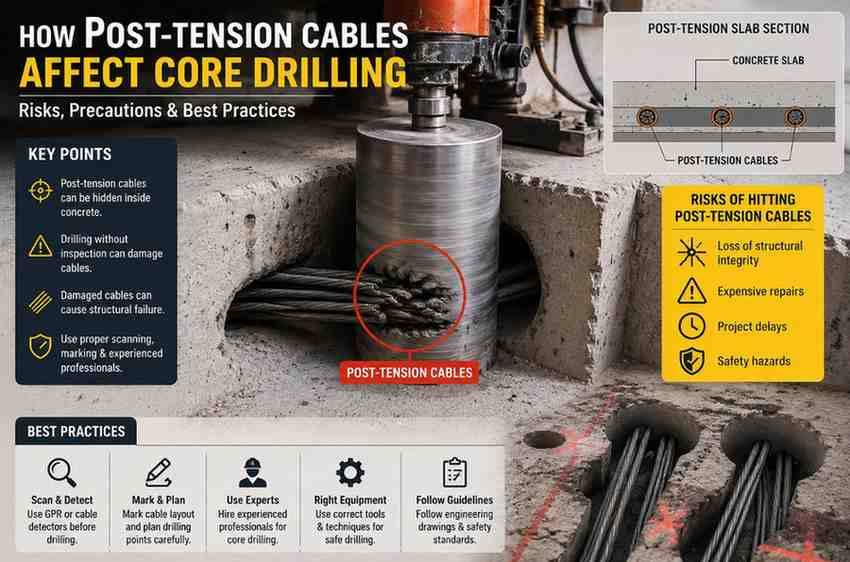
Core drilling is one of the most common construction and renovation activities used to create openings in concrete for plumbing lines, electrical conduits, HVAC ducts, elevator shafts, and structural inspections. While the process may look straightforward on the surface, one hidden factor can turn a routine drilling job into a costly and dangerous mistake — post-tension (PT) cables embedded within the concrete.
At Core Cutting India ([email protected]), we frequently work on buildings constructed using post-tensioned concrete, and we understand firsthand how critical it is to identify these cables before any cutting or drilling begins. In this blog, we will explore what post-tension cables are, how they affect core drilling, the risks of ignoring them, and the best practices followed by professional core drilling companies to ensure safety and structural integrity.
What Are Post-Tension Cables?
Post-tension cables are high-strength steel strands or tendons encased in a protective sheathing and embedded within a concrete slab or structural element. After the concrete is poured and partially cured, these cables are tensioned using hydraulic jacks and anchored at each end. This tensioning process compresses the concrete, allowing it to carry greater loads while using thinner slabs and fewer support columns compared to conventional reinforced concrete (RCC) construction.
Post-tensioned (PT) slabs are widely used in:
- High-rise residential and commercial buildings
- Parking structures and multi-level garages
- Bridges and flyovers
- Podium slabs and transfer decks
- Long-span floors requiring fewer columns
Because the cables remain under continuous, immense tension throughout the life of the structure, they behave very differently from ordinary reinforcement bars when disturbed.
Why Post-Tension Cables Matter During Core Drilling
Unlike standard rebar, which is passive reinforcement and simply adds tensile strength to concrete, post-tension cables are actively stressed, often carrying tension loads of several tons per strand. This single distinction is what makes core drilling near PT cables far more hazardous than drilling through a conventional RCC slab.
When a core drilling operator is unaware of the presence of PT cables and drills directly into one, several serious consequences can occur:
1. Sudden and Violent Cable Release
If a tensioned cable is severed, the stored energy releases instantly. This can cause the cable to snap back violently, sometimes whipping several feet through the air. This is one of the most dangerous outcomes of uncontrolled core drilling and has resulted in serious injuries on construction sites worldwide.
2. Loss of Structural Integrity
Post-tension cables are integral to the slab's load-carrying capacity. Cutting even a single strand can significantly reduce the slab's ability to bear loads, potentially leading to sagging, cracking, or in extreme cases, partial structural failure.
3. Costly Repairs and Project Delays
Repairing a severed PT cable is a specialized and expensive process. It typically involves re-tensioning or splicing the cable, which requires structural engineers, specialized contractors, and temporary shoring — all of which add significant cost and time to a project.
4. Legal and Liability Issues
Damage to post-tension cables can trigger contractual disputes, insurance claims, and liability battles between the drilling contractor, the general contractor, and the property owner. In many cases, the core drilling company may be held financially responsible for the damage.
How Post-Tension Cables Affect the Core Drilling Process Itself
Beyond the safety risks, the presence of PT cables also changes how the entire core drilling process is planned and executed:
Pre-Drilling Scanning Becomes Mandatory
Before any hole is drilled in a suspected post-tensioned slab, professional core drilling companies use non-destructive scanning technologies such as:
- Ground Penetrating Radar (GPR): Detects the location and depth of embedded cables, rebar, and conduits without damaging the concrete.
- X-ray Imaging: Provides a highly accurate visual of cable placement, though it requires the area to be cleared for radiation safety.
- Rebar/Cover Meters: Useful for shallow detection but less reliable for deeper or heavily reinforced slabs.
At Core Cutting India, GPR scanning is a standard part of our pre-drilling assessment on any structure suspected to be post-tensioned, ensuring that drilling locations are safely mapped out in advance.
Adjusted Drilling Locations
Once cables are mapped, the intended drilling point may need to shift by a few inches to avoid the cable path. This requires close coordination between the core drilling team, structural engineers, and the client to ensure the new location still meets functional requirements (such as pipe routing or duct placement).
Controlled Drilling Depth and Technique
Even after confirming cable-free zones, drilling near post-tensioned areas is done with greater caution — slower drilling speeds, smaller pilot holes, and constant monitoring are used to reduce risk further.
Use of Diamond Core Bits for Precision
Diamond-tipped core bits are preferred in PT slab drilling because they provide cleaner, more controlled cuts with less vibration and less risk of unexpected concrete spalling that could expose or shift nearby cables.
Signs That a Slab May Be Post-Tensioned
Not all buildings clearly disclose whether their slabs are post-tensioned, especially in older structures where drawings may be missing. Some indicators include:
- Thinner slab profiles compared to conventional RCC slabs of similar span
- Visible anchor pockets or "dead-end" anchorages along slab edges
- Buildings constructed after the 1970s–80s with long, column-free spans
- Parking structures and podium levels, which frequently use PT systems
- Structural drawings explicitly labeling "PT slab" or showing tendon layout
Whenever there is uncertainty, it is always safer to assume the slab may be post-tensioned and proceed with scanning before drilling.
Best Practices for Safe Core Drilling in Post-Tensioned Structures
Professional core drilling requires a structured approach when working with or near PT cables:
- Review structural drawings — Always request PT tendon layout drawings from the client or structural engineer before starting work.
- Conduct GPR or X-ray scanning — Physically verify cable locations on-site rather than relying solely on drawings, as actual cable placement can differ from design documents.
- Mark and document scanned areas — Clearly mark safe zones and cable locations on the slab surface for the drilling crew.
- Involve a structural engineer for critical cuts — For load-bearing areas or larger openings, a structural engineer should review and approve the drilling plan.
- Use trained and certified operators — Core drilling near PT cables should only be performed by experienced professionals familiar with post-tensioned construction.
- Have a contingency plan — In case a cable is accidentally exposed or nicked, work should stop immediately, and a structural engineer should be consulted before proceeding.
Why Choose Professional Core Drilling Services
Given the risks involved, core drilling in post-tensioned buildings should never be treated as a routine task. It requires:
- Advanced scanning equipment
- Trained technicians who understand PT slab behavior
- Coordination with structural engineers
- Strict adherence to safety protocols
At Core Cutting India, we specialize in precision core drilling and concrete cutting services for residential, commercial, and industrial structures, including buildings with post-tensioned slabs. Our team follows a strict scanning-first approach, using GPR technology to detect embedded cables, rebar, and utilities before any drilling begins. This ensures the safety of our crew, the integrity of the structure, and the satisfaction of our clients.
Whether you are planning a plumbing retrofit, HVAC installation, or structural modification in a post-tensioned building, our experienced team can help you plan and execute the work safely and efficiently.
Frequently Asked Questions (People Also Ask)
What happens if you drill into a post-tension cable? Drilling into a post-tension cable can cause the cable to snap under its stored tension, releasing energy suddenly and violently. This can result in serious injury to workers nearby and can compromise the structural strength of the slab, requiring specialized repair.
How do you know if a slab is post-tensioned? Signs include thinner slab thickness for long spans, visible anchor pockets at slab edges, and construction drawings labeled with PT tendon layouts. When in doubt, a professional scan using GPR or X-ray is the most reliable way to confirm.
Can you core drill through post-tensioned concrete? Yes, core drilling can be safely performed in post-tensioned concrete, but only after the area has been scanned to identify and avoid the exact location of the embedded cables.
How much does it cost to repair a cut post-tension cable? Repair costs vary widely depending on the extent of damage, the number of cables affected, and the structural significance of the area, but repairs typically involve specialized contractors, temporary shoring, and re-tensioning work, making them considerably more expensive than a standard drilling job.
What is the safest way to drill near post-tension cables? The safest approach involves reviewing structural drawings, performing GPR or X-ray scanning to locate cables precisely, marking safe drilling zones, and using trained core drilling professionals who follow strict safety protocols throughout the process.
Conclusion
Post-tension cables play a vital role in modern concrete construction, allowing for thinner slabs, longer spans, and more efficient structural designs. However, their presence introduces significant risks during core drilling if not properly identified and managed. Understanding how these cables affect the drilling process — from scanning and planning to execution — is essential for protecting workers, preserving structural integrity, and avoiding costly repairs.
If you are planning core drilling work in a building that may contain post-tensioned slabs, trust the experts. Contact Core Cutting India at [email protected] for professional, safety-first core drilling and concrete scanning services tailored to your project's needs.
Target-Related Searches: post tension slab core drilling, how to locate PT cables before drilling, core drilling in post-tensioned concrete, risks of cutting post-tension cables, PT cable scanning services, concrete scanning before core drilling, post-tension cable repair cost, difference between PT slab and RCC slab drilling
People Also Ask:
- What happens if you drill into a post-tension cable?
- How do you know if a slab is post-tensioned?
- Can you core drill through post-tension concrete?
- How much does it cost to repair a cut post-tension cable?
- What is the safest way to drill near post-tension cables?