
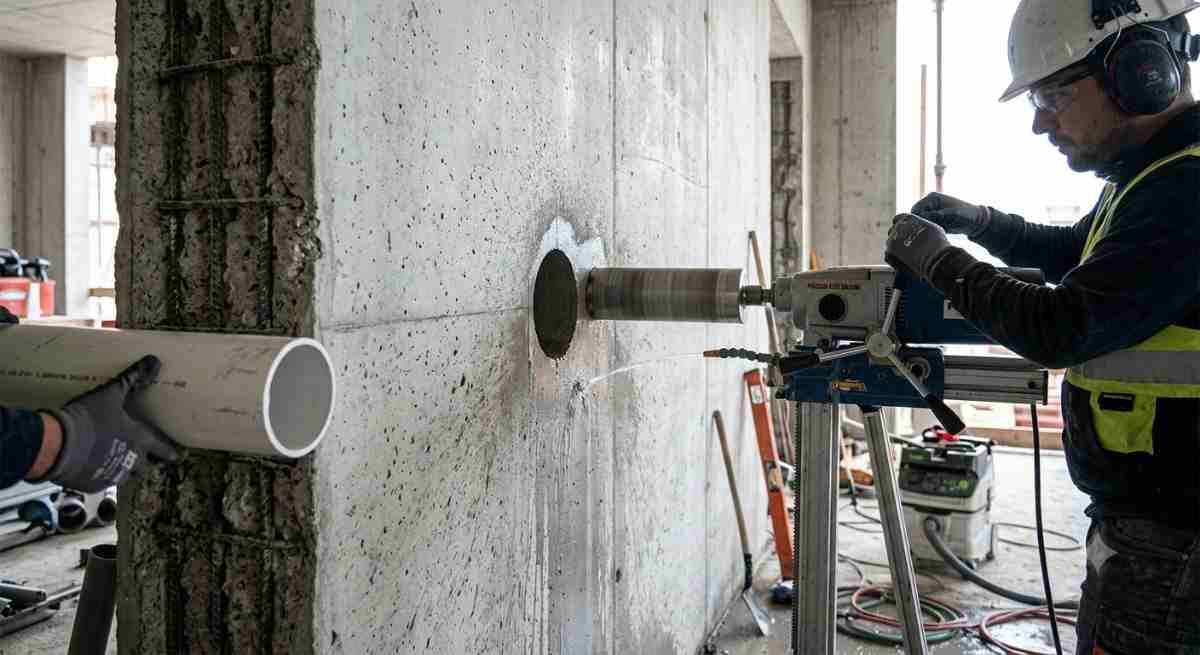
Creating penetrations for plumbing, electrical conduits, HVAC systems, and drainage lines through thick Reinforced Cement Concrete (RCC) walls is a critical task in modern construction, retrofitting, and infrastructure development. Whether working on high-rise residential towers, commercial complexes, industrial plants, or infrastructure tunnels, making openings in reinforced concrete requires extreme precision.
When executed incorrectly, cutting through heavy load-bearing RCC walls can lead to severe structural degradation, spalling, micro-fracturing, costly structural repairs, and compromised waterproofing. Traditional percussion methods—such as jackhammers and heavy impact drills—transmit violent shockwaves through the concrete matrix, fracturing the surrounding bond between the concrete and reinforcing steel (rebar).
This comprehensive guide explores advanced engineering methodologies, specialized equipment, step-by-step execution protocols, and safety standards required to create precise pipe openings in thick RCC walls safely and efficiently.
https://corecuttingindia.com/rate-calculator/
1. Understanding RCC Wall Dynamics and Structural Integrity
Reinforced Cement Concrete is an engineered composite material designed to withstand immense compressive and tensile loads. The concrete matrix handles high compressive stress, while embedded steel rebar networks absorb tensile and shear forces.
When an opening is cut into an RCC wall, two major physical alterations occur:
-
Load Redistribution: The continuous load path of the wall is interrupted, transferring forces around the newly created void.
-
Rebar Severance: Cutting through embedded steel bars reduces the cross-sectional tensile capacity of the wall unless reinforcement is properly managed or sleeved.
The Dangers of Percussive Demolition
Using pneumatic hammers or heavy breakers on thick RCC walls causes uncontrolled shock and vibration. These shockwaves propagate outward from the point of impact, creating radial micro-cracks that weaken the structural integrity far beyond the boundary of the intended opening. Furthermore, percussive force causes spalling—where chunks of concrete break away unevenly from the rear exit face of the wall, ruining aesthetic finishes and creating sealing challenges for pipe sleeves.
2. Modern Technologies for Precision Pipe Openings
To prevent structural damage and ensure millimeter-level accuracy, modern civil engineering relies on rotary and abrasive diamond-cutting technologies rather than impact forces.
A. Diamond Core Drilling
Diamond core drilling is the gold standard for creating circular pipe penetrations ranging from small 20 mm electrical conduits to massive 1000 mm industrial drainage pipes.
-
Mechanism: A rotary drill motor turns a hollow steel barrel (core bit) tipped with industrial diamond segments embedded in a metal matrix. Water is fed through the barrel to cool the diamond segments and flush out concrete slurry.
-
Advantages: Produces perfectly smooth, cylindrical holes with zero vibration, zero micro-cracking, and no damage to the surrounding wall finish. It cuts effortlessly through both high-strength concrete and embedded steel rebar.
B. Wall Sawing and Wire Sawing
For larger rectangular, square, or oversized utility openings where core drilling alone is insufficient, wall sawing or diamond wire sawing is deployed.
-
Wall Sawing: Utilizes a track-mounted circular diamond blade capable of cutting flush against floors and corners, perfect for precise square utility chases.
-
Diamond Wire Sawing: Employs a multi-strand steel cable threaded with diamond beads, driven at high speeds through thick concrete structures. It is ideal for massive walls exceeding 500 mm in thickness where circular blades cannot reach.
3. Step-by-Step Guide to Executing Accurate Pipe Openings
Achieving a flawless pipe penetration in thick RCC requires a disciplined, multi-phase engineering workflow.
Step 1: Structural Assessment and Utility Scanning
Before a single tool touches the wall, a thorough structural evaluation must take place.
-
Consult Structural Drawings: Verify whether the wall is load-bearing or shear-critical.
-
Non-Destructive Testing (NDT): Utilize Ground Penetrating Radar (GPR) and electromagnetic rebar locators to map out the exact position, depth, and spacing of embedded steel reinforcement and hidden electrical or plumbing lines.
Step 2: Precise Layout and Marking
Accuracy begins with clear layout lines.
-
Measure and mark both the entry and exit faces of the wall (using through-wall pilot holes if necessary to transfer centerlines accurately).
-
Account for outer sleeve dimensions, pipe pitch, slope requirements (crucial for drainage lines), and waterproofing clearances.
Step 3: Rig Setup and Anchoring
Stability is paramount for precision core drilling.
-
Securely anchor the heavy-duty core drill rig to the wall using heavy-duty masonry anchor bolts or vacuum suction bases (where wall surfaces permit).
-
Verify plumb alignment using spirit levels to ensure the drill bit enters and exits at the exact required angle without wandering.
Step 4: Controlled Cutting and Slurry Management
-
Water Cooling: Maintain a steady, regulated water supply to lubricate the diamond segments, suppress dust (silica dust hazard), and prevent thermal overheating of the bit.
-
Feed Rate Control: Apply steady, controlled manual or hydraulic feed pressure. Forcing the drill too fast causes bit glazing and motor strain, while feeding too slow accelerates diamond wear.
-
Slurry Containment: Utilize industrial wet-vacuums and containment rings to capture concrete slurry, maintaining a clean and safe work environment.
Step 5: Post-Cut Inspection and Finishing
-
Extract the concrete core cleanly.
-
Inspect the inner perimeter for smoothness and check rebar exposure.
-
Install appropriate pipe sleeves, fire-stop collars, and non-shrink waterproof epoxy grouts to seal the annular space between the pipe and the concrete wall.
4. Avoiding Common Pitfalls and Structural Failures
Executing concrete penetrations without professional oversight often leads to preventable errors:
-
Ignoring Rebar Depth: Severing primary structural rebar without consulting a structural engineer can cause load failures. If critical bars must be cut, structural lintels, steel plates, or carbon fiber wrapping must be engineered to bridge the load.
-
Back-Face Spalling: Occurs when the drill bit breaks through the rear surface of the wall without proper support or backup cutting. Using pilot-guided core bits or cutting midway from both sides eliminates rear blowout.
-
Thermal Shock: Allowing a diamond core bit to run dry generates extreme heat, warping the steel barrel and destroying the diamond segments instantly.
5. Why Professional Expertise Matters
Creating accurate pipe openings in thick RCC walls is not a standard DIY or general contractor task. It demands specialized industrial machinery, diamond tooling expertise, experienced operators, and strict adherence to safety protocols.
At Core Cutting India ([https://corecuttingindia.com/](https://corecuttingindia.com/)), we specialize in heavy-duty concrete cutting, diamond core drilling, wall sawing, and structural modifications across residential, commercial, and industrial sectors. Equipped with state-of-the-art hydraulic and electric diamond cutting systems, our certified technicians deliver clean, vibration-free penetrations on schedule and with zero collateral damage to your structures.
Get in Touch with Our Experts
Need professional core cutting or wall opening services for your project? Contact us today for consultations, estimates, and reliable execution:
-
Website: https://corecuttingindia.com/
-
Rate Calculator: https://corecuttingindia.com/rate-calculator/
-
Direct Phone / WhatsApp: +91 70096 79903
-
Email: info@corecuttingindia.com
Conclusion
Precise pipe openings in thick RCC walls are vital for integrating modern building services without compromising structural safety. By replacing destructive percussive tools with advanced diamond core drilling and wall sawing techniques, engineers and contractors can achieve clean, exact penetrations while preserving the integrity of the concrete and reinforcing steel matrix. Partnering with experienced professionals ensures that every cut is executed safely, efficiently, and to exact engineering specifications.