
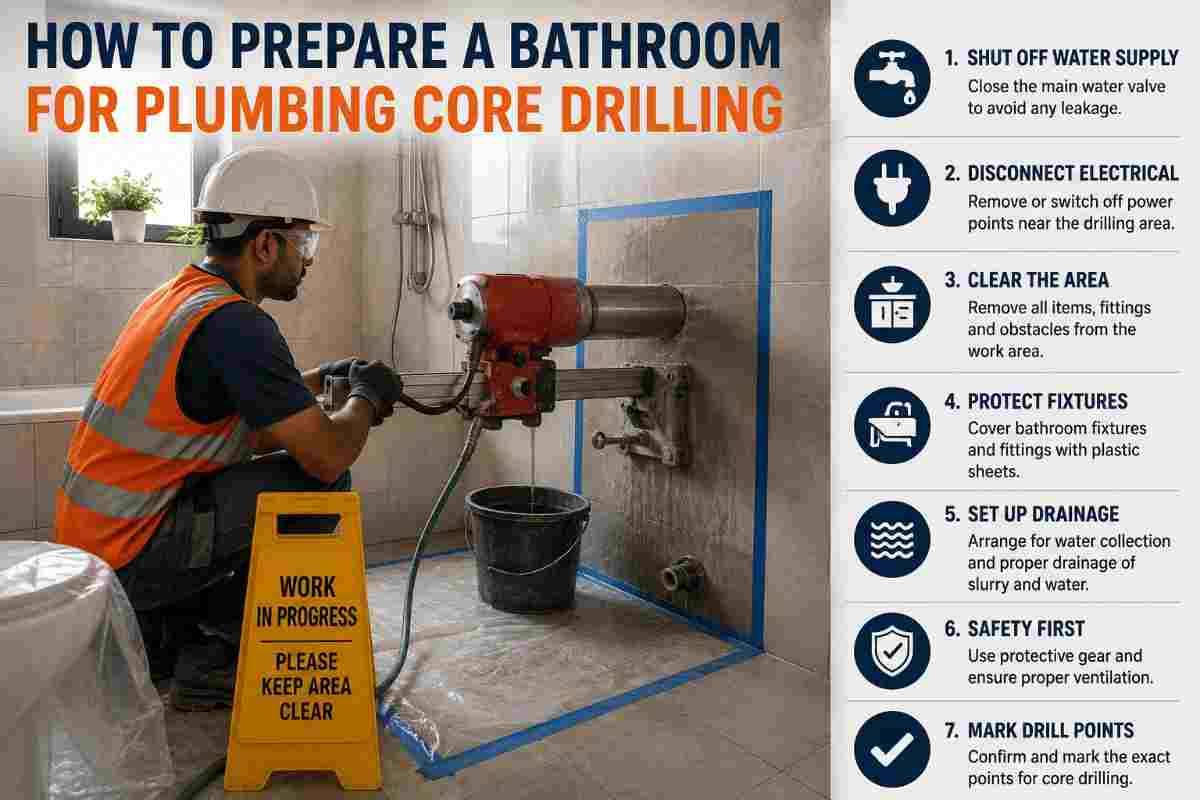
Renovating a bathroom or shifting a drain line often means making a clean, precise hole through a concrete slab, wall, or floor. That is where plumbing core drilling comes in. It is the cleanest, safest, and most accurate way to create openings for drain pipes, waste lines, water supply lines, and exhaust ducts in reinforced concrete.
But even the best drilling crew can only do their job well if the bathroom is properly prepared. A little planning beforehand prevents water damage, dust problems, damaged tiles, and costly delays.
At Core Cutting India, we have handled thousands of bathroom core drilling jobs in apartments, villas, offices, and commercial buildings. In this guide, we share the exact steps to prepare your bathroom so the work is fast, safe, and mess-free.
What Is Plumbing Core Drilling?
Core drilling uses a hollow, diamond-tipped cylindrical bit mounted on a drilling rig to cut circular holes in concrete, brick, stone, and reinforced slabs. Unlike hammer drilling or chiselling, it doesn’t shatter the surrounding structure. The result is a smooth, round hole with minimal vibration and no cracks radiating outward.
In bathrooms, core drilling is commonly used for:
- Installing or relocating floor drains and WC (toilet) waste pipes
- Passing soil pipes and waste pipes through slabs
- Creating openings for exhaust fan ducts
- Adding new water supply or drainage lines during renovation
- Retrofitting plumbing in old buildings with thick concrete floors
Hole sizes typically range from 50 mm to 200 mm or more, depending on the pipe being installed.
Why Bathroom Preparation Matters
A bathroom is one of the most delicate areas to drill. It contains waterproofing membranes, embedded pipes, tiles, fixtures, and often a living space or another bathroom directly below. Poor preparation can lead to:
- Water leakage into the floor below because of a damaged waterproofing layer
- Hitting hidden pipes or electrical conduits inside the slab
- Broken or stained tiles and damaged fixtures
- Dust and slurry spreading across the home
- Safety hazards from water and electricity near each other
- Project delays when the crew arrives to find an unready site
Proper preparation protects your property, speeds up the work, and often lowers the final cost.
Step 1: Finalise the Plumbing Layout Before Drilling
Never start with the drill. Start with a plan.
Confirm the exact pipe location. Decide where each drain, waste pipe, or duct opening will go. Check it against your plumber’s drawing or your architect’s plan. Once a core is cut, it can’t be undone.
Mark the centre point and diameter. Use a marker or chalk to mark the exact centre of every hole, and draw the circle at the required diameter. Your drilling team will verify these marks, but clear marking avoids confusion.
Consider the slope. Drain lines need a proper gradient. Make sure the hole position supports the slope your plumber needs, and don’t place it too close to a wall or corner where fitting the pipe becomes difficult.
Check clearances. Leave enough room around the hole for the drilling rig, the pipe fittings, and future maintenance access. As a rule of thumb, keep the hole at least 150 mm away from walls or edges where possible.
Step 2: Check for Hidden Services Inside the Slab
This is the most important safety step. Concrete slabs often contain steel reinforcement bars, electrical conduits, and sometimes old plumbing or embedded sleeves.
Review building drawings. Structural and electrical drawings show where major rebar, beams, and conduits run. If you live in an apartment, ask your society or builder for these plans.
Ask about scanning. A professional team can use a rebar and conduit scanner (like GPR or electromagnetic detectors) to locate hidden items before drilling. This helps avoid cutting through structural steel or live wiring.
Avoid beams and columns. Core drilling through a structural beam or column should never be done without an engineer’s approval. If your hole falls near one, speak to a structural engineer first.
Know what’s below. Check what’s under the slab, such as a bedroom, kitchen, or false ceiling. Water or debris could fall through if the hole breaks through unexpectedly.
Step 3: Clear the Bathroom Completely
Empty the bathroom so the crew has a safe, open workspace.
- Remove towels, mats, toiletries, buckets, cleaning supplies, and décor
- Take out movable items such as shelves, stools, and laundry baskets
- Remove glass shower screens or panels if they sit near the drilling zone
- Disconnect and remove accessories like geysers or exhaust fans if they obstruct access
The more room the team has, the more accurately and safely they can position the drilling rig.
Step 4: Protect Fixtures, Tiles, and Surfaces
Even though core drilling is cleaner than traditional methods, water, slurry, and vibration can still affect nearby surfaces.
Cover the floor and fixtures. Use thick plastic sheets, tarpaulin, or old blankets to cover the toilet, washbasin, bathtub, and any tiles you want to protect.
Seal the edges. Use masking tape to hold coverings in place and prevent slurry from seeping underneath.
Protect walls. If you’re drilling near a wall, cover that section with plastic sheeting to catch splashes.
Take extra care with new tiles. If you’ve recently installed tiles, tell the crew so they can use extra protection and a gentler drilling technique. Also keep a few spare tiles of the same batch in case of damage.
Step 5: Manage Water Supply and Electricity
Core drilling is typically a wet process. Water cools the diamond bit and controls dust. That makes managing both water and power essential.
Provide a nearby water source. Keep a tap or water tank accessible so the crew can feed the drilling rig. If the bathroom’s water must be shut off, arrange an alternative like a bucket or hose from another point.
Switch off the geyser and bathroom lights if needed. Water and electricity must never mix. Turn off power to any outlets near the work area, including the geyser, extractor fan, and sockets.
Arrange a safe power source. The drilling machine needs a stable electrical supply, usually a standard single-phase socket or a generator. Keep a grounded power point within reach, ideally outside the wet zone, and use a proper extension cable with a residual current device (RCD) where possible.
Locate your main water valve. Know where the main shut-off is, just in case of any emergency.
Step 6: Plan for Water and Slurry Control
Drilling produces a muddy slurry of water and concrete dust. If you don’t contain it, it spreads quickly.
- Keep a wet vacuum ready. A wet-dry vac collects slurry as it forms. Professional teams carry their own, but having a spare helps.
- Use a slurry ring or barrier. Many crews build a small dam of putty or foam around the hole to hold water and guide it into a vacuum.
- Block the floor drain. Cover any nearby drain with a cloth or plug so slurry doesn’t enter and clog the pipes.
- Prepare buckets. Keep a few empty buckets and a mop on hand for cleanup.
Careful slurry management keeps the bathroom, adjoining rooms, and drainage system clean.
Step 7: Inform Neighbours and Building Management
If you live in an apartment or a gated society, tell the people around you before drilling starts.
- Notify the residents below. Core drilling can cause slight vibration or water seepage, so warn the flat beneath you, especially if you’re cutting through a slab above their ceiling.
- Get permission from the society or RWA. Many housing societies require prior approval and set permitted work hours.
- Check noise timings. Core drilling is quieter than hammering, but it still produces sound. Schedule it during allowed hours, usually daytime on weekdays.
A quick conversation avoids complaints and keeps your project on schedule.
Step 8: Arrange Access and Working Space
Make sure the team can reach your bathroom easily.
- Clear a path from the entrance to the bathroom for equipment
- Reserve parking or loading space for the machine and tools
- Confirm lift access and timing if you live in a high-rise
- Keep the door open and well lit
- Ensure the bathroom is well ventilated, since drilling can create damp and dust
Core drilling rigs are heavy, so a clear, obstacle-free route saves time and prevents accidents.
Step 9: Prepare for the Pipe Installation
Core drilling is only half the job. Your plumber will need the hole ready for pipe fitting right away.
- Have pipes and fittings on-site. Keep the correct pipe size, couplings, and sealants available so installation follows immediately.
- Plan for sleeves. Some jobs use a PVC or steel sleeve through the slab. Decide this ahead of time.
- Prepare waterproofing materials. After the pipe is fixed, the gap around it should be sealed with non-shrink grout, waterproof sealant, or a brush-applied waterproofing coat. This stops leakage between floors.
- Coordinate with your plumber and tile fitter. Everyone should know the sequence of work so there are no gaps or delays.
Step 10: Choose a Professional Core Cutting Team
Preparation helps, but the quality of the work depends on the people holding the drill.
Look for a team that offers:
- Diamond core drilling machines with proper rigs and anchoring systems
- Experienced operators who understand structural safety
- Rebar and conduit scanning before work starts
- Dust and slurry control as standard practice
- Transparent pricing based on diameter and depth
- Quick turnaround with minimal disruption
At Core Cutting India, we provide professional concrete core drilling for bathrooms, kitchens, terraces, basements, and commercial buildings across India. Our trained technicians use modern diamond equipment to deliver clean, accurate holes with minimal mess, and we guide you through preparation so the day of drilling goes smoothly.
📞 Call or WhatsApp: +91 70096 79903
🌐 Visit: https://corecuttingindia.com/
Pre-Drilling Bathroom Checklist
Use this quick list before your crew arrives:
- Pipe and hole positions are marked clearly
- Hole diameter and depth are confirmed
- Hidden services are checked or scanned
- Bathroom is emptied of loose items
- Tiles, fixtures, and walls are covered
- Water supply is available nearby
- Power is safe and accessible, with the geyser off
- Floor drain is blocked and slurry control is ready
- Neighbours and society are informed
- Access route for the machine is clear
- Pipes, sleeves, and waterproofing materials are ready
Common Mistakes to Avoid
- Drilling without checking for rebar or conduits. This can damage structure or hit live wires.
- Skipping waterproofing afterward. Even a small gap around a pipe can cause long-term leaks.
- Marking the wrong location. Always double-check measurements with your plumber.
- Ignoring neighbours. Surprise drilling creates conflict.
- Not protecting tiles. Slurry can stain and scratch.
- Hiring unqualified workers. Poor drilling can crack slabs and cost far more to repair.
Safety Tips During Drilling
- Stay out of the bathroom while the machine is running unless supervised
- Keep children and pets away from the area
- Never touch electrical points with wet hands
- Wear a mask and eye protection if you need to be nearby
- Let the crew handle all equipment, anchoring, and water flow
After Drilling: What to Do Next
Once the hole is cut:
- Let the crew clear the core (the removed concrete cylinder) and clean the opening.
- Inspect the edges for smoothness and check that the diameter is correct.
- Install the pipe or sleeve immediately.
- Seal around it with non-shrink grout or waterproof sealant.
- Test for leaks by running water for several hours.
- Re-tile and finish the area only after the test passes.
Frequently Asked Questions (People Also Ask)
1. How much does bathroom core drilling cost in India?
Cost depends on the hole diameter, slab thickness, and location. Smaller holes for drain pipes cost less, while larger or deeper cuts cost more. Contact Core Cutting India at +91 70096 79903 for an accurate quote.
2. Is core drilling better than chiselling for bathroom pipes?
Yes. Core drilling creates a clean, precise hole without cracking or weakening the slab, while chiselling causes heavy vibration, noise, and uneven damage.
3. Can core drilling damage waterproofing?
It can disturb it locally, but proper post-drilling sealing and waterproofing around the pipe restore protection. Always reapply waterproofing after installation.
4. How long does it take to drill a hole in a bathroom slab?
A typical 100 mm hole through a standard slab takes about 20 to 45 minutes, depending on reinforcement and thickness.
5. Is core drilling messy?
It is far cleaner than traditional methods because water suppresses dust. With proper slurry control, the mess is minimal.
6. Can I do core drilling myself?
It’s not recommended. The equipment is heavy, specialised, and risky near water and electricity. Hiring professionals protects both safety and structure.
7. Does core drilling weaken the slab?
When done correctly and away from beams, columns, and heavy rebar, it does not weaken the structure. A professional check ensures safety.
8. What size hole is needed for a toilet drain?
Most WC outlets use 100 mm to 110 mm pipes, so the hole is often 125 mm to 150 mm for fittings and sleeves. Confirm with your plumber.
Final Thoughts
Preparing your bathroom for plumbing core drilling doesn’t have to be complicated. With a clear layout, protected surfaces, safe power and water arrangements, and a skilled team, the job can be completed quickly and cleanly. Preparation saves time, protects your home, and ensures your new plumbing works perfectly for years.
If you’re planning bathroom core drilling in Delhi, NCR, or anywhere in India, Core Cutting India is ready to help with expert equipment, trained operators, and reliable service.
📞 Call now: +91 70096 79903
🌐 Website: https://corecuttingindia.com/