
Introduction
Walk past any major construction or renovation site in Mumbai, Delhi NCR, Bengaluru, or Pune today, and you're likely to see a compact machine gliding through a concrete wall with almost surgical precision, leaving behind a clean, dust-controlled edge instead of the chaos once associated with breaking through concrete. This is diamond saw wall cutting in action — a technology that has quietly transformed how Indian contractors, builders, and infrastructure developers approach structural modifications.
Gone are the days when creating an opening in a reinforced concrete (RCC) wall meant hours of hammering, deafening noise, cracked adjoining structures, and clouds of dust settling over an entire neighbourhood. Diamond saw technology has replaced that brute-force approach with a controlled, engineering-driven process that is faster, safer, and far more precise. In this guide, we'll walk through exactly how wall cutting using diamond saw technology works, why it has become the preferred method across Indian cities, and where you'll find it being used in real projects around the country.
TARGET-RELATED SEARCHES: diamond saw wall cutting near me, wall cutting machine price in India, RCC wall cutting cost per sq ft, concrete wall cutting contractors India, diamond blade wall saw for sale, wall cutting for door opening, concrete cutting company Mumbai, wall sawing services Delhi NCR, diamond core cutting company India, wall cutting and demolition services
What Is Diamond Saw Wall Cutting?
Diamond saw wall cutting is a specialised concrete cutting technique that uses blades embedded with industrial-grade diamond segments to slice through concrete, brick, stone, and reinforced structures. Unlike conventional demolition tools that rely on impact and vibration, diamond saws use a combination of rotational speed and continuous water cooling to grind through material with minimal disturbance to the surrounding structure.
The diamond segments — small chips of synthetic diamond bonded to a metal matrix — are the hardest cutting material commercially available, capable of slicing through steel-reinforced concrete, natural stone, and masonry with equal ease. This makes the technology suitable for everything from cutting a simple doorway in a residential wall to creating large structural openings in metro stations, industrial plants, and high-rise commercial towers.
The Core Equipment Used in Diamond Wall Cutting
Before understanding the process, it helps to know the equipment involved:
1. Wall Saws A wall saw is a track-mounted cutting machine fixed to the wall surface using an anchored guide rail. The circular diamond blade moves along this rail, cutting deep, straight, and highly accurate lines into the wall. Wall saws can typically cut depths ranging from a few centimetres up to over 60 cm, depending on the blade diameter, making them ideal for thick load-bearing walls common in Indian RCC construction.
2. Diamond Wire Saws For extremely thick sections, curved cuts, or areas where a wall saw's rail cannot be mounted, contractors use a diamond wire saw. This involves a continuous loop of steel cable embedded with diamond beads, which is threaded through drilled pilot holes and then pulled through the material by a hydraulic or electric motor. Wire saws are particularly useful for cutting large structural elements, bridge piers, and thick foundation walls.
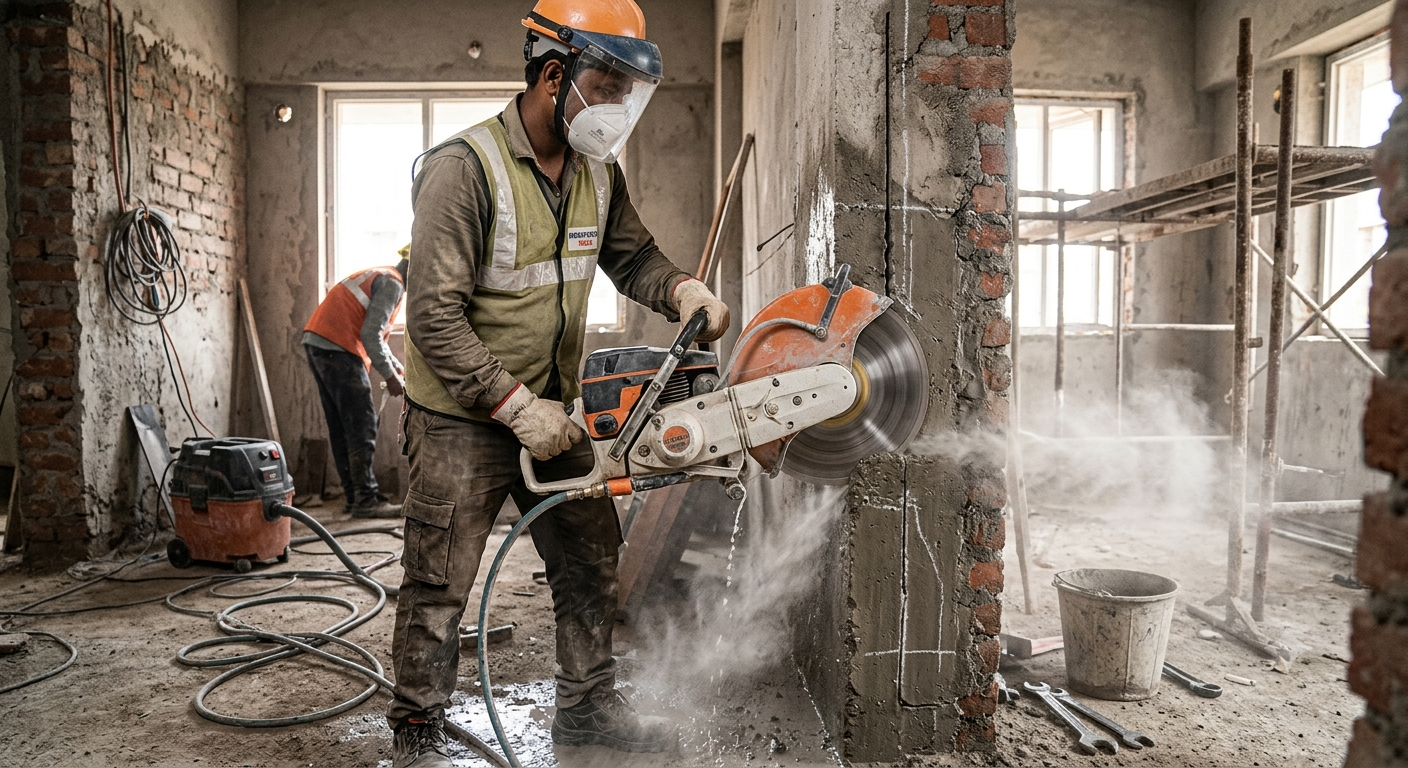
3. Handheld Diamond Blade Cutters For smaller jobs — like cutting openings for electrical conduits, HVAC ducts, or plumbing lines — handheld diamond cutters offer flexibility and speed without the need for track mounting.
4. Core Drilling Machines Often used alongside wall saws, core drills create circular openings for pipes, cables, or ventilation shafts, and are frequently the first step in preparing a wall saw's cutting path.
Step-by-Step: How the Wall Cutting Process Works
Step 1: Site Survey and Structural Assessment
Before any cutting begins, a structural engineer or experienced technician surveys the wall to identify reinforcement bars (rebar), embedded utilities, and load-bearing considerations. This step is critical in India, where many buildings — from older heritage structures in cities like Ahmedabad and Kolkata to newer high-rises in Gurugram and Hyderabad — vary widely in construction quality and structural documentation.
Step 2: Marking and Planning the Cut
Once the assessment is complete, the exact cutting lines are marked on the wall. For structural openings — such as adding a new doorway, window, or duct passage — engineers calculate whether temporary shoring or support beams are needed to maintain structural integrity during and after the cut.
Step 3: Mounting the Wall Saw
The guide track is securely anchored to the wall using bolts or vacuum mounts. This ensures the diamond blade follows a perfectly straight and stable path, which is essential for achieving clean, accurate cuts without deviation.
Step 4: Cutting with Continuous Water Cooling
As the diamond blade rotates at high speed, water is continuously fed to the cutting zone. This serves two purposes: it cools the blade to prevent overheating and diamond segment wear, and it suppresses dust — a major advantage over traditional dry-cutting or hammering methods, especially important for occupied buildings, hospitals, and metro stations where dust control is non-negotiable.
Step 5: Removing the Cut Section
Once the cut is complete on all sides, the isolated concrete section is carefully removed using lifting equipment, cranes, or manual extraction depending on size and weight. In multi-storey buildings, this step often requires coordination with structural support systems to prevent any settling or cracking in adjacent areas.
Step 6: Finishing and Edge Treatment
The final step involves smoothing the cut edges, checking for exposed rebar, and preparing the opening for its intended purpose — whether that's a new doorway, ventilation shaft, or utility passage.
Why Diamond Saw Cutting Is Preferred Over Traditional Methods
Traditional demolition using jackhammers or breakers is still common in India for small, non-structural work, but for anything involving precision, structural integrity, or occupied spaces, diamond saw cutting offers clear advantages:
- Precision: Cuts are accurate to within millimetres, critical for structural modifications and MEP (mechanical, electrical, plumbing) installations.
- Reduced Vibration: Unlike hammering, diamond cutting produces minimal vibration, protecting adjacent structures — an important factor in densely built Indian cities where buildings often share walls or foundations.
- Dust and Noise Control: Water-cooled cutting drastically reduces airborne dust, making it suitable for hospitals, IT parks, residential societies, and heritage sites where noise and air quality regulations are strict.
- Speed: A task that might take days with manual breaking can often be completed in hours with diamond saw equipment.
- Structural Safety: Because the technique doesn't rely on impact force, there's a much lower risk of hairline cracks spreading into surrounding concrete — a common issue with hammer-based demolition.
Applications Across Indian Construction Projects
Diamond saw wall cutting has found application across a wide spectrum of Indian construction and infrastructure work:
Metro Rail and Infrastructure Projects: Urban metro systems across cities like Delhi, Mumbai, Bengaluru, Chennai, and Pune have required extensive concrete cutting for station modifications, tunnel connections, and utility diversions, where precision and minimal disruption to surrounding structures are essential.
Residential Renovations: As Indian homeowners increasingly renovate older flats and independent houses, diamond cutting is used to create new doorways, merge rooms, or install modular kitchen and bathroom fittings without damaging structural walls.
Commercial and IT Parks: Office spaces in tech hubs like Bengaluru, Hyderabad, and Gurugram frequently require wall modifications for cabling, HVAC ducting, and layout changes during fit-out work, all of which rely on clean, dust-free cutting.
Industrial and Factory Retrofitting: Manufacturing units across industrial belts in Maharashtra, Gujarat, and Tamil Nadu use diamond wall cutting to install new machinery access points, exhaust systems, or structural modifications without halting entire production lines.
Heritage and Restoration Work: In cities with significant older building stock, diamond cutting's low-vibration nature makes it a safer choice when modifications are unavoidable near sensitive or ageing structures.
Safety Considerations in Diamond Wall Cutting
While diamond saw technology is significantly safer than manual demolition, it still requires trained operators and proper planning. Key safety practices include:
- Conducting a thorough structural assessment before cutting any load-bearing wall
- Using rebar scanners to avoid unexpected obstructions
- Installing temporary shoring where structural support is compromised
- Ensuring proper water drainage during wet cutting to prevent slip hazards
- Using appropriate personal protective equipment (PPE) for operators
- Working with experienced, certified cutting contractors who understand local building codes
This is particularly important in India, where building regulations and enforcement can vary by state and municipality, making it essential to work with a knowledgeable, professional cutting team.
Choosing the Right Wall Cutting Partner
Given the technical precision and safety considerations involved, wall cutting is not a task for inexperienced contractors. The right partner should bring:
- Trained and certified operators
- Well-maintained wall saws, wire saws, and core drilling equipment
- A track record across residential, commercial, and infrastructure projects
- A clear process for structural assessment and safety planning
- Transparent project timelines and cost estimates
At Core Cutting India, we specialise in diamond saw wall cutting, core drilling, and diamond wire cutting services for residential, commercial, and industrial projects across the country. Our teams combine modern diamond cutting equipment with structural know-how to deliver clean, precise, and safe cutting solutions — whether it's a single doorway opening or a large-scale structural modification project.
Conclusion
Diamond saw technology has fundamentally changed how wall cutting is approached in Indian construction, replacing noisy, imprecise demolition with a controlled, engineering-driven process. From metro infrastructure to home renovations, the ability to cut cleanly through concrete, brick, and reinforced structures with minimal vibration and dust has made diamond cutting the standard choice for professionals across the country.
Whether you're planning a small residential modification or a large commercial retrofit, understanding how this technology works can help you make informed decisions and choose the right cutting partner for your project.
For professional diamond saw wall cutting services anywhere in India, reach out to Core Cutting India at [email protected].
People Also Ask
1. What is diamond saw cutting used for? Diamond saw cutting is used to create precise openings in concrete, brick, and stone structures — such as doorways, windows, ventilation shafts, and utility passages — as well as for structural modifications in residential, commercial, and infrastructure projects.
2. How much does wall cutting cost in India? Costs vary based on wall thickness, reinforcement, location, and project complexity, typically calculated per square foot or per running foot of cut. It's best to get a site-specific quote from a professional cutting contractor like Core Cutting India.
3. Is diamond wall cutting safe for load-bearing walls? Yes, when performed by trained professionals following a proper structural assessment. Temporary shoring or support beams are often used to maintain structural integrity during and after cutting load-bearing sections.
4. What is the difference between wall sawing and core cutting? Wall sawing creates straight, linear cuts using a track-mounted circular blade, typically for openings like doors and windows. Core cutting uses a rotating drill bit to create circular holes, commonly used for pipes, cables, and ventilation ducts.
5. How long does diamond wall cutting take? Depending on wall thickness and size of the opening, cuts can take anywhere from a few hours to a full day, significantly faster than traditional manual demolition methods.
6. Can diamond saws cut through steel-reinforced concrete? Yes. Diamond blades and wires are specifically designed to cut through both concrete and embedded steel reinforcement, making them suitable for RCC structures common in Indian construction.
Core Cutting India — Precision Diamond Cutting Solutions | [email protected]