
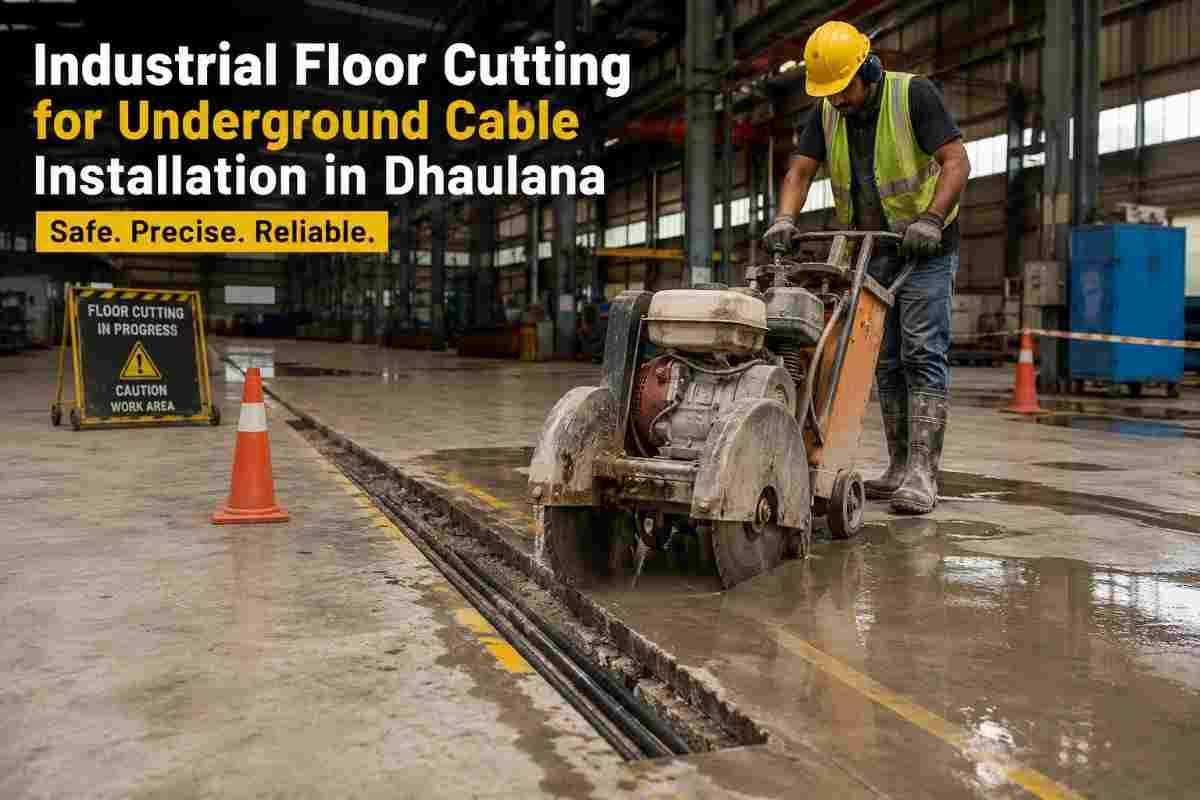
As Dhaulana expands into a high-density industrial corridor driven by manufacturing hubs, warehousing facilities, automotive engineering plants, and modern logistics parks, the demand for high-capacity electrical infrastructure continues to surge. Rapid industrial expansion requires reliable power distribution networks, high-voltage lines, fiber-optic connectivity, and heavy machinery cabling.
Installing these critical lines beneath industrial concrete floors provides long-term protection against mechanical impact, chemical exposure, foot traffic, and forklift stress. However, cutting heavy-duty reinforced concrete floors inside operating facilities requires high-precision floor saw cutting, structural evaluation, vibration mitigation, and dust control.
This comprehensive guide breaks down the engineering procedures, heavy machinery requirements, step-by-step techniques, safety compliance protocols, and specialized solutions provided by Core Cutting India for industrial floor cutting and cable trenching in Dhaulana.
1. The Critical Role of Floor Cutting in Cable Installation
Industrial facilities feature heavy-duty concrete slabs (typically ranging from 150mm to 350mm or deeper) mixed with high compressive strength concrete (M30 to M50 grade) and heavy steel rebar matrices. Jackhammers or mechanical breakers cause micro-fracturing, internal structural damage, micro-cracks, and uneven trench lines that weaken the floor slab.
       CONCRETE TRENCHING CROSS-SECTION

  ┌──────────────────────────────────────────────┐ ◄────── Concrete Slab Surface
  │  [Cut Line]                      [Cut Line]  │
  │     │                               │        │
  │     │      Re-compacted Fill        │        │ ◄────── Rebar Layer
  │     ├───────────────────────────────┤        │
  │     │      Cement / Sand Bed        │        │
  │     │  ┌─────────────────────────┐  │        │
  │     │  │   Conduit / Cable Duct  │  │        │ ◄────── Cable Duct / Conduit
  │     │  └─────────────────────────┘  │        │
  └─────┴───────────────────────────────┴────────┘ ◄────── Sub-Base Bedding
Diamond floor cutting (slab sawing) offers distinct engineering advantages:
-
Structural Integrity: Precision diamond blades sever rebar and aggregate cleanly without transmitting impact shock waves into adjacent slabs.
-
Dimensional Accuracy: Straight, clean edges allow clean trenching, simplified conduit alignment, precise cable laying, and seamless concrete backfilling.
-
Reduced Operational Downtime: High-speed self-propelled flat saws execute long linear runs quickly, keeping plant shutdown windows to a minimum.
-
Dust & Noise Control: Wet diamond cutting suppresses airborne concrete dust completely, maintaining clean environments in sensitive industrial plants.
2. Technical Engineering Requirements & Cable Trench Depths
Calculating exact cut depths, trench widths, and expansion joint clearances is vital before deploying heavy walk-behind saws. Cable trenching specifications are dictated by standard industrial cabling depth guidelines:
| Cable Category | Typical Cable Type | Standard Depth Requirement | Recommended Floor Cut Depth |
| Low Voltage (LV) | Control Wiring, Internal Signals, Data | 450 mm – 600 mm | Full Slab Cut (150 mm - 250 mm) + Soil Trench |
| Medium Voltage (MV) | 11kV – 33kV Plant Feeder Lines | 750 mm – 1000 mm | Full Depth Slab Severance + Structural Excavation |
| High Voltage (HV) | Primary Grid Distribution Cables | 1000 mm – 1200 mm+ | Deep Slab Sawing + Concrete Conduit Encasement |
| Fiber Optic/Data | Telecom, Automation & IT Lines | 300 mm – 450 mm | Shallow/Medium Cut + Protective Ducting |
3. Floor Cutting Machinery & Diamond Blade Specs
Executing clean industrial trench cuts in Dhaulana's industrial facilities requires match-grade equipment configured specifically for cured reinforced concrete.
Equipment Types
+-------------------------------------------------------------------------------+
|                        FLOOR SAWING EQUIPMENT TYPES                           |
+------------------------------------+------------------------------------------+
| Walk-Behind Electric Floor Saws    | Zero emissions; ideal for enclosed indoor |
| (15 kW - 35 kW)                    | industrial plants and food facilities.   |
+------------------------------------+------------------------------------------+
| Diesel / Petrol Heavy-Duty Saws    | High-torque performance for outdoor      |
| (35 HP - 75 HP+)                   | yards, roadways, and large logistics.    |
+------------------------------------+------------------------------------------+
| Handheld Cut-Off Saws & Wall Saws  | For tight corners, wall-adjacent cuts,   |
|                                    | and constrained indoor spots.            |
+------------------------------------+------------------------------------------+
Diamond Blade Mechanics
-
Blade Diameters: Saws utilize blades ranging from 350 mm up to 1200 mm, achieving single-pass or multi-pass cut depths from 120 mm to over 500 mm.
-
Segment Matrix: Soft-bond diamond segments are selected for hard granite aggregate reinforced concrete to allow continuous diamond exposure during cutting.
-
Blade Kerf Width: Blade widths typically range between 4.5 mm and 10 mm to ensure clean, jam-free blade clearance during deep cuts.
4. Step-by-Step Cable Installation Workflow
5. Technical Challenges in Dhaulana Industrial Sites
Operating heavy cutting equipment inside Dhaulana's manufacturing plants presents unique site constraints:
-
Continuous Vibration Limits: Sensitive CNC machines and automated assembly lines require vibration-free cutting, making diamond floor sawing essential over percussion breaking.
-
Zero Airborne Dust Standards: Wet cutting and industrial slurry vacuuming systems are mandatory inside food processing, pharmaceutical, and electronic assembly plants.
-
High Rebar Density: Industrial floors often contain dual-mesh T16 or T20 steel rebar matrices that require high-power floor saws (minimum 30 HP) paired with premium matrix diamond blades.
-
Zero Water Leaks into Sub-grade: Slurry recovery units capture slurry water in real-time, preventing wastewater from seeping into sub-base soil layers.
6. Safety Standards & Quality Protocol Compliance
Safety compliance governs every project undertaken by Core Cutting India:
-
Operator Protection: Mandatory use of personal protective equipment (PPE), including steel-toe safety boots, hearing protection, safety goggles, high-visibility vests, and respiratory masks.
-
Electrical Hazard Prevention: Lockout/Tagout (LOTO) procedures enforced on all nearby live plant utility lines.
-
Slurry Management: Industrial slurry recycling units capture slurry directly behind the blade guard, keeping floors slip-free and dry.
7. Related Searches & Target Keywords
To help plant managers, industrial civil contractors, and electrical engineers locate technical floor cutting services in Dhaulana, key target search terms include:
-
Industrial floor cutting Dhaulana
-
Concrete slab trenching for cable laying in Dhaulana
-
Heavy duty diamond concrete cutting Dhaulana
-
Underground electric cable trench cutting services
-
Floor saw concrete cutting contractors near Dhaulana
-
Reinforced concrete floor saw cutting price per meter Dhaulana
-
Dustless indoor concrete floor trenching Dhaulana
8. People Also Ask (PAA)
Q1: How deep can a floor saw cut concrete for cable trenching?
Floor saws can cut up to 450 mm to 625 mm deep in a single pass using large-diameter diamond blades (ranging from 800 mm to 1200 mm). For standard industrial floor slabs (150 mm to 250 mm), walk-behind electric or diesel saws sever the slab effortlessly.
Q2: Why is wet diamond sawing preferred over jackhammering inside factories?
Wet diamond sawing produces zero micro-fracturing in surrounding structural slabs, eliminates airborne dust, lowers noise levels, cuts rebar cleanly, and leaves crisp, straight edges ideal for clean trench reinstatement.
Q3: How much time does industrial floor trenching take per 100 meters?
A professional 35 HP+ floor saw crew can cut approximately 150 to 250 linear meters per day in standard 200 mm reinforced concrete, depending on rebar density and site accessibility.
Q4: Can floor cutting be done inside operational plants without halting production?
Yes. Using 3-phase electric zero-emission floor saws equipped with real-time slurry vacuum containment, work can proceed in operating facilities without air contamination or carbon monoxide hazards.
9. Contact Details & Professional Assistance
For industrial floor cutting, slab sawing, core drilling, and underground cable trenching projects across Dhaulana and surrounding industrial sectors, contact Core Cutting India:
-
Website: https://corecuttingindia.com/
-
Direct Phone / WhatsApp: +91 70096 79903
-
Official Business Inquiry Email: info@corecuttingindia.com
-
Instant Online Rate Estimator: Core Cutting India Rate Calculator