
Renovating an apartment in Delhi NCR, knocking down walls for an open-plan kitchen in Mumbai, or creating French doors for a balcony in Bengaluru often brings homeowners face-to-face with a critical structural element: the lintel beam.
Whether you need to enlarge a window, convert a standard doorway into an arch, or run heavy AC copper piping and ventilation ducts through a wall, the question inevitably arises: Is lintel cutting safe?
The short answer is: Lintel cutting is NOT inherently safe if done arbitrarily, but it CAN be executed safely if proper structural engineering protocols, propping procedures, and non-destructive diamond core cutting techniques are used.
Cutting or modifying a load-bearing RCC (Reinforced Cement Concrete) or brick lintel without understanding structural physics can compromise the stability of your entire building, leading to wall cracks, ceiling sagging, or catastrophic structural failure.
In this deep-dive guide, we break down everything you need to know about lintel cutting in Indian construction—from structural engineering standards (IS 456 and IS 1905) to essential safety precautions and modern diamond cutting methods.
Understanding the Lintel: Why is it Structural, Not Decorative?
Before touching a chisel, jackhammer, or core drilling machine, it is vital to understand what a lintel does.
          +-----------------------------------+
          |         WALL ABOVE LINTEL         |
          |       (Triangular Load Zone)      |
          +-----------------------------------+
          |======== LINTEL BEAM (RCC) ========|
          +----------+-------------+----------+
          | BEARING  |  OPENING    | BEARING  |
          | (Min 150mm)| (Door/Window)|(Min 150mm)|
          +----------+-------------+----------+
1. What is a Lintel?
A lintel is a horizontal structural beam placed across the top of door, window, or corridor openings. Its primary role is to transfer the immense dead load of the masonry wall and floor slab above the opening to the flanking side walls or columns.
2. Arching Action & Load Distribution (IS 1905)
Under IS 1905 (Code of Practice for Structural Use of Unreinforced Masonry), masonry walls above an opening exhibit a natural phenomenon known as "arching action."
-
The wall directly above the lintel forms an equilateral triangular zone (with a base equal to the opening width and a height equal to ).
-
The lintel carries the full weight of this triangular masonry segment plus any point loads landing directly within it (such as floor joists or balcony beams).
-
The load above this triangle arches laterally into the adjacent walls.
If you alter, cut, or remove the lintel without transferring this load, the triangular wall section loses its foundation, triggering shear cracks and progressive masonry collapse.
Load-Bearing vs. RCC Frame Structures: Crucial Differences in Indian Construction
The safety of cutting a lintel depends heavily on your building's structural framework. Indian construction generally falls into two primary structural types:
The Real Hazards: What Happens When Lintel Cutting Goes Wrong?
When untrained local contractors attempt lintel cutting using conventional chisels or heavy hammer drills, several severe structural failures can occur:
1. Micro-Fissuring and Impact Shock
Using impact-based tools like jackhammers sends violent shockwaves through the reinforced concrete beam. This causes micro-cracking in the surrounding concrete matrix, weakening the bond between concrete and steel reinforcement.
2. Rebar Severing & Loss of Tensile Capacity
Standard Indian RCC lintels are reinforced with high-yield strength deformed (HYSD) steel bars (typically 2-T10 or 2-T12 at the bottom for tension and 2-T8 at the top with shear stirrups). Cutting through bottom tension bars eliminates the beam’s flexural capacity instantly.
3. Shear Failure at Supports
According to IS 456:2000 (Plain and Reinforced Concrete - Code of Practice), a lintel requires a minimum bearing length of 150 mm or the depth of the lintel (whichever is greater) on either side of the opening. Indiscriminate cutting near the bearing ends reduces shear transfer capacity, leading to steep 45∘ diagonal cracks extending into the masonry wall.
       UNSAFE LINTEL CUTTING DAMAGE
       +-----------------------------------+
       |       /  DIAGONAL SHEAR  \        |
       |      /   CRACKS FORMING   \       |
       +-----/----------------------\------+
       |====[ X CUT AREA X ]========|
       +-----------------------------------+
       |  OPENING                          |
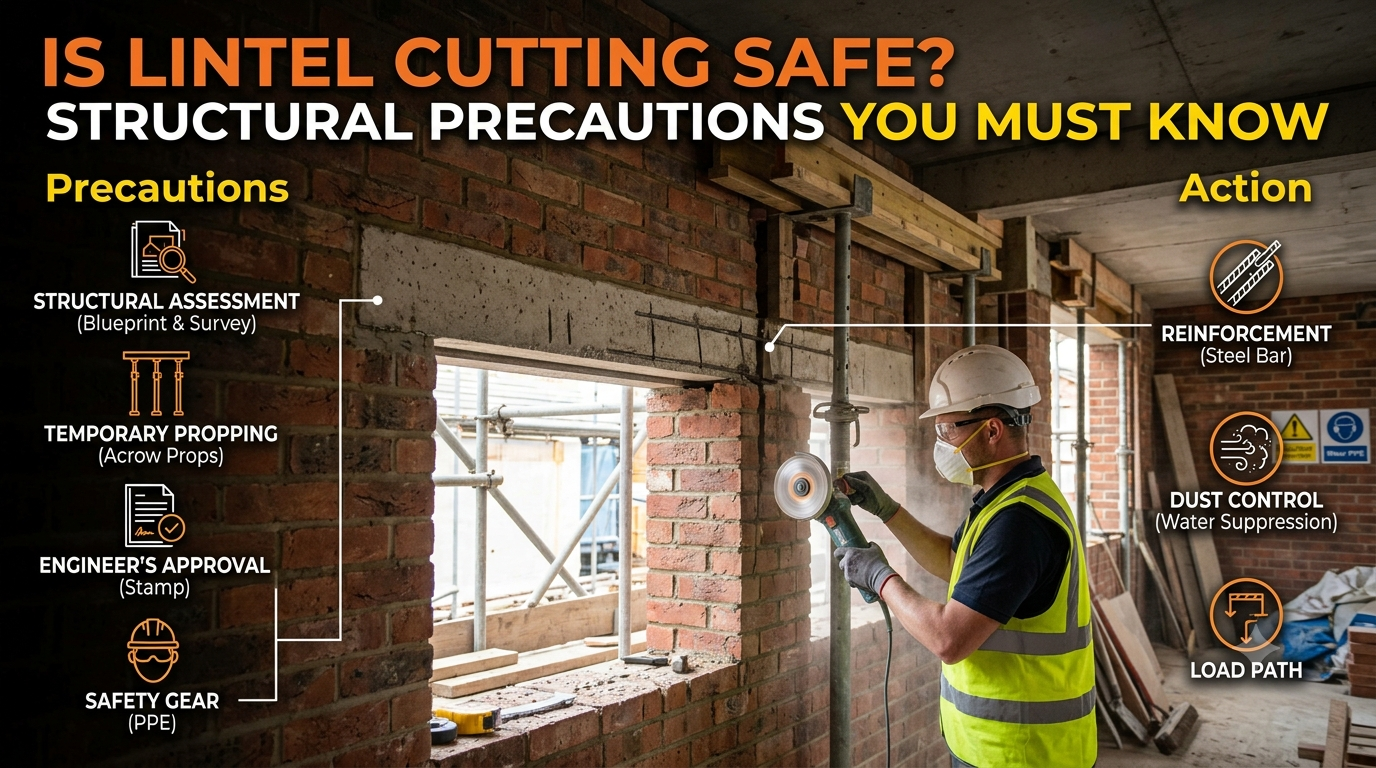
Essential Structural Precautions Before Cutting a Lintel
If a architectural revision or utility route requires cutting or modifying a lintel, adhere strictly to these engineering guidelines:
1. Conduct a Structural Inspection
Before cutting, hire a registered structural engineer to inspect the wall. The engineer will assess:
-
Whether the wall is load-bearing or infill AAC/brick masonry.
-
Loads landing on the lintel (slab load, water tank load, column reactions).
-
Existing lintel dimension and concrete grade (M20/M25 as per IS 456).
2. Rebar Location Scanning
Never cut concrete blind. Modern core cutting teams use cover meters / wall scanners to map embedded steel rebar, electrical conduits, and post-tension cables before drilling or sawing.
3. Install Temporary Load-Transfer Support (Propping)
Never cut a lintel without propping the slab and masonry above it.
-
Install adjustable steel Acrow props with wooden wall-head plates on both sides of the wall.
-
In load-bearing structures, install temporary steel needle beams driven through holes made above the lintel line to transfer floor loads directly to the floor below until a new lintel or steel channel is retrofitted.
4. Pre-Determine Alternative Lintels or Framing Steel
If an existing lintel must be completely cut out to increase doorway height:
-
A new, higher lintel (ISMC steel channel or cast-in-situ RCC beam) must be installed BEFORE the lower lintel is completely removed.
-
Steel frame jacketing (using steel angles or box sections anchored with chemical anchors) should be installed around the new opening perimeter.
Why Modern Diamond Core Cutting & Wall Sawing is Essential
Traditional manual demolition (chiseling, hammer drilling) is dangerous for lintel modifications. The industry gold standard in India is Diamond Core Cutting and Track-Guided Wall Sawing.
+------------------------+------------------------------------+-------------------------------------+
| Feature                | Traditional Jackhammering          | Diamond Core Cutting / Wall Sawing  |
+------------------------+------------------------------------+-------------------------------------+
| Vibration Impact       | High (Causes micro-fissures) [1.2.1]| Zero Vibration (Rotary cutting)     |
| Structural Precision   | Crude, jagged, uncontrolled breaks | Pinpoint precision to millimeter    |
| Rebar Handling         | Bends and tears rebar messily      | Slices rebar cleanly without shock  |
| Noise & Dust           | Extreme noise & hazardous dust     | Water-cooled, low noise, zero dust  |
| Surrounding Wall Risk  | High risk of cracking adjacent brick| Leaves structural integrity intact  |
+------------------------+------------------------------------+-------------------------------------+
Core Drilling for MEP Sleeves
When running plumbing lines, HVAC ducting, or fire-fighting pipes through a lintel zone, circular diamond core drilling (25mm to 350mm diameter) creates clean penetrations without compromising the structural integrity of the rest of the beam.
Track-Guided Wall Sawing for Door/Window Enlargements
For full rectangular cutouts in concrete or stone walls, hydraulic or electric track saws with diamond circular blades ride along anchored rails to cut clean, flush lines through RCC walls up to 600 mm thickness without damaging adjacent walls.
Indian Renovation Case Studies
Case Study 1: Living Room Window Conversion in a DDA Flat (New Delhi)
-
Problem: A homeowner in Vasant Kunj, Delhi, wanted to convert a 1.2 m living room window into a floor-to-ceiling balcony glass door in a 1980s load-bearing brick structure.
-
Initial Mistake: The local contractor started chiseling away the bottom portion of the lintel bearing area directly under the brick wall. Within hours, fine hair cracks appeared in the plaster of the bedroom on the floor above.
-
Corrective Solution: The project was halted and handed to structural specialists. Steel Acrow props and needle beams were installed to take the masonry load. The old lintel was replaced by an engineered ISMC 150 steel beam anchored with high-strength chemical grout. The lintel cutout was made precisely using diamond wall sawing without further cracking.
Case Study 2: Commercial Office HVAC Ducting in Bengaluru
-
Problem: A commercial space in Whitefield, Bengaluru, required a 200 mm duct passage through an internal RCC wall near the lintel level.
-
Solution: Rather than breaking the wall with impact tools, Core Cutting India used high-grade diamond core bits to drill a 200 mm clean sleeve through the concrete wall while protecting surrounding rebar structures. The job was completed in under two hours with zero dust disruption to neighboring offices.
Step-by-Step Safe Lintel Cutting Execution Protocol
[1. Site Audit] ──► [2. Rebar Scan] ──► [3. Propping] ──► [4. Diamond Cut] ──► [5. Retrofit/Framing]
-
Step 1: Structural Assessment & Marking
Mark the precise cut boundary. Verify dimensions against architectural and structural drawings.
-
Step 2: Install Acrow Props & Needles
Pre-load props to carry dead and live loads from upper slabs.
-
Step 3: Rebar Scanning
Identify underlying steel layout to prevent accidental cutting of primary structural columns or main beams.
-
Step 4: Diamond Core Cutting / Sawing
Mount the diamond track-saw or core drilling machine. Use water-recirculation slurry suppression systems to contain dust and keep equipment cool.
-
Step 5: Load Transfer & Steel Retrofitting
Install pre-fabricated steel channels (ISMC) or structural angle irons if necessary, then gradually release temporary props once structural curing or anchoring is complete.
Target-Related Searches
If you are researching concrete modifications, core drilling, or structural alterations in India, explore these related terms:
-
Lintel cutting core cutting India
-
RCC wall core cutting cost per inch Delhi NCR
-
Can we cut door lintel beam during renovation
-
Structural precautions for load-bearing wall removal
-
Diamond wall sawing for door opening in RCC frame
-
IS 456 concrete cutting guidelines India
-
Hilti core drilling services near me
-
How to enlarge window opening in brick masonry
-
Cost of RCC floor and lintel cutting in India
-
Chemical anchoring and steel jacketing for lintels
People Also Ask (PAA)
Q1: Can I cut a lintel beam to increase door height?
Answer: Yes, but only with a structural engineering review and temporary propping. If you cut a lintel, you must install a new lintel higher up or install a structural steel frame (ISMC channel) to carry the wall loads above the new opening height.
Q2: What is the minimum bearing required for a lintel in India?
Answer: According to IS 1905 and IS 456, the minimum bearing for a lintel on masonry walls is 150 mm or the depth of the lintel beam, whichever is greater. Cutting into this bearing length weakens the support and causes shear failure.
Q3: Is lintel cutting safe in RCC framed apartment buildings?
Answer: In RCC framed buildings, lintel beams are typically non-load-bearing infill elements supporting only the wall section directly above them. However, cutting them still requires care to avoid cracking surrounding masonry, severing electrical conduits, or damaging main structural columns and beams.
Q4: Why should I avoid jackhammers for lintel modification?
Answer: Jackhammers and chisels transfer high-impact vibrations into the structure. This breaks the bond between steel rebar and concrete, induces micro-fissures in adjacent walls, and causes uncontrolled masonry collapse. Diamond core cutting and track sawing provide smooth, vibration-free cuts without structural shock.
Q5: How much does professional RCC core cutting cost in India?
Answer: Professional diamond core cutting charges generally range from ₹400 to ₹1,500 per hole/meter depending on wall thickness, rebar density, hole diameter, and accessibility. Wall sawing for door/window openings in RCC walls typically costs between ₹3,000 to ₹8,000 per opening including basic propping setup.
Conclusion & Expert Structural Assistance
So, is lintel cutting safe? It is safe only when approached as a precise engineering task rather than a destructive demolition job. By adhering to Indian standard design codes, using temporary propping, and engaging professional precision core cutting teams, you can safely modify your space without compromising your building's structural health.
Need Safe, Vibration-Free Core Cutting or Wall Sawing Services?
Whether you need precision core drilling for MEP pipes, AC sleeves, or full track wall sawing for door and window openings across India, Core Cutting India delivers engineered, vibration-free solutions with state-of-the-art diamond machinery.
-
📩 Email Us for Technical Audits & Quotes: [email protected]
-
🌐 Specialties: Heavy RCC Core Drilling, Diamond Wall Sawing, Floor Sawing, Chemical Anchoring, and Structural Demolition.