
Introduction
In the modern construction and demolition industry, precision and structural modification are critical. Whether creating pathways for utility lines, HVAC installations, or structural openings, core cutting and core drilling are indispensable techniques. Utilizing diamond-embedded core bits and high-powered machinery, these operations can cut through heavily reinforced concrete, brick, and stone with incredible accuracy.
However, the immense power required to cut through dense materials introduces profound occupational hazards. From flying debris and high noise levels to structural collapses and electrical shock, the risks are substantial. To protect workers, maintain project timelines, and comply with occupational health and safety regulations, a rigorous Job Safety Analysis (JSA)—often referred to as a Job Hazard Analysis (JHA)—is essential before any core cutting operation begins.
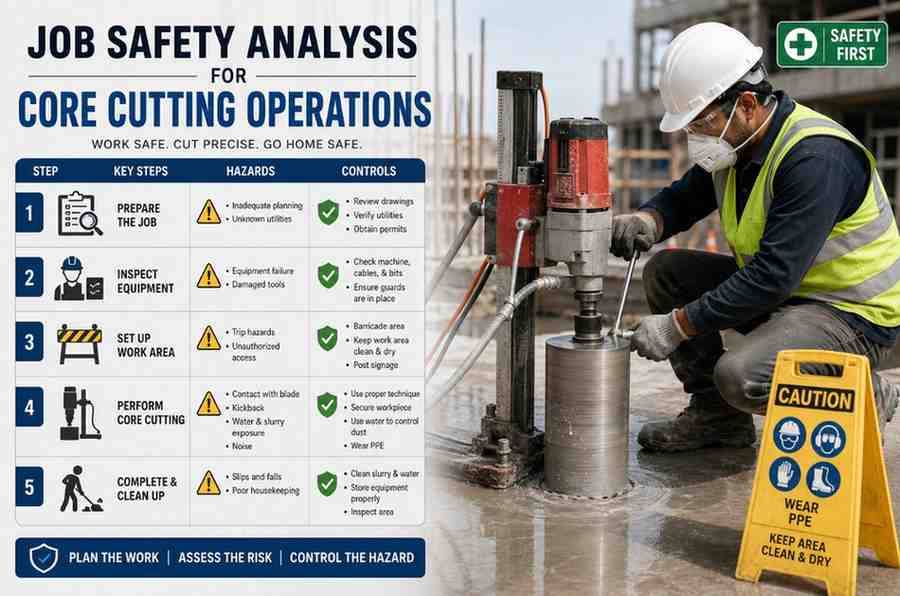
This guide provides an exhaustive 2,000-word JSA framework for core cutting operations. It breaks down the process into sequential steps, identifies potential hazards, and outlines actionable control measures to guarantee a safe working environment.
Understanding Job Safety Analysis (JSA)
A Job Safety Analysis is a risk-management procedure that systematically breaks down a specific job task into its component steps, identifies potential hazards associated with each step, and determines the best ways to eliminate or control those hazards.
For high-risk activities like concrete core cutting, a JSA serves multiple vital functions:
-
Standardization: Establishes a uniform safety baseline for all technicians and equipment operators.
-
Proactive Risk Mitigation: Identifies dangers before work commences, rather than reacting to accidents after they happen.
-
Regulatory Compliance: Aligns operations with standard safety frameworks (such as OSHA or local municipal safety codes).
-
Training and Communication: Acts as a practical training tool during toolbox talks and pre-job briefings.
Pre-Operational Planning and General Safety Prerequisites
Before a single machine is powered on, thorough preliminary steps must be executed. Skipping pre-job planning is the leading cause of catastrophic structural and electrical incidents during core cutting.
1. Utility Locating and Ground Penetrating Radar (GPR)
Cutting blindly into a concrete slab, wall, or ceiling can result in striking live electrical cables, high-pressure gas lines, water pipes, or post-tension cables.
-
Control Measure: Mandatory scanning using Ground Penetrating Radar (GPR) and electromagnetic locators must be performed by certified technicians to map out all embedded utilities and reinforcement bars prior to marking cut locations.
2. Structural Engineering Review
Core cutting involves removing sections of load-bearing material, which can compromise the structural integrity of a building or bridge.
-
Control Measure: Obtain written clearance and structural drawing approvals from a qualified structural engineer before initiating slab or wall cutting. Install temporary shoring or structural props if necessary.
3. Permit-to-Work Systems
Depending on the job site (e.g., operational industrial plants, confined spaces, or high-rise buildings), specific permits are required.
-
Control Measure: Secure Hot Work Permits (if applicable), Confined Space Entry Permits, and Working at Heights Permits.
Step-by-Step Job Safety Analysis for Core Cutting Operations
Below is a detailed breakdown of core cutting operations divided into sequential job steps, accompanied by hazard identifications and control hierarchies.
Step 1: Mobilization, Tool Inspection, and Site Setup
Transporting heavy equipment, inspecting machinery, and establishing a safe work zone.
| Job Step | Potential Hazards | Recommended Control Measures |
| 1.1 Unloading and moving heavy core drilling rigs and power packs. |
• Musculoskeletal injuries / Strains. • Foot crush injuries from dropped equipment. • Slips, trips, and falls on uneven ground. |
• Utilize proper manual handling techniques and team lifts. • Use mechanical aids such as trolleys, cranes, or forklifts. • Wear Steel-Toed Safety Footwear (ANSI/ASTM approved). • Clear walkways of debris and cords. |
| 1.2 Pre-start inspection of electric/hydraulic core drilling machines and diamond bits. |
• Electrical shock from frayed cables. • Flying fragments from damaged or cracked diamond segments. • Mechanical failure during operation. |
• Conduct a thorough pre-operational check. • Tag out and remove any damaged tools from service immediately. • Ensure all electrical cords are double-insulated, free of cuts, and connected to a functioning Ground Fault Circuit Interrupter (GFCI). |
Step 2: Core Rig Anchoring and Surface Preparation
Securing the core drill stand to the floor, wall, or ceiling.
| Job Step | Potential Hazards | Recommended Control Measures |
| 2.1 Drilling anchor holes or utilizing vacuum pads for rig mounting. |
• Silica dust inhalation from dry anchor drilling. • Hand-arm vibration syndrome (HAVS). • Struck-by hazards from loose anchors. |
• Use wet-drilling methods or vacuum dust collection systems for anchor holes. • Wear anti-vibration gloves and rotate operators. • Verify anchor pull-out strength before mounting the rig to prevent kickback or detachment under load. |
| 2.2 Positioning and leveling the core rig. |
• Rig instability causing bit binding or snapping. • Pinch points during adjustments. |
• Ensure the rig column is securely locked and plumb/level. • Keep hands clear of moving adjustment slides and lead screws. |
Step 3: Water and Slurry Management Setup
Providing cooling water to the diamond bit and managing wet slurry.
| Job Step | Potential Hazards | Recommended Control Measures |
| 3.1 Connecting water lines and slurry containment systems. |
• Slips and falls due to wet working surfaces. • Electrical hazards if water contacts power sources. • Environmental contamination from untreated concrete slurry. |
• Route water hoses safely away from high-traffic zones. • Use splash guards, wet-dry vacuums, and slurry rings to capture runoff instantly. • Keep electrical generators and power distribution boxes elevated and waterproofed. • Dispose of concrete slurry in compliance with local environmental regulations. |
Step 4: Executing the Core Cutting / Drilling Operation
Engaging the motor, feeding the diamond core bit into the material, and extracting the concrete core.
| Job Step | Potential Hazards | Recommended Control Measures |
| 4.1 Starting the motor and initiating the cut. |
• Sudden rotational torque (core bit binding/jamming). • High noise exposure (exceeding 85 dB). • Flying debris and water spray. |
• Maintain a firm, two-handed grip on hand-held units or steady control on rig-mounted units. • Start drilling at a low RPM/feed rate until the bit establishes a groove. • Wear certified Hearing Protection (earplugs or earmuffs) and Safety Glasses with side shields / Full Face Shields. • Establish a safety exclusion zone to keep unauthorized personnel away. |
| 4.2 Continuous drilling through reinforced concrete (rebar). |
• Excessive heat generation causing bit segment loss. • Motor burnout or overload. • Increased vibration and kickback when hitting rebar. |
• Maintain continuous, adequate water flow to cool the diamond matrix and flush out debris. • Monitor feed pressure; do not force the bit through steel reinforcement. • Ensure emergency stop functions are tested and operational. |
| 4.3 Core breakout and core extraction. |
• Dropping heavy concrete cylinders. • Sharp edges on extracted concrete cores. • Pinch points when prying out the core. |
• Use core extraction wedges, tongs, or mechanical lifting eyes for heavy cores. • Wear cut-resistant heavy-duty gloves when handling extracted cores. • Secure the core so it does not fall to lower levels (especially during elevated slab cutting). |
Step 5: Post-Operation Clean-Up and Demobilization
Wrapping up operations, inspecting the site, and packing equipment.
| Job Step | Potential Hazards | Recommended Control Measures |
| 5.1 Disconnecting power, water supplies, and disassembling the rig. |
• Electric shock during teardown. • Slips on accumulated wet slurry. • Manual handling strains. |
• Lock out / Tag out (LOTO) power sources before disconnecting lines. • Thoroughly clean up and squeegee the work area. • Properly coil cables and hoses to prevent tripping hazards during load-out. |
| 5.2 Waste disposal and site handover. | • Leaving behind sharp hazards, core plugs, or uncontained slurry. |
• Inspect the work zone to ensure all debris, core slugs, and slurry are cleared. • Hand over the site safely to the general contractor or client. |
Comprehensive Personal Protective Equipment (PPE) Matrix
Because core cutting combines high kinetic energy, water, dust, and heavy loads, standard construction PPE must be enhanced for this specific trade.
| PPE Item | Specification / Standard | Purpose |
| Safety Helmet | ANSI Z89.1 / CE EN 397 | Protects against falling objects, core bits, or overhead hazards. |
| Eye & Face Protection | ANSI Z87.1 / EN 166 | Shields eyes from high-velocity concrete chips, slurry splashes, and water spray. Full face shields recommended during active drilling. |
| Hearing Protection | NRR 25+ / SNR 30+ | Mitigates noise-induced hearing loss from high-RPM diamond motors and hydraulic packs. |
| Respiratory Protection | N95 / P100 / Half-mask respirator | Guards against crystalline silica dust inhalation during anchor drilling or dry cleanup phases. |
| High-Visibility Vest | ANSI Class 2 or 3 | Ensures operators are visible to heavy machinery operators on active job sites. |
| Gloves | Cut-resistant (ANSI Level A4+) & Anti-vibration | Protects hands from sharp edges of concrete cores, sheet metal, and mitigates hand-arm vibration syndrome. |
| Safety Footwear | Steel-toed, waterproof, slip-resistant | Prevents crush injuries from dropped equipment and slips on wet surfaces. |
Hazard Mitigation Deep-Dive: Crystalline Silica Dust
One of the most insidious hazards in core cutting is respirable crystalline silica. When concrete, brick, or mortar is cut, pulverized silica dust is released into the air. Inhaling these microscopic particles can lead to silicosis, lung cancer, and chronic obstructive pulmonary disease (COPD).
Best Practices for Dust Control:
-
Wet Methods (Primary Control): Always use a continuous pressurized water feed directed straight to the cutting face. Water suppresses dust at the point of generation.
-
Local Exhaust Ventilation (LEV): If wet cutting is prohibited (e.g., near sensitive electrical equipment), shroud the cutting area with a vacuum attachment connected to a HEPA-filtered dust extractor.
-
Air Monitoring: Conduct periodic air sampling on large projects to verify that silica levels remain well below occupational exposure limits.
-
Respiratory Fit Testing: Ensure all operators are medically cleared, fit-tested, and trained in wearing appropriate respirators.
Emergency Response and Preparedness
Even with the strictest safety protocols in place, unexpected emergencies can occur. Every core cutting team must be prepared for the following scenarios:
-
Electrical Shock / Electrocution: Immediately shut down the main power supply or use an insulated non-conductive object to separate the victim from the circuit. Do not touch the victim with bare hands if they are still in contact with live current. Administer CPR and call emergency medical services (EMS) immediately.
-
Structural Collapse / Slab Drop: In the event of unexpected structural movement or support failure, immediately evacuate all personnel from the danger zone, secure the area, and notify the site safety manager and structural engineer.
-
Major Laceration or Crush Injury: Apply direct pressure to bleeding wounds using clean dressings. For crush injuries, do not move the limb if a fracture is suspected unless immediate danger is present. Keep the emergency first-aid kit and eye-wash station easily accessible on-site.
Conclusion
Core cutting is an essential pillar of modern construction, but it carries inherent risks that cannot be ignored. Implementing a comprehensive Job Safety Analysis (JSA) transforms safety from a theoretical concept into an active, everyday practice. By systematically evaluating every phase—from utility locating and rig anchoring to wet slurry control and core extraction—operations can proceed smoothly without compromising human life or structural integrity.
For professional, safe, and certified core cutting solutions tailored to the highest industry standards, reach out to trusted experts at [email protected]. Prioritize safety on every project, protect your workforce, and build a culture of zero accidents.