
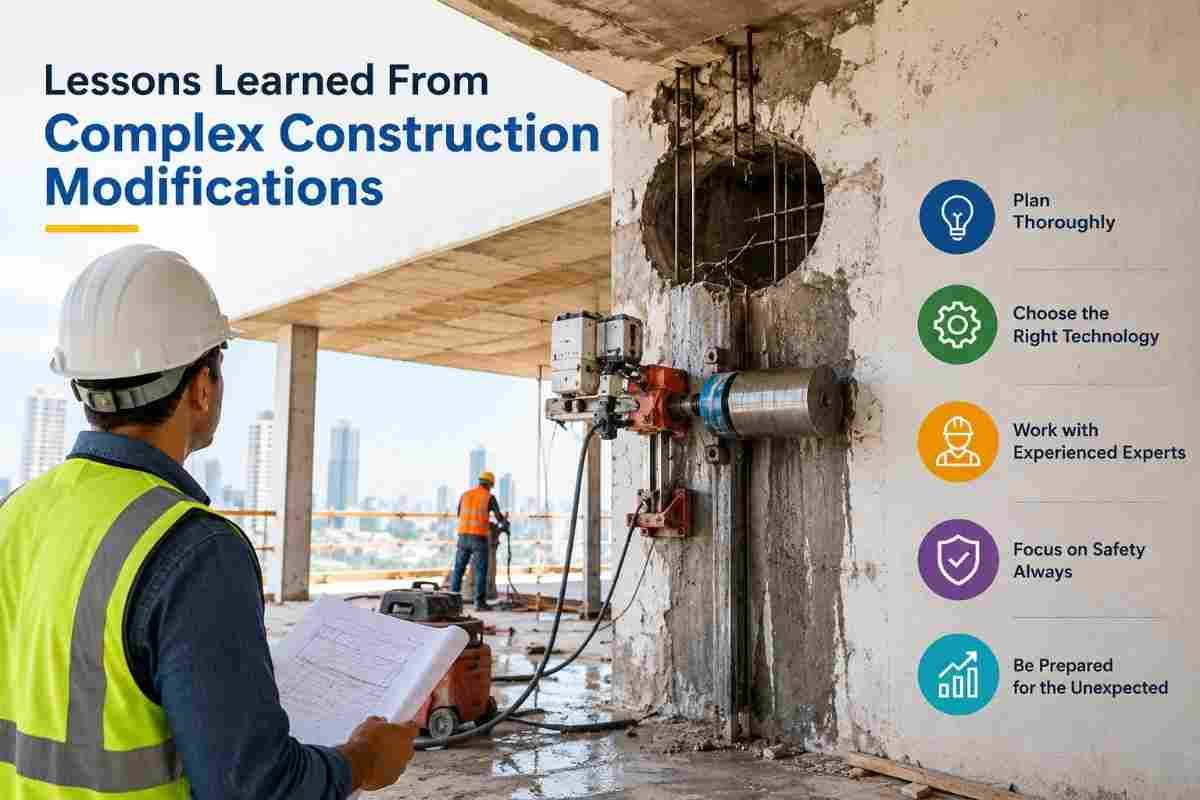
Modern urban development relies heavily on vertical expansion, adaptive reuse, and architectural modernization. However, transforming an existing structure—whether retrofitting a century-old commercial facility in Mumbai or reconfiguring a multi-story IT park in Bengaluru—rarely unfolds without engineering hurdles. Complex construction modifications test the limits of modern building science, material behavior, and specialized execution techniques.
When structural engineers, architects, and demolition specialists step onto a retrofitting job site, they encounter a dynamic environment where blueprints meet unpredictable field realities. Hidden reinforcement patterns, aging concrete matrices, shifting loads, and stringent structural tolerances demand absolute precision. At Core Cutting India, our extensive field experience across diverse metropolitan and industrial landscapes has demonstrated that successful modifications require far more than heavy machinery; they demand rigorous planning, multidisciplinary collaboration, and adherence to proven engineering lessons.
This comprehensive guide explores the core lessons learned from executing complex structural modifications, detailing the critical engineering methodologies, hazard mitigations, and technical execution strategies required to transform existing concrete structures safely and efficiently.
1. The Foundation of Precision: Comprehensive Pre-Modification Assessment
One of the most valuable lessons learned in structural retrofitting is that inspection and non-destructive testing (NDT) can never be rushed. Entering a concrete modification project without a complete understanding of the existing structural layout is an invitation to costly delays, structural instability, or catastrophic failure.
Structural Mapping and Non-Destructive Testing (NDT)
Older structures often lack comprehensive, as-built documentation. Changes made during past renovations frequently go unrecorded. Before a single diamond core bit touches a slab or wall, engineers must perform rigorous NDT evaluations:
-
Ground Penetrating Radar (GPR): Essential for locating embedded steel reinforcement bars (rebars), post-tension cables, electrical conduits, and PVC or metal piping. Cutting through an active post-tension cable can release immense stored energy, resulting in severe structural damage and severe personal injury.
-
Ultrasonic Pulse Velocity (UPV): Used to assess concrete homogeneity, detect internal voids, honeycombing, or micro-cracks resulting from aging or seismic stress.
-
Rebound Hammer Testing: Provides a quick estimation of surface compressive strength across various structural elements.
Load Path Analysis
Every modification alters the original load path of a building. Removing a load-bearing wall, cutting an expansive utility opening in a suspended slab, or introducing a new elevator shaft redistributes dead and live loads to adjacent columns, beams, and foundations. Comprehensive structural analysis models must simulate these redistribution vectors before physical work commences. Temporary shoring and propping plans must be engineered to bear these redirected loads safely throughout the modification phase.
2. Advanced Cutting Methodologies: Replacing Percussion with Precision
Traditional demolition methods—such as pneumatic breakers, sledgehammers, and heavy jackhammers—generate severe vibration, acoustic trauma, uncontrolled dust, and micro-fracturing in the surrounding concrete matrix. One of the greatest technological shifts in complex construction modifications is the widespread adoption of vibration-free diamond cutting technologies.
Diamond Core Drilling for Utility Penetrations
Mechanical, electrical, plumbing (MEP), and HVAC retrofitting frequently demands hundreds of precise penetrations through thick concrete walls and elevated slabs.
-
Core Cutting Efficiency: Utilizing industrial diamond core drill bits mounted on stable anchor rigs allows technicians to create clean, circular openings ranging from 25 mm to over 500 mm in diameter without damaging adjacent structural integrity.
-
Wet Cutting and Slurry Management: Water-cooled diamond drilling suppresses airborne silica dust (protecting worker health and complying with environmental regulations) and prevents thermal degradation of the diamond segments. Effective vacuum slurry management systems prevent messy runoff and maintain clean job sites.
Wall Sawing and Track-Mounted Precision
When creating new doorways, elevator shafts, or expansive window cutouts in reinforced concrete walls, track-mounted wall saws deliver unmatched dimensional accuracy.
-
Flush Cutting Capabilities: Hydraulic or high-frequency electric wall saws can cut flush against adjacent floors and ceilings, eliminating the need for tedious manual patching and corner over-cuts.
-
Control of Thermal and Mechanical Stress: High-frequency cutting heads offer variable speed control, allowing operators to adjust cutting parameters dynamically based on aggregate hardness and rebar density.
Diamond Wire Sawing for Massive Structural Members
For ultra-thick bridge piers, massive industrial foundations, heavy retaining walls, or large concrete blocks that exceed the cutting depth of standard wall saws, diamond wire sawing is the definitive solution.
-
Infinite Depth Capacity: A multi-beaded diamond wire loop is tensioned and driven at high speeds through the concrete mass, guided by a system of pulleys. It can slice effortlessly through heavily reinforced mass concrete of virtually unlimited thickness.
-
Controlled Sectional Removal: Diamond wire sawing allows engineers to segment massive structures into manageable blocks that can be safely hoisted away by cranes without compromising the surrounding structural envelope.
3. Controlling Structural Risks: Shoring, Propping, and Temporary Load Transfer
When executing complex modifications, structural stability is a moving target. The period during which structural elements are being cut, removed, or replaced represents the highest-risk phase of any project.
[Original Load Path] ➔ [Pre-Modification GPR & NDT Scanning] ➔ [Temporary Shoring & Propping]
                        ➔ [Precision Diamond Cutting] ➔ [Structural Retrofitting / Steel Jacketing]
                        ➔ [Load Transfer Verification] ➔ [Final Handover]
Engineering Temporary Support Systems
Temporary shoring is not merely a matter of placing a few steel jacks under a slab; it is a specialized sub-structure engineered to support dead loads, construction live loads, and dynamic equipment weight.
-
Load Calculation Accuracy: Shoring frames must be designed with adequate safety factors, accounting for eccentric loads and potential impact forces during block removal.
-
Foundation Bearing Capacity: Temporary props transferred down to lower floors or ground levels must not overload underlying slabs that were not designed to act as primary shoring foundations. Load distribution timber sole plates or secondary structural steel spreader beams are often mandatory.
Phased Demolition and Sequential Modification
Complex projects must never be modified all at once. Phasing breaking and cutting activities ensures that alternative load paths remain intact throughout the transformation.
-
Top-Down vs. Bottom-Up Strategies: Depending on whether columns or roofs are being modified, sequences must be meticulously planned. For example, when strengthening basement columns while upper floors remain occupied, jacking frames must unload the column incrementally before encasement or replacement work begins.
4. Structural Retrofitting and Rehabilitation Techniques
Cutting concrete is often only the first half of a complex modification project. Once openings are created or damaged sections are removed, structural rehabilitation restores or enhances the load-carrying capacity of the building.
Structural Steel Jacketing and Framing
Introducing new steel beams, channels, and columns is a standard method for reinforcing cut openings.
-
Moment Connections: Steel collars and header beams installed around large slab or wall cutouts must be tightly bolted, welded, and epoxied to transfer shear and bending moments effectively back into the primary concrete skeleton.
-
Non-Shrink Grouting: The microscopic gap between newly installed steel plates and existing concrete must be filled entirely with high-strength, non-shrink structural epoxy grout to ensure seamless load transfer without slip.
Carbon Fiber Reinforced Polymer (CFRP) Strengthening
For modern retrofitting where additional dead weight must be minimized, CFRP composites offer an exceptional strength-to-weight ratio.
-
Flexural and Shear Upgrading: Epoxy-bonded carbon fiber sheets or strips applied to the tension faces of beams and slabs increase load capacity without encroaching on architectural headroom.
-
Ductility Improvement: CFRP wraps around concrete columns significantly enhance confinement, improving seismic resilience and ductility.
5. Environmental, Safety, and Compliance Lessons on Site
Complex construction modifications bring unique occupational health and safety (OH&S) challenges. Adhering to stringent safety protocols safeguards workers, surrounding occupants, and structural assets.
Silica Dust Control and Respiratory Protection
Concrete cutting generates fine crystalline silica dust, inhalation of which causes silicosis and other severe respiratory conditions.
-
Mandatory Wet Cutting: Continuous water feeds at the cutting interface capture the majority of airborne particles at the source.
-
HEPA Extraction and PPE: Dry cutting (where permitted) requires industrial shrouds connected to HEPA filter vacuum systems. Workers must wear certified N95 or P100 respirators, eye protection, and hearing protection against high-frequency saw noise.
Noise and Vibration Mitigation
Urban modifications often take place within occupied buildings, hospitals, residential complexes, or commercial hubs.
-
Acoustic Enclosures: Utilizing electric saws instead of noisy combustion engines and erecting temporary acoustic barriers minimizes disruption to surrounding environments.
-
Vibration Monitoring: Seismic and vibration monitoring sensors placed on adjacent structural columns ensure that peak particle velocity (PPV) remains within safe thresholds, preventing cosmetic cracking or structural fatigue in neighboring structures.
6. Case Study Insights: Practical Applications across India
At Core Cutting India, our journey across diverse infrastructural landscapes has provided invaluable, real-world lessons in overcoming complex modification challenges.
Commercial Retrofitting in High-Density Metros
In bustling commercial centers like Delhi, Mumbai, and Bengaluru, space is at an absolute premium. Projects frequently involve carving out new staircase wells, elevator shafts, and HVAC risers within fully tenanted office towers.
-
The Challenge: Working during strict off-hours (night shifts) to eliminate business interruption, while operating heavy diamond wire saws in confined basement levels with limited ventilation.
-
The Lesson Learned: Strict acoustic scheduling, wireless slurry extraction, and meticulous logistical staging are just as critical to project success as the engineering cuts themselves.
Industrial Plant Modifications and Equipment Foundations
Industrial facilities frequently require cutting massive reinforced concrete machinery bases, heavy foundation blocks, and thick containment walls to install new manufacturing lines.
-
The Challenge: Extreme rebar density (often up to 32 mm rebars at tight spacings) combined with high-strength vibrated concrete.
-
The Lesson Learned: Standard diamond blades wear out rapidly under heavy reinforcement. Utilizing specialized high-cobalt diamond segments and variable-speed hydraulic wall saws ensures continuous cutting progress without stalling or segment shearing.
Summary Checklist for Complex Construction Modifications
To ensure successful execution on your next structural modification project, keep this professional engineering checklist in mind:
-
Perform Comprehensive NDT: Always execute GPR scanning and structural mapping before cutting.
-
Design Robust Temporary Shoring: Never underestimate load redistribution; engineer temporary support with ample safety margins.
-
Choose Vibration-Free Diamond Tools: Replace destructive percussion tools with diamond core drilling, wall sawing, and wire sawing.
-
Implement Strict Dust & Slurry Control: Prioritize wet cutting and HEPA extraction to protect worker health and site cleanliness.
-
Partner with Experienced Specialists: Collaborate with certified structural modification experts who possess the right equipment, technical expertise, and safety record.
Conclusion: Partnering with Core Cutting India for Precision Engineering
Complex construction modifications are high-stakes undertakings where there is no room for error. From initial structural scanning and non-destructive testing to precision diamond core cutting, wall sawing, and heavy structural retrofitting, every phase demands uncompromising technical rigor, modern machinery, and experienced execution.
When planning your next structural alteration, commercial renovation, or industrial infrastructure upgrade, trust the specialists who understand the intricate mechanics of concrete.
To explore our complete suite of professional services, review technical specifications, or request a site assessment, visit Core Cutting India today—your trusted partner in precision concrete cutting and structural modification solutions across India.