
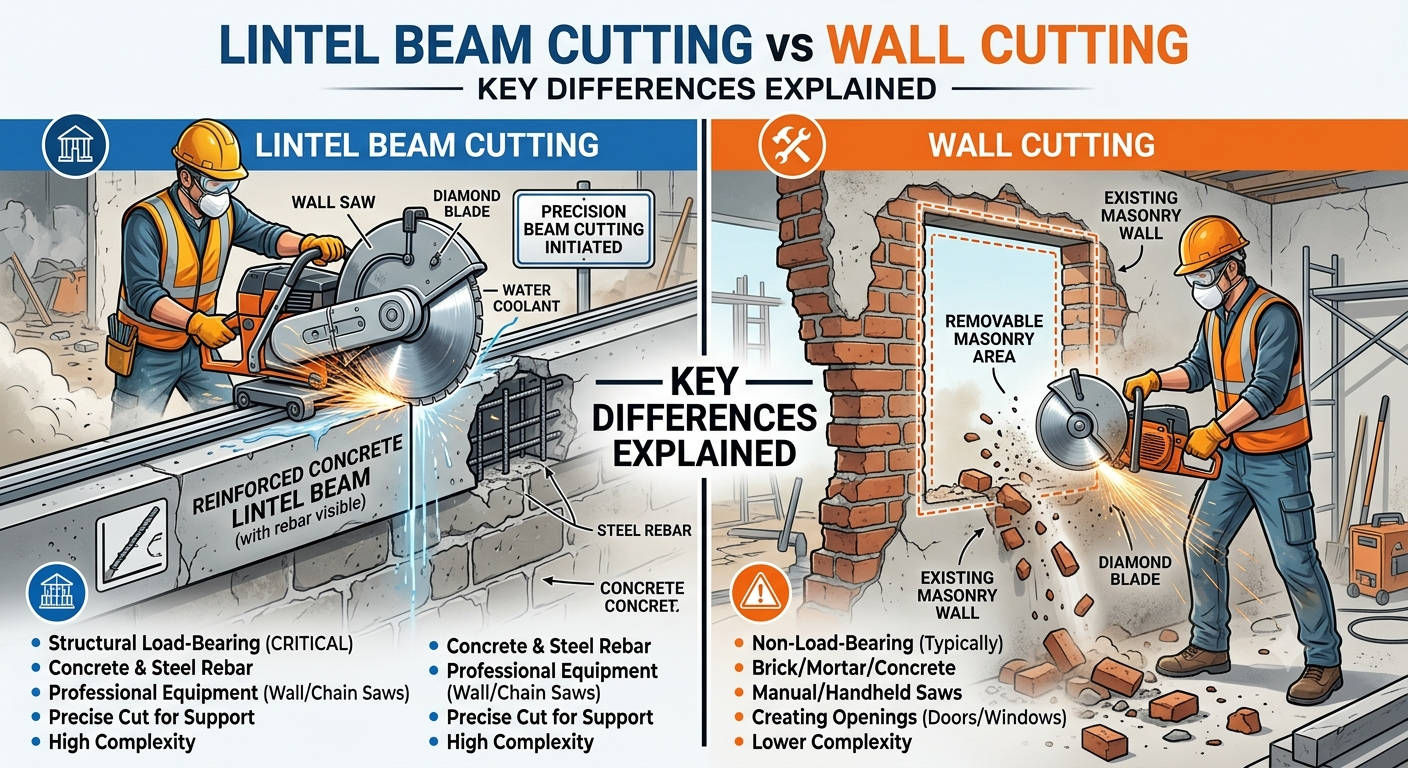
When retrofitting an Indian residential independent house, apartment unit, or commercial facility, modifying wall layouts and door/window dimensions is common. Homeowners in metropolitan centers like Mumbai, Bengaluru, Delhi NCR, and Hyderabad frequently plan renovations involving door height expansions, MEP (Mechanical, Electrical, Plumbing) pipe routing, split AC copper tubing penetrations, or kitchen layout modifications.
However, there is a fundamental structural distinction between wall cutting and lintel beam cutting. Treating reinforced concrete lintels like standard brick masonry can lead to structural failure, diagonal masonry cracking, or roof slab deflection.
This comprehensive technical guide breaks down the core differences, structural mechanics, equipment requirements, safety precautions, and costs associated with lintel beam cutting versus wall cutting under Indian construction practices.
1. Understanding the Fundamental Concepts
To understand why these cutting procedures require drastically different structural precautions, let's establish what each element does inside a building frame.
       +------------------------------------+
       |          Overhead RCC Slab          |
       +------------------------------------+
       |                                    |
       |       Upper Masonry Wall           |
       |                                    |
       +------------------------------------+
       |======= RCC Lintel Beam ============|  <-- TRANSFERS LOAD TO SIDES
       +--------------+      +--------------+
       |              |      |              |
       | Door / Window| Door |  Brick Wall  |  <-- NON-STRUCTURAL MASONRY
       |   Opening    | Frame|   Section    |      (Standard Wall Cutting)
       |              |      |              |
       +--------------+      +--------------+
What is a Lintel Beam?
A lintel beam is a horizontal structural element installed across door, window, or ventilator openings. Its principal engineering function is to support the dead load of the masonry wall directly above the opening and transfer those vertical loads to the adjacent side walls or columns.
In modern Indian civil construction, lintels are almost universally built with Reinforced Cement Concrete (RCC), cast in-situ with M20 or M25 grade concrete and high-yield strength deformed (HYSD) rebar like TMT Fe-500/550 bars.
What is Wall Cutting?
Wall cutting refers to the selective removal or slotting of vertical non-bearing or load-bearing wall surfaces. These walls are typically constructed using:
-
Standard Red Clay Bricks
-
Fly Ash Bricks
-
AAC (Autoclaved Aerated Concrete) Blocks
-
Concrete Hollow Blocks
Wall cutting is routinely performed to create new openings, shorten existing walls, or chase grooves for concealed electrical conduits and plumbing lines.
2. Core Differences: Lintel Beam Cutting vs. Wall Cutting
| Structural Feature | Lintel Beam Cutting | Wall Cutting (Masonry/Partition) |
| Primary Material | High-density RCC with TMT Rebar | Red Brick, AAC Blocks, Fly Ash |
| Structural Significance | High load-bearing member | Non-structural or distributed load-bearing |
| Failure Risk | Localized structural collapse or slab sagging | Non-structural cosmetic cracking |
| Tool Requirement | Water-cooled Diamond Rim Core Drills & Track Saws | Chasing machines, Angle Grinders, Hand Cutters |
| Structural Sign-off | Mandatory by a certified Structural Engineer | Optional (unless cutting a main load-bearing wall) |
| Dust & Noise Level | Low dust (Wet Cutting), Moderate Noise | Very high dry dust (unless dustless vacuum saws are used) |
| Typical Cost Range | Higher (Price calculated per inch-diameter / core) | Lower (Calculated per running foot / square foot) |
3. Structural Impact Mechanics & Risk Engineering
Mechanical Load Paths in Indian Construction
Under Indian Standard Codes (IS 456:2000 for Plain and Reinforced Concrete and IS 1905 for Unreinforced Masonry), building loads follow specific transfer paths:
-
In Framed Structures (RCC Columns & Beams): Floor slabs transfer loads to primary beams, which route them down columns to footings. The masonry walls are infill partitions, and the lintel beam solely supports the triangular masonry weight overhead.
-
In Load-Bearing Masonry Structures (Older/Low-rise Independent Houses): The brick walls directly take slab loads. Here, the lintel acts as a critical bridge. Modifying it disrupts the arching action of the brickwork.
       TRIANGULAR LOAD ARCHING ACTION OVER LINTEL
                     ▲
                    / \
                   /   \
                  /     \  <-- Load transfers to side walls
                 /-------\
                /  Brick  \
               /  Masonry  \
              +-------------+
              | Lintel Beam | <-- Cutting here breaks load bridge!
              +-------------+
              |   OPENING   |
Risk Profile of Cutting a Lintel Beam
-
Rebar Severing: Cutting an RCC lintel cuts through the bottom tensile steel reinforcement (TMT bars). Concrete has high compressive strength but poor tensile capacity. Cutting tensile steel drastically reduces the lintel's bending moment capability.
-
Shear Failure at Supports: Cutting near the ends (bearing zone) strips away the stirrups (shear ties). This risks sudden shear failure, causing deep diagonal shear cracks starting from door corners up toward the ceiling.
-
Deflection & Frame Deformation: Once a lintel gives way, the door or window frame below compresses, causing doors to bind, jam, or break.
Risk Profile of Cutting Standard Wall Masonry
Cutting through AAC blocks or fly-ash bricks generally poses fewer structural threats, provided the wall is an infill partition wall.
However, if cutting into a load-bearing brick wall (typically 9-inch or 13.5-inch thick structural walls in older homes), indiscriminate cutting can reduce the overall masonry cross-sectional area, causing vertical stress concentrations.
4. Execution Methodologies & Machinery Used
When modifying concrete or brick surfaces, choosing the correct machinery prevents micro-fracturing across the rest of the structure.
Equipment for Lintel Beam Cutting (Core Cutting & Sawing)
Because RCC lintels contain embedded high-tensile steel rebars, traditional impact tools (like jackhammers or sledgehammers) should never be used. Hammering creates severe vibrations that cause micro-cracking and de-bonding between the steel rebar and surrounding concrete matrix.
Instead, specialized equipment is used:
-
Heavy-Duty Diamond Core Drilling Machines: Hydraulic or electric core drills fitted with diamond-segmented barrel bits. Used to drill clean circular holes (from 1 inch to 14+ inches in diameter) through RCC lintels for AC pipes, drain lines, or electrical conduits without micro-vibrations.
-
Track-Mounted Diamond Wall Saws: Diamond blade track saws anchored directly to the concrete. They deliver clean, straight cuts through reinforced concrete up to 400 mm deep without generating heavy structural shock.
       CORE DRILLING THROUGH RCC LINTEL (No Micro-Vibrations)

          +----------------------------------+
          |         RCC Lintel Beam          |
          |  [Steel TMT Bar]  o  [TMT Bar]   |
          |                  / \             |
          |                 |   |  <----------- Circular Core Cut
          |                  \ /             |  (Smooth Diamond Cut)
          +----------------------------------+
Equipment for Wall Cutting
-
Handheld Wall Cutters / Angle Grinders: Outfitted with diamond blades for quick single-cut chasing in brickwork.
-
Chasers with Integrated Dust Extraction: Specialized groove cutters connected to industrial vacuum extractors, keeping indoor environments dust-free during interior alterations.
5. Real-World Indian Case Studies & Site Scenarios
Case Study 1: Door Height Expansion in a Bengaluru Villa (Lintel Cut)
-
Location: Whitefield, Bengaluru
-
Problem Statement: A homeowner wanted to install modern 8-foot-high floor-to-ceiling wooden doors in place of standard 7-foot doors. This required removing a 10-inch deep RCC lintel beam spanning 4 feet over the doorway.
-
Structural Mistake Avoided: The interior contractor initially planned to hammer out the existing RCC lintel with an electric breaker. A structural inspection revealed that the wall above supported a 6-inch thick RCC floor slab load.
-
Engineering Solution:
-
Steel props (ACROW jacks) were installed on both sides of the opening to support the floor slab above.
-
Wet diamond wall sawing was used to cut the existing RCC lintel cleanly, preventing vibrations from cracking adjacent plasterwork.
-
An ISMB 150 structural steel channel beam was inserted above the new 8-foot line to serve as a replacement header beam before removing the shoring.
-
Case Study 2: Kitchen Layout Modification in a Delhi Apartment (Wall Cut)
-
Location: Dwarka, Delhi NCR
-
Problem Statement: An open-kitchen layout conversion required cutting a 4.5-inch thick AAC block partition wall to create a service counter window.
-
Engineering Solution:
-
Because the wall was non-load-bearing infill, no structural shoring was necessary.
-
Wall chasers equipped with dust extraction units were used to cut the AAC blocks cleanly without disturbing electrical conduits inside adjacent walls.
-
A light precast concrete lintel was added over the new counter opening to support the few courses of AAC blocks above it.
-
6. Indian Building Codes & Safety Standards
When carrying out core cutting, lintel modifications, or wall modifications, civil contractors in India must follow key national construction codes:
-
IS 456:2000 (Code of Practice for Plain and Reinforced Concrete):
-
Regulates modifications to reinforced structural elements. Structural integrity must be evaluated before cutting or core drilling any RCC member.
-
-
IS 1893 (Part 1): Seismic Design Criteria:
-
Unplanned cuts through lintels or structural walls alter a building's lateral stiffness during seismic events.
-
-
National Building Code (NBC 2016) - Fire & Structural Safety:
-
Core cut penetrations through RCC lintels or walls must be sealed using certified fire-stop sealants to maintain fire compartmentation integrity.
-
7. Cost & Timeline Comparison in India
Understanding the pricing model helps avoid project delays and cost overruns during structural alterations.
| Metric | Lintel Beam Cutting | Wall Cutting (Brick/AAC) |
| Pricing Model | Charged per inch-diameter / core bit depth or linear meter | Charged per running foot or square foot of wall removed |
| Average Cost Range (India) | ₹400 – ₹1,200 per core cut (depends on rebar density & core size) | ₹40 – ₹120 per running foot (depends on thickness & material) |
| Time per Opening | 2 to 5 hours (including machine rigging & wet cooling setup) | 30 to 90 minutes |
| Site Cleanup Needs | Slurry management (using wet-vac systems) | Dry dust sweep / vacuum collection |
8. Summary Checklist Before You Cut
Before approving any demolition, slotting, or core drilling work on your property, run through this quick engineering checklist:
-
[ ] Identify the Material: Is it red brick/AAC block, or is it dense RCC with steel reinforcement?
-
[ ] Consult a Structural Specialist: Is the cut section supporting overhead load, or is it an infill partition?
-
[ ] Use the Right Machinery: Use diamond-tipped core drills or track wall saws to protect concrete bond strength. Avoid manual sledgehammers and breakers on structural concrete.
-
[ ] Plan for Shoring: Install temporary steel props before cutting through any load-bearing lintel or structural masonry wall.
-
[ ] Hire Certified Operators: Ensure your concrete cutting contractor uses wet-cutting methods with dust and slurry collection systems.
Need Expert Concrete Cutting & Core Drilling Services?
Whether you need precise diamond core drilling for utility lines, RCC lintel modifications, slab openings, or wall saw cuts, executing the job safely requires specialized equipment and structural expertise.
Get in touch with Core Cutting India for technical site assessments and dustless diamond cutting solutions across India:
-
Email Us: [email protected]
-
Services: Diamond Core Drilling, RCC Beam & Lintel Sawing, Controlled Demolition, Slab Cutting, Rebaring Solutions.
To see how a professional team carries out clean core drilling on reinforced concrete without causing structural vibrations or structural cracks, check out this guide on Beam Core Cutting Demonstration. This video illustrates the machinery setup, wet-cooling method, and precise cutting process used on RCC members.
Target-Related Searches
-
Difference between lintel beam and wall cutting
-
Can we cut a lintel beam during home renovation in India?
-
Diamond saw concrete cutting cost per running foot India
-
Is it safe to cut load-bearing brick masonry wall?
-
RCC lintel core drilling for AC piping and plumbing
-
Structural safety guidelines for beam cutting IS 456
People Also Ask (PAA)
-
Can I cut a lintel beam to increase door height in an Indian house?
-
Answer: Cutting a lintel beam directly reduces its moment of inertia and load-carrying capacity over an opening. It requires structural recalculation, temporary shoring (props), and steel jacket re-framing before making any cuts.
-
-
What is the difference between wall cutting and lintel cutting?
-
Answer: Wall cutting removes non-structural brickwork or partition blocks, while lintel cutting alters reinforced cement concrete (RCC) structural elements designed to transfer overhead loads around wall openings.
-
-
Will wall cutting cause structural cracks in neighboring flats?
-
Answer: Impact methods like breaker hammers send micro-vibrations through the slab, causing hairline cracks in plaster. Dustless diamond rim wall sawing avoids this by cleanly slicing without impact forces.
-
-
Who should I contact for safe diamond core cutting in India?
-
Answer: Always hire certified concrete cutting experts who consult with structural engineers. You can reach out directly via [email protected] for professional structural modification assessments.
-