
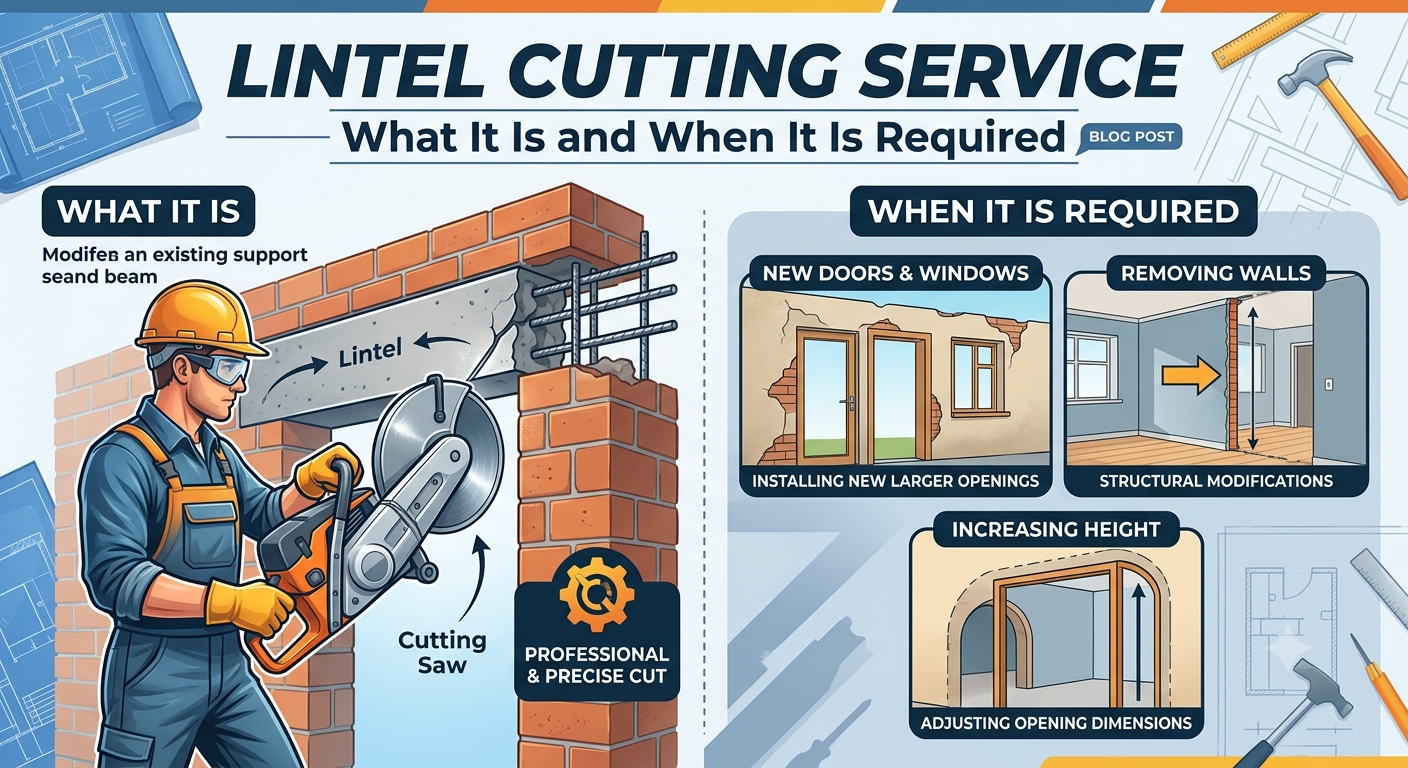
Across India's fast-changing architectural landscape—from high-rise apartments in Mumbai and Bengaluru to independent bungalows in Delhi-NCR and Tier-2 hubs—renovation and spatial re-engineering have become essential. As urban living spaces evolve, property owners frequently modify room layouts, raise door heights, install modular kitchens, and fit modern HVAC equipment.
However, during structural alterations, builders inevitably encounter a critical structural element above doorways, windows, and passage openings: the lintel.
Attempts to trim, reshape, or enlarge an opening through a reinforced lintel using traditional hammers or jackhammers risk severe structural cracking, compromised load paths, and safety hazards. This is where a specialized Lintel Cutting Service becomes indispensable.
Below is an in-depth guide on what lintel cutting entails, why it requires specialized engineering tools, when it is required in Indian structural modifications, and how industry experts like [email protected] carry out precise, vibration-free modifications.
1. What is a Lintel in Indian Construction?
Before exploring the modification process, it is important to understand the structural role of a lintel.
A lintel is a horizontal structural beam placed across openings like doors, windows, corridors, or ventilation spaces in buildings. Its primary duty is to support the heavy weight of the masonry wall, brickwork, or concrete slab resting directly above the opening and safely transfer those downward loads to the adjacent vertical columns or load-bearing walls.
       +---------------------------------------------+
       |            BRICKWORK / RCC SLAB             |
       +---------------------------------------------+
       |============== RCC LINTEL BEAM ==============| <-- Load Bearer
       +--------------------+   +--------------------+
       |   LEFT WALL /      |   |    RIGHT WALL /    |
       |     COLUMN         |   |      COLUMN        |
       |                    | O |                    |
       |                    | P |                    |
       |                    | E |                    |
       |                    | N |                    |
       |                    | I |                    |
       |                    | N |                    |
       |                    | G |                    |
Types of Lintels Found in Indian Structures:
-
Reinforced Cement Concrete (RCC) Lintels: The industry standard across urban and rural India, consisting of concrete embedded with high-yield strength deformed (Fe-500/Fe-550) steel rebar matrices.
-
Precast Concrete Lintels: Factory-cured RCC blocks installed during masonry construction to save project time.
-
Brick Lintels with Steel Bands: Commonly found in older independent homes and heritage properties across South and East India.
-
Steel Angle / Channel Lintels: Used extensively in industrial sheds, commercial showrooms, and steel-frame structures.
2. What is a Professional Lintel Cutting Service?
A Lintel Cutting Service is a specialized civil engineering and structural modification technique that uses diamond-tipped, low-vibration cutting equipment to trim, shave, notch, or completely remove RCC lintels without disturbing the structural integrity of surrounding walls and ceilings.
Unlike old-fashioned demolition methods using sledgehammers or pneumatic breakers, professional lintel cutting relies on controlled diamond cutting technology. This delivers clean, surgically precise edges with zero impact micro-fracturing.
Technical Insight: Standard concrete possesses high compressive strength but relatively low tensile strength. When high-vibration equipment hits an RCC lintel, the concrete-to-steel bond breaks, leading to internal shear stress and propagation cracks throughout the upper masonry. Specialized diamond lintel cutting bypasses this issue entirely through continuous abrasive diamond grinding.
                     TRADITIONAL METHOD vs. DIAMOND CUTTING
┌─────────────────────────────────────────┬─────────────────────────────────────────┐
│ IMPACT / PERCUSSIVE METHOD              │ CONTROLLED DIAMOND CUTTING              │
├─────────────────────────────────────────┼─────────────────────────────────────────┤
│ ❌ Heavy shockwaves & micro-cracks      │ ✔ Zero vibration to structural walls    │
│ ❌ Jagged, unpredictable concrete edges │ ✔ Sharp, surgically clean cut profiles  │
│ ❌ High dust, flying debris & noise     │ ✔ Wet-cutting dust suppression systems  │
│ ❌ Risks loosening rebar bond           │ ✔ Cut steel rebar flushed seamlessly    │
│ ❌ Prolonged structural risk            │ ✔ Fast turnaround times                 │
└─────────────────────────────────────────┴─────────────────────────────────────────┘
3. Key Reasons & Scenarios: When is Lintel Cutting Required?
Indian homes and commercial properties frequently undergo structural redesigns to accommodate contemporary interior trends and equipment upgrades. Here are the primary real-world scenarios requiring a professional lintel cutting service:
                                  WHEN IS LINTEL CUTTING REQUIRED?
                                                  │
         ┌───────────────────┬────────────────────┼───────────────────┬───────────────────┐
         ▼                   ▼                    ▼                   ▼                   ▼
Door / Frame Height   Open-Plan Layouts     HVAC & Commercial    MEP Ductwork & Pipe   Chhajja / Sunshade
     Expansion          & Openings             Ventilation           Passages           Modifications
Scenario A: Expanding Doorway and Frame Heights
In modern interior designs, standard 6.5-foot door frames are frequently upgraded to 7-foot, 8-foot, or floor-to-ceiling flush doors for a more spacious feel. Because the existing RCC lintel restricts vertical clearance, the bottom overhang of the lintel must be trimmed using diamond wall saws.
-
Real Indian Example: A duplex owner in Gurgaon, Haryana, converting standard wooden bedroom doors to custom 8-foot veneered doors needs 6 inches of the RCC lintel trimmed without disturbing the upper false ceiling.
Scenario B: Creating Open-Plan Living Structures (Archways & Passages)
Converting traditional multi-room apartments into open-plan layouts often requires combining adjacent spaces—such as connecting a dining room to a living room or integrating an enclosed balcony (sit-out) into a bedroom. If a load-bearing or non-load-bearing lintel blocks the desired overhead clearance, controlled lintel sectioning is necessary.
Scenario C: Installing Commercial HVAC and Ducting
Commercial spaces, offices, and modern villas often require large rectangular cutouts through lintels or beam sections to run central air conditioning ducts, fire-fighting pipelines, and cable trays.
-
Real Indian Example: A restaurant conversion in Indiranagar, Bengaluru, requires passing 18-inch rectangular industrial HVAC ducts through an internal wall above doorway height. Controlled lintel cropping ensures the duct clears the wall safely.
Scenario D: MEP Pipe Runs (Mechanical, Electrical & Plumbing)
When installing heavy drainage lines, kitchen chimneys, or fresh-air duct systems, MEP contractors often run into low lintel heights. Standard diamond core drills or hand saws cut neat openings through the lintel concrete without cracking the plaster.
Scenario E: Trimming Sunshades (Chhajjas) and Overhanging Elements
In many Indian residential designs, lintels are cast monolithically with exterior sunshades (chhajjas) over windows. During facade modernizations or balcony enclosures, these heavy external RCC overhangs need to be cut away or trimmed back flush with the external wall line.
4. How Lintel Cutting Works: Key Equipment & Technologies Used
Executing a successful lintel modification requires high-precision diamond machinery tailored to structural depth and site constraints.
                                 LINTEL CUTTING EQUIPMENT
                                            │
         ┌──────────────────────────────────┼──────────────────────────────────┐
         ▼                                  ▼                                  ▼
Diamond Wall Sawing                Handheld Hydraulic Saws            Diamond Wire Sawing
(Precision track-mounted cuts)     (For confined indoor spaces)       (For ultra-thick RCC lintels)
1. Diamond Track Wall Sawing
-
Best Used For: Straight, deep cuts along horizontal lintels.
-
How It Works: A steel track is anchored directly to the concrete wall, and an electric or hydraulic sawhead equipped with a circular diamond blade traverses the track. It delivers straight, accurate cuts through high-density concrete and thick steel reinforcement bars.
2. Handheld Ring and Cut-Off Saws
-
Best Used For: Flush cutting, partial notch removals, and tight interior locations where track mounting isn't feasible.
-
How It Works: High-RPM hydraulic or electric saws with diamond blades quickly slice through light RCC sections with low vibration.
3. Diamond Wire Sawing
-
Best Used For: Massive, heavy RCC lintel beams, bridge girders, or structural elements exceeding 400 mm in thickness.
-
How It Works: A flexible steel cable embedded with industrial diamond beads wraps around the concrete section and is driven at high speeds by a hydraulic pulley system to slice through heavy concrete effortlessly.
4. Core Drilling & Stitch Drilling
-
Best Used For: Circular duct penetrations or step-by-step sectioning of lintels in sensitive locations.
-
How It Works: Overlapping circular diamond core bits drill out the section without creating micro-fractures in the surrounding masonry.
5. Structural Precautions Before Cutting an RCC Lintel
Because lintels support overhead loads, cutting into one without structural evaluation can lead to wall sagging or cracking. Professional operators strictly adhere to essential safety protocols before making any cut:
                            PRE-CUTTING CHECKLIST

  [ 1. Structural Assessment ] ──> Identify load paths & slab load transfer
               │
  [ 2. Load Redirection ]     ──> Install heavy-duty steel prop shores (Acrow props)
               │
  [ 3. Rebar Mapping ]        ──> Scan using Profometer / Rebar Locators
               │
  [ 4. Cutting Execution ]    ──> Execute wet diamond saw cut safely
               │
  [ 5. Retrofitting / RSJ ]   ──> Install supplementary steel angles if required
-
Load-Bearing vs. Non-Load-Bearing Evaluation:
Before cutting, a structural engineer evaluates whether the lintel supports a live floor load from above or simply holds up a localized brick wall partition.
-
Temporary Shoring & Support:
If a significant section of a load-bearing lintel is removed, adjustable steel Acrow props and wooden runners are placed under the ceiling slab to carry the load safely during cutting.
-
Rebar Locating & Rebar Scanning:
High-tech concrete scanners detect primary steel rebar, stirrups, and embedded electrical conduits inside the lintel, helping technicians plan cuts safely.
-
Retrofitting & RSJ Installation:
When enlarging an opening horizontally, a new steel beam (Rolled Steel Joist / RSJ) or structural steel angle is inserted directly above the cut zone to restore the wall's load capacity.
6. Step-by-Step Execution of a Lintel Cutting Project
Below is how a professional lintel cutting service executes a job at a residential or commercial site:
7. Major Advantages of Hiring Professional Lintel Cutting Services
Choosing professional diamond cutting over manual chiseling or pneumatic demolition offers clear operational benefits:
| Feature | Professional Lintel Cutting | Traditional Breaking / Chiseling |
| Structural Integrity | Zero vibration; leaves surrounding concrete uncracked | Severe shockwaves cause cracks in brick plaster |
| Precision | Millimeter-accurate, straight, smooth edges | Rough, uneven edges requiring heavy masonry repair |
| Speed & Turnaround | Completed in a few hours | Takes days of noisy, manual labor |
| Dust & Noise Control | Wet cutting suppresses dust completely | Dense dust harms indoors and living spaces |
| Steel Cutting Capability | Slices effortlessly through high-density rebar | Sledgehammers struggle with embedded steel bars |
8. Lintel Cutting Services Across Key Indian Real Estate Markets
Demand for specialized lintel cutting services spans residential, commercial, and industrial projects across India:
🏙️ Metro High-Rise Renovation (Mumbai, Delhi-NCR, Bengaluru)
In high-rise apartments, traditional percussive hammering is strictly banned by Resident Welfare Associations (RWAs) and facility managers due to noise and vibration risks. Controlled wet diamond cutting provides a quiet, low-vibration solution that complies with society guidelines.
🏡 Independent Houses and Kothi Remodeling (Punjab, Kerala, Tamil Nadu)
Homeowners extending floor plans or adding grand entrances rely on lintel trimming to install larger wooden doors or sliding glass panels without compromising structural stability.
🏭 Commercial Warehouses & Factories (Pune, Gujarat, Hyderabad)
Industrial facilities modifying door openings for forklifts or overhead cranes routinely use heavy-duty diamond wire sawing to cut thick RCC lintels safely.
9. Cost Factors in Lintel Cutting Services in India
The overall cost of a professional lintel cutting service depends on several project variables:
-
Concrete Depth & Thickness: Standard 4-inch to 9-inch residential wall lintels cost less than thick 12-inch to 18-inch commercial RCC lintel beams.
-
Steel Reinforcement Density: High rebar counts require specialized diamond blades, which slightly impacts pricing.
-
Height & Site Accessibility: Work on scaffolding at higher elevations or in cramped tight-space interiors requires specialized gear setup.
-
Total Volume of Work: Larger project scopes across multiple doors or floors lower the per-meter cutting rate.
Typical Market Rates: In India, precision RCC wall and lintel cutting services generally range from ₹250 to ₹1,500 per running meter, depending on thickness, location, and complexity.
10. Partner with India's Core Cutting Experts
Modifying concrete structures without proper tools can compromise building stability. Whether you are expanding a doorway, modernizing a floor plan, or retrofitting industrial ventilation, expert diamond cutting ensures a safe, fast, and precise result.
For professional, low-vibration lintel cutting, RCC wall sawing, and diamond core drilling services anywhere in India:
Contact Core Cutting India:
📧 Email: [email protected]
🌐 Website & Support: [email protected]
🛠️ Services Offered: RCC Lintel Cutting, Diamond Core Drilling, Wall Saw Cutting, Slab Cutting & Chemical Rebaring.
Target-Related Searches
-
RCC lintel cutting contractors in India
-
Modern diamond saw lintel cutting price per feet
-
How to modify concrete lintel beam safely
-
Lintel beam cutting for door height expansion
-
Controlled diamond concrete cutting services India
-
Structural safety during lintel beam trimming
-
Lintel modification for ventilation and exhaust ducts
People Also Ask (PAA)
-
Can you cut an RCC lintel beam without damaging the wall structure?
-
Yes, using non-vibrational diamond saw or wire cutting equipment, expert engineering contractors can cut RCC lintels without sending micro-fractures through the surrounding masonry.
-
-
What is the difference between a load-bearing lintel and a non-load-bearing lintel in Indian construction?
-
A load-bearing lintel carries heavy brickwork or slab loads above an opening and transfers them to adjacent walls, requiring temporary steel shoring before cutting. A non-load-bearing lintel only spans small partition openings.
-
-
How much does a professional lintel cutting service cost in India?
-
In India, lintel cutting costs typically range between ₹250 to ₹1,500 per running meter or running foot, depending on concrete thickness, steel rebar density, height above ground, and accessibility.
-
-
Why shouldn't I use a hammer and chisel for RCC lintel removal?
-
Manual percussive pounding sends intense vibrations through reinforced cement concrete (RCC), causing structural cracks, unseating rebar bonds, and risking sudden brick wall collapse.
-