
Construction sites have long been synonymous with noise — the deafening roar of jackhammers, the grinding of saw blades, and the constant vibration that rattles nearby buildings. For decades, this was simply accepted as the cost of progress. But as cities grow denser and construction increasingly takes place next to hospitals, schools, offices, and residential complexes, the tolerance for disruptive noise and vibration has shrunk dramatically. This shift has pushed the concrete cutting industry to innovate, giving rise to a new generation of noise-free and low-vibration techniques that are reshaping how demolition and renovation work gets done.
At Core Cutting India ([email protected]), we've seen this transformation firsthand. What was once a niche request from noise-sensitive clients has become a mainstream expectation. This blog explores the innovations driving noise-free construction, why they matter, and how they're changing the way contractors approach concrete cutting projects across India.
The Problem With Traditional Concrete Cutting
Traditional concrete demolition methods — jackhammering, impact breaking, and explosive blasting — rely on brute force. They shatter concrete through repeated high-impact blows or explosive pressure. While effective, these methods come with serious downsides:
- Excessive noise pollution that can exceed 100–120 decibels, well above safe occupational limits and disruptive to surrounding communities.
- Structural vibration that can weaken adjacent buildings, crack plaster, or damage sensitive equipment in nearby facilities like hospitals or laboratories.
- Dust and debris that pose health hazards to workers and pedestrians.
- Regulatory restrictions in urban areas that limit working hours or ban certain methods altogether near residential zones.
As urban construction projects increasingly overlap with occupied buildings, these limitations have become business-critical problems, not just environmental concerns. Contractors who can't work quietly or without vibration risk losing access to entire categories of projects — hospital renovations, occupied office retrofits, heritage building work, and construction near schools or courts, to name a few.
What Does "Noise-Free" Concrete Cutting Actually Mean?
It's worth clarifying that "noise-free" doesn't mean silent in the literal sense — some sound is unavoidable with any mechanical process. Instead, it refers to techniques engineered to minimize noise, vibration, and dust to levels that are safe, compliant with local regulations, and non-disruptive to nearby occupants. The goal is precision demolition: removing exactly what needs to be removed, with minimal collateral disturbance.
This is achieved through a combination of specialized equipment, controlled cutting methods, and smart planning — all of which we'll explore below.
Key Innovations Driving Noise-Free Construction
1. Diamond Wire Sawing
Diamond wire sawing is one of the most significant advances in modern concrete cutting. Instead of hammering or blasting through concrete, a diamond-coated wire is looped around the structure and driven by a motorized pulley system, slicing through concrete, reinforced steel, and even thick structural elements with a smooth, continuous cutting motion.
Because the wire cuts rather than impacts, diamond wire sawing produces significantly less noise and virtually no vibration. It's precise enough to cut complex shapes and large structural sections — bridge piers, dam walls, foundations — that would be impossible or extremely disruptive to remove with traditional tools. This method has become the go-to solution for large-scale infrastructure projects located near sensitive environments.
2. Wall Saws and Track-Mounted Saws
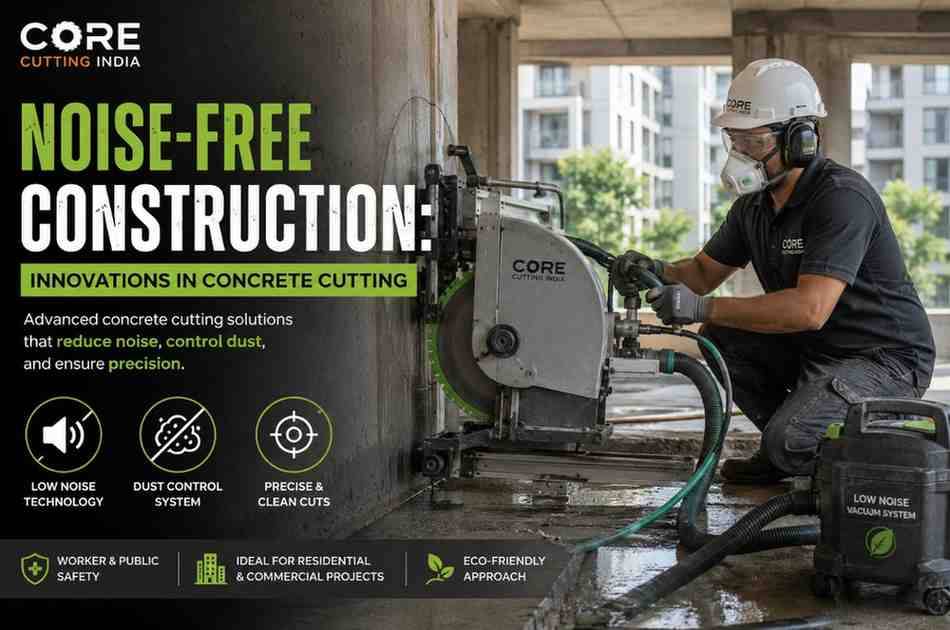
Wall saws use a diamond blade mounted on a track system, allowing for controlled, straight-line cuts through walls, floors, and slabs. Unlike handheld saws, track-mounted systems provide stability and precision, reducing the erratic vibration that occurs with manual cutting. Many modern wall saws are also electrically powered rather than hydraulic or petrol-driven, which further reduces operational noise and eliminates exhaust emissions — an added benefit for indoor or enclosed worksites.
3. Hydraulic Bursting and Splitting
For situations where sawing isn't practical, hydraulic bursting offers a quiet alternative to explosive or percussive demolition. Small holes are drilled into the concrete, and hydraulic splitters or expansive burster heads are inserted. These apply gradual, controlled pressure that fractures the concrete along predictable lines — without the noise spike of a jackhammer or the shockwave of blasting.
This technique is particularly valuable in confined spaces, near occupied structures, or in projects where structural integrity of adjacent sections must be preserved.
4. Diamond Core Drilling
Core drilling uses a hollow, diamond-tipped drill bit to bore precise, clean holes through concrete and masonry — commonly used for plumbing, electrical conduits, HVAC penetrations, and structural testing. Compared to traditional hammer drilling, diamond core drilling is quieter, faster, and generates far less dust and vibration, making it ideal for occupied buildings where disruption must be kept to a minimum.
5. Robotic Demolition Equipment
Remote-controlled robotic demolition machines are increasingly used for selective, high-precision demolition work. These compact, track-mounted machines are fitted with interchangeable attachments — breakers, crushers, or cutting wheels — and can be operated remotely in tight or hazardous spaces. Because they're electrically or hydraulically powered and precisely controlled, they generate far less noise and vibration than manual jackhammering, while also improving worker safety by removing operators from direct contact with unstable structures.
6. Dust and Water Suppression Systems
While not strictly a "noise" innovation, integrated water-fed dust suppression systems are a core part of the noise-free construction philosophy. Modern diamond saws and drills are often designed with built-in water delivery that cools the blade, reduces friction (and therefore noise), and suppresses airborne dust simultaneously. This not only protects worker health but also keeps the surrounding air quality within safe limits — a requirement increasingly enforced by environmental regulations in Indian cities.
7. Vibration Monitoring and Smart Sensors
Modern noise-free construction isn't just about the tools — it's about the data. Vibration monitoring sensors are now commonly placed on adjacent structures during sensitive cutting operations. These devices provide real-time feedback on vibration levels, allowing operators to adjust technique or equipment speed instantly if levels approach a threshold that could risk structural damage. This proactive monitoring has become standard practice for projects near heritage buildings, hospitals, and high-precision industrial facilities.
Why These Innovations Matter
Compliance With Urban Noise Regulations
Most Indian cities enforce noise pollution limits, particularly in residential and silence zones, with stricter rules during night hours. Noise-free cutting technologies allow contractors to work within legal decibel limits without abandoning project timelines, helping avoid fines, stop-work orders, or community complaints.
Minimizing Structural Risk
Vibration from traditional demolition can compromise the structural integrity of adjacent buildings — a serious liability, especially in dense urban environments where structures often share walls or foundations. Precision cutting techniques dramatically reduce this risk, protecting both the client's project and neighboring properties.
Enabling Work in Sensitive Environments
Hospitals, data centers, laboratories, and heritage sites often cannot tolerate the disruption of traditional demolition. Noise-free techniques make it possible to carry out renovation or expansion work in these environments without halting operations or risking sensitive equipment.
Improving Worker Safety and Health
Lower vibration and dust levels directly benefit the health of on-site workers, reducing exposure to hand-arm vibration syndrome, respiratory hazards, and hearing damage — all of which are recognized occupational health risks in traditional demolition work.
Supporting Sustainable Construction Practices
Precision cutting generates less waste, as it removes only the targeted concrete rather than shattering larger sections. Combined with water-based dust suppression and electrically powered equipment, these methods align with the broader industry shift toward environmentally responsible construction.
Applications Across Industries
Noise-free concrete cutting isn't limited to one type of project. Its applications span a wide range of sectors:
- Residential renovations — cutting openings for doors, windows, or utility lines without disturbing residents.
- Commercial retrofits — modifying occupied office buildings without halting business operations.
- Infrastructure projects — bridge repair, road widening, and utility tunneling near live traffic and residential zones.
- Industrial facilities — modifying factory floors or foundations without disrupting ongoing production.
- Heritage and sensitive structures — careful, precise removal of concrete sections without risking damage to historically significant buildings.
- Healthcare facilities — expansion or renovation work carried out with minimal disruption to patient care.
Choosing the Right Concrete Cutting Partner
As demand for noise-free construction grows, not every contractor is equipped to deliver it. Choosing the right partner requires looking beyond basic equipment ownership and evaluating:
- Experience with specialized techniques like diamond wire sawing, hydraulic bursting, and robotic demolition.
- Availability of vibration monitoring and dust suppression systems.
- A track record of working in sensitive environments — hospitals, occupied buildings, or heritage structures.
- Compliance knowledge regarding local noise and environmental regulations.
- Transparent project planning that accounts for surrounding structures and community impact.
Conclusion
The construction industry's relationship with noise is fundamentally changing. What was once viewed as an unavoidable byproduct of demolition and cutting work is now a controllable, manageable variable — thanks to innovations like diamond wire sawing, hydraulic bursting, robotic demolition, and real-time vibration monitoring. These technologies are not just about compliance; they represent a more precise, safer, and more sustainable approach to construction as a whole.
As cities continue to densify and construction moves closer to occupied and sensitive spaces, noise-free techniques will only become more essential. Contractors and clients alike benefit from faster approvals, fewer community complaints, safer job sites, and reduced risk to surrounding structures.
If you're planning a project that demands precision, minimal disruption, and full regulatory compliance, it's worth partnering with a team experienced in these modern methods.
Get in touch with Core Cutting India at [email protected] to discuss how noise-free concrete cutting solutions can support your next project.