
Target-related searches: concrete cutting safety protocols, core cutting permit to work, construction safety management, wall sawing risk assessment, diamond cutting hazard control, safe system of work for concrete coring.
People Also Ask:
-
What is a Permit-to-Work system in construction?
-
Why is a permit required for concrete cutting and coring?
-
What are the major hazards associated with concrete cutting?
-
How does a PTW system prevent utility strikes during core cutting?
Introduction: The Hidden Risks Beneath the Surface
To the untrained eye, concrete cutting and core drilling look like straightforward mechanical tasks—bring in a heavy-duty saw, apply water, cut through the slab, and clear the debris. However, professional structural modification is a high-risk operation. Modern buildings and infrastructure networks are dense webs of embedded steel reinforcement, live electrical conduits, high-pressure plumbing, and post-tension cables.
When high-powered diamond blades interface with reinforced concrete, the margin for error is razor-thin. A single miscalculated cut can trigger a catastrophic utility strike, structural destabilization, or severe operator injury. This is why modern construction and demolition management relies heavily on a Permit-to-Work (PTW) system.
At [email protected], safety is engineered into every project phase. Implementing a rigorous PTW system ensures that every concrete cutting, wall sawing, and core drilling task is thoroughly vetted, planned, and executed under strict supervision.
What is a Permit-to-Work (PTW) System?
A Permit-to-Work (PTW) system is a formal, documented safety procedure used to control high-risk, non-routine, and potentially hazardous operational activities. It acts as a legal and operational safety contract between project management, safety supervisors, and the execution crew.
Rather than relying on informal verbal agreements, a PTW mandates a systematic review of the work environment. It answers critical questions:
-
What exact task is being performed, and where?
-
What structural or environmental hazards exist?
-
What isolation steps or utility shutdowns are required?
-
Who is authorized to execute the work, and who signs off on its completion?
Why Concrete Cutting Requires a Dedicated Permit System
Concrete cutting, coring, and demolition are rarely isolated events; they interact directly with active building systems. A dedicated Cut, Core, and Drill Permit is essential for several reasons:
-
Prevention of Subsurface Utility Strikes: Striking a live electrical cable can cause electrocution or arc-flash explosions, while hitting a water or gas line can shut down an entire facility or cause structural flooding.
-
Structural Integrity Protection: Unplanned or unauthorized penetrations can sever post-tension cables or load-bearing rebar grids, compromising the structural stability of floors and walls.
-
Health Hazard Mitigation: Concrete cutting generates large quantities of crystalline silica dust and high noise levels, both of which pose long-term occupational health risks.
-
Accountability and Legal Compliance: A signed PTW serves as documented evidence that the contractor has fulfilled rigorous risk assessment obligations.
Core Components of a Concrete Cutting PTW Process
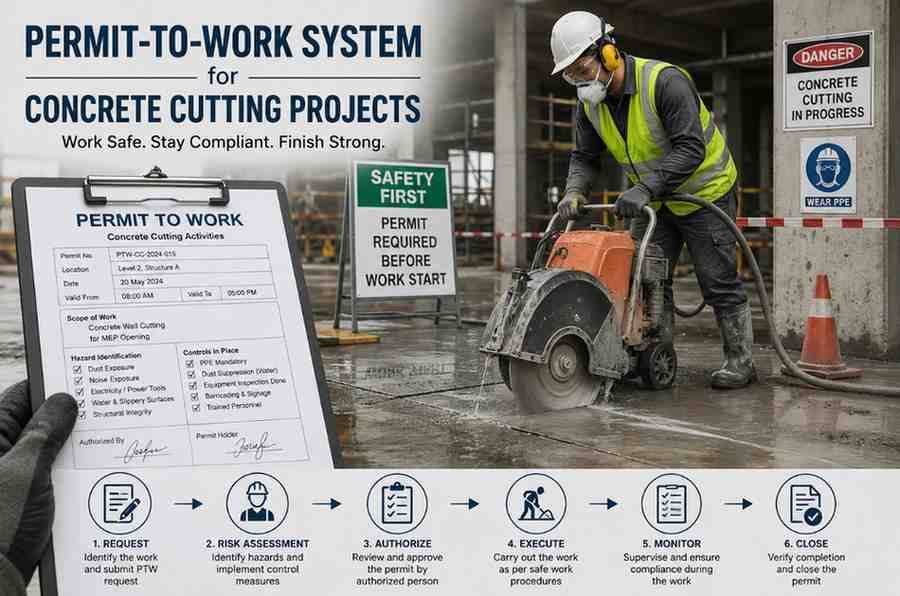
A successful Permit-to-Work framework for concrete operations follows a structured lifecycle from conception to closeout.
[1. Hazard Identification & Scanning] ➔ [2. Risk Assessment & Controls] ➔ [3. Authorization & Sign-off] ➔ [4. Active Execution & Monitoring] ➔ [5. Permit Closeout]
1. Pre-Work Planning and Subsurface Scanning
Before any permit is drafted, the work area must undergo rigorous non-destructive evaluation. Ground Penetrating Radar (GPR) and electromagnetic scanning must be deployed to map out reinforcement patterns, conduits, and voids. The exact cutting path must be clearly chalked or painted on the surface.
2. Hazard Identification and Risk Assessment (HIRA)
The PTW document must explicitly list all anticipated hazards associated with the specific cutting technique (e.g., slab sawing, wire sawing, core drilling, or wall sawing). Key hazards include:
-
Blade Kickback and Jamming: Occurs when a blade pinches due to shifting concrete or off-line cuts.
-
Silica Dust Exposure: Inhalation of fine crystalline silica particles leading to respiratory illnesses.
-
Electrical Hazards: Damaged power cords or wet conditions creating shock risks.
-
Slips, Trips, and Falls: Slurry accumulation and uneven walking surfaces.
3. Isolation and Safety Precautions
Before the permit is authorized, necessary energy isolations must be verified. This includes implementing Lockout/Tagout (LOTO) protocols for electrical circuits running through the cutting zone, routing water suppression lines for dust control, and erecting physical barricades and warning signage around the perimeter.
4. Roles, Competencies, and Sign-Off
A PTW clearly assigns responsibilities among key stakeholders:
-
Permit Originator: Submits the request detailing the scope of work.
-
Safety Officer / Area Authority: Reviews site conditions, verifies scan results, and grants authorization.
-
Permit Holder (Contractor Lead): Accepts full responsibility for executing the work in compliance with safety rules.
-
Operators: Must possess certified training records and valid competency licenses for handling heavy cutting machinery.
Key Safety Measures Integrated within the Permit
When a concrete cutting permit is active, specific engineering and administrative controls must be maintained at all times:
-
Wet Cutting Techniques: Continuous water feed must be supplied to the diamond blade interface to suppress airborne dust and cool the cutting edge. When wet cutting is restricted, industrial HEPA-filtered vacuum attachments must be utilized.
-
Personal Protective Equipment (PPE): Operators and nearby crew members must wear mandatory PPE, including high-impact safety glasses, hearing protection (earplugs/muffs), steel-toe safety footwear, heavy-duty gloves, and approved respiratory protection (N95 or half-mask respirators).
-
Equipment Pre-Inspection: Saws, power packs, hydraulic lines, and diamond segments must be thoroughly inspected for structural cracks, loose guards, or mechanical wear prior to engine ignition.
Permit Closeout and Post-Work Review
A Permit-to-Work does not remain open indefinitely; it is typically valid for a single work shift (e.g., 8 to 12 hours). Once the cutting or coring task is completed:
-
Site Restoration: The work area must be cleared of heavy slurry, sharp concrete debris, and tripping hazards.
-
Structural Inspection: A competent engineer must inspect the cut edges and surrounding structural components to ensure integrity remains uncompromised.
-
Formal Sign-Off: The Permit Holder and Safety Coordinator sign the closure section of the document, formally handing the area back to project operations.
Conclusion
Concrete cutting is a powerful discipline that shapes modern infrastructure, but it leaves zero room for complacency. Implementing a structured Permit-to-Work system bridges the gap between ambitious engineering goals and absolute workplace safety. By formalizing hazard identification, mandating subsurface scans, and ensuring clear communication channels, projects can avoid costly damages and tragic injuries.
For professional, safe, and precision-engineered structural modifications, partnering with certified experts is essential. Reach out to [email protected] to learn more about our uncompromising safety standards and specialized concrete cutting solutions tailored to your next project.