
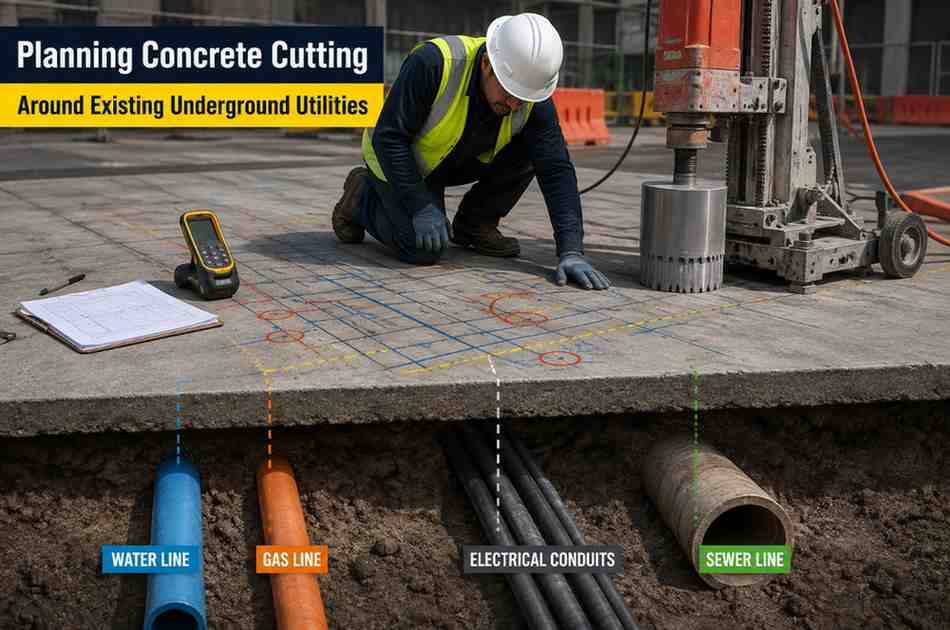
Concrete cutting is one of the most routine yet high-risk activities on any construction, renovation, or infrastructure project. Whether it's core drilling for plumbing, wall sawing for a new doorway, or slab sawing to access a foundation, every cut carries a hidden danger that isn't visible from the surface: underground utilities. Electrical cables, gas lines, water pipes, telecom ducts, and sewage networks often run just inches below concrete slabs, and striking even one of them can lead to devastating consequences — from costly repairs and project delays to serious injuries or fatalities.
At Core Cutting India, we've seen firsthand how a few hours of careful planning can prevent weeks of downtime, six-figure damage claims, and safety incidents. This guide walks you through everything you need to know about planning concrete cutting operations around existing underground utilities — the risks involved, the technology used to detect utilities, the step-by-step planning process, and best practices followed by professional concrete cutting contractors.
Why Underground Utility Awareness Matters
Before any concrete cutting or core drilling begins, understanding what lies beneath the surface is non-negotiable. Underground utilities are rarely installed in a single, predictable layer. Over decades of urban development, cables, pipes, and ducts get added, rerouted, and repaired, often without accurate as-built documentation. This creates a tangled, unpredictable underground environment.
The consequences of cutting into an unidentified utility line can be severe:
- Electrical hazards: Striking a live electrical cable can cause arc flashes, fires, or electrocution of workers on site.
- Gas leaks: Damaging a gas line can trigger explosions or toxic exposure, requiring immediate evacuation and emergency response.
- Water and sewage damage: Ruptured water or sewage lines can flood work areas, damage adjacent structures, and create long-term contamination issues.
- Telecom disruption: Cutting fiber-optic or telecom cables can disrupt communication networks for entire neighborhoods or business districts, leading to liability claims.
- Project delays and cost overruns: Emergency repairs, regulatory investigations, and rescheduling can add weeks to a project timeline and significantly inflate costs.
Given these risks, planning concrete cutting around underground utilities isn't just a best practice — in most jurisdictions, it's a legal and regulatory requirement.
Step 1: Gather Existing Utility Records and Site Drawings
The planning process should always begin with documentation. Before any equipment reaches the site, project teams should collect:
- As-built drawings from the original construction or previous renovation projects.
- Utility maps from local municipal bodies, electricity boards, water departments, and telecom providers.
- Previous survey reports if the site has undergone earlier utility detection work.
- Building information modeling (BIM) data, if available, for newer structures.
While these records provide a useful starting point, they should never be treated as fully accurate. Utility lines are frequently added or modified without updating official records, so this step is only the first layer of due diligence — not the final word.
Step 2: Conduct a Professional Underground Utility Survey
Once existing records are reviewed, the next step is an on-site utility survey using specialized detection equipment. Professional concrete cutting companies typically rely on a combination of the following technologies:
Ground Penetrating Radar (GPR)
GPR is one of the most widely used non-destructive tools for detecting subsurface utilities. It sends high-frequency radio waves into the ground and measures the reflected signals to identify the location, depth, and in many cases the material composition of buried objects. GPR is particularly effective at detecting non-metallic pipes (like PVC water lines) that traditional electromagnetic locators might miss.
Electromagnetic Locators (EM Locators)
EM locators detect metallic pipes and cables by sensing electromagnetic fields, either naturally emitted by live electrical cables or induced through a transmitter connected to the utility. This method is fast and reliable for metallic conduits but less effective for non-conductive materials.
Utility Mapping and 3D Scanning
For larger or more complex sites, some contractors use 3D utility mapping software that overlays GPR and EM survey data onto digital site plans. This creates a visual reference map that engineers and cutting crews can consult throughout the project, reducing the chances of human error during execution.
Physical Verification (Potholing)
Even with advanced scanning technology, physical verification through small-scale excavation — commonly called potholing or hand-digging — remains the gold standard for confirming the exact location and depth of a utility before cutting begins. This step is especially critical in high-risk zones, such as areas near known gas or electrical lines.
Step 3: Mark and Document Utility Locations
Once utilities are located, they must be clearly marked on the surface using an internationally recognized color-coding system:
- Red – Electrical power lines, cables, conduits
- Yellow – Gas, oil, steam, or other flammable materials
- Orange – Communication, telecom, and fiber-optic lines
- Blue – Potable water lines
- Green – Sewers and drainage lines
- Purple – Reclaimed water, irrigation lines
- Pink – Temporary survey markings
Alongside physical marking, all findings should be documented in a utility location report, complete with measurements, depth readings, and photographs. This report becomes an essential reference for the cutting crew and a legal safeguard for the contractor.
Step 4: Choose the Right Concrete Cutting Method
Different cutting techniques carry different levels of risk when working near utilities. Selecting the appropriate method is a critical part of the planning process.
Core Drilling
Core drilling is used for creating precise circular holes, often for pipes, cables, or HVAC penetrations. Because it's highly localized, it's generally considered lower-risk when utility locations are confirmed. However, depth control is essential — drilling too deep can still strike buried lines.
Wall Sawing
Wall sawing is used to cut openings in vertical concrete or masonry structures, such as doorways or windows. Since it typically operates at a fixed depth, it requires accurate confirmation of embedded electrical conduits or plumbing within walls.
Slab Sawing (Flat Sawing)
Slab sawing is used for horizontal surfaces like floors, driveways, and pavements. This method is particularly high-risk near utilities because slabs often conceal a dense network of pipes and cables. Adjustable-depth saws with pre-set cutting limits are commonly used to reduce risk.
Diamond Wire Sawing
For thicker structural elements or precision demolition work, diamond wire sawing offers a controlled, vibration-free cutting method. It's often chosen for sensitive environments where minimizing structural disturbance is critical.
Step 5: Coordinate with Utility Companies and Local Authorities
In most regions, contractors are legally required to notify utility companies before excavation or cutting work near their infrastructure. This coordination process, sometimes called a "utility locate request," ensures that:
- Utility providers can send representatives to verify or mark their lines.
- Live services can be temporarily de-energized or isolated if necessary.
- Emergency contact protocols are established in case of accidental utility strikes.
Skipping this step not only increases safety risk but can also result in regulatory penalties and voided insurance coverage in the event of damage.
Step 6: Develop a Site-Specific Safety Plan
Every concrete cutting project near underground utilities should include a documented safety plan covering:
- Exclusion zones around confirmed utility locations.
- Emergency response procedures for gas leaks, electrical exposure, or water line ruptures.
- Personal protective equipment (PPE) requirements for the crew.
- Communication protocols between the cutting team, site supervisor, and utility company representatives.
- Depth restrictions clearly communicated to equipment operators.
This plan should be reviewed with the entire crew before work begins and updated if any new utility information comes to light during the project.
Step 7: Execute with Continuous Monitoring
Even after thorough planning, cutting operations should proceed with caution and real-time oversight. Best practices during execution include:
- Cutting slowly and incrementally near marked utility zones, rather than making a single continuous pass.
- Using spotters or supervisors to monitor progress against the utility map.
- Stopping immediately if unexpected resistance, unusual sounds, or unmarked lines are encountered.
- Re-verifying utility locations if there's any delay between the survey and the actual cutting date, since underground conditions can change due to nearby excavation or maintenance work.
The Value of Hiring a Professional Concrete Cutting Contractor
While some aspects of utility planning can be handled by general contractors, the complexity and risk involved make it worthwhile to engage a specialized concrete cutting company. Experienced contractors bring:
- Access to advanced detection equipment like GPR and EM locators.
- Trained technicians who understand utility color codes, depth thresholds, and regional regulations.
- Liability insurance and safety certifications that protect both the client and the project.
- A track record of successfully navigating complex sites, from residential renovations to large-scale infrastructure projects.
At Core Cutting India, our teams combine on-site utility surveys with precision cutting techniques — including core drilling, wall sawing, and slab sawing — to deliver safe, efficient, and code-compliant results. We work closely with clients, engineers, and utility providers at every stage to eliminate guesswork and reduce project risk.
Conclusion
Planning concrete cutting around existing underground utilities is a process that demands diligence, the right technology, and experienced professionals. From reviewing historical records and conducting GPR surveys to marking utility lines and choosing the appropriate cutting method, every step plays a role in preventing accidents, protecting infrastructure, and keeping projects on schedule.
Cutting corners on utility planning is never worth the risk. Whether you're managing a small renovation or a large commercial development, investing in proper utility detection and a qualified concrete cutting partner pays off many times over in safety, cost savings, and peace of mind.
If you're planning a concrete cutting project and want to ensure it's done safely around underground utilities, reach out to our team at Core Cutting India. Contact us at [email protected] for a site assessment and expert consultation.
Frequently Asked Questions (People Also Ask)
1. How do you identify underground utilities before cutting concrete? Underground utilities are identified using a combination of historical records, Ground Penetrating Radar (GPR), electromagnetic locators, and physical verification through potholing. This multi-layered approach ensures that both metallic and non-metallic utility lines are accurately located before any cutting begins.
2. What happens if you cut through an underground utility line? Cutting through a utility line can cause electrocution, gas leaks, flooding, or communication outages, depending on the utility type. It also leads to costly emergency repairs, project delays, regulatory scrutiny, and potential legal liability for the contractor and site owner.
3. What is the safest depth to core drill near utilities? There is no universal safe depth, as utility burial depths vary by region and utility type. This is why depth verification through GPR scanning and physical potholing is essential before setting drilling limits, rather than relying on standard assumptions.
4. Do concrete cutting companies use ground penetrating radar (GPR)? Yes, professional concrete cutting companies increasingly use GPR to detect both metallic and non-metallic utilities before cutting. It's considered one of the most reliable non-destructive detection methods available today.
5. Who is responsible for locating utilities before construction work? Responsibility typically falls on the contractor or project owner to request utility locates from relevant utility companies and local authorities. However, hiring a specialized concrete cutting contractor ensures an additional layer of on-site verification and safety oversight.
Core Cutting India | Professional Concrete Cutting, Core Drilling, Wall Sawing & Slab Sawing Services 📧 [email protected]