
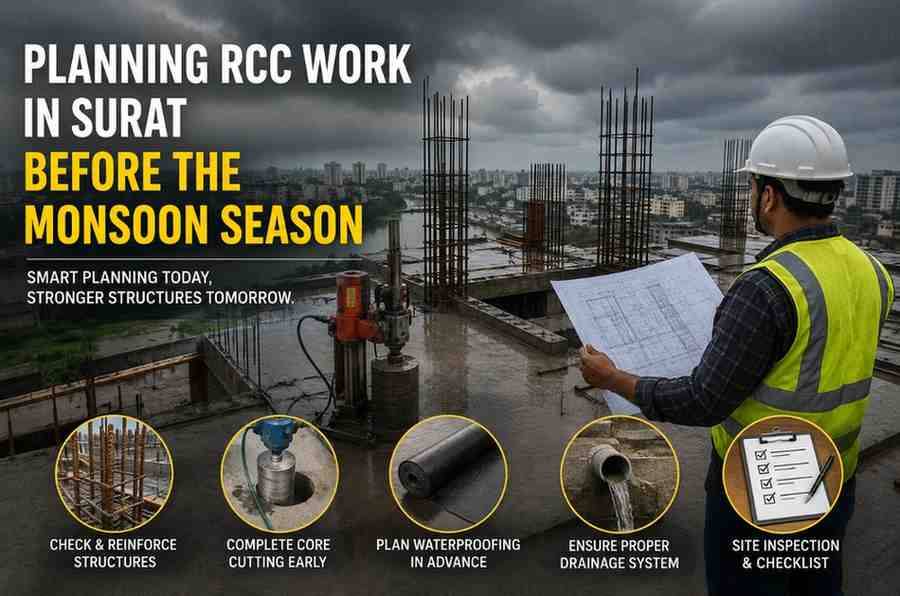
Surat's skyline is growing faster than almost any other city in Gujarat. New residential towers, commercial complexes, and industrial units are coming up across Adajan, Vesu, Piplod, Pal, and the outskirts of the Diamond City every month. But with this rapid pace of construction comes a challenge every builder, contractor, and property owner in Surat knows all too well: the monsoon. Once the rains arrive, usually by mid-June, RCC (Reinforced Cement Concrete) work becomes significantly harder to manage, and mistakes made in a rush can cost lakhs in rework, delays, and structural compromise.
At Core Cutting India (corecuttingindia.com), we work with builders and civil contractors across Surat on core cutting, concrete drilling, and structural modification projects, and we consistently see the same pattern each year: sites that plan their RCC work around the monsoon calendar finish stronger, safer, and on schedule, while sites that don't end up facing cracked slabs, weak curing, water seepage, and costly delays. This guide walks you through everything you need to know about planning RCC work in Surat before the monsoon season hits.
Understanding Surat's Monsoon Pattern
Surat, like the rest of coastal Gujarat, experiences a distinct monsoon season driven by the southwest monsoon winds. Rainfall typically begins in the second week of June and continues through September, with July and August usually bringing the heaviest and most consistent downpours. Because Surat sits close to the Arabian Sea and along the Tapi River, the city also faces high humidity levels even before the rains officially begin, and the risk of waterlogging in low-lying areas is a real concern for any ongoing construction site.
This means the effective "dry construction window" for major RCC activities in Surat generally runs from October through May, with April and May being warm but still workable, provided proper curing measures are in place. Anything scheduled for June onward needs to be planned with monsoon contingencies built in from day one.
Why Pre-Monsoon Planning Matters for RCC Work
RCC work is uniquely sensitive to weather conditions because the strength and durability of concrete depend heavily on the quality of the pour and, just as importantly, the curing process that follows. Unplanned exposure to rain during or shortly after casting can lead to a number of serious problems:
- Surface washout: Rainwater falling on freshly poured concrete can wash away the cement paste from the top layer, weakening the surface and leaving it porous.
- Improper curing: While concrete does need moisture to cure, uncontrolled rainwater is not the same as controlled curing. It can dilute the water-cement ratio unevenly and cause honeycombing.
- Formwork and reinforcement issues: Waterlogged sites make it difficult to place shuttering accurately, and standing water can corrode exposed reinforcement bars before the pour even happens.
- Site accessibility problems: Muddy access roads and waterlogged plots slow down material transport, mixer movement, and labour mobility, pushing timelines further behind.
- Increased safety risks: Wet scaffolding, slippery surfaces, and exposed electrical connections on site become significant hazards once the rains set in.
Given these risks, the smartest approach is not to fight the monsoon once it arrives, but to plan the RCC work schedule so that the most weather-sensitive stages are completed well before the first showers.
Key RCC Activities to Prioritise Before Monsoon
1. Foundation and Footing Work
Foundation work involves excavation, and an open excavation pit is one of the most vulnerable parts of any site during heavy rain. Waterlogging in foundation trenches can destabilise soil, delay curing of footings, and even lead to soil erosion around the base. Ideally, foundation and plinth-level RCC work should be fully completed, cured, and backfilled at least a month before the monsoon begins.
2. Columns and Beams
Vertical RCC elements like columns can generally tolerate light monsoon work better than horizontal elements, but formwork removal and curing schedules still need to be carefully timed. It's advisable to complete ground-floor and lower-floor column and beam casting before the peak rains, since scaffolding stability becomes a concern on wet, muddy ground.
3. Slab Casting
Slab casting is by far the most weather-sensitive RCC activity. A freshly poured slab needs a flat, controlled curing environment for at least 7 to 14 days. Rain hitting an uncured or partially cured slab can cause surface defects, uneven strength gain, and in some cases, cracking once the structure is loaded. Wherever possible, major slab pours should be scheduled to finish at least two to three weeks before the expected monsoon onset in Surat.
4. Waterproofing Works
This is where many Surat builders lose valuable time. Waterproofing for terraces, sunken slabs in bathrooms and kitchens, basements, and retaining walls should be completed and tested before the rains, not after leaks appear. A terrace that isn't waterproofed before June is almost guaranteed to show seepage issues by August.
Site Preparation and Drainage Planning
Good pre-monsoon planning goes beyond the concrete itself. The construction site as a whole needs to be prepared to handle heavy rainfall without disrupting ongoing work or damaging materials. Key steps include:
- Temporary drainage channels: Dig or reinforce drainage paths around the site perimeter to direct rainwater away from excavation pits, material storage areas, and access roads.
- Covered storage for cement and steel: Cement bags should be stored on raised wooden pallets inside a covered, ventilated area to prevent moisture absorption. Reinforcement steel should be stacked off the ground and covered with tarpaulins to prevent rust.
- Protective sheeting for freshly cast elements: Keep polythene sheets or tarpaulins ready to cover any RCC element that may still be curing when unexpected pre-monsoon showers arrive.
- Sump pits and pumps: For basement or below-ground-level work, having a functional dewatering system in place before the rains is essential to keep excavation areas workable.
Material Quality Control Before the Rains
Humidity levels rise in Surat well before the rains actually start, and this affects material behaviour. Cement that absorbs moisture during storage loses strength and can develop lumps, reducing its effectiveness in the mix. Aggregates stored in open yards can retain excess water, throwing off the water-cement ratio during batching if not accounted for. Builders should tighten their material inspection protocols starting from April and May, checking moisture content in sand and aggregates more frequently as humidity climbs.
Curing Challenges During the Monsoon
One misconception is that monsoon rain naturally helps with curing, since curing does require water. In reality, uncontrolled rain is not a substitute for proper curing methods. Effective curing depends on a steady, moderate supply of moisture over a sustained period, not intermittent heavy downpours followed by dry spells. Contractors planning RCC work close to the monsoon transition should have covered curing setups, curing compounds, or wet hessian cloth arrangements ready so that curing quality doesn't depend entirely on unpredictable weather.
Core Cutting and Structural Modification Before Monsoon
For projects that involve core cutting, concrete drilling, or structural modifications, such as creating openings for plumbing, electrical conduits, HVAC ducts, or structural alterations, timing these activities before the monsoon offers real advantages. Dry concrete surfaces allow for cleaner, more precise cutting, and dust and debris management is considerably easier when the site isn't dealing with mud and standing water. At Core Cutting India, we recommend scheduling core cutting and drilling work for RCC slabs, walls, and beams during the dry months so that any resulting openings can be properly sealed and waterproofed well ahead of the rains.
Safety Precautions for Monsoon-Adjacent Construction
Even with the best planning, some RCC-related work may need to continue into the early monsoon weeks. In such cases, safety planning becomes critical:
- Ensure all electrical panels and temporary wiring are elevated and weatherproofed.
- Provide non-slip footing and handrails on scaffolding and staircases.
- Schedule work around forecast rain windows rather than fixed hours.
- Keep a stock of quick-drying additives and rapid-set materials on hand for emergency situations.
- Brief the labour force on monsoon-specific safety protocols before the season begins.
Building a Pre-Monsoon RCC Checklist
A simple but effective way to stay on track is to build a checklist for the weeks leading up to June:
- Complete and cure all foundation and footing work
- Finish ground and lower-floor column and beam casting
- Schedule and complete major slab pours with adequate curing time
- Apply and test waterproofing on terraces, basements, and wet areas
- Set up temporary site drainage and dewatering systems
- Move cement and steel to covered, raised storage
- Complete core cutting, drilling, and structural openings
- Seal and waterproof any new openings or penetrations
- Stock curing compounds and protective sheeting
- Review site safety measures for wet-weather conditions
Choosing the Right Partner for Pre-Monsoon RCC Work
Timing is everything when it comes to RCC work in a city like Surat, where the monsoon can arrive with little warning and disrupt even the most carefully laid schedules. Working with an experienced structural and concrete services partner makes it easier to sequence foundation work, slab casting, waterproofing, and any required core cutting or drilling activities so that the most weather-sensitive stages are safely behind you before the first heavy showers.
Core Cutting India has supported builders, contractors, and property owners across Surat with precision core cutting, concrete drilling, and structural modification services, always with an eye on the local climate calendar. Planning these activities into the dry season not only protects the quality of the concrete work but also helps avoid the cost overruns that come with monsoon-related delays and rework.
Conclusion
Monsoon season in Surat is not something construction schedules can work around once the rains have already started; it has to be planned for well in advance. From foundation casting and slab pours to waterproofing and core cutting, the RCC activities most sensitive to weather need to be completed and properly cured before June arrives. Site preparation, material storage, and safety protocols should all be reviewed and strengthened in the months leading up to the season. Builders and contractors who treat the pre-monsoon period as a planning deadline, rather than a soft target, consistently see stronger structures, fewer defects, and smoother project timelines.
If you're planning RCC work, core cutting, or structural modifications in Surat ahead of this monsoon season, reach out to Core Cutting India at [email protected] or visit corecuttingindia.com to schedule a site assessment before the rains set in.