
Introduction
In the modern landscape of construction and home renovation, precision is paramount. Whether you are installing a new plumbing system, setting up an HVAC duct, or routing electrical conduits, creating clean, structural openings in reinforced cement concrete (RCC) is a critical task. This is where core cutting becomes indispensable.
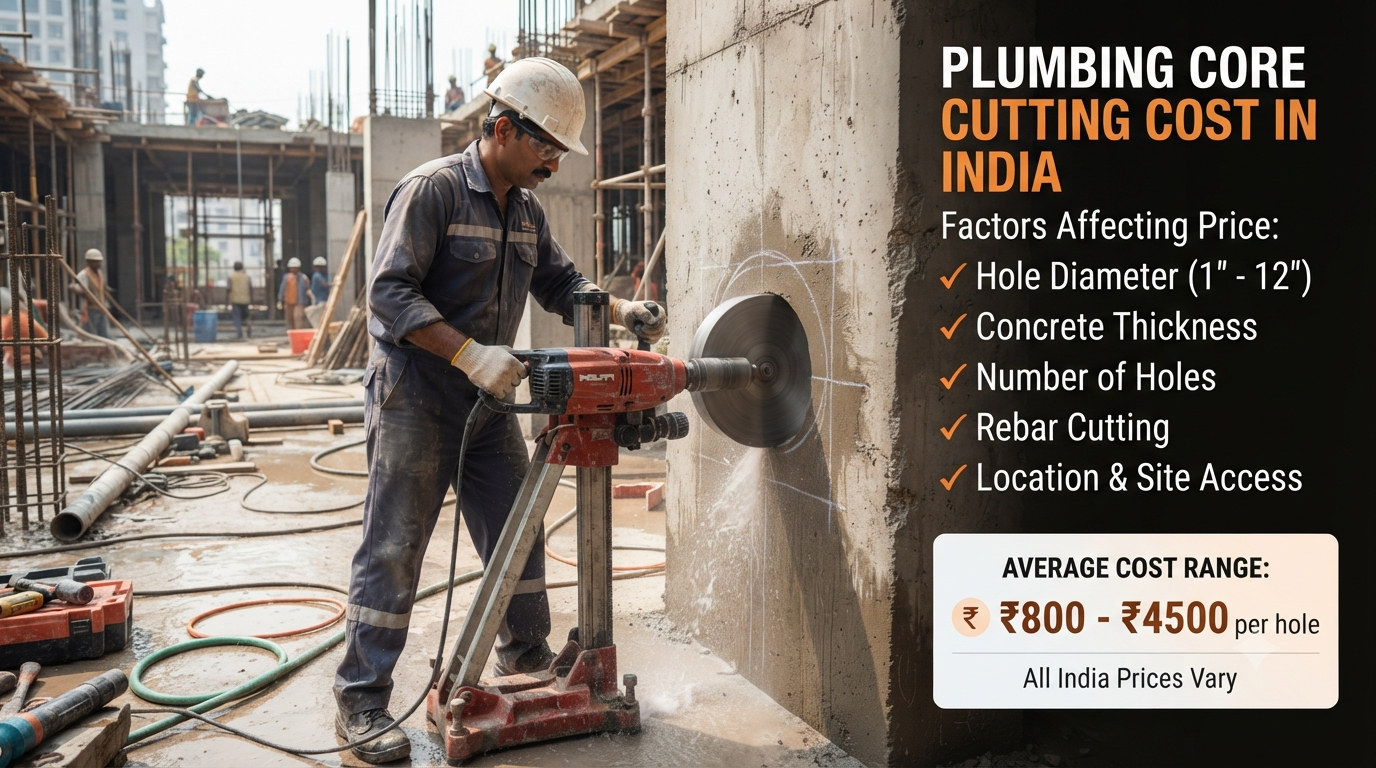
If you are a homeowner, contractor, or builder, you might be wondering: What is the cost of plumbing core cutting in India? Because construction projects vary in complexity, there is no single "one-size-fits-all" price. In this guide, we break down the pricing models, the factors that influence these costs, and how you can get the best value for your project by contacting [email protected].
What is Core Cutting for Plumbing?
Core cutting is a specialized technique that uses a diamond-tipped drill bit to create precise, circular holes in hardened concrete, masonry, or stone [1.3.1, 1.4.1]. Unlike traditional demolition methods—which can cause cracks, structural vibrations, and unnecessary damage—core cutting ensures a clean finish that preserves the integrity of the surrounding structure [1.1.1, 1.4.1].
For plumbing, this process is essential for:
-
Passing water supply lines and drain pipes through RCC slabs and beams.
-
Installing ventilation pipes for chimneys and exhaust fans.
-
Creating pathways for multi-utility conduits.
Understanding Pricing Models in India
The cost of core cutting in India typically follows a few common pricing structures [1.2.2]. It is important to clarify these with your contractor before work begins to avoid hidden charges [1.1.2].
1. Pricing Per Inch (Diameter or Depth)
Many professional contractors charge based on the diameter of the hole or the depth of the concrete being drilled [1.4.1].
-
Rate: This can range from ₹70 to ₹400 per inch, depending on the hardness of the concrete and the specific requirements [1.2.2, 1.5.1].
2. Pricing Per Hole (Piece)
For standard residential work—like AC pipe installation or simple plumbing outlets—contractors often charge a fixed rate per hole [1.4.2].
-
Average Cost: Small holes (up to 3 inches) might cost between ₹500 and ₹1,500, while larger, more complex holes can go up to ₹5,000+ per piece [1.2.2, 1.4.2].
3. Hourly Rates
Some industrial or large-scale projects may be billed on an hourly basis, especially if the site conditions are difficult or if multiple holes are required in high-altitude areas [1.2.2].
-
Average Cost: Hourly rates often range from ₹800 to ₹4,000 per hour [1.2.2].
Factors Influencing the Cost
Why does one project cost significantly more than another? Several variables influence the final quote:
-
Diameter and Depth: Larger and deeper holes require specialized, heavy-duty machinery and more time, naturally increasing the price [1.1.1, 1.4.1].
-
Material Hardness: Drilling through standard brick is significantly cheaper than drilling through high-grade RCC (Reinforced Concrete) with heavy steel reinforcement (rebars) [1.1.1, 1.4.2].
-
Location and Accessibility: Work on high-rise ceilings or narrow, hard-to-reach crawl spaces requires extra safety measures and labor, which may increase the cost [1.1.1, 1.4.1].
-
Number of Holes: Contractors often provide discounted rates for "bulk" work. If you have 20 holes to drill, the cost per hole will be lower than drilling just one.
-
Urgency: Emergency or "out-of-hours" service requests may attract a premium fee [1.1.2].
Why Choose Professional Services?
While it might be tempting to hire a local handyman with a hammer and chisel, professional core cutting is a technical skill. At [email protected], we emphasize safety and precision.
Benefits of professional intervention:
-
Structural Safety: Amateur drilling can hit structural reinforcement bars, compromising the building's stability.
-
Precision: Diamond drilling machines ensure the hole is perfectly round and exactly where it needs to be [1.1.1, 1.4.1].
-
Minimal Disturbance: Advanced machines produce less noise and dust, making them ideal for occupied homes and offices [1.1.1, 1.4.1].
People Also Ask (PAA)
Q: Is core cutting safe for my building? A: Yes, when done by professionals using high-quality diamond equipment, core cutting is vibration-free and does not cause structural cracks [1.1.1, 1.4.1].
Q: Does the cost include the cleanup? A: Most professional services include basic cleanup, but it is always best to confirm this in the quotation to ensure no debris is left behind [1.1.2].
Q: How long does it take to drill a single hole? A: Depending on the thickness and hardness of the wall, a single core cut usually takes between 30 to 60 minutes.
Q: Do I need to provide electricity at the site? A: Yes, most professional core cutting machines are electric, so a reliable power source must be available at the site [1.2.1, 1.4.2].
Related Searches
-
RCC wall cutting services India
-
Diamond core drilling contractors near me
-
Concrete slab cutting for plumbing
-
Industrial core cutting solutions
-
Best price for RCC core drilling
Conclusion
Plumbing core cutting is a vital part of modern construction that requires a balance of cost, precision, and safety. Rather than focusing solely on the cheapest quote, prioritize contractors who use ISO-certified equipment and have a track record of safety [1.1.1, 1.4.1].
For accurate, transparent, and high-quality core cutting services tailored to your specific needs, feel free to reach out to our team at [email protected]. We are here to help you build better, one hole at a time.