
Introduction
In the world of core drilling and exploration, few things are as costly as unplanned downtime. A diamond drilling rig sitting idle in the field — whether due to a worn-out bit, a hydraulic failure, or a burnt-out motor — doesn't just cost money in repairs. It costs lost drilling hours, missed project deadlines, and in many cases, damaged client relationships. This is precisely why predictive maintenance has become one of the most talked-about strategies in the drilling and mining equipment industry today.
At Core Cutting India, we work closely with drilling contractors, exploration companies, and mining operations across the country, supplying diamond core bits, reaming shells, and drilling consumables that are built to perform under pressure. Through this experience, we've seen firsthand how a shift from reactive repairs to predictive maintenance transforms the economics of a drilling operation. In this blog, we break down what predictive maintenance really means for diamond drilling equipment, how it works, and why it should be part of every serious drilling operation's strategy.
What Is Predictive Maintenance?
Predictive maintenance is a data-driven approach to equipment upkeep that uses real-time monitoring, historical performance data, and analytical tools to predict when a machine component is likely to fail — before it actually does. Instead of servicing equipment on a fixed calendar schedule (preventive maintenance) or waiting for something to break down (reactive maintenance), predictive maintenance relies on the actual condition of the equipment to determine when intervention is needed.
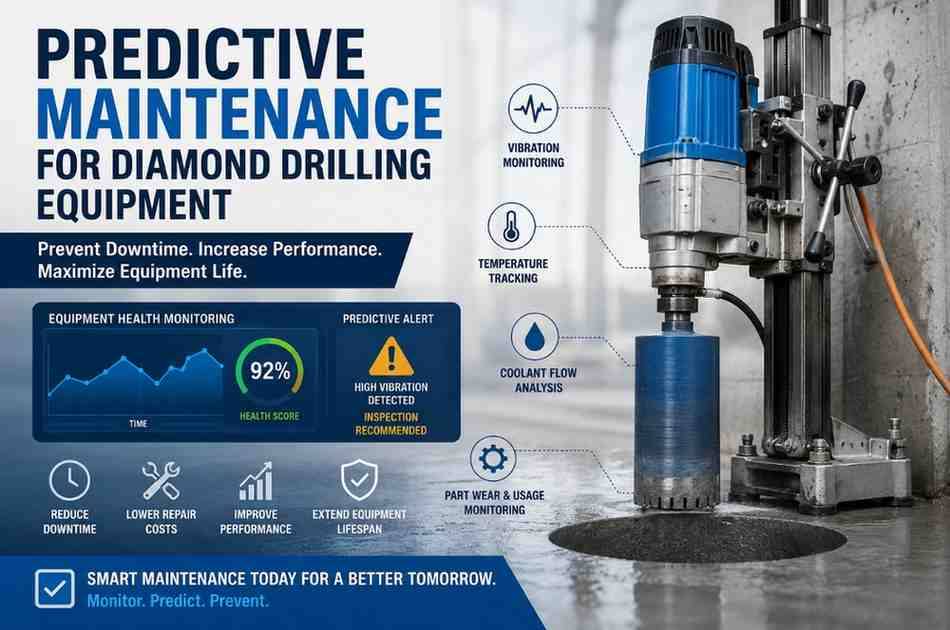
For diamond drilling equipment specifically, this means monitoring variables such as vibration patterns, temperature fluctuations, hydraulic pressure, rotational speed, torque, and bit wear rates. When these variables begin to deviate from their normal operating range, it signals that a part — whether it's a bearing, a swivel, a chuck, or the diamond bit itself — is approaching the end of its useful life.
Why Diamond Drilling Equipment Needs a Different Maintenance Approach
Diamond drilling is a demanding application. Rigs are often deployed in remote exploration sites, harsh geological conditions, and continuous multi-shift operations. The core barrels, drill rods, bits, and pump systems are subjected to extreme friction, heat, and pressure for extended periods. Unlike standard industrial machinery that operates in controlled environments, diamond drilling equipment faces variable ground conditions — from soft overburden to hard abrasive rock formations — which makes wear patterns far less predictable using generic maintenance schedules.
This variability is exactly why a blanket preventive maintenance schedule often falls short. A rig drilling through highly abrasive quartzite will wear out its bit and reaming shell far faster than one drilling through softer sedimentary rock, yet both might be serviced on the same fixed interval under a traditional maintenance plan. This mismatch leads to two costly outcomes: premature part replacement (wasting good components) or unexpected failure (because the schedule didn't account for accelerated wear).
Predictive maintenance solves this by tailoring service intervals to the actual condition of each machine and each drilling environment, rather than applying a one-size-fits-all timetable.
Key Components Monitored in Predictive Maintenance for Diamond Drilling Rigs
1. Diamond Core Bits and Reaming Shells
The bit is the single most critical wear component in any diamond drilling operation. Monitoring penetration rate, torque resistance, and vibration signatures can indicate when diamond exposure is reducing or when the matrix is wearing unevenly. Catching this early prevents damage to the borehole and avoids costly re-drilling.
2. Drill Rods and Rod Strings
Fatigue cracking and thread wear in drill rods can lead to sudden rod breaks downhole — one of the most time-consuming failures to recover from. Ultrasonic testing and visual inspection data, combined with usage-hour tracking, help predict when rods need replacement.
3. Hydraulic Systems
Hydraulic pressure drops or temperature spikes often precede pump or seal failures. Continuous pressure monitoring allows operators to catch leaks or pump degradation before a complete hydraulic failure halts operations.
4. Swivel and Chuck Assemblies
These components experience constant rotational stress. Vibration analysis is particularly effective here, as abnormal vibration frequently indicates bearing wear long before it becomes audible or visible.
5. Motor and Gearbox Health
Temperature sensors and oil analysis (checking for metal particulates in lubricant) can reveal internal gearbox wear or motor overheating trends well before a breakdown occurs.
6. Water and Flushing Pump Systems
Since flushing is essential to cooling the bit and removing cuttings, any drop in pump efficiency directly threatens bit life. Flow rate monitoring helps predict pump wear and clogging issues.
How Predictive Maintenance Works: The Technology Behind It
Sensors and IoT Devices
Modern drilling rigs increasingly come equipped with, or can be retrofitted with, sensors that continuously capture vibration, temperature, pressure, and rotational data. These sensors feed information to onboard or cloud-based systems in real time.
Data Analytics and Machine Learning
Raw sensor data alone isn't useful without analysis. Predictive maintenance platforms use historical failure data combined with machine learning algorithms to recognize patterns that precede equipment failure. Over time, these systems become more accurate at forecasting when a specific component is likely to need attention.
Condition-Based Alerts
Instead of a maintenance technician manually checking every component on a fixed schedule, the system generates automated alerts when a monitored parameter crosses a defined threshold. This allows maintenance teams to act precisely when needed — not too early, not too late.
Integration with Maintenance Management Systems
Many operations link predictive maintenance data with computerized maintenance management systems (CMMS), allowing automatic work order generation, spare parts forecasting, and maintenance history tracking — all of which streamline field operations.
Benefits of Predictive Maintenance for Diamond Drilling Operations
Reduced Unplanned Downtime The most immediate benefit is fewer surprise breakdowns. Since maintenance is scheduled based on actual equipment condition, failures that would otherwise halt drilling mid-shift are caught and addressed proactively.
Extended Equipment Lifespan By avoiding both under-maintenance (which causes premature failure) and over-maintenance (which wastes serviceable parts), predictive maintenance helps rigs, bits, and ancillary equipment reach their full operational lifespan.
Lower Maintenance Costs Emergency repairs in remote drilling locations are significantly more expensive than planned servicing — factoring in mobilization costs, expedited parts shipping, and lost production time. Predictive maintenance reduces the frequency of these costly emergency interventions.
Improved Safety Component failures, particularly in high-pressure hydraulic systems or rotating assemblies, pose real safety risks to drill crews. Early detection of wear reduces the chance of catastrophic, safety-critical failures on site.
Better Resource and Spare Parts Planning Knowing in advance which components are likely to need replacement allows procurement teams to order parts — such as diamond bits, reaming shells, or bearings — with adequate lead time, avoiding stockouts or rushed logistics.
Data-Driven Decision Making Over time, the accumulated data helps operations managers identify which rigs, operators, or drilling conditions are associated with higher wear rates, informing better fleet management and operator training decisions.
Common Challenges in Implementing Predictive Maintenance
While the benefits are substantial, implementing predictive maintenance for diamond drilling equipment does come with challenges worth acknowledging.
Initial Investment: Sensors, monitoring software, and system integration require upfront capital, which can be a barrier for smaller drilling contractors.
Remote and Harsh Site Conditions: Many exploration sites lack reliable internet connectivity, making real-time cloud-based monitoring difficult. Offline data logging with periodic syncing is often needed as a workaround.
Skill Gaps: Interpreting sensor data and analytics requires training. Field teams accustomed to traditional maintenance schedules may need upskilling to fully use predictive tools.
Data Quality: Predictive systems are only as good as the data feeding them. Poorly calibrated sensors or inconsistent data logging can undermine the accuracy of failure predictions.
Despite these challenges, the long-term return on investment — in the form of reduced downtime and extended equipment life — generally outweighs the setup costs, particularly for operations running multiple rigs across active projects.
Best Practices for Getting Started with Predictive Maintenance
- Start with Critical Components First — Prioritize monitoring for the highest-cost, highest-failure-impact parts, such as bits, hydraulic pumps, and drill rods, before expanding to the full rig.
- Establish a Baseline — Collect data during normal operation to understand what "healthy" performance looks like for each rig, since abnormal readings only carry meaning relative to a known baseline.
- Combine Predictive with Preventive Maintenance — Predictive maintenance works best as a layer on top of basic preventive practices like regular lubrication and cleaning, not as a total replacement for them.
- Train Field Crews — Ensure operators and site technicians understand how to respond to alerts and log observations that support the data being collected.
- Partner with Reliable Equipment and Consumables Suppliers — Using high-quality, consistent diamond bits and drilling consumables reduces variability in wear data, making predictive models more accurate over time.
- Review and Refine Regularly — Predictive maintenance models improve with more data. Regularly review prediction accuracy and adjust thresholds as more operational history is gathered.
The Role of Quality Consumables in Predictive Maintenance Success
It's worth emphasizing that predictive maintenance systems are only as effective as the equipment they're monitoring. Inconsistent or poor-quality diamond bits and reaming shells introduce unpredictable wear patterns that make it harder for predictive models to generate reliable forecasts. This is one of the reasons operations that use dependable, consistently manufactured drilling consumables tend to get more accurate and useful results from their predictive maintenance programs.
At Core Cutting India, our diamond core bits and drilling tools are engineered for consistent performance across varying ground conditions, which supports more predictable wear behavior — a critical factor for any operation implementing condition-based monitoring.
Conclusion
Predictive maintenance represents a fundamental shift in how diamond drilling operations approach equipment care — moving away from rigid schedules and reactive firefighting toward a smarter, data-informed strategy. For drilling contractors and exploration companies operating in competitive, cost-sensitive environments, the ability to anticipate failures before they happen isn't just a technical advantage; it's a business necessity.
As sensor technology becomes more affordable and analytics tools more accessible, predictive maintenance is no longer limited to large-scale mining operations. Small and mid-sized drilling contractors can increasingly adopt scaled-down versions of these systems to protect their equipment investment and improve project reliability.
If you're looking to strengthen your drilling operation with reliable diamond core bits, reaming shells, and drilling consumables built for consistent, predictable performance, Core Cutting India is here to help. Reach out to us at [email protected] to learn more about our product range and how we support drilling operations across India with quality and consistency at every stage of the drilling process.
Core Cutting India | [email protected]