
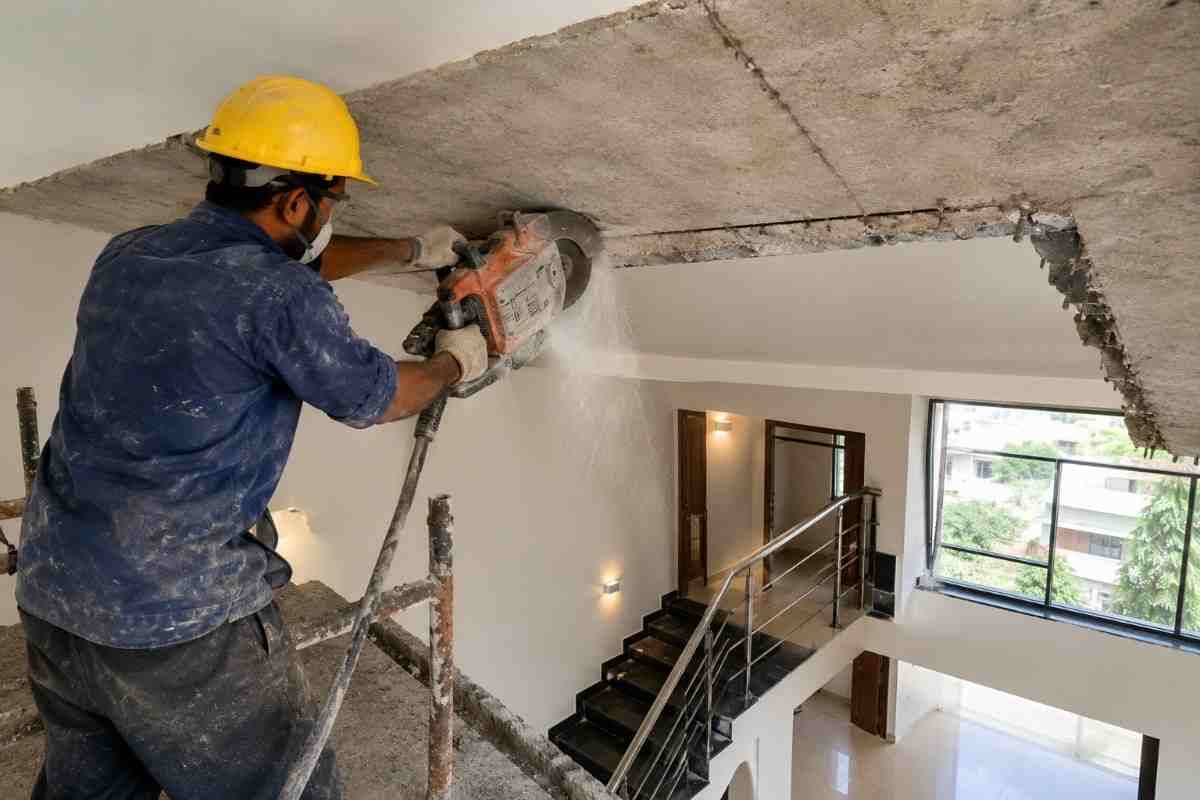
Bangalore is a city of vertical growth. Land is expensive and families are expanding, so homeowners are adding floors, converting independent houses into duplexes, and building terrace rooms. Almost every one of these projects raises the same question: how do you create a staircase opening in an existing concrete roof slab without damaging the building?
The answer is professional chhat cutting. Done by trained specialists with modern diamond equipment, it is clean, precise and safe. Done with hammers and chisels, it can lead to cracks, structural stress and expensive repairs.
This guide covers how chhat cutting for staircase openings works, why it matters, what the process looks like, what to consider before you start, and how to choose the right service provider in Bangalore. It draws on the expertise of CoreCuttingIndia.
What Is Chhat Cutting?
“Chhat” is the Hindi word for roof or slab. Chhat cutting means cutting a defined opening in a reinforced concrete (RCC) roof or floor slab. In staircase projects, it creates the void through which the new stairs will pass, connecting the floor below to the floor above or to the terrace.
Unlike demolition, chhat cutting is controlled. The aim is not to break concrete but to remove a precisely marked section, leaving the surrounding slab, beams and columns undisturbed.
Common reasons Bangalore homeowners need it:
- Adding an internal staircase to reach a terrace or new floor
- Converting a single-storey home into a duplex or triplex
- Creating access to a terrace room or “barsati”
- Opening a slab for a lift shaft or dumbwaiter
- Modifying the staircase position during a renovation
Why Staircase Openings in Bangalore Homes Are Becoming So Common
Several local factors explain the demand.
Rising property values. In areas like Indiranagar, Koramangala, Jayanagar, HSR Layout, JP Nagar and Whitefield, building upward is often cheaper than buying new land.
Growing joint families. Many families want more space for parents, children or tenants, and an added floor with its own staircase provides it.
Work-from-home lifestyles. Terrace offices, studios and extra bedrooms are popular, and they all need a safe, comfortable staircase.
Older homes needing modification. Many Bangalore houses were built decades ago without internal stairs to the terrace. Opening the slab and adding stairs is a common upgrade.
Whatever the reason, the cutting must be accurate and structurally sound.
Why Traditional Breaking Methods Are Risky
Some contractors still break the slab by hand or with a heavy jackhammer. This approach has real drawbacks:
- Vibration damage: Heavy impact travels through the structure and can cause hairline cracks in beams, walls, tiles and plaster far from the work area.
- Irregular edges: Broken edges are jagged and need extensive patching and finishing.
- Reinforcement damage: Uncontrolled breaking can bend or weaken the steel bars you may want to preserve or reconnect.
- Noise and dust: Neighbours in Bangalore’s closely built localities will not appreciate it, and apartment associations often object.
- Longer timelines: Rework and cleanup add days to the schedule.
Professional cutting avoids nearly all of these problems.
How Professional Chhat Cutting Works
Professional services use diamond-tipped tools designed to slice through concrete and steel cleanly. The main methods are described below.
1. Wall Saw / Slab Saw Cutting
A rail-mounted saw with a diamond blade runs along a marked line and cuts straight, smooth edges. It suits straight-edged rectangular openings, which is exactly what a staircase needs. It produces little vibration and works at precise depths.
2. Wire Saw Cutting
A diamond-impregnated wire loops around the section to be cut and pulls through it. It is useful for thick slabs, hard-to-reach areas, or places where a large blade cannot fit.
3. Core Drilling
Core drilling makes round holes with a hollow diamond bit. In staircase work, it is often used at the corners of the marked opening. The cores relieve stress and allow the saw to make clean, over-cut-free corners. Core holes can also be used for lifting points and for pipe or conduit routes.
4. Hand Saw and Chain Saw Cutting
Handheld diamond saws are used in tight spaces, for finishing, and for small adjustments where larger machines cannot reach.
A good provider picks the method that suits your slab thickness, accessibility, and the structure around it.
Step-by-Step: The Chhat Cutting Process for a Staircase Opening
Understanding the process helps you plan, so here is how a professional job typically unfolds.
Step 1: Site Inspection and Assessment
The team visits the property and studies the slab thickness, reinforcement pattern, nearby beams and columns, and the available working area. They also check for electrical conduits, plumbing lines or water tanks near the proposed opening.
Step 2: Structural Evaluation
This is the most important step. Cutting a slab changes how loads travel through the building, so a qualified structural engineer should review the plan. The engineer decides where the opening can safely go and whether trimmer beams, additional steel, or other strengthening is needed around it.
Step 3: Marking the Opening
The cutting lines are carefully marked to match the staircase design, including the required headroom, tread size and landing positions. Accuracy here prevents expensive corrections later.
Step 4: Preparing the Work Area
The area below is cleared and protected with covers. Water supply and electricity are arranged, since diamond cutting uses water for cooling and dust suppression. Safe lifting and removal arrangements are planned for the cut pieces.
Step 5: Cutting
Using the chosen method, the team cuts along the marked lines. The slab is usually cut into manageable blocks so each piece can be supported and lowered safely, not dropped. The process is controlled, steady and relatively quiet.
Step 6: Removal and Cleanup
Cut blocks are lifted or broken down further for disposal. Slurry and debris are cleaned, leaving a tidy, finished opening.
Step 7: Finishing and Strengthening
Where the engineer has specified it, edge strengthening is done, such as new beams or added reinforcement. Exposed steel is treated, and the opening is ready for the staircase construction.
Key Benefits of Professional Chhat Cutting
Structural safety. Controlled cutting protects the rest of the building, especially when guided by an engineer’s plan.
Clean, accurate edges. Diamond cutting leaves straight, smooth edges that reduce finishing work and make staircase installation easier.
Minimal vibration. Neighbouring walls, tiles and fittings stay safe, which matters in Bangalore’s densely built layouts.
Lower noise and dust. Wet cutting keeps dust down, and the noise is far lower than heavy breaking.
Faster completion. Precise cutting reduces rework, so the project moves on to staircase construction sooner.
Less disruption to daily life. If you are staying in the house during renovation, cleaner and quieter work makes a real difference.
Things to Check Before You Cut a Slab in Bangalore
Before any cutting begins, take care of the following.
1. Structural engineer’s approval. Never cut a slab without one. Every building is different, and an opening in the wrong place can compromise the structure.
2. Building regulations and permissions. Adding floors or altering structures may require approval from local authorities such as BBMP (now part of the Greater Bengaluru Authority framework) or the relevant development authority. Check the current rules for your property and location.
3. Apartment or society permission. If you live in a flat, duplex or gated community, check with the resident welfare association or builder before any structural work.
4. Slab and reinforcement details. If you have the original drawings, share them with your engineer and contractor. If not, a scan can help locate rebar and conduits.
5. Utilities. Know where wiring, plumbing and water tanks are, so they can be rerouted or protected.
6. Staircase design. Decide the staircase type (straight, L-shaped, U-shaped, spiral or modular) and dimensions first. These determine the opening size and position.
7. Timing and neighbours. Inform neighbours in advance and plan work in reasonable hours to avoid complaints.
Choosing the Right Chhat Cutting Service in Bangalore
Not every provider offers the same quality. When comparing options, look for:
- Modern diamond equipment: wall saws, wire saws and core drills in good condition
- Experienced operators: skill matters as much as machines
- Safety practices: protective gear, supervised lifting, and slab support during cutting
- Willingness to work with your structural engineer
- Clear quotations: a written estimate that explains what is included
- Cleanliness and debris handling
- Relevant references or past work on residential projects
- Responsive communication before, during and after the job
CoreCuttingIndia focuses on precise, professional concrete cutting solutions, including slab cutting, wall cutting, core drilling and openings for staircases, lifts and more. Choosing a specialist company rather than a general labour contractor gives you better equipment, trained crews and more predictable results.
How Much Does Chhat Cutting for a Staircase Cost in Bangalore?
Cost varies widely, so treat any figure you read online as a rough guide. The main factors are:
- Slab thickness: thicker slabs take more time and blade wear
- Opening size: a larger opening means more linear cutting
- Reinforcement density: heavily reinforced slabs are harder to cut
- Cutting method: wire saws and special setups can cost more
- Access and location: upper floors, narrow lanes and limited access add effort
- Water, power and disposal arrangements
- Additional work: strengthening, finishing or debris removal
Concrete cutting is usually priced by running foot, by area, or as a lump sum for the job. The best approach is to request a site visit and a written quote. Be cautious of unusually low estimates, as they may involve poor equipment, hidden charges or unsafe shortcuts.
Common Mistakes to Avoid
- Cutting without structural advice. This is the single biggest and most costly mistake.
- Choosing only on price. Cheap work can create expensive problems.
- Poor marking. A few inches of error can affect headroom or staircase fit.
- Ignoring support for cut slab pieces. Unsupported cutting is dangerous.
- Forgetting utilities. Cut cables or pipes lead to delays and hazards.
- Skipping edge reinforcement. Openings often need trimmer beams or added steel for long-term strength.
- Not planning debris removal. Concrete waste is heavy and needs a proper disposal plan.
Safety Matters
Concrete cutting is skilled work. Reliable teams use proper protective equipment, secure the area, prevent falling pieces, control water and slurry, and manage electrical safety around wet cutting. As the homeowner, keep children, pets and elderly family members away from the site, and make sure only trained people operate the machines.
Final Thoughts
A staircase opening is more than a hole in your roof. It is a structural change that affects how your home carries load, how it looks, and how safely your family can move between floors. Professional chhat cutting gives you an accurate, clean and controlled opening, with less vibration, less mess and a better foundation for your new staircase.
For Bangalore homeowners planning a duplex conversion, terrace room or renovation, the right steps are straightforward. Consult a structural engineer, confirm the necessary permissions, plan the staircase design, and hire an experienced concrete cutting specialist. To discuss your project and request a site assessment, visit CoreCuttingIndia.com.
Frequently Asked Questions (People Also Ask)
1. What is chhat cutting?
Chhat cutting is the process of cutting an opening in a concrete roof or slab using diamond tools. It is commonly done to create space for staircases, lifts or shafts.
2. Can I cut an RCC slab for a staircase in my house?
Often yes, but only after a structural engineer confirms the location and any required strengthening. Cutting without proper assessment can weaken the building.
3. How is slab cutting done without damaging the building?
Professionals use wall saws, wire saws and core drills, which cut precisely with very little vibration. The slab is cut into blocks and lowered safely, not broken by impact.
4. How long does chhat cutting for a staircase opening take?
A typical residential opening is often completed in a day or two, depending on slab thickness, opening size and site access. Strengthening and finishing are extra.
5. Is chhat cutting noisy or messy?
Diamond cutting is far quieter and cleaner than hammering. Wet cutting controls dust, though some slurry and debris cleanup is still required.
6. Do I need permission to add a staircase opening in Bangalore?
It depends on the property, the scale of the changes and local rules. Adding floors or altering structures may need approval, and apartments need association or builder consent. Check with the relevant authority and your engineer.
7. How much does concrete slab cutting cost in Bangalore?
Cost depends on slab thickness, opening size, reinforcement, method and access. Request a site visit and written quote for an accurate figure.
8. Does cutting a slab weaken the structure?
It can if done carelessly. With engineering guidance and proper reinforcement around the opening, the structure can remain safe and sound.
9. Which areas in Bangalore does CoreCuttingIndia serve?
For current service areas, availability and project enquiries across Bangalore, contact the team through corecuttingindia.com.