
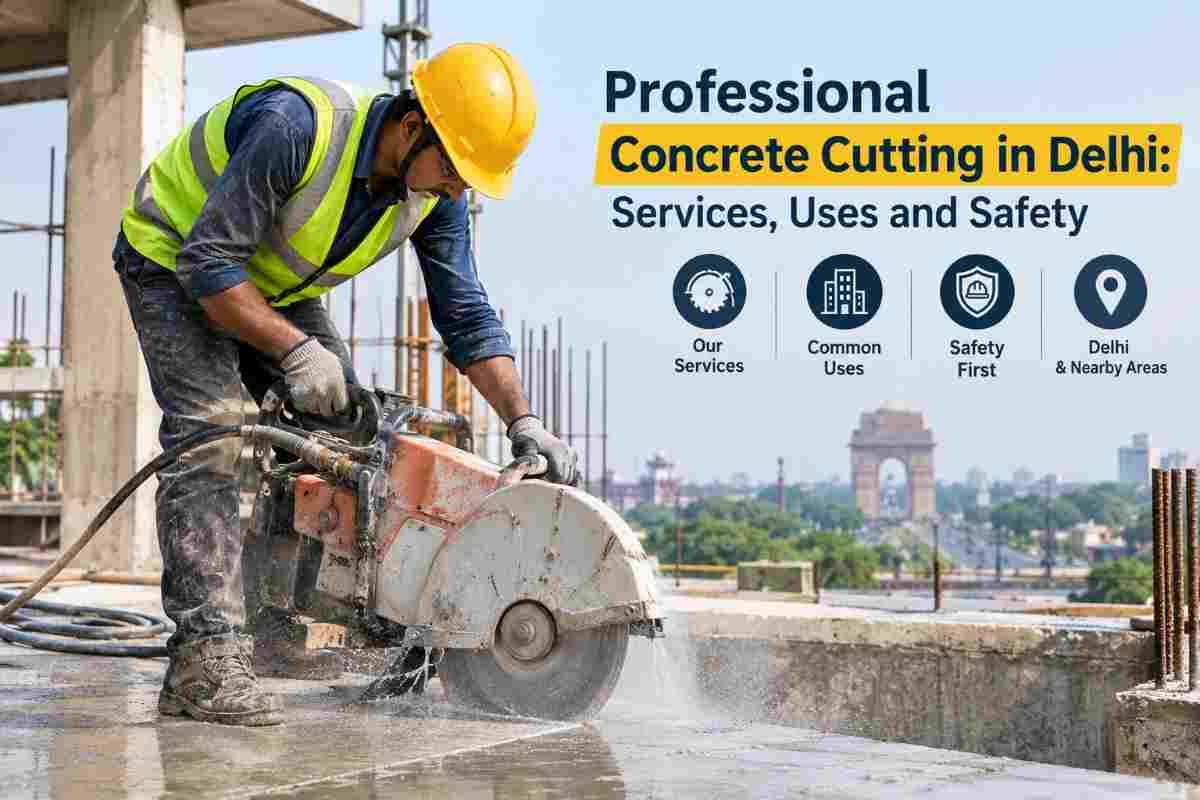
Delhi never stops building. Metro corridors, flyovers, high-rise apartments, commercial complexes, hospitals, and industrial units are always being built, extended, or renovated. Where there is construction, there is concrete. Eventually, that concrete has to be opened up, resized, or removed, and a hammer or chisel will not do the job.
Traditional demolition methods such as breakers, jackhammers, and manual chipping create heavy vibration, cracks in surrounding structures, loud noise, and clouds of dust. In a dense city where buildings stand shoulder to shoulder, those side effects are unacceptable. This is why professional concrete cutting in Delhi has become the preferred method for modification and demolition work.
Concrete cutting uses diamond-tipped tools that slice through reinforced concrete, brick, stone, and asphalt with exact precision. The cuts are clean, the surrounding structure stays intact, and the work finishes faster than most conventional methods.
This guide explains what concrete cutting is, the main services available, where it is used, the safety standards that matter, and how to choose the right contractor. It draws on the kind of work that specialists such as Core Cutting India carry out across Delhi NCR.
What Is Concrete Cutting?
Concrete cutting is the process of cutting, drilling, or removing concrete and masonry with specialized diamond-bladed or diamond-bit equipment. Diamond is the hardest known material, so tools embedded with industrial diamond segments can grind through reinforced concrete, steel rebar, and stone without shattering the structure around the cut.
Unlike demolition by impact, cutting is a controlled, precision process. The operator marks the exact line, and the machine follows it. This makes it ideal for projects where only a specific section of concrete needs to be altered while the rest of the structure stays safe and sound.
Most professional concrete cutting falls into a few core techniques, each suited to different tasks.
Core Concrete Cutting Services Available in Delhi
1. Core Drilling (Core Cutting)
Core drilling uses a hollow cylindrical diamond bit to cut perfectly round holes through concrete walls, slabs, columns, and floors. The cylindrical “core” of concrete is removed intact, leaving a smooth-edged hole.
Typical uses include:
- Openings for plumbing, drainage, and sewage pipes
- Passages for electrical conduits and cables
- HVAC and ventilation ducts
- Holes for anchor bolts and dowel bars
- Sampling concrete cores for strength testing
Core drilling is one of the most requested services in Delhi, from home renovations to large infrastructure projects. Hole diameters range from a few centimetres to well over 500 mm, depending on equipment.
2. Wall Saw Cutting
Wall saw cutting uses a track-mounted, hydraulic or electric saw fitted with a large circular diamond blade. The saw runs along a rail fixed to the wall and cuts straight, precise lines through thick RCC walls.
It is commonly used for:
- Creating new door and window openings
- Cutting lift shafts and staircase openings
- Removing sections of load-bearing or partition walls
- Resizing openings in industrial buildings
Because the blade is guided on a track, the cut is accurate to a few millimetres, and the edges are clean enough that little finishing is needed.
3. Slab Saw and Floor Saw Cutting
Floor saws are walk-behind or ride-on machines that cut horizontally across concrete floors, roads, and pavements. They are used for:
- Cutting expansion and control joints
- Trenching for pipes and cables
- Removing damaged sections of road or floor
- Creating openings for staircases, lifts, or service ducts in slabs
In Delhi, road and pavement cutting is common for utility works, repairs, and metro-related construction.
4. Wire Saw Cutting (Diamond Wire Cutting)
Wire sawing uses a flexible cable studded with diamond beads that is looped around the structure and pulled through at high speed. It is the answer when the concrete is too large, too thick, or too awkwardly placed for a conventional blade.
It suits:
- Bridge piers and large columns
- Thick foundations and machine bases
- Heavy industrial structures
- Dismantling large sections in segments
Wire sawing can cut through almost any thickness, and it works in places where other saws cannot reach.
5. Hand Saw / Ring Saw Cutting
Hand-held and ring saws handle small, precise, or hard-to-reach jobs, such as cutting out corners, small openings, or sections in tight spaces where larger machines cannot fit.
6. Chasing and Grooving
Wall chasing cuts narrow channels in walls to embed electrical conduits and plumbing pipes. Machine chasing is far cleaner and faster than manual chiselling, and it produces neat, uniform grooves with far less damage to the wall.
Key Uses and Applications of Concrete Cutting in Delhi
Concrete cutting supports a wide range of sectors in the city.
Residential Renovation
Delhi homeowners often modify their space by widening doorways, adding windows, creating balcony openings, or running new plumbing and electrical lines. Cutting lets them make these changes without shaking the building or disturbing neighbours. It is especially valuable in tightly packed colonies where buildings share walls.
Commercial Buildings and Offices
Offices, malls, and showrooms are frequently remodelled. Cutting is used for new staircases, lift installations, HVAC openings, and floor modifications, often while neighbouring floors continue to operate.
Infrastructure Projects
Roads, flyovers, metro stations, and bridges all involve concrete that needs precise cutting, from expansion joints to the removal of damaged segments.
Industrial Facilities
Factories need openings for machinery, pipelines, conveyor systems, and cable trays. Wire sawing and slab cutting are often used to modify heavy foundations and floors.
Hospitals and Sensitive Facilities
Vibration and noise are serious concerns near hospitals, laboratories, and data centres. Diamond cutting produces far less vibration than impact demolition, which makes it the safe choice for such environments.
Structural Retrofitting and Repair
Older buildings often need strengthening or partial removal of damaged concrete. Cutting allows engineers to remove only the affected portion and leave the sound structure undisturbed.
Concrete Testing
Core samples extracted by drilling are sent to laboratories to assess compressive strength, which helps engineers judge the condition of existing structures.
Benefits of Professional Concrete Cutting Over Traditional Demolition
Precision. Cuts follow marked lines exactly, so only the required portion is removed.
Minimal vibration. Diamond cutting does not hammer the structure, so it protects the integrity of the surrounding building and adjacent properties.
Lower noise. It is quieter than breakers and jackhammers, which matters in residential and commercial neighbourhoods.
Reduced dust. Most professional cutting uses water cooling, which suppresses dust at the source. This is particularly important in a city like Delhi, where air quality is a constant concern.
Speed and efficiency. Machines cut quickly and cleanly, which shortens project timelines and reduces labour costs.
Clean finish. Smooth cut edges reduce the need for patching, plastering, and rework.
Ability to cut reinforced concrete. Diamond tools cut through rebar as easily as concrete, something that is slow and difficult with manual methods.
Flexibility. From a small pipe hole to a huge bridge pier, there is a cutting method for almost every job.
Safety in Concrete Cutting: What Matters Most
Concrete cutting is powerful work that involves heavy machinery, high-speed blades, water, electricity, and structural loads. Safety is therefore not optional. A professional contractor builds safety into every stage of the job.
1. Structural Assessment Before Cutting
Before a blade touches the wall, qualified personnel should assess how the structure carries its load. Cutting the wrong wall, beam, or column can compromise stability. Drawings should be reviewed, and temporary supports or shoring should be installed where required.
2. Scanning for Hidden Utilities and Rebar
Concrete often hides electrical conduits, water lines, gas pipes, and dense reinforcement. Professionals use scanning tools such as ground-penetrating radar or rebar detectors to locate these before cutting. This prevents electrocution, flooding, gas leaks, and equipment damage.
3. Personal Protective Equipment (PPE)
Operators should always wear:
- Safety helmets
- Safety goggles or face shields
- Ear protection
- Dust masks or respirators where needed
- Cut-resistant gloves
- Steel-toe safety boots
- Waterproof or high-visibility clothing
4. Dust Control
Cutting concrete releases fine silica dust, which is hazardous if inhaled over time and can cause serious lung disease. Wet cutting, vacuum extraction, and proper ventilation are the main controls. This is also relevant to Delhi’s pollution-control rules, which restrict dust-generating construction activity at certain times of year, so wet methods are strongly preferred.
5. Electrical and Water Safety
Many cutting machines use water for cooling and dust suppression, so electrical safety is critical. Equipment should be properly earthed, cables protected, and residual current devices used. Slurry and wastewater should be collected and disposed of correctly rather than left to flow into drains or the street.
6. Blade and Equipment Inspection
Blades, bits, and wires should be inspected before use. Worn, damaged, or incorrectly fitted blades can break or bind, causing serious injury. Machines must be maintained and operated only by trained personnel.
7. Safe Handling of Cut Sections
Large pieces of cut concrete can weigh several tonnes. Without planning, they can fall unexpectedly. Professionals plan the cutting sequence, support sections with cranes, hoists, or props, and set up exclusion zones so nobody stands beneath or beside the work.
8. Site Barricading and Signage
Work zones should be clearly marked and barricaded to keep unauthorised people away, especially in occupied buildings and public areas such as roads.
9. Training and Experience
The most important safety factor is a trained crew. Experienced operators understand how concrete behaves, how loads shift, and how to react if something goes wrong.
How to Choose the Right Concrete Cutting Company in Delhi
With many providers in the market, the choice affects your safety, timeline, and budget. Consider the following.
Experience and track record. Look for a company that has handled projects similar to yours, whether residential, commercial, or industrial.
Range of services. A provider offering core drilling, wall sawing, floor sawing, and wire sawing can recommend the right method rather than forcing one technique onto every job.
Modern equipment. Quality diamond tools and well-maintained machines give cleaner, faster, and safer results.
Safety practices. Ask about their PPE, site safety procedures, dust control, and structural assessment process. A reputable contractor will answer confidently.
Trained operators. Skilled technicians make the difference between a clean cut and a costly mistake.
Transparent pricing. Get a clear quote that explains the scope, the method, and what is included. Be cautious of prices that seem far below the market.
Timely service. Construction schedules are tight. Choose a team that can mobilise quickly and finish on time.
Customer references and reviews. Past clients are the best indicator of reliability.
If you are looking for a dependable partner, Core Cutting India provides concrete cutting solutions for projects across Delhi NCR, with a focus on precision and site safety.
Factors That Affect the Cost of Concrete Cutting
Pricing varies from job to job. The main factors are:
- Type of cutting: Core drilling, wall sawing, and wire sawing are priced differently.
- Thickness and depth: Thicker concrete takes more time and wear on tools.
- Reinforcement density: Heavy rebar slows cutting and wears blades faster.
- Quantity and size: Larger jobs often reduce the cost per unit.
- Site access: Cramped spaces, upper floors, or difficult access increase effort.
- Height and working conditions: Work at height or in confined areas requires extra equipment and safety measures.
- Disposal: Removal of debris and slurry may be charged separately.
The best way to get an accurate figure is to request a site visit and written quotation.
Frequently Asked Questions About Concrete Cutting in Delhi
What is concrete cutting?
Concrete cutting is the use of diamond-tipped tools to cut, drill, or remove concrete and masonry accurately, with minimal vibration and damage to the surrounding structure.
What is the difference between core cutting and core drilling?
The two terms are generally used interchangeably. Both refer to drilling cylindrical holes through concrete using a hollow diamond bit.
Is concrete cutting better than breaking concrete with a hammer?
For most projects, yes. Cutting is more precise, quieter, and produces less vibration and dust than breaking, and it reduces the risk of cracking adjacent structures.
Can concrete cutting be done without damaging the building?
Yes, when done by trained professionals. Planning, structural assessment, and the right equipment keep the surrounding structure safe.
Can reinforced concrete (RCC) be cut?
Yes. Diamond tools cut through both concrete and steel reinforcement.
How thick a wall can be cut?
Wall saws and wire saws can handle very thick sections, often well over a metre, depending on the equipment and method.
Is concrete cutting noisy or dusty?
It is considerably quieter than impact demolition, and wet cutting greatly reduces dust. Slurry management is still needed.
Is concrete cutting safe in occupied buildings?
Yes, with the right precautions. Low vibration and controlled dust make it suitable for homes, offices, and hospitals, provided safety procedures are followed.
How long does concrete cutting take?
A simple core drilling job can be completed in minutes per hole, while large wall or slab cutting may take hours or days depending on size and complexity.
Do I need permission before cutting concrete?
If the work affects structural elements, you should consult a structural engineer and, where required, obtain approvals from the building owner, society, or local authority.
Conclusion
As Delhi continues to grow upward and outward, the demand for precise, safe, and efficient construction methods keeps rising. Professional concrete cutting meets that demand by letting builders, homeowners, and engineers modify concrete structures without the vibration, mess, and risk of conventional demolition.
From core drilling for pipes to wall sawing for new openings and wire sawing for massive structures, each technique solves a specific problem. The common thread is precision, and precision depends on skilled operators, quality equipment, and strict safety practice.
Whether you are renovating a home, expanding a commercial space, or working on an infrastructure project, choosing an experienced and safety-focused contractor protects your structure, your people, and your budget. To discuss your project or request a site assessment, visit Core Cutting India and speak with a team that understands the demands of concrete cutting in Delhi.