
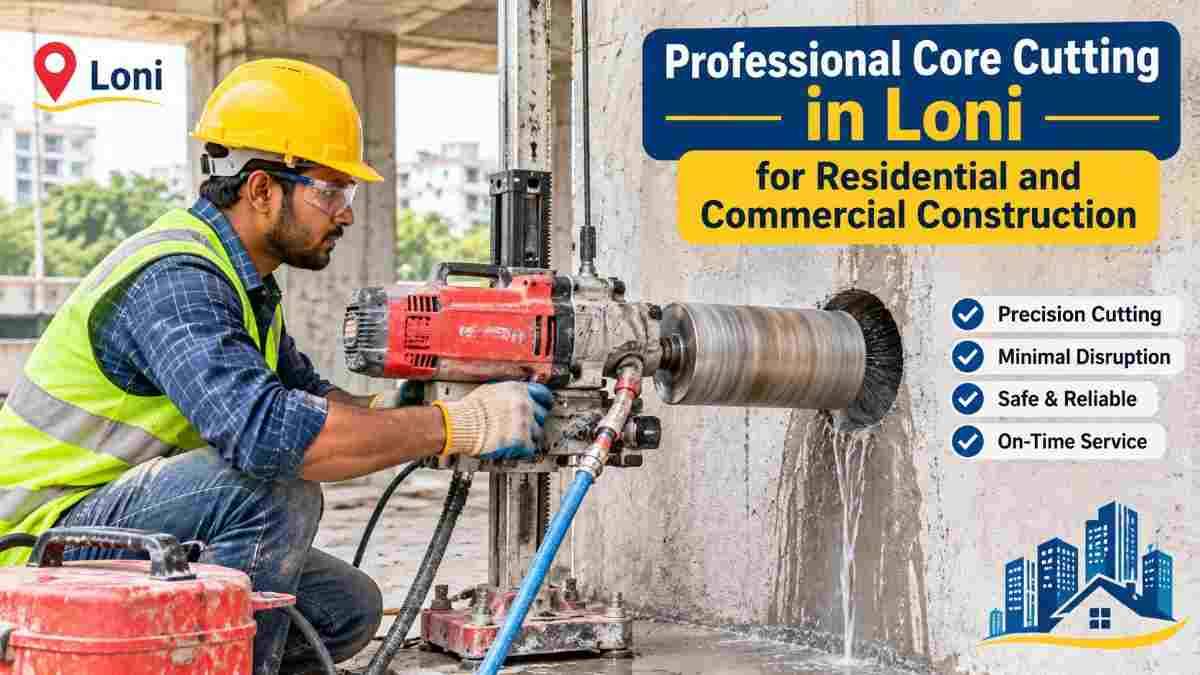
Loni, in the Ghaziabad district of Uttar Pradesh, is growing fast. New housing societies, warehouses, factories, showrooms, and mixed-use buildings are coming up across the area, and many older buildings are being renovated or upgraded. Almost every one of these projects needs openings made in concrete, such as a hole for a pipe, a cut for a staircase, or a doorway through a load-bearing wall.
Doing that with a hammer and chisel is slow, noisy, and risky, and it can crack the structure you are trying to improve. That is why professional core cutting in Loni has become a first choice for builders, contractors, architects, and homeowners.
This guide covers what core cutting is, where it is used, how the process works, what affects cost, and how to choose a reliable service provider. It is written for homeowners planning a renovation as much as for site engineers on large commercial jobs.
What Is Core Cutting?
Core cutting, also called core drilling or diamond core drilling, is a method for making clean, precise, round holes in hard materials such as reinforced cement concrete (RCC), brick, stone, and masonry. A hollow cylindrical drill bit with diamond segments on its edge is rotated at high speed, usually with water for cooling. The bit grinds through the material and leaves a smooth hole. The solid cylinder of concrete left inside the bit, the “core,” is then removed.
Because the cutting is done by abrasion and not by impact, it creates very little vibration. Nearby walls, beams, and columns are not shaken, so the surrounding structure stays intact.
Core cutting is commonly done in diameters from about 25 mm up to 600 mm or more, depending on the equipment. Larger openings, such as doorways, windows, lift shafts, and staircase cutouts, are made with related techniques like wall sawing, slab sawing, and wire sawing.
Why Core Cutting Matters for Construction in Loni
Loni’s construction landscape is unusually varied. In a single day you may find a residential colony being extended, a factory adding a new production line, a warehouse installing fire-fighting pipes, and a commercial complex fitting new HVAC ducts. All of these need accurate openings in concrete, and the work is often done in or next to occupied buildings, where noise and dust are real concerns.
Professional core cutting suits these conditions because it:
- Protects structural integrity: Clean cuts avoid the micro-cracks that breakers and chisels cause.
- Reduces disruption: Low noise and vibration mean neighbors, tenants, and staff are far less affected.
- Saves time: Work that takes days by hand can often be done in hours.
- Gives accurate results: Holes are cut to exact diameters and positions, so pipes, cables, and ducts fit properly the first time.
- Keeps the site cleaner: Water-based cutting suppresses dust, which matters for health and for finished interiors.
Residential Applications of Core Cutting
1. Plumbing and Drainage Lines
When a new bathroom or kitchen is added, or an existing one is relocated, pipes must pass through slabs and walls. Core drilling creates neat, correctly sized openings for water supply, soil pipes, and drainage lines without damaging the surrounding floor.
2. Air Conditioner Installations
Split ACs need a small hole through the wall for refrigerant pipes and drain lines. A core-cut hole is clean, correctly angled, and easy to seal, which prevents leaks and keeps the wall looking tidy.
3. Electrical and Cable Conduits
Concealed wiring, inverter cables, solar connections, and CCTV lines often need to pass through concrete. Core cutting gives a safe, smooth passage that does not damage the cables.
4. Doorways and Window Openings
Homeowners often want to open up a space, add a door between rooms, or enlarge a window. With controlled wall cutting, openings are made to exact dimensions with straight edges, ready for framing and finishing.
5. Staircase and Balcony Modifications
Adding a staircase to a first-floor extension, or opening a slab for a new access point, calls for precise slab cutting. Done correctly, it preserves the reinforcement layout and the strength of the structure.
6. Water Harvesting and Ventilation
Rainwater pipes, exhaust fans, and chimney or kitchen ventilation lines can all be installed neatly using core holes.
Commercial and Industrial Applications of Core Cutting
Commercial and industrial buildings in Loni are larger, with thicker slabs, heavier reinforcement, and tighter project schedules. Core cutting is used here for:
- HVAC and ducting: Large circular and rectangular openings for ducts, chillers, and ventilation shafts.
- Fire-fighting systems: Sprinkler pipes, hydrant lines, and fire-rated service penetrations.
- Plumbing and sewage networks: Core holes for stacks, drains, and wastewater lines in multi-storey buildings.
- Electrical and data infrastructure: Cable trays, bus ducts, and network cabling through floors and walls.
- Machinery foundations and anchor holes: Precisely drilled holes for anchor bolts and equipment mounting.
- Lift shafts and staircase openings: Slab openings cut with wall and floor saws for vertical circulation.
- Structural retrofitting: Cutting openings in existing structures for upgrades without demolishing large sections.
- Concrete sampling and testing: Core samples taken to test the compressive strength of existing concrete, often needed for structural audits.
In these settings, accuracy and speed directly affect project cost. A mis-cut opening can lead to rework, delays, and structural concerns.
Types of Concrete Cutting Services
Different jobs call for different techniques. A professional provider should be able to offer a range of them.
Core Drilling: Round holes from small to large diameters, in slabs, walls, and beams, using handheld or rig-mounted drills.
Wall Sawing: A track-mounted saw cuts straight, accurate openings in walls for doors, windows, and ducts, and can handle thick, heavily reinforced walls.
Slab/Floor Sawing: A walk-behind saw makes straight cuts in floors, pavements, and industrial slabs, commonly for expansion joints, trenches, and openings.
Wire Sawing: A diamond wire cuts very large or awkwardly located structures where other saws cannot reach, such as thick foundations, heavy beams, and bridge elements.
Hand Sawing: Compact saws handle small openings and tight spaces.
Concrete Chasing and Grooving: Narrow channels are cut into walls and floors for concealed pipes and cables.
How the Core Cutting Process Works
Understanding the process helps you plan the job and judge the quality of a contractor.
Step 1: Site inspection and planning. The team checks the location, wall or slab thickness, and access. They confirm the diameter and position of each opening against the drawings or your requirements.
Step 2: Scanning for reinforcement and services. Before cutting, a good contractor locates steel bars, embedded conduits, and pipes. This avoids hitting live electrical lines or cutting critical reinforcement.
Step 3: Marking. The exact centre and outline of each opening are marked clearly.
Step 4: Securing the machine. The drilling rig or saw is anchored to the surface so it stays stable and the cut stays straight.
Step 5: Cutting with water cooling. The diamond bit or blade cuts through the concrete while water cools it and controls dust.
Step 6: Core removal and cleanup. The core is extracted, slurry is collected, and the area is cleaned.
Step 7: Final inspection. The opening is checked for size, alignment, and finish before the team hands over the site.
Core Cutting vs. Conventional Breaking
| Factor | Core Cutting | Manual Breaking/Chiselling |
|---|---|---|
| Accuracy | Very high, clean edges | Low, rough and uneven |
| Vibration | Minimal | High, may crack nearby structure |
| Noise | Low to moderate | Very high |
| Dust | Controlled with water | Heavy dust |
| Speed | Fast | Slow |
| Structural safety | Preserves integrity | Risk of weakening |
| Finishing work | Minimal | Extensive repair needed |
For nearly any job involving structural concrete, core cutting is the safer and more economical option once you factor in repair and rework costs.
Safety, Dust, and Environmental Considerations
Concrete cutting is technical work, and safety must be built into it. A responsible provider follows these practices:
- Wet cutting to suppress silica dust, which is harmful if inhaled over time.
- Personal protective equipment such as helmets, goggles, gloves, ear protection, and dust masks.
- Slurry management, so cutting water does not spread across floors, damage finishes, or enter drains.
- Electrical safety, including proper earthing and waterproof connections, since water and power are used together.
- Barricading and signage to keep other workers and residents away from the cutting zone.
- Structural awareness, meaning the team understands which beams, columns, and walls must not be disturbed.
If a contractor cannot explain how they manage these points, that is a warning sign.
Factors That Affect the Cost of Core Cutting in Loni
Pricing varies from project to project. These are the main factors:
- Hole diameter: Larger holes need bigger bits and more time.
- Depth or thickness of the material: Thicker slabs and walls take longer.
- Reinforcement density: Heavy steel slows cutting and wears the diamond segments faster.
- Number of holes: Larger quantities often reduce the per-hole rate.
- Access and height: Cutting at height, in confined spaces, or in difficult locations needs extra effort.
- Type of equipment required: Wall saws and wire saws cost more to deploy than a simple core drill.
- Utilities at site: Availability of water and electricity affects setup.
- Urgency and scheduling: Night work or tight deadlines may change the price.
The best approach is to ask for a clear quotation after a site visit. Be cautious of rates quoted without any inspection, since hidden extras may appear later.
How to Choose the Right Core Cutting Contractor in Loni
With demand rising, many operators now advertise concrete cutting services. Use these checks before you hire:
- Experience on similar jobs: Ask for examples of residential, commercial, or industrial projects they have handled.
- Modern equipment: Diamond core drilling rigs, wall saws, and slab saws give better results than improvised tools.
- Trained operators: The person running the machine matters as much as the machine.
- Reinforcement scanning: A serious contractor checks before cutting.
- Transparent quotation: The quote should state the rate, the scope, and what is included.
- Safety practices: Look for wet cutting, PPE, and site discipline.
- Responsiveness: Quick site visits, clear communication, and punctuality reflect how the work will go.
- Clean finishing: Ask whether slurry removal and cleanup are included.
Common Mistakes to Avoid
- Cutting without scanning, which risks hitting rebar, pipes, or live cables.
- Choosing the cheapest bidder without checking equipment or experience, which often leads to poor finishes and rework.
- Skipping structural advice before cutting large openings in load-bearing walls or beams.
- Ignoring dust and water control in occupied or finished spaces.
- Poor planning, such as marking openings in the wrong position and having to patch and recut.
A little care at the start avoids expensive corrections later.
Why Choose Core Cutting India for Core Cutting in Loni
Core Cutting India (https://corecuttingindia.com/) offers professional concrete cutting and core drilling solutions for homeowners, builders, contractors, and industrial clients in and around Loni, Ghaziabad. The focus is on precise, safe, and efficient work that respects both your structure and your schedule.
What you can expect:
- Precision core drilling for plumbing, electrical, HVAC, and ventilation needs.
- Wall, slab, and wire sawing for larger openings and structural modifications.
- Low-vibration, controlled-dust methods suited to occupied buildings.
- Skilled operators and well-maintained equipment for consistent results.
- Clear communication and transparent quotations so there are no surprises.
- Support for projects of all sizes, from a single AC hole in a home to multi-floor commercial installations.
To discuss your requirement or arrange a site visit, call +91 70096 79903 or visit https://corecuttingindia.com/.
Frequently Asked Questions (FAQs)
1. What is core cutting in construction?
Core cutting is a method of making precise round holes in concrete, brick, or stone using a hollow diamond-tipped drill bit. It is used for pipes, cables, ducts, and anchor holes.
2. Is core cutting safe for load-bearing walls and slabs?
It can be, when planned properly. Cutting causes little vibration, but the position and size of openings in load-bearing elements should be reviewed by a structural engineer.
3. How long does core cutting take?
A standard hole can often be completed within minutes to an hour, depending on diameter, thickness, and reinforcement. Larger sawing jobs take longer.
4. Does core cutting create a lot of dust or mess?
Wet cutting keeps dust low. Some slurry is produced, but a professional team contains and cleans it.
5. Can core cutting be done in an occupied house or office?
Yes. Because it is low in vibration and noise compared to breaking, it is well suited to occupied spaces. Protective sheeting and slurry control keep the area clean.
6. What is the difference between core cutting and wall cutting?
Core cutting makes round holes, while wall cutting (wall sawing) makes larger rectangular or custom-shaped openings such as doors and windows.
7. How much does core cutting cost in Loni?
Cost depends on diameter, depth, reinforcement, number of holes, and site conditions. A site visit gives the most accurate quote.
8. Can core cutting be used to test concrete strength?
Yes. Core samples extracted from existing structures are commonly sent for compressive strength testing during structural audits.
Conclusion
Whether you are renovating a home, fitting out a shop, or building a large industrial facility, openings in concrete need to be made correctly. Professional core cutting in Loni delivers accuracy, speed, and structural safety that traditional breaking cannot match, with less noise, less dust, and less repair work afterward.
Choose a provider with the right equipment, trained operators, and a safety-first approach. Core Cutting India is ready to support your residential and commercial projects with dependable concrete cutting services.
Call +91 70096 79903 or visit https://corecuttingindia.com/ for a site visit and a clear quotation.