
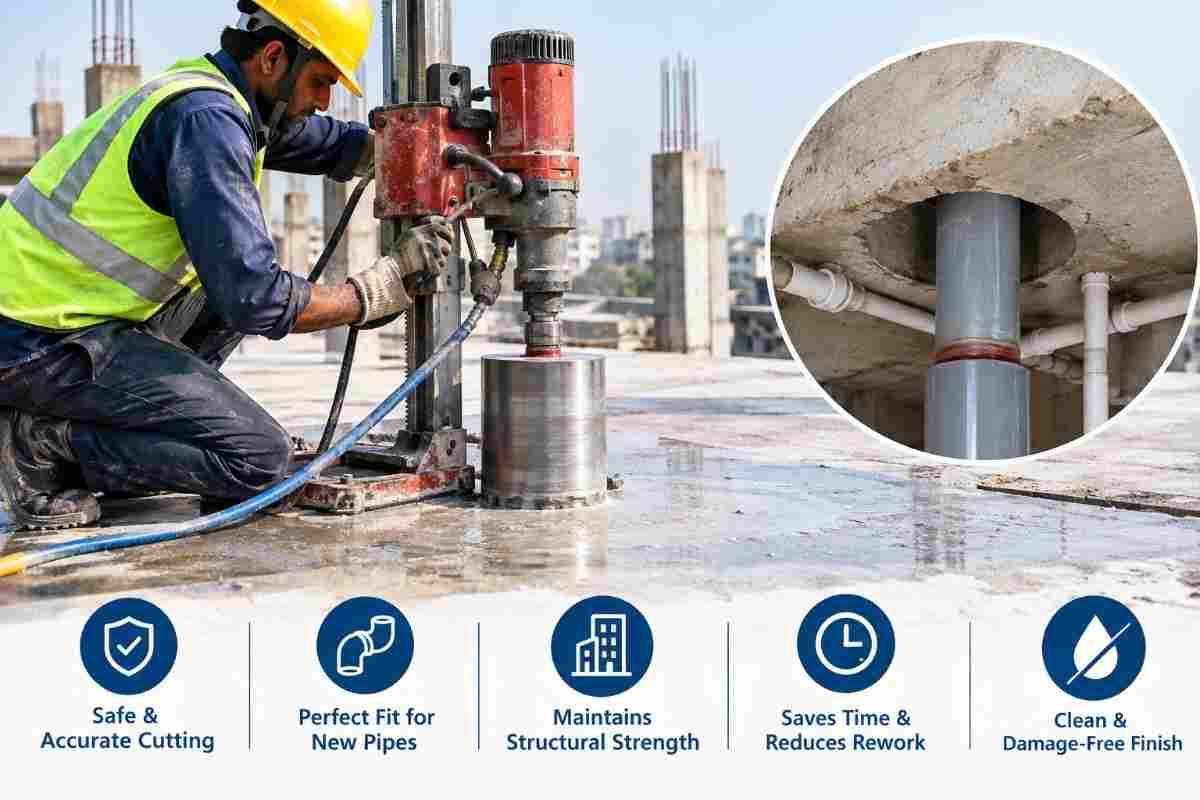
Every building eventually needs a change. A new bathroom is added, a kitchen is relocated, an extra floor drain is required, or a fire-fighting line has to pass through an existing floor. All of these have one thing in common: they need a clean, accurate opening through a reinforced cement concrete (RCC) slab.
It is tempting to treat this as a small job. Hire a labourer with a hammer and chisel, break a hole, and fix the pipe. But an RCC slab is not a plain block of concrete. It is an engineered element made of concrete and steel reinforcement that works together to carry loads. A badly made opening can weaken it, crack it, leak, or cost far more to repair than the original work would have cost to do properly.
This is why professional RCC slab cutting matters. In this guide, we explain what it involves, what goes wrong with unprofessional methods, and how to choose the right service for your new pipe openings. At Core Cutting India, we see the results of both approaches, and the difference is significant.
What Is RCC Slab Cutting?
RCC slab cutting is the controlled removal of a section of a reinforced concrete slab using specialised diamond-tipped tools. For pipe openings, the most common method is core cutting (also called core drilling). A hollow cylindrical bit with diamond segments on its edge is rotated against the concrete, usually with water as a coolant, producing a perfectly round hole and a solid cylinder of concrete (the “core”) that is removed intact.
Other related methods include:
- Wall saw cutting, for large or straight-edged openings in walls.
- Slab or floor saw cutting, for long straight cuts in floors, such as trenches for drain lines.
- Wire saw cutting, for very thick or massive structures.
For circular pipe penetrations, core cutting is almost always the preferred technique, because it produces a clean, precise hole of exactly the required diameter with minimal disturbance to the surrounding structure.
Why New Pipe Openings Need Special Care
When a building is constructed, the plumbing sleeves and openings are usually planned in advance and cast into the slab. A new pipe opening is different. You are cutting into concrete that has already cured, is already carrying load, and already contains reinforcement bars, electrical conduits, or even post-tensioned cables.
Several factors make this delicate:
- The slab is load-bearing. It transfers weight from the floor above to beams and columns.
- Reinforcement steel is hidden inside. Cutting through the wrong bar can reduce the slab’s strength.
- Services may be embedded. Electrical conduits, water lines, or other utilities might lie in your cutting path.
- The building is often occupied. Noise, dust, and vibration affect residents, tenants, or machinery below.
- Finish matters. The opening must be clean enough for proper sealing, sleeving, and waterproofing.
Each of these risks is manageable with the right equipment, planning, and experience. None of them is manageable with a hammer.
The Hidden Dangers of Unprofessional Slab Breaking
Many property owners choose manual breaking to save money. Let us look at what can go wrong.
1. Structural Damage and Cracking
Hammering and chiselling send shock waves through the slab. The impact can create micro-cracks that spread well beyond the intended opening. These cracks may not be visible immediately, but over time they allow moisture to enter, corrode the steel, and weaken the slab. Core cutting, by contrast, removes the concrete through grinding action without impact or vibration.
2. Irregular, Oversized Openings
Manual breaking nearly always produces ragged edges and holes larger than needed. The excess then has to be filled with grout or patch mortar, which is weaker than the original concrete and prone to cracking and leakage. A core-cut hole matches the pipe or sleeve diameter, so the fit is tight and clean.
3. Cutting Through Critical Reinforcement
Without scanning, a worker cannot know where the rebar lies. Cutting a main reinforcement bar by accident reduces the slab’s tensile capacity right where it is needed. In post-tensioned slabs, striking a tendon can be dangerous and extremely costly. Professionals use scanning methods first to locate steel and embedded services, then choose the safest position for the opening.
4. Water Leakage and Seepage
In wet areas such as bathrooms, kitchens, and terraces, an imperfect opening is a leakage point. Rough edges make it hard to create a waterproof seal around the pipe. Over time, water seeps into the slab and the ceiling below, causing dampness, stains, mould, and expensive repairs.
5. Safety Hazards
Chipping concrete produces flying fragments and heavy dust. Workers risk eye injuries, hand injuries, and inhaling silica dust, which is a serious long-term health hazard. Falling debris can also injure people or damage property below.
6. Hidden Costs
What seems cheaper at first often becomes more expensive: extra patching, waterproofing repairs, ceiling repainting, structural consultation, and rework. A single poorly cut opening can cost more to fix than a professional job would have cost in the first place.
Benefits of Professional RCC Slab Cutting for Pipe Openings
Precision and Accuracy
Diamond core cutting produces holes in exact diameters, from small openings for electrical or small plumbing lines to large ones for drainage, ventilation, and fire-fighting pipes. The edges are smooth and the walls of the hole are straight, which allows proper sleeve installation and sealing.
Minimal Vibration and Structural Impact
Because the process is based on abrasion rather than impact, the surrounding concrete stays intact. This is especially important in older buildings, heritage structures, or slabs that are already showing signs of stress.
Protection of Reinforcement and Embedded Services
Professional teams scan the slab before cutting. Using this information, they position the opening to avoid main bars, conduits, and pipes wherever possible. If a bar must be cut, the decision is made deliberately and, where required, with guidance from a structural engineer.
Clean and Low-Dust Operation
Wet cutting uses water to cool the bit and suppress dust. This keeps the work area cleaner and greatly reduces airborne silica. Slurry is collected using vacuum or containment methods, so floors and furnishings stay protected.
Speed and Efficiency
A core cutting machine can drill through a standard slab in minutes. Compared with manual breaking, which can take hours and produce piles of debris, professional cutting is faster and generates less rubble to clear.
Reduced Noise
Although machinery does make some noise, the continuous, low-impact sound of core drilling is usually far more tolerable than the repeated banging of hammers. This matters in hospitals, offices, residential societies, and commercial buildings.
Better Waterproofing and Sealing
A clean, circular opening allows installation of a proper sleeve with water-stop collars, sealants, and non-shrink grout. The result is a long-lasting, leak-resistant penetration.
How Professional RCC Slab Cutting Works: Step by Step
Understanding the process helps you judge whether a service provider is doing the job correctly.
Step 1: Site inspection and planning. The team studies the slab, its thickness, access conditions, and the area below. The exact location and diameter of each opening are marked.
Step 2: Scanning. The slab is checked for rebar, conduits, and other embedded elements. The position is adjusted if something critical is in the way.
Step 3: Safety setup. The area below is cleared or protected. Power supply, water supply, and slurry control arrangements are made.
Step 4: Machine fixing. The core drilling rig is anchored firmly to the slab, using a bolt or vacuum base, so it stays stable and perfectly vertical.
Step 5: Cutting. The diamond bit is selected to suit the concrete and reinforcement density. It is advanced steadily with continuous water flow until the core breaks through.
Step 6: Core removal and cleaning. The cylindrical core is lifted out, and the opening and surrounding area are cleaned.
Step 7: Inspection and handover. The opening is checked for size and finish, ready for sleeve installation and pipe fixing.
When Do You Need Professional RCC Slab Cutting?
Professional cutting is the right choice in situations like these:
- Adding a new bathroom, toilet, or kitchen in an existing building
- Installing additional floor drains or waste lines
- Routing water supply, sewer, or rainwater pipes through slabs
- Laying fire-fighting, HVAC, or ventilation lines
- Passing electrical conduits or cable trays between floors
- Installing exhaust ducts or chimney lines
- Renovating older buildings where services must be upgraded
- Industrial and commercial projects with new equipment lines
In any of these cases, the opening is a permanent part of the building. It deserves to be done once and done right.
Key Factors That Influence Cost
Property owners often ask about the cost of RCC slab cutting. While exact pricing depends on the project, these factors usually determine the quote:
- Diameter of the hole. Larger diameters need bigger bits and more time.
- Depth or thickness of the slab. Thicker slabs take longer to cut.
- Reinforcement density. Heavily reinforced concrete wears bits faster.
- Number of openings. Multiple holes in one visit often reduce the per-hole cost.
- Accessibility. Cutting at height, in tight spaces, or in basements may need special set-ups.
- Location and mobilisation. Distance to the site can affect charges.
It is wise to compare quotes on what is included, such as scanning, water supply, slurry management, and cleaning, rather than on price alone.
How to Choose a Reliable RCC Slab Cutting Service
Not all providers deliver the same quality. When selecting one, look for the following:
- Experience. Ask how many similar projects they have completed and whether they handle both residential and commercial sites.
- Modern equipment. Diamond core drilling machines, quality bits, and scanning tools are essential.
- Trained operators. Skilled technicians make better decisions about positioning, speed, and safety.
- Safety practices. Look for protective gear, controlled slurry handling, and respect for the occupants and property.
- Clear quotation. A transparent estimate with no hidden extras signals professionalism.
- Range of services. Providers who also offer wall cutting, wire sawing, and floor sawing can manage larger or more complex requirements.
- References and reviews. Feedback from past clients shows how they actually perform.
At Core Cutting India, we focus on precise, clean, and safe concrete cutting so that your new pipe openings are right the first time.
Best Practices Before You Book a Cutting Job
Preparation helps the job go smoothly:
- Finalise pipe sizes and positions with your plumber or designer before cutting begins.
- Check building drawings if available, to understand beam and column locations.
- Consult a structural engineer for large openings or if the slab is old, heavily loaded, or post-tensioned.
- Clear the work area above and below the slab.
- Inform neighbours or occupants about the schedule.
- Plan sleeve and waterproofing materials in advance, so installation follows immediately after cutting.
Frequently Asked Questions
Can I make a hole in an RCC slab myself?
It is technically possible with a hammer drill and chisel, but it is not advisable. Without scanning and proper equipment, you risk cutting reinforcement, cracking the slab, and creating an uneven opening. Professional core cutting is safer and more reliable.
Is core cutting safe for the structure?
Yes, when done correctly. Core cutting removes concrete without impact, so it creates very little vibration or cracking. Proper planning and scanning ensure that critical reinforcement is protected.
How long does it take to cut a pipe opening in an RCC slab?
A single standard opening can often be completed in a short time, typically minutes to a little over an hour, depending on diameter, thickness, and reinforcement. Setup and cleaning add to the total duration.
What is the difference between core cutting and slab sawing?
Core cutting makes round holes using a hollow diamond bit. Slab sawing makes straight cuts for trenches or rectangular openings. For pipe openings, core cutting is the usual choice.
Will cutting damage the rebar?
If the opening location is chosen after scanning, damage to main reinforcement can usually be avoided. If a bar must be cut, a structural engineer should approve the plan.
Is wet cutting better than dry cutting?
For most slab work, yes. Water cools the bit, extends its life, and controls dust, which makes the process cleaner and safer.
Can large-diameter openings be cut in slabs?
Yes. Modern diamond core machines can cut large diameters, though very large openings may require saw cutting and structural review.
How do I prevent leaks after making a pipe opening?
Use a properly sized sleeve, fix it with non-shrink grout, and apply waterproofing and sealant around the pipe. A clean core-cut hole makes this far easier.
Conclusion
New pipe openings may look like a minor part of a renovation or construction project, but they affect a building’s strength, safety, and durability. A hole broken with a hammer can bring cracks, leaks, damaged reinforcement, and repair bills. A hole created through professional RCC slab cutting is precise, clean, and structurally sound.
By choosing diamond core cutting carried out by experienced operators, you protect your slab, your occupants, and your budget. You also get an opening that is ready for proper sealing and long-term performance.
If you are planning new pipe openings in an RCC slab, speak to the team at Core Cutting India. Plan the work, scan the slab, cut it professionally, and your building will thank you for years to come.