
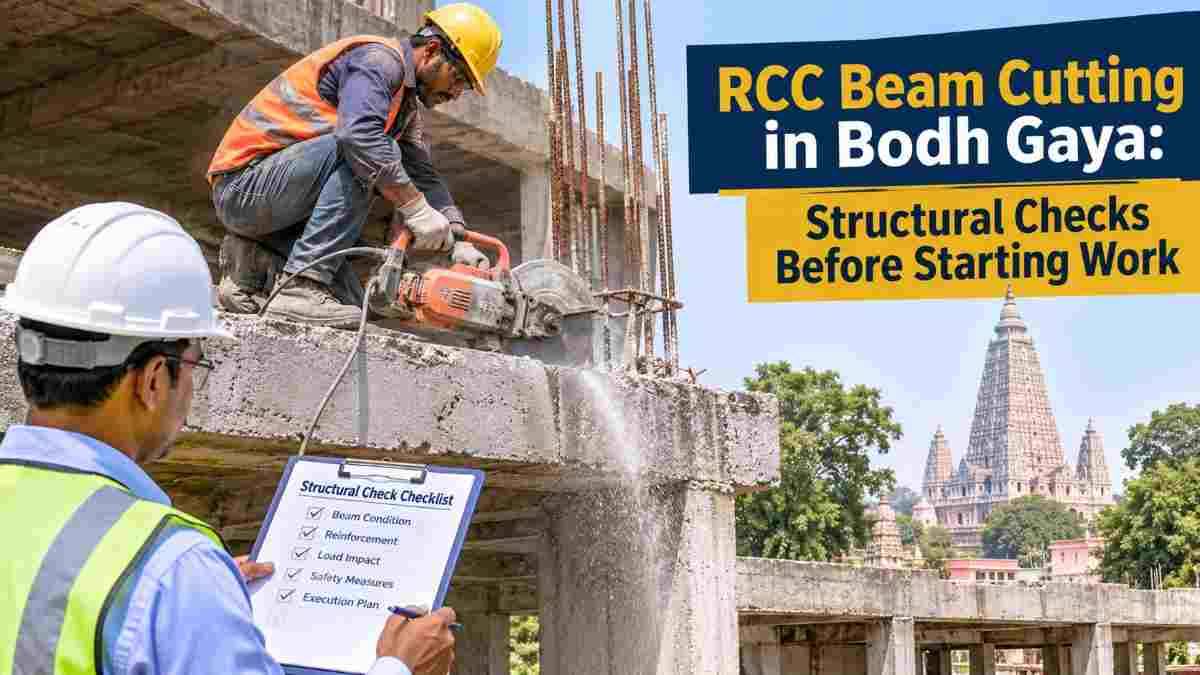
Bodh Gaya is changing quickly. Guesthouses, monasteries, hotels, schools and homes are being renovated and extended to serve the pilgrims, monks and tourists who arrive every year. Many of these projects need openings cut through reinforced cement concrete (RCC) members: new staircases, lift shafts, duct and pipe routes, or reworked floor layouts. Sooner or later, someone asks whether a beam can be cut.
The answer is rarely a simple yes or no. A beam is not a wall. It is a primary structural member that carries slab loads, transfers them to columns, and resists bending and shear. Cutting it without proper checks can cause cracking, excessive deflection, or in the worst case, partial collapse.
This guide explains the structural checks to complete before any RCC beam cutting starts in Bodh Gaya. Whether you are a property owner, contractor or site engineer, it will help you plan safely and avoid costly mistakes. It is general guidance. Every building is different, and the final decision must come from a qualified structural engineer.
Why RCC Beam Cutting Is Not Like Ordinary Concrete Cutting
Cutting a core through a slab or a small opening in a non-load-bearing wall is routine. Beam cutting is a different category of work for three reasons.
1. Beams carry concentrated loads. A typical beam supports its own weight, the slab on top of it, the brickwork above it, and sometimes loads from columns or beams above. Removing concrete or steel from it changes how that load travels.
2. Reinforcement does the real work. Concrete is strong in compression but weak in tension. The steel at the bottom of a beam handles tension from bending, and the stirrups (shear links) resist diagonal shear cracking. Cutting through these bars, or damaging them by accident, can seriously weaken the member.
3. Failures can be sudden. A badly cut beam may not show distress immediately. Cracks, sagging or failure can appear hours or days later, often once new loads are placed.
That is why professional contractors treat beam cutting as an engineered operation, not a simple demolition task.
Step 1: Collect the Structural Drawings and Building History
Before anything else, gather every available document about the building:
- Architectural and structural drawings
- Beam schedules showing sizes and reinforcement details
- Approved building plan and sanction records
- Records of past additions, floors added later, or earlier renovations
- Concrete grade and steel grade details, if available
In Bodh Gaya, as in many Indian towns, buildings are often extended in stages. A two-storey house may later have a third floor added, or a guesthouse may have been remodelled by successive owners. The original drawings may no longer match what exists today. If drawings are missing or unreliable, tell your engineer early. In that case, more on-site investigation will be needed, such as rebar scanning, cover measurement and perhaps non-destructive testing of concrete strength.
Step 2: Identify the Beam Type and Its Structural Role
Not every beam plays the same role. Your engineer should establish:
- Main beam or secondary beam: Main beams span between columns and carry the greatest loads. Secondary beams usually transfer loads to main beams.
- Plinth, floor, roof or lintel beam: Each has a different function and load path.
- Simply supported or continuous: Continuous beams have both positive and negative moment zones. A cut in the wrong zone can be far more harmful.
- Cantilever beam: Cutting these is extremely sensitive, because the top steel near the support is critical.
- Part of a moment frame: In frame structures, beams and columns work together to resist lateral loads, including earthquakes. Altering a beam can affect the whole frame.
Bihar lies in a region that experiences seismic activity, so lateral load resistance is not a theoretical concern. A beam that looks like it only carries gravity loads may also be contributing to the building’s earthquake performance.
Step 3: Locate Reinforcement with Rebar Scanning or GPR
Never cut blind. Even when drawings exist, the actual placement of steel can differ from the design. Before cutting, use:
- Rebar locator or cover meter: Detects bar position and approximate concrete cover.
- Ground Penetrating Radar (GPR): Gives a more detailed view of reinforcement, conduits and embedded elements, particularly in congested sections.
The scan should identify:
- Main tension bars (top and bottom)
- Stirrup spacing, particularly near supports where shear is highest
- Embedded electrical conduits, pipes or sleeves
- Any post-tensioning tendons, which are uncommon in small buildings but must be ruled out
Mark the findings clearly on the beam surface. If tendons or unexpected congestion are found, stop and consult the engineer. Cutting a post-tensioned member without a specific procedure is dangerous.
Step 4: Get a Structural Engineer’s Assessment and Written Approval
This is the single most important check. A qualified structural engineer should review the proposed cut and decide:
- Whether the cut is acceptable at all. In some cases the answer is no, and the design should change.
- Where the cut can be located. Openings are generally less harmful near mid-depth in low-shear zones, and much riskier near supports, in high-shear zones, or at the extreme tension or compression fibres.
- What size is permissible. Large openings may need reinforcement around them, or the beam may need to be strengthened.
- What strengthening is required. Options include steel plates, steel sections, additional beams, column jacketing or fibre-reinforced polymer wraps.
- The sequence of work. The order of cutting, propping and strengthening matters.
Ask for the decision in writing, with sketches showing the cut location and any strengthening details. The relevant design provisions in India come from IS 456:2000 (plain and reinforced concrete code), and for earthquake-resistant detailing, IS 13920 and IS 1893. Your engineer will use these to check capacity, shear and deflection after the modification.
A verbal “it should be fine” from a contractor or mason is not a substitute for an engineer’s analysis.
Step 5: Plan Temporary Support (Propping and Shoring)
Even a well-designed cut needs temporary support while work is under way. Before cutting, the load on the beam should be taken off or transferred.
Good propping practice includes:
- Installing adjustable steel props under the beam and the slab it supports
- Placing props on solid, stable bearing, not on loose soil, broken tiles or weak floors
- Using timber or steel head plates to spread the load
- Propping floors below where necessary, since load travels downward through several storeys
- Keeping props in place until the strengthening work has gained its required strength
The number and spacing of props depend on beam span, load and the size of the cut. This should be specified by the engineer, not guessed on site.
Step 6: Choose the Right Cutting Method
Once the structural questions are settled, choose the method that suits the job.
Wire saw cutting: A diamond wire loops around the member and cuts it with controlled, low-vibration action. It is well suited to large beams, thick sections and places where a circular blade cannot reach. It produces clean edges and minimal vibration.
Wall saw or slab saw cutting: A track-mounted diamond blade makes straight, precise cuts. It works well for beams and slabs where there is access for the track.
Hand-held ring saw: Useful for small, confined or awkward areas, though depth is limited.
Core drilling: Used for circular openings such as pipe or duct penetrations. Core drilling through a beam must be located carefully to avoid main bars and stirrups, and engineers often limit the diameter and position.
Why not a jackhammer or breaker? Impact tools create vibration and micro-cracking in the concrete that remains. For a member you intend to keep working, diamond cutting is almost always the safer choice.
Diamond cutting also reduces noise and dust compared with demolition, which matters near occupied buildings, temples and monasteries, and in the quieter lanes of Bodh Gaya.
Step 7: Safety, Water, Dust and Site Controls
Structural checks are only part of safe work. Before starting, confirm that:
- Power and water supply are available, with proper electrical protection (RCCB or earth-leakage protection) because water and electricity are used together.
- Slurry management is planned. Diamond cutting uses water, and the resulting slurry should be collected and disposed of properly, not drained into public lanes.
- Work area is barricaded and unauthorised people are kept away, especially below the cut.
- Cut-off pieces are controlled. Large sections need lifting or lowering arrangements, such as chain pulley blocks or temporary supports, so they do not drop uncontrolled.
- Workers wear PPE: helmets, safety shoes, gloves, eye protection and ear protection.
- Utilities are isolated: switch off and verify electrical lines, and check for gas or water lines in the area.
Bodh Gaya-Specific Considerations
Local conditions are worth planning around.
Busy pilgrimage seasons. Bodh Gaya sees peak visitor numbers in the cooler months. Hotels and guesthouses may want work completed in the off-season, and noise or dust control becomes more important when guests are on site.
Proximity to sensitive sites. Work near the Mahabodhi Temple complex, monasteries and other heritage or religious places needs extra sensitivity. Low-vibration, low-noise diamond cutting is far more appropriate than impact demolition. Check whether any local permissions or restrictions apply to the area.
Narrow lanes and access. Many streets are narrow. Plan equipment delivery, slurry disposal and debris removal in advance.
Variable construction quality. Older and informally built structures may have inconsistent concrete strength and reinforcement. This makes on-site investigation especially valuable.
Summer heat and monsoon. Hot weather affects crew comfort and productivity, and monsoon rain affects site access, electrical safety and curing of any repair or strengthening work.
Pre-Cutting Structural Checklist
Use this list before work begins:
- Drawings and building history collected (or on-site investigation arranged)
- Beam type, span and load path identified
- Rebar scan or GPR survey completed and marked
- Structural engineer has approved the cut location and size, in writing
- Strengthening design prepared, if needed
- Propping and shoring designed and installed
- Cutting method selected and matched to access conditions
- Electrical, water and slurry arrangements confirmed
- Safety barricading and PPE in place
- Plan for handling and removing cut pieces ready
- Post-cutting inspection and repair plan agreed
If any item cannot be ticked, pause the work until it is resolved.
Common Mistakes to Avoid
- Cutting first and asking later. Once a beam is cut, it cannot be uncut.
- Relying only on drawings. Actual reinforcement can differ from the design.
- Cutting reinforcement to “make it easier.” Severed main bars reduce capacity directly.
- Skipping propping. Removing support is how sudden failures happen.
- Using impact tools on members that must remain. This risks hidden cracking.
- Ignoring the floors above and below. A beam’s loads and effects extend beyond the single floor.
- Choosing by price alone. Cheaper work with no engineering input can cost far more in repair or liability.
Frequently Asked Questions
Can an RCC beam be cut safely?
Sometimes, yes, but only after a structural engineer has assessed the beam, specified the allowable cut and designed any strengthening and temporary support. In many cases it is safer to redesign the plan than to cut a primary beam.
How do I know where the reinforcement is before cutting?
A rebar scanner or GPR survey maps the position of bars and stirrups. Cutting should never begin until this has been done and the results reviewed by the engineer.
Is it better to cut a beam with a wire saw or a wall saw?
It depends on size, access and the geometry of the cut. Wire saws suit thick or hard-to-reach sections, while wall saws suit straight cuts where a track can be fixed. A professional contractor will recommend the method after seeing the site.
Do I need permission to cut a beam in my building?
Requirements vary by property and location. You should at minimum obtain a structural engineer’s approval, and check with local authorities or your building association if the work affects structural elements, especially in commercial, heritage or multi-owner buildings.
Is core cutting through a beam allowed?
Small cores are sometimes permitted if placed in low-stress zones and away from main reinforcement, but only with engineer approval. Never drill through a beam without scanning first.
How long does RCC beam cutting take?
Time depends on the beam size, access, the chosen method and the amount of propping and strengthening required. The preparation phase, which includes investigation, design and propping, often takes longer than the cutting itself.
What happens if a beam is cut incorrectly?
Possible consequences include cracking, excessive deflection, reduced load capacity and, in severe cases, local or progressive collapse. Remedial strengthening can be expensive and disruptive.
Will cutting a beam create a lot of dust and noise?
Diamond cutting with water produces far less dust and vibration than breaking concrete, which makes it suitable for occupied buildings and sensitive locations.
Final Thoughts
RCC beam cutting in Bodh Gaya, like anywhere, rewards preparation. The cutting itself may take only hours. The decisions made before it, namely understanding the structure, scanning the reinforcement, getting engineer approval, designing strengthening and propping the load, determine whether the job is safe and successful.
Treat the structural checks as part of the work, not an obstacle to it. They protect your building, the people inside it and your investment.
If you are planning concrete cutting in Bodh Gaya or nearby areas in Bihar, working with an experienced diamond cutting team makes the process safer and more predictable. Core Cutting India offers professional concrete cutting services, including wire saw cutting, wall cutting and core drilling, with a focus on precision and site safety.
Visit: https://corecuttingindia.com/
Call or WhatsApp: +91 70096 79903