
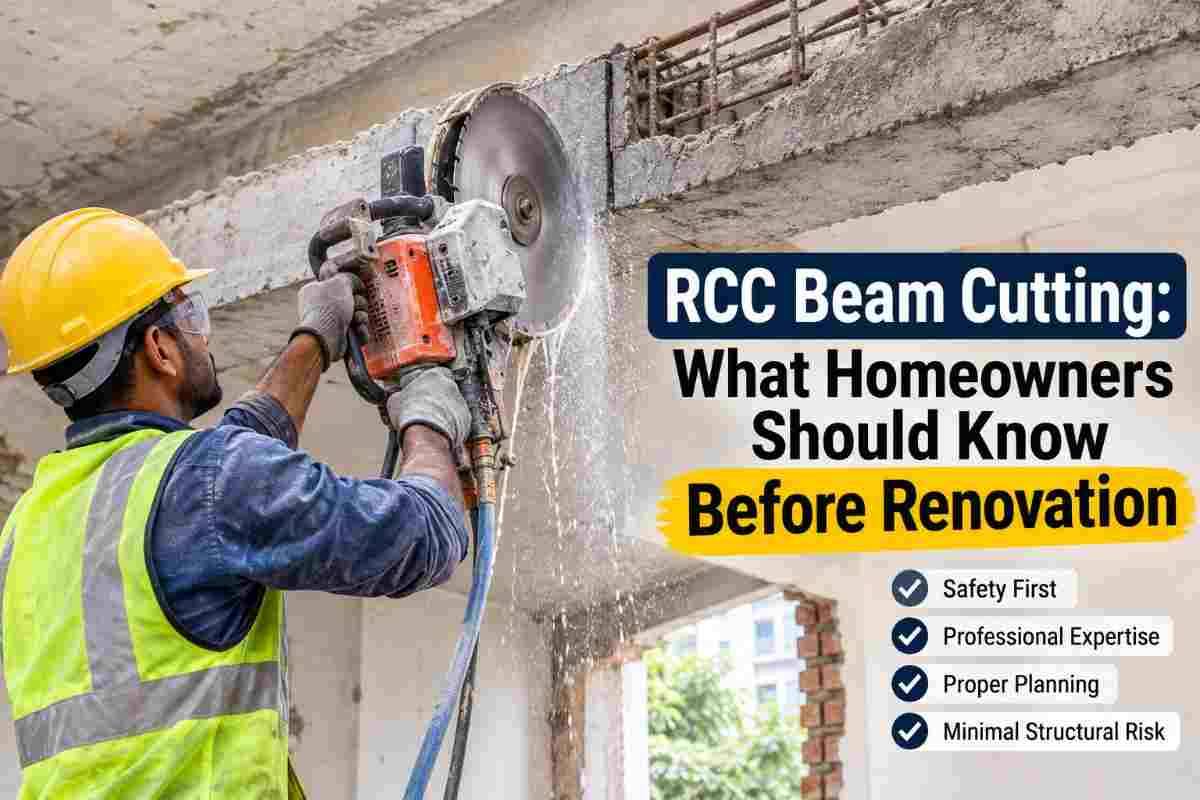
Every renovation starts with a vision: a wider living room, an open kitchen, a new staircase, or a lift shaft in an older home. Sooner or later, that vision runs into a beam. In most Indian homes, which are built with reinforced cement concrete (RCC), beams are the hidden skeleton that holds floors and roofs in place. Cutting or modifying one is not like knocking down a partition wall.
This guide explains what RCC beam cutting is, when it can be done, what risks it carries, and what you should check before you hire anyone. It is written for homeowners, so you can make informed decisions and ask the right questions. It is published by Core Cutting India, a specialist concrete cutting service.
What Is RCC Beam Cutting?
RCC beam cutting is the controlled removal or modification of a reinforced concrete beam, or a section of it. Unlike demolition with hammers or breakers, professional concrete cutting uses diamond-tipped tools that slice through concrete and steel reinforcement cleanly, with far less vibration, noise, and damage to the surrounding structure.
A reinforced beam consists of concrete and embedded steel bars (rebar) tied together with stirrups. The concrete resists compression, while the steel handles tension. Cutting through it means dealing with both materials, which is why ordinary tools are rarely suitable.
The term can cover several situations:
- Complete beam removal: taking out an entire beam, which usually requires a redesigned load path.
- Partial cutting: removing a section to create an opening or passage.
- Notching or chasing: cutting small recesses for pipes, ducts, or cables (this also needs engineering approval).
- Cutting for extension work: trimming a beam end to connect a new structure.
Why Do Homeowners Need Beam Cutting?
People usually search for RCC cutting services in these situations:
- Opening up spaces: merging two rooms or widening a doorway.
- Installing a lift: adding an elevator shaft to an existing multi-storey home.
- Creating a new staircase: cutting a floor slab or beam to make a stair opening.
- Rerouting plumbing, HVAC, or electrical lines: where a beam blocks the path.
- Fixing construction errors: correcting a misplaced or poorly designed beam.
- Redevelopment and remodelling: changing the layout of an older property.
In all of these, the goal is the same: change the space without compromising the structure. That is where the planning matters more than the cutting itself.
The Most Important Thing: A Beam Is Not Just a Piece of Concrete
Beams carry loads from slabs, walls, and upper floors and transfer them to columns and then to the foundation. Removing or weakening a beam can redistribute these loads in unexpected ways, leading to:
- Cracks in walls, ceilings, and floors
- Sagging or deflection of slabs
- Damage to adjacent beams and columns
- In serious cases, partial or total structural failure
Some beams are obviously load-bearing, while others only appear to be non-structural. You cannot tell the difference by looking. A structural engineer must assess it using drawings and, if needed, on-site investigation.
Rule of thumb: never cut a beam on the advice of a mason or a general contractor alone. Get a qualified structural engineer to approve the plan in writing first.
Step 1: Get a Structural Assessment
Before any cutting begins, a structural engineer should:
- Review the original drawings (if available) to understand the beam’s role, size, and reinforcement.
- Inspect the building’s condition, including its age, existing cracks, signs of corrosion, and past modifications.
- Calculate the load path to determine what happens if the beam is cut or removed.
- Design the alternative support, such as a steel beam, new RCC beam, or column jacketing, if the beam must be replaced.
- Specify the cutting sequence and temporary support requirements.
For older buildings with no drawings, the engineer may use tests such as rebound hammer tests or rebar scanning to estimate concrete strength and reinforcement layout. This adds a little to the cost but avoids guesswork on something that holds up your home.
Step 2: Check Permissions and Rules
Depending on your city and the type of property, structural alterations may require approval from the local municipal body or development authority. If you live in an apartment, you will almost certainly need permission from the housing society or resident welfare association (RWA), since beams and columns are typically part of the common structure.
Some key points to verify:
- Whether your local building bye-laws allow structural modification.
- Whether society or builder consent is needed (especially in apartments).
- Whether neighbours could be affected, particularly in shared-wall or row-house constructions.
- Whether your insurance and home loan terms are affected by structural changes.
Skipping permissions can lead to legal trouble, stop-work orders, or difficulty when you later sell the property.
Step 3: Understand the Cutting Methods
Modern concrete cutting is precise, relatively quiet, and generates far less vibration than conventional demolition. The most common methods used in RCC beam cutting are:
Wire Saw Cutting
A wire saw uses a continuous loop of wire embedded with diamond beads, pulled through the concrete by a motor. It is ideal for thick, large, or awkwardly shaped members like heavy beams, because it can cut sections of almost any size and in confined locations. It cuts cleanly through both concrete and rebar.
Wall Saw (Track Saw) Cutting
A wall saw is mounted on a rail attached to the structure and uses a large circular diamond blade. It makes straight, accurate cuts and is well suited to slabs, walls, and some beams. Cut depth depends on blade size.
Hand-Held Ring or Chain Saw Cutting
Used for smaller jobs and tight spaces, these are portable tools suited to limited cutting where larger machines won’t fit.
Core Drilling
While not a cutting method for the beam itself, core drilling is commonly used to make clean, round holes for pipes and conduits, or to create relief holes before sectional cutting. Any holes through a beam must still be approved by the structural engineer, as location and size matter greatly.
Why Not a Jackhammer?
Breaker-based demolition sends strong vibrations through the structure, can create micro-cracks in adjacent elements, damages concrete you want to preserve, and creates more dust and noise. For beams that are part of an occupied building, diamond cutting is typically the safer and cleaner choice.
Step 4: Temporary Support (Propping and Shoring)
Before a beam is cut, the load it carries must be taken over by temporary supports. This is called propping or shoring, and it is non-negotiable.
Props, usually adjustable steel props or heavy-duty shoring frames, are placed under the slab or beam to hold it while the cutting is carried out and until the permanent support is installed and has gained strength. The engineer specifies the number, position, and duration of the props.
Be wary of any contractor who proposes to cut a structural beam without a clear propping plan.
Step 5: Cutting in a Planned Sequence
A well-run cutting job typically follows this order:
- Marking and layout: cut lines are marked exactly as per the engineer’s drawing.
- Site protection: floors, furniture, and nearby fittings are covered, and dust and slurry control is arranged.
- Propping: temporary supports are installed and checked.
- Cutting in sections: large beams are cut into manageable pieces rather than removed in one go.
- Safe removal: cut sections are lifted or lowered carefully, often with hoists or manual handling depending on weight.
- Installation of permanent support: new steel or RCC elements are fixed as designed.
- Cleanup and inspection: debris and slurry are removed, and the work is reviewed.
What Affects the Cost of RCC Beam Cutting?
There is no single price, because each job is different. Costs generally depend on:
- Beam size and thickness: more concrete and steel mean more cutting time and wear on diamond tools.
- Amount of reinforcement: heavily reinforced beams cut slower.
- Accessibility: cramped, high, or hard-to-reach locations may need special equipment.
- Cutting method: wire sawing often costs more than wall saw cutting but may be the only option for certain beams.
- Temporary support requirements: props and shoring add to the project cost.
- Debris removal and disposal: hauling away heavy concrete is a real expense.
- Engineering and permissions: the structural design fee and any approvals are separate from the cutting cost.
- Location and mobilisation: transporting machines and crew to your site.
Always ask for an itemised quote that clearly lists what is included, so you can compare offers fairly. The cheapest quote is not always the best, especially when structural safety is involved.
Common Mistakes Homeowners Should Avoid
- Assuming a beam is “decorative.” Many beams look like design features but carry real loads.
- Hiring without an engineer. A contractor’s confidence is not a substitute for structural calculations.
- Skipping propping to save money. This is one of the riskiest shortcuts.
- Cutting before the replacement support is ready. The sequence matters.
- Ignoring the building’s age. Older concrete may have corroded rebar or reduced strength.
- Not informing neighbours or the society. Vibration, noise, and dust affect others and can cause disputes.
- Accepting vague quotes. Unclear scopes lead to hidden charges later.
- Neglecting post-cutting finishing. Cut surfaces and exposed rebar need proper treatment to prevent corrosion.
How to Choose a Concrete Cutting Contractor
When comparing providers, look for:
- Relevant experience with structural cutting, not just wall chasing or small drilling jobs.
- Modern diamond equipment, including wire saws and wall saws, in good working condition.
- A willingness to work with your structural engineer and follow the approved plan.
- Clear safety practices, including propping, PPE, and dust and slurry management.
- Transparent pricing and a written scope of work.
- References or past project examples you can verify.
- Responsive communication, since a good contractor answers your questions patiently.
At Core Cutting India, we focus on precision concrete cutting for homes, commercial buildings, and infrastructure, and we work alongside your engineer and project team to keep your renovation safe and on schedule.
Frequently Asked Questions About RCC Beam Cutting
Can I cut an RCC beam in my house?
In many cases, yes, but only after a structural engineer has assessed the building and designed the necessary support. Cutting a beam without this assessment is risky and can lead to serious structural damage.
Is it safe to remove a beam during renovation?
It can be safe when it is planned and executed properly. That means an engineer’s design, temporary propping, correct cutting methods, and proper permanent support. Without these, it is unsafe.
How do I know if a beam is load-bearing?
You can’t reliably tell by appearance. Load-bearing status is determined from structural drawings and engineering analysis. Beams that seem minor can carry significant loads.
What is the best method to cut a concrete beam?
It depends on the beam’s size and location. Wire saw cutting is popular for thick or large beams, while wall saws suit straight cuts in accessible areas. A professional will recommend the method after seeing your site.
How much does RCC beam cutting cost?
Costs vary based on beam dimensions, reinforcement, access, method, propping, and debris removal. A site inspection is the best way to get an accurate quote.
Does beam cutting cause cracks in the rest of the building?
Diamond cutting causes much less vibration than breaker demolition, which lowers the risk of cracks. But if the load isn’t properly supported or redistributed, cracking can still occur, which is why engineering and propping matter.
Do I need permission to cut a beam?
Often, yes. Requirements vary by city and property type, and apartment owners usually need society or builder consent. Check with your local authority and housing society before starting.
How long does RCC beam cutting take?
A small job may take a few hours to a day, while larger or more complex beams can take several days, particularly when propping and replacement support installation are included.
Can a cut beam be replaced with steel?
Yes, steel beams or new RCC members are commonly used as replacements, but the design must come from a structural engineer, including connection details and bearing arrangements.
Is noise and dust a problem during cutting?
Diamond cutting is generally quieter and cleaner than traditional demolition, especially with water cooling that controls dust. Some noise and slurry are still expected, so protect your belongings and plan ahead.
A Quick Pre-Renovation Checklist
Before you book any RCC cutting work, make sure you can answer “yes” to these:
- Has a qualified structural engineer reviewed the plan?
- Do you have written approval and a design for the cutting and replacement support?
- Have you checked local rules and society or builder permissions?
- Is there a clear propping and sequencing plan?
- Do you have an itemised written quote?
- Have you informed neighbours and arranged for debris removal?
- Is a post-cutting inspection and finishing included?
Final Thoughts
RCC beam cutting can transform a home, opening up space, light, and possibilities that seemed out of reach. But it is a structural intervention, not a cosmetic one. The safest renovations are those where the engineer, the cutting contractor, and the homeowner work together from the start.
Take your time, ask questions, and never let anyone rush you into cutting a beam without proper assessment and support. A well-planned job protects your family, your investment, and your neighbours.
If you’re planning a renovation that involves RCC beam cutting, wall cutting, slab cutting, or core drilling, the team at Core Cutting India is ready to help with a site visit and a clear quote.
📞 Call us today: +91 70096 79903
🌐 Website: https://corecuttingindia.com/