
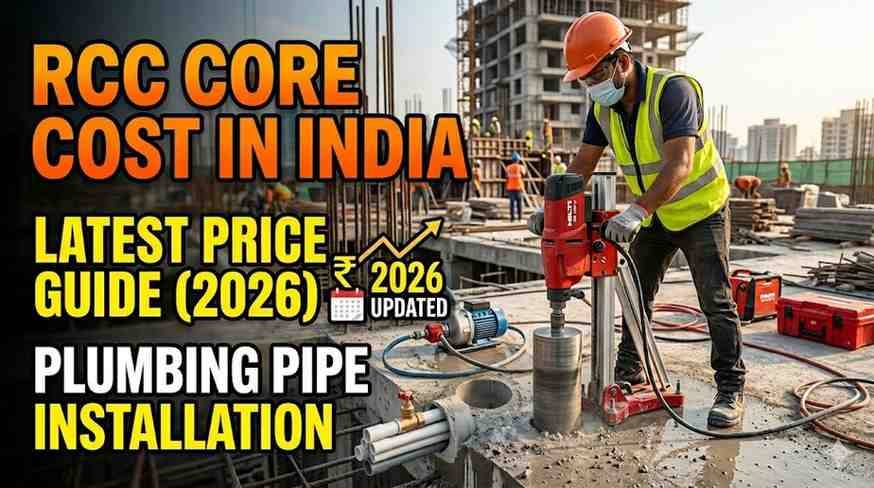
Plumbing work in an RCC (Reinforced Cement Concrete) structure is never as simple as picking up a hammer and chisel. Walls, slabs, and beams are load-bearing, and a careless hole can crack tiles, weaken reinforcement, or trigger seepage that shows up months later. That's exactly why RCC core cutting for plumbing pipes has become the standard method for creating clean, accurately sized openings for water supply lines, drainage pipes, and sewer connections in residential, commercial, and industrial buildings.
If you're searching for a reliable core cutting service for plumbing pipes, this guide explains what the process involves, why it matters, and how to choose the right contractor — and at the end, you'll find quick answers to the questions people ask us most often.
What Is RCC Core Cutting?
RCC core cutting is a precision drilling technique that uses a diamond-tipped core bit mounted on a motorized rig to cut perfectly round holes through reinforced concrete. Unlike manual breaking or hammer drilling, core cutting machines rotate at controlled speeds while water cools the bit, producing a smooth, accurate hole with no cracking, no dust clouds, and minimal vibration to the surrounding structure.
For plumbing applications specifically, core cutting is used to create openings for:
- CPVC and PVC water supply pipes
- Drainage and waste pipes
- Sewer and soil pipes
- Rainwater downpipes
- Sleeve pipes for future plumbing runs
- AC drain lines and HVAC piping that run alongside plumbing
Hole diameters typically range from 25mm for small supply lines to 300mm or more for large sewer and drainage pipes, depending on the pipe specification.
Why Core Cutting Is the Right Method for Plumbing Pipes
1. No Damage to Reinforcement Bars
Plumbers and builders often need to pass pipes through RCC slabs and beams that contain steel reinforcement. A skilled core cutting operator uses a rebar detector before drilling to locate steel bars and plan the hole position so the structural integrity of the slab is never compromised. This is something a manual breaker simply cannot guarantee.
2. Dust-Free and Low-Vibration Process
Traditional concrete breaking generates heavy dust and shakes the entire structure, which is risky in occupied buildings, hospitals, and finished interiors. Wet diamond core drilling keeps dust suspended in water rather than airborne, and the controlled rotary action produces far less vibration than hammering — making it safe for occupied flats, offices, and heritage structures.
3. Accurate, Clean, Reusable Openings
A core-cut hole is perfectly circular and exactly the diameter the pipe needs. This means a tighter, leak-resistant fit when the pipe is sealed and grouted, compared to the uneven, oversized holes left by manual chiseling.
4. Works on Any Thickness and Angle
Modern core cutting rigs can cut through slabs, beams, shear walls, and footings of varying thickness, and can drill at angles when plumbing routes require a non-vertical pass-through.
5. Faster Project Timelines
Because the hole is cut once, cleanly, there's no follow-up patching of accidental cracks or oversized gaps. This keeps plumbing and waterproofing schedules on track, which matters a lot on commercial and high-rise projects.
Common Applications of Core Cutting for Plumbing Pipes
- Residential buildings: Bathroom and kitchen pipe routing through slabs and walls
- High-rise apartments: Vertical sewer and drainage shafts passing through multiple floors
- Commercial complexes: Large-diameter drainage and HVAC drain lines
- Industrial plants: Process piping through thick RCC walls and footings
- Renovation and retrofit projects: Adding new plumbing lines to existing structures without demolishing walls
- Basement and water tank plumbing: Inlet/outlet pipe openings in tanks and underground structures
The RCC Core Cutting Process, Step by Step
- Site survey and marking — The exact pipe entry and exit points are marked based on the plumbing drawing.
- Rebar detection — A scanner checks for embedded steel to avoid cutting through structural reinforcement.
- Rig setup — The core drilling machine is anchored securely to the wall, slab, or beam.
- Wet diamond drilling — The diamond core bit cuts through the RCC with continuous water cooling.
- Core extraction — The cut concrete cylinder (the "core") is removed cleanly.
- Edge finishing — Edges are smoothed and checked against the required pipe diameter.
- Handover for pipe fixing — The opening is ready for the plumber to install and seal the pipe.
The entire process is far quicker and cleaner than conventional breaking, especially when multiple holes are needed across several floors.
Choosing the Right Core Cutting Contractor
Not every core cutting team has the experience needed for plumbing-specific work. Here's what to look for:
- Experience with plumbing layouts, not just generic concrete cutting
- Rebar scanning equipment to protect structural integrity
- Diamond core bits in multiple diameters to match pipe specifications
- Proper water management on site to avoid mess in finished areas
- Safety compliance for working at height or in occupied buildings
- Transparent pricing based on hole diameter, slab thickness, and quantity
A contractor who understands plumbing requirements will coordinate directly with your plumber on pipe sizes, slopes for drainage lines, and sleeve requirements — saving you from rework later.
Why Choose Core Cutting India
At Core Cutting India, we specialise in RCC core cutting for plumbing pipes across residential, commercial, and industrial projects. Our team uses advanced diamond core drilling machines and rebar detection to deliver clean, precise, structurally safe openings — every time.
What sets us apart:
- Experienced operators trained specifically in plumbing pipe core cutting
- Dust-controlled, low-vibration drilling suitable for occupied buildings
- All pipe diameters covered, from small supply lines to large sewer cores
- Fast turnaround to keep your plumbing schedule on track
- Pan-India service with local teams for quick site visits
📞 Need RCC Core Cutting for Plumbing Pipes? Get a Free Quote Today
Don't risk cracked slabs or weakened walls with manual breaking. Talk to our core cutting experts and get accurate, damage-free pipe openings done right the first time.
Call or WhatsApp now: 7009679903 Email us: [email protected] Visit: corecuttingindia.com
Whether it's a single bathroom pipe opening or a multi-floor sewer shaft for a high-rise, our team is ready to handle it with precision and care. Reach out on WhatsApp at 7009679903 for instant quotes and site visit scheduling.
Related Services You May Need
- Core Cutting for Electrical Conduits
- RCC Wall Cutting Services
- Concrete Core Drilling for HVAC Ducts
- Diamond Core Cutting for Sewer Lines
(Replace these with your actual internal page URLs for the strongest SEO interlinking benefit.)
Frequently Asked Questions (FAQ)
1. What is RCC core cutting used for in plumbing? RCC core cutting creates precise round holes through reinforced concrete slabs, beams, and walls so that water supply, drainage, and sewer pipes can pass through without damaging the structure.
2. Is core cutting safer than manual breaking for plumbing pipe holes? Yes. Core cutting uses diamond-tipped bits with rebar detection, producing clean, accurate holes with no cracking or vibration damage, unlike manual hammering which can compromise structural strength.
3. What pipe sizes can be accommodated with core cutting? Core cutting machines can drill holes ranging from 25mm for small supply pipes up to 300mm or larger for sewer and drainage pipes, depending on project requirements.
4. Can core cutting be done in occupied buildings? Yes. The wet diamond drilling method is dust-controlled and low-vibration, making it suitable for occupied homes, offices, and hospitals without major disruption.
5. How long does RCC core cutting for a plumbing pipe take? A single hole typically takes 15–30 minutes depending on slab thickness and diameter, though larger diameter sewer cores may take longer.
6. Does core cutting damage the reinforcement bars in concrete? No, when done correctly. Rebar scanning before drilling ensures the cutting position avoids steel reinforcement, preserving structural integrity.
7. How much does RCC core cutting for plumbing pipes cost? Cost depends on hole diameter, slab/wall thickness, location, and number of holes required. Contact us on 7009679903 for a customised quote.
8. Do you provide core cutting services across India? Yes, Core Cutting India provides RCC core cutting services for plumbing pipes across multiple cities in India. Call or WhatsApp 7009679903 to check availability in your area.
Get in touch today for fast, professional, and safe RCC core cutting for plumbing pipes. 📞 Call/WhatsApp: 7009679903 | 📧 [email protected] | 🌐 corecuttingindia.com