
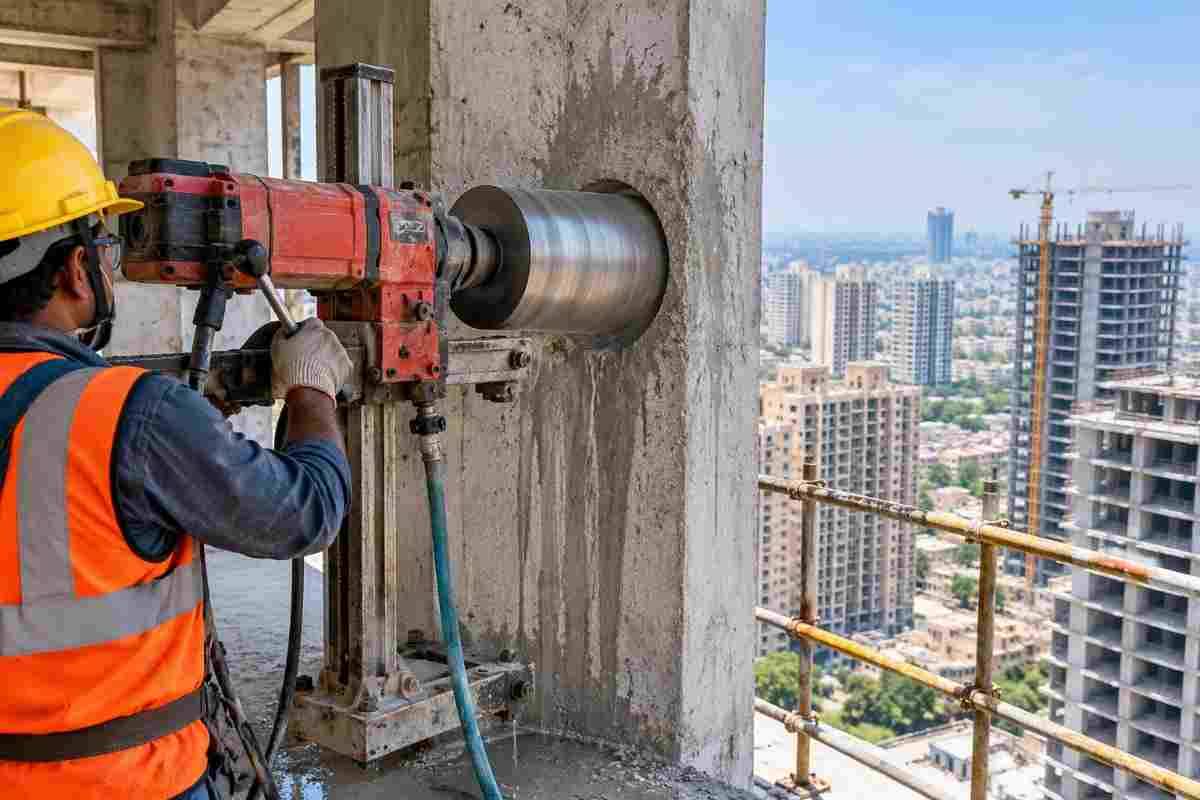
Delhi’s skyline is changing. From Dwarka and Rohini to Gurugram-border corridors, the Central Vista precinct and the redevelopment of East Delhi, tall RCC structures are going up at pace. On every one of these projects, someone eventually has to make a clean, precise opening in hardened concrete for a pipe, a duct, a cable tray or a core sample.
That is where RCC core cutting comes in. Done well, it is invisible. Done badly, it can cut a post-tensioned tendon, weaken a column, flood a floor below or bring the site to a standstill over a dust complaint. This guide, from the team at CoreCuttingIndia.com, covers what contractors working on high-rise buildings in Delhi should know before they order a single core.
What Is RCC Core Cutting?
RCC (reinforced cement concrete) core cutting, also called core drilling, uses a hollow cylindrical bit with industrial diamond segments on its cutting edge. A drill rig spins the bit while water cools it and flushes out slurry. The bit grinds through concrete and rebar, leaving a clean round hole and an intact cylindrical core.
Unlike hammer drilling or breaker work, diamond core cutting does not shatter the surrounding concrete. There is minimal vibration, little micro-cracking and no spalling around the edges. That matters in a high-rise, where slabs, shear walls and columns carry load paths calculated down to the last bar.
Typical hole diameters run from about 25 mm to over 600 mm, and larger openings can be made by overlapping cores or by wall saw and wire saw methods. Hole depth is limited by bit length and extensions, so thick raft foundations and deep shear walls may need specialised setups.
Why Core Cutting Matters More in High-Rises
A low-rise building might need a handful of penetrations after the slab is cast. A high-rise needs thousands. Every tower includes:
- Plumbing and drainage: soil stacks, vent pipes, water supply risers and sleeves for sanitary fittings.
- HVAC: refrigerant lines, condensate drains and duct openings for VRF and split systems.
- Electrical and ELV: cable penetrations, bus duct openings and conduits.
- Fire safety: sprinkler pipework, hydrant risers and smoke exhaust openings.
- Retrofit and fit-out work: changes requested by tenants, late design revisions and missed sleeves.
Ideally, most of these are planned with sleeves cast into the formwork. In reality, drawings change, sleeves get misplaced and clients alter layouts after the slab is poured. Post-cast core cutting is the practical fix, and on tall buildings the volume makes it a scheduling and quality issue, not just a minor task.
Know the Structure Before You Cut
The single most important rule is simple: never cut blind. A high-rise in Delhi sits in Seismic Zone IV under IS 1893, so structural members are typically heavily reinforced and carefully detailed. Cutting through the wrong bar in the wrong place can compromise performance.
Scan before you drill
Reputable contractors use rebar scanners or ground-penetrating radar (GPR) to map reinforcement and embedded services before marking a hole. Scanning identifies:
- Main and distribution bars in slabs and beams
- Stirrups and ties in columns and beams
- Embedded electrical conduits and sleeves
- Post-tensioning ducts and tendons
If you are working on flat-slab or podium structures with post-tensioned (PT) slabs, scanning is non-negotiable. Cutting a stressed tendon can cause a sudden, dangerous release of energy and serious structural damage. Always get the PT layout from the structural consultant and have it approved before any drilling.
Get structural sign-off
Cutting in beams, columns, shear walls and core walls, or openings above a size threshold in slabs, should be cleared by the project’s structural engineer. A common practice is to define permitted zones, such as mid-span slab areas away from column strips, and to prohibit openings near beam-column joints. Keep written approvals, because they protect you if questions arise later.
Respect minimum spacing and edge distances
As a rule of thumb, avoid cutting too close to beams, columns and slab edges, and keep adequate clear spacing between neighbouring holes. Your structural engineer should specify the exact distances for your project. Clustering many cores in one slab area can weaken it even if each hole is small.
Methods Used on High-Rise Sites
Different jobs call for different techniques. A good contractor will match the method to the structure.
Hand-held and rig-mounted core drilling
For holes up to roughly 150 mm in diameter, hand-held drills are common for quick jobs. For larger diameters and deeper holes, rig-mounted machines fixed with an anchor or vacuum base give better alignment and safety. On upper floors, stable mounting is essential because a jammed bit on an unsecured rig can twist violently.
Wall sawing
Wall saws cut straight openings in shear walls and thick partitions for doors, ducts or lift openings. A circular diamond blade runs on a rail anchored to the wall, giving precise, vibration-free cuts.
Slab sawing and wire sawing
Slab saws cut openings in floors for stair modifications or shaft expansions. Wire saws, with a diamond-impregnated wire looped around the element, can cut massive or awkwardly shaped sections such as thick columns, beams and foundations where blades cannot reach.
Core sampling for testing
Core cutting is also used to extract cylindrical samples from existing concrete for compressive strength testing. This is common when cube test results are doubtful, when a structure is being assessed for additional floors or change of use, or during quality audits.
Core Testing: What Contractors Should Know
When cube results are low or in dispute, core testing becomes the arbiter. Practices are guided by IS 456 and IS 516, and the relevant provisions generally state that concrete in a member is considered acceptable if the average strength of cores is at least 85 percent of the specified characteristic strength, and no individual core falls below 75 percent. Verify the current clauses in your project specification and the latest code editions before relying on these figures.
Practical points for taking test cores:
- Choose locations carefully. Avoid cutting near joints, edges or heavily congested reinforcement. Cores should come from representative areas, and the engineer should agree on locations.
- Avoid rebar in the core. Steel within the specimen distorts results. Scan first, and aim for cores free of reinforcement where possible.
- Mind the length-to-diameter ratio. Standard testing expects a suitable aspect ratio, usually close to 1:1 to 2:1 after trimming. Correction factors apply otherwise.
- Label and record everything. Note member, location, direction of drilling, date and moisture condition. Poor documentation can invalidate otherwise sound results.
- Use an accredited lab. NABL-accredited laboratories carry more weight with consultants, clients and authorities.
- Repair the hole properly. Fill core holes with non-shrink grout or a suitable repair mortar, compacted well, so the member is restored.
Delhi-Specific Challenges
Dust and air quality regulations
Delhi’s air quality is a serious public concern, and construction activity is closely monitored. Under the Graded Response Action Plan (GRAP), certain construction activities can be restricted during severe pollution episodes, and dust-control norms issued by the Delhi Pollution Control Committee (DPCC) and the Commission for Air Quality Management (CAQM) apply to larger sites. Wet core cutting produces far less airborne dust than dry methods, which makes it the preferred option. Collect and dispose of slurry properly rather than letting it dry and become dust. Always check the latest notices, because restrictions change with the season and pollution levels.
Noise limits and working hours
Residential and mixed-use neighbourhoods have noise limits, and occupied buildings, such as hospitals, offices and housing societies, may have their own work-hour restrictions. Core cutting is much quieter than breaker work, which is one more reason it is preferred for retrofits next to occupied spaces. Plan noisy tasks around permitted hours and tenant needs.
Water and slurry management
On upper floors, uncontrolled water can damage finishes, electrical panels and equipment on the floors below. Use slurry rings, wet vacuums and drip trays, and protect nearby electrical installations. Never let slurry enter stormwater drains.
Summer heat and monsoon
Delhi’s extreme summers affect crews and equipment. Water supply for cooling bits is critical, and operators need hydration breaks and shade. During monsoon, slippery surfaces and wet conditions on open floors increase risk, so electrical safety (RCD-protected supplies) becomes essential.
Access, logistics and material movement
High-rise sites often have limited hoist capacity and tight schedules. Plan the delivery of rigs, bits, extension rods and water tanks ahead of time. Coordinate with the main contractor so the cutting crew is not waiting for a lift or a work permit.
Safety Practices That Should Be Standard
Core cutting looks simple, but the risks are real, especially at height.
- Permit to work. Obtain site permits, confirm isolation of electrical circuits and verify that nothing sensitive sits below the drilling area.
- Protect the zone below. Mark and barricade the area under the opening. A falling core can weigh several kilograms or much more for large diameters.
- Anchor the rig securely. Use proper anchor bolts or vacuum bases, and check them before starting.
- Electrical safety. Use RCD or GFCI-protected power and keep cables away from water.
- PPE. Helmets, safety shoes, gloves, eye protection, hearing protection and, in dusty conditions, respiratory protection.
- Core catching. For through-holes in slabs, use a supported catch system or lower the core in a controlled way rather than letting it drop.
- Edge protection. Cover or barricade finished openings immediately so no one steps into them.
Choosing the Right Core Cutting Contractor in Delhi
Because the work happens inside live structures, contractor quality matters more than a few hundred rupees saved per hole. When evaluating a provider, ask:
- Do they scan before cutting? Rebar and PT detection should be part of the process.
- What is their equipment range? A good firm offers hand-held, rig-mounted, wall saw and wire saw options.
- Can they handle large diameters and depths? High-rise work often demands more than standard sizes.
- How do they manage slurry and dust? Ask about wet vacuums and disposal practices.
- What is their safety record? Request safety policies, operator training records and insurance.
- Do they provide documentation? Core-sampling jobs especially need labelled, traceable specimens and clear reports.
- Can they mobilise quickly? Tight schedules mean response time matters across Delhi NCR.
- Are their quotes transparent? Clear rates per hole or per metre, with details on minimum charges, height surcharges and scanning, avoid disputes later.
Understanding Costs
Core cutting is typically priced per hole (by diameter and depth) or per running metre of cut for saw work. Prices in Delhi vary widely with diameter, slab thickness, reinforcement density, floor height, access difficulty, quantity and urgency. Instead of relying on generic figures, request a written quotation based on a site visit or drawings. Also clarify what is included: scanning, water and power, slurry removal, core retrieval, hole grouting and mobilisation.
Cheap quotes can be false economies. A missed tendon, a flooded floor or a delayed handover will cost far more than the savings.
Planning to Reduce Core Cutting Costs and Risks
Smart contractors reduce the need for rework before the concrete is poured.
- Coordinate MEP and structure early. Clash detection through BIM or coordinated drawings catches conflicts before slabs are cast.
- Cast sleeves wherever possible. Pre-placed sleeves are cheaper and safer than drilling later.
- Batch your cuts. Grouping work by floor and zone reduces mobilisation and supervision overhead.
- Freeze layouts before cutting. Late changes mean extra holes, extra risk and extra cost.
- Keep an as-built opening register. Record every penetration’s location and size so future teams know what has been cut.
Firestopping and Finishing After Core Cutting
In a high-rise, penetrations through fire-rated slabs and walls must be sealed to maintain the compartment’s fire rating. Once pipes or cables are installed, use tested firestop sealants, collars or wraps appropriate to the penetration type, in line with the fire consultant’s specification and the National Building Code requirements. Unsealed openings are a common audit failure and a genuine life-safety hazard because fire and smoke can travel between floors.
Also consider waterproofing around wet-area penetrations. Poorly sealed sleeves are a frequent source of leakage complaints in finished towers.
Common Mistakes to Avoid
- Cutting without scanning or without engineer approval
- Ignoring PT slabs or assuming they do not exist
- Drilling too close to columns, beams and slab edges
- Skipping slurry control and flooding lower floors
- Using worn or wrong-specification bits, which slows work and increases jamming risk
- Not securing the rig properly on upper floors
- Leaving core holes unsealed or poorly grouted
- Failing to document core locations for test samples
Final Thoughts
RCC core cutting is a small activity with outsized consequences on high-rise projects. In Delhi’s demanding environment, with strict dust and noise expectations, heavily reinforced seismic-zone structures and compressed schedules, the difference between a smooth job and a costly one often comes down to planning, scanning, structural coordination and the choice of contractor.
Treat core cutting as an engineered operation, not a last-minute chore. Scan first, get approvals, manage water and dust, protect people below, and document everything. Do that, and your penetrations and test cores will support the project instead of delaying it.
If you need professional diamond core cutting, wall sawing, slab cutting or core sampling for a high-rise or commercial project in Delhi NCR, visit CoreCuttingIndia.com to request a site assessment and quotation.
Frequently Asked Questions (People Also Ask)
What is RCC core cutting?
It is a method of making precise round holes in reinforced concrete using a diamond-tipped hollow bit and water cooling, with minimal vibration and damage to surrounding concrete.
Is core cutting safe for high-rise buildings?
Yes, when done correctly. Scanning for rebar and PT tendons, obtaining structural approval and following safety procedures make it a controlled, low-vibration process.
How much does core cutting cost in Delhi?
Pricing depends on hole diameter, depth, reinforcement, floor height, access and quantity. Request a written quotation after a site assessment for accurate figures.
Can core cutting damage a building’s structure?
Poorly planned cutting can, especially if it hits main reinforcement or PT tendons or is placed in critical zones. Proper scanning and engineer approval prevent this.
What is the difference between core cutting and hammer drilling?
Core cutting uses a rotating diamond bit that grinds through concrete cleanly. Hammer drilling uses impact, creating vibration and a higher risk of cracks and spalling.
How is a concrete core test done?
A core is extracted, trimmed, conditioned and tested in a compression machine at a laboratory, and the result is compared with the specified grade according to the applicable IS code provisions.
Is wet or dry core cutting better in Delhi?
Wet cutting is generally preferred because it controls dust, cools the bit and complies better with Delhi’s dust-control expectations.
Can you cut through a post-tensioned slab?
Only with extreme caution. Cutting must be avoided in tendon zones unless the structural engineer provides explicit approval and a safe location based on the PT layout.