
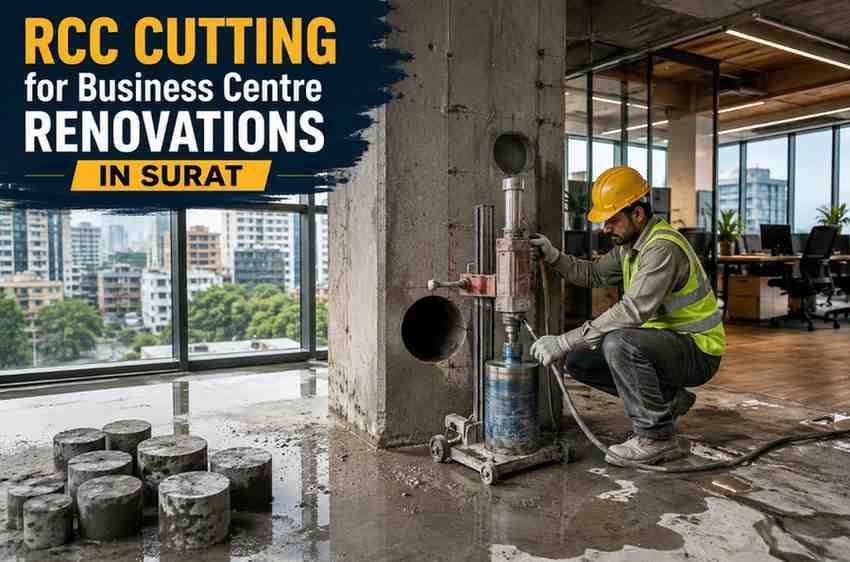
Surat's skyline has changed dramatically over the last decade. What used to be a textile and diamond hub is now home to sprawling business centres, corporate towers, co-working spaces, and commercial complexes that cater to a fast-growing economy. As businesses expand, relocate, or simply modernize their workspaces, one construction requirement keeps coming up again and again: RCC cutting.
Reinforced Cement Concrete (RCC) cutting is no longer a niche construction activity reserved for large infrastructure projects. It has become an essential part of business centre renovations across Surat — from Adajan and Vesu to Ring Road and City Light. Whether it's creating a new doorway, installing modern HVAC ducting, laying fresh electrical and plumbing lines, or reshaping an entire floor plate for a new tenant, RCC cutting makes it possible to renovate without demolishing.
In this blog, we at Core Cutting India (reach us at [email protected]) walk you through everything you need to know about RCC cutting for business centre renovations in Surat — the methods, the benefits, the process, and how to choose the right cutting partner for your project.
Why Business Centres in Surat Are Renovating at Scale
Surat has seen an explosion of commercial real estate activity. New-age businesses need open floor plans, better ventilation systems, upgraded fire safety infrastructure, and flexible layouts that can be reconfigured as tenants change. Older commercial buildings, built with traditional RCC structures, were not designed with today's technology and workflow needs in mind.
This has created a strong demand for structural modification services that can:
- Reconfigure floor layouts for new office tenants
- Create additional doorways, windows, or ventilation openings
- Install elevators, escalators, or staircases in existing buildings
- Route new electrical, plumbing, and HVAC systems through concrete slabs and walls
- Reinforce or modify structural elements for seismic retrofitting
- Convert old commercial spaces into modern co-working or retail formats
All of these renovation goals share one common requirement: precise, controlled cutting of reinforced concrete without compromising the structural integrity of the building. That's where professional RCC cutting services come in.
What Is RCC Cutting?
RCC cutting is the process of cutting through reinforced cement concrete — walls, slabs, columns, or beams — using specialized diamond-tipped equipment. Unlike traditional demolition methods such as hammering or breaking, which are noisy, dusty, and structurally unpredictable, RCC cutting is a controlled, engineered process. It allows contractors to remove or modify specific sections of concrete with millimeter-level precision, leaving the surrounding structure undisturbed.
For business centres, where operations often continue during renovation and where structural safety is non-negotiable, this precision is invaluable. A poorly executed cut can weaken load-bearing elements, cause unnecessary vibration damage to adjacent finishes, and create safety hazards for occupants. Professional RCC cutting eliminates these risks.
Common RCC Cutting Methods Used in Commercial Renovations
Different renovation goals call for different cutting techniques. At Core Cutting India, we typically deploy the following methods depending on the scope of the business centre renovation project.
1. Wall Sawing
Wall sawing uses a track-mounted diamond blade to make straight, precise cuts through vertical concrete walls. This is commonly used for creating new doorways, widening existing openings, or removing entire wall sections to merge two office spaces into one open layout. Wall sawing produces clean, straight edges and can cut through walls of varying thickness with minimal vibration.
2. Floor Sawing (Slab Sawing)
Floor sawing is used when horizontal concrete slabs need to be cut — for example, to create openings for staircases, elevator shafts, service risers, or floor-to-floor ducting. Self-propelled floor saws can cut deep into RCC slabs while maintaining tight control over depth and alignment, which is critical in multi-storey business centres where slabs also serve as the ceiling of the floor below.
3. Core Drilling
Core drilling creates precise circular holes through concrete walls, floors, or ceilings. This is one of the most frequently used techniques in business centre renovations because nearly every modernization project requires new routes for electrical cables, data and networking lines, plumbing pipes, or HVAC ducts. Core drilling machines can bore holes ranging from a couple of inches to several feet in diameter, all with minimal disturbance to the surrounding concrete.
4. Wire Sawing
For thicker structural elements like heavy columns, beams, or foundations, wire sawing is often the preferred method. A diamond-embedded wire loop is threaded around the concrete section and pulled through under tension, allowing contractors to cut through very thick or heavily reinforced concrete that would be difficult to manage with a standard blade.
5. Chain Sawing and Hand Sawing
For tight corners, smaller openings, or areas with restricted access — common in compact office units within larger business centres — hand-held diamond chain saws and hand saws provide the flexibility needed to make precise cuts in confined spaces.
Why Business Centres Prefer Professional RCC Cutting Over Traditional Demolition
Business centre renovations differ from ground-up construction in one key way: the work often has to happen around existing tenants, ongoing operations, and finished interiors. This makes the choice of cutting method critically important.
Minimal disruption: Diamond cutting techniques generate significantly less vibration and noise compared to jackhammers or breakers, which is essential when neighbouring offices or retail units remain operational during renovation.
Dust control: Modern RCC cutting equipment uses water-cooled diamond blades that suppress dust generation, keeping the work environment cleaner and healthier — an important consideration in enclosed commercial buildings with shared HVAC systems.
Structural precision: Because cuts are planned and executed with engineering accuracy, there's far less risk of damaging rebar, adjacent walls, or load-bearing elements that weren't meant to be touched.
Faster turnaround: Precision cutting is typically faster than manual demolition, which translates into shorter renovation timelines and reduced downtime for business operations.
Cost efficiency: Preserving surrounding structure and finishes means less repair work afterward, which often makes RCC cutting more cost-effective than demolition-and-rebuild approaches over the life of a renovation project.
The RCC Cutting Process for a Business Centre Renovation
A well-managed RCC cutting project for a commercial renovation in Surat typically follows these stages:
1. Site Assessment and Structural Review Before any cutting begins, our team conducts a detailed site survey to understand the existing structure, identify load-bearing elements, and review architectural or structural drawings if available. This step is crucial in occupied business centres to avoid unintended structural risk.
2. Planning and Method Selection Based on the renovation scope — whether it's a new doorway, a service riser, or a full floor reconfiguration — the appropriate cutting method (wall sawing, floor sawing, core drilling, or wire sawing) is selected.
3. Utility and Rebar Scanning Before cutting into any wall or slab, it's essential to scan for embedded electrical conduits, plumbing lines, and reinforcement bars using ground-penetrating radar or rebar detectors. This prevents accidental damage to live utilities or structural steel.
4. Cutting Execution Trained technicians carry out the cutting work using calibrated diamond equipment, following the planned cut lines precisely. Water suppression systems are used throughout to control dust and cool the blades.
5. Debris Removal and Site Cleanup Once cutting is complete, concrete sections are safely removed, and the site is cleared of debris, slurry, and dust residue, leaving it ready for the next phase of renovation work.
6. Quality Check and Handover A final inspection ensures the cuts meet the required dimensions and specifications before the site is handed back to the renovation contractor or client for the next stage of work.
Applications of RCC Cutting in Surat's Business Centres
Surat's commercial landscape includes everything from mid-sized office complexes to large multi-tenant business parks. RCC cutting supports a wide range of renovation scenarios across these spaces, including:
- Creating fire exit doorways and staircases to meet updated fire safety norms
- Installing new elevators or escalators in older buildings
- Opening up floor plates for internal staircases connecting duplex office units
- Routing HVAC ducting through slabs for centralized air conditioning upgrades
- Cutting openings for data centre cabling and IT infrastructure
- Modifying washroom and pantry layouts during interior redesigns
- Creating additional windows or ventilation openings for compliance or aesthetics
- Reinforcement and structural retrofitting for seismic safety upgrades
Choosing the Right RCC Cutting Partner in Surat
Business centre renovations involve tight timelines, live occupancy considerations, and strict safety requirements. Choosing an experienced RCC cutting contractor makes a measurable difference to how smoothly the project runs. Here's what to look for:
Experience with commercial and occupied buildings: Cutting in a live business environment requires a different level of planning compared to a construction site with no occupants.
Modern, well-maintained equipment: Diamond cutting equipment should be regularly serviced and calibrated to ensure clean, accurate cuts.
Trained and certified technicians: Skilled operators reduce the risk of structural errors and ensure work is completed safely and on schedule.
Utility scanning capability: A contractor who scans for rebar and embedded utilities before cutting protects your building from costly and dangerous mistakes.
Transparent process and documentation: Clear site assessments, method statements, and safety protocols reflect a professional approach to the job.
Local presence in Surat: A contractor familiar with Surat's building types, local regulations, and commercial districts can respond faster and plan more accurately.
At Core Cutting India, we specialize in RCC cutting, core drilling, wall sawing, and floor sawing services tailored to commercial renovation projects across Surat. Our team understands the operational sensitivities of business centres and works to deliver clean, precise, and minimally disruptive cutting solutions.
Safety and Compliance Considerations
Because business centres are occupied structures, safety planning is a critical part of any RCC cutting project. This typically includes:
- Structural assessment to confirm cuts won't compromise load-bearing capacity
- Temporary shoring or support where required during slab or wall removal
- Dust and noise control measures to minimize impact on other tenants
- Coordination with building management for access, timing, and utility shutdowns
- Compliance with local municipal and fire safety regulations in Surat
Working with an experienced RCC cutting contractor ensures these considerations are built into the project plan from day one, rather than addressed reactively.
Final Thoughts
As Surat continues to grow as a commercial and business hub, renovation activity across its business centres is only expected to increase. RCC cutting has become the go-to method for modernizing commercial spaces because it offers the precision, safety, and efficiency that traditional demolition simply cannot match.
Whether you're planning a small structural modification or a large-scale floor reconfiguration, partnering with an experienced RCC cutting company ensures your renovation stays on schedule, within budget, and structurally sound.
If you're planning a business centre renovation in Surat and need reliable RCC cutting, core drilling, or wall sawing services, get in touch with Core Cutting India at [email protected]. Our experienced team is ready to help you plan and execute your project safely and efficiently.
Frequently Asked Questions (People Also Ask)
1. What is RCC cutting and why is it used in renovations? RCC cutting is the process of cutting through reinforced cement concrete using diamond-tipped equipment to create openings, remove sections, or modify structural elements. It's used in renovations because it offers precise, controlled results without the vibration and unpredictability of traditional demolition methods.
2. How much does RCC cutting cost in Surat? Costs vary depending on the cutting method, thickness of the concrete, reinforcement density, accessibility of the site, and the scale of the renovation project. Factors like wall sawing versus core drilling, and whether utility scanning or shoring is required, also affect pricing. It's best to request a site assessment for an accurate quote.
3. Is RCC cutting safe for occupied business centres? Yes, when performed by an experienced contractor. Professional RCC cutting uses low-vibration diamond equipment, dust suppression, and pre-cutting utility scanning to minimize disruption and risk to occupied spaces.
4. How long does RCC cutting take for a commercial renovation? Timelines depend on the scope of work — a single core-drilled opening may take a few hours, while a full floor reconfiguration with wall and slab sawing can take several days. A detailed project plan from your cutting contractor will provide a realistic timeline.
5. What is the difference between core drilling and wall sawing? Core drilling creates circular holes, typically used for utility routing like pipes, cables, or ducts. Wall sawing creates straight cuts through vertical walls, typically used for doorways, openings, or wall removal. Both methods use diamond-tipped tools but are suited to different renovation needs.
6. Do you need permission before RCC cutting in a commercial building? In most cases, yes. Structural modifications, even minor ones, may require approval from building management, a structural engineer, or local municipal authorities in Surat, especially for load-bearing elements. It's advisable to confirm requirements before work begins.
Core Cutting India | [email protected]