
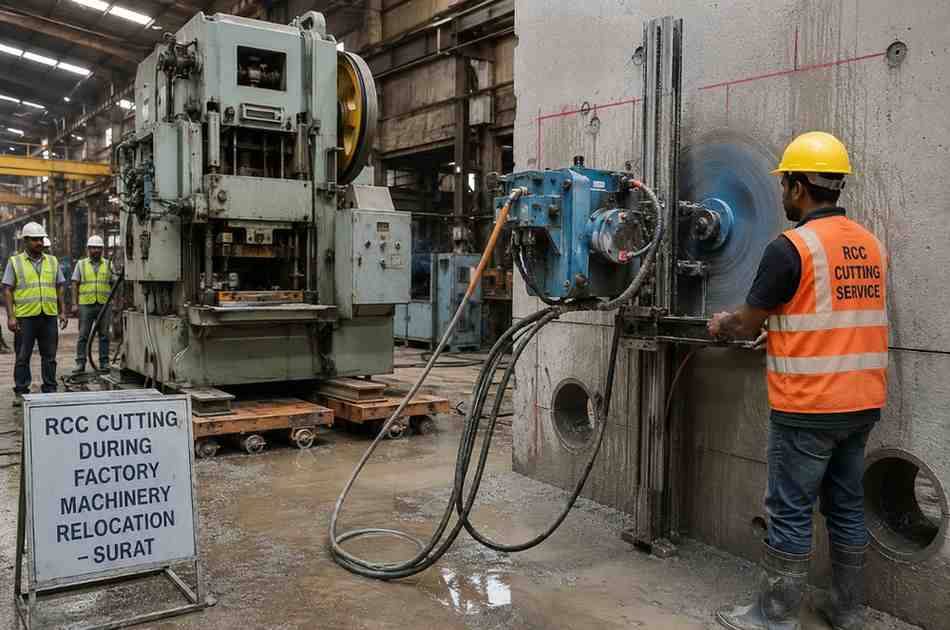
Surat has long stood as one of India's most dynamic industrial hubs, home to thousands of textile mills, diamond processing units, chemical plants, and engineering factories. As businesses expand, upgrade equipment, or shift operations to new facilities, one operation quietly makes all of this possible: RCC cutting. When heavy machinery needs to be relocated, the reinforced cement concrete (RCC) foundations, floors, and walls that hold it in place must be cut with precision — without damaging the surrounding structure or delaying production. This is where professional RCC cutting services, like those offered by Core Cutting India ([email protected]), become indispensable to Surat's factories.
In this blog, we'll explore why RCC cutting is essential during factory machinery relocation, the techniques involved, safety considerations, and how to choose the right contractor for the job in Surat.
Why Factory Machinery Relocation Requires RCC Cutting
Industrial machines — whether power looms, embroidery machines, CNC units, compressors, or heavy presses — are rarely just "bolted down." Over time, factories embed them into thick RCC foundations designed to absorb vibration, bear enormous loads, and keep equipment perfectly aligned during operation. When a business decides to relocate machinery, whether to a new unit, a different floor, or an entirely new facility, these concrete foundations must first be cut and removed.
Simply hammering or breaking the concrete is not an option in a modern factory setting. Uncontrolled demolition can:
- Crack adjoining floors or load-bearing walls
- Damage underground cables, pipelines, or drainage systems
- Create excessive dust, noise, and vibration that disrupts nearby operations
- Delay the relocation timeline due to unpredictable breakage
- Pose serious safety risks to workers
Professional RCC cutting solves these problems by using controlled, precision-based methods that isolate exactly the section of concrete that needs to go — nothing more, nothing less.
Common Scenarios Where RCC Cutting Is Needed in Surat's Factories
Surat's industrial landscape is diverse, and RCC cutting requirements vary depending on the sector:
Textile and Power Loom Units: Surat is India's textile powerhouse, and power looms are often set on deep RCC beds to control vibration. Relocating even a single loom line requires cutting through these thick foundations without disturbing neighboring machines still in operation.
Diamond Processing Units: Precision-cutting and polishing machines used in Surat's diamond industry are mounted on vibration-isolated RCC platforms. Any relocation demands extremely accurate cutting to avoid disturbing calibration-sensitive equipment nearby.
Engineering and Fabrication Workshops: Heavy presses, lathes, and CNC machines are frequently anchored into thick concrete slabs. When workshops upgrade or reorganize their shop floor layout, RCC cutting allows machinery to be freed and shifted with minimal downtime.
Chemical and Process Plants: Tanks, reactors, and pumps often sit on reinforced plinths. Relocation in these environments requires extra caution due to the presence of pipelines and hazardous materials nearby.
Warehouse and Godown Conversions: As Surat's industrial areas evolve, older units are often repurposed. This involves cutting out redundant machine bases, trenches, and RCC slabs to prepare the space for new use.
RCC Cutting Techniques Used During Machinery Relocation
Professional contractors like Core Cutting India rely on a range of specialized techniques depending on the thickness of the concrete, the presence of reinforcement bars, and the sensitivity of the surrounding area.
1. Diamond Wall Sawing
This method uses a diamond-tipped circular blade mounted on a track to make deep, straight, and precise cuts through RCC walls and slabs. It's ideal for cutting large sections of a machine foundation cleanly, with minimal vibration transmitted to adjoining structures — a crucial factor when other machines are still running nearby.
2. Core Drilling
Core drilling uses a hollow diamond bit to bore circular holes through concrete. This technique is commonly used to create access points for anchor bolts, cable routing, or to weaken a section before larger cuts are made. It's also used when machinery bases need circular openings for pipes, shafts, or foundation bolts.
3. Wire Saw Cutting
For extremely thick or heavily reinforced concrete — such as deep machine foundations with multiple layers of steel reinforcement — wire saw cutting is often the preferred method. A diamond-embedded wire loops around the structure and cuts through it steadily, making it suitable for large, load-bearing sections that other tools can't handle efficiently.
4. Floor Sawing
Flat, walk-behind or ride-on floor saws are used to cut horizontal slabs, such as factory flooring around a machine base. This method ensures straight, even cuts across large floor areas with speed and accuracy.
5. Hand-Held and Ring Saw Cutting
In tight spaces where large machinery can't be maneuvered, compact hand-held diamond saws and ring saws allow technicians to make precise cuts in corners, around pipes, or in areas with limited headroom — common in older Surat factory buildings.
The RCC Cutting Process for Machinery Relocation
A well-executed RCC cutting project typically follows these stages:
1. Site Survey and Planning Before any cutting begins, the contractor inspects the site to understand the machine's foundation depth, reinforcement pattern, and proximity to electrical or plumbing lines. This helps in choosing the right cutting method and sequence.
2. Marking and Layout The exact cutting lines are marked out based on the machine's dimensions and the depth of the foundation, ensuring only the necessary concrete is removed.
3. Cutting Execution Using the appropriate combination of wall saws, wire saws, or core drills, technicians cut through the RCC in a controlled sequence — often starting with pilot holes before proceeding to full cuts.
4. Debris Removal Cut concrete blocks are safely lifted and removed using cranes, hoists, or manual labor depending on size and weight, keeping the work area clear for the machinery removal team.
5. Surface Finishing Once the machine base is removed, the exposed surface is leveled or prepared for the next stage — whether that's a new machine installation, flooring work, or structural repair.
6. Site Handover The area is cleaned, inspected, and handed over to the relocation team so that machinery lifting and transport can proceed without delay.
Why Precision Matters in Factory Environments
Unlike open-site demolition, RCC cutting inside an active factory demands an exceptionally high degree of control. A slight miscalculation can crack a foundation meant for a neighboring machine, damage buried cabling, or compromise the structural integrity of the building itself. Precision cutting equipment allows technicians to:
- Cut exact dimensions matching the machine base or opening required
- Minimize vibration that could affect sensitive equipment still operating nearby
- Reduce dust and noise, which is especially important in textile units where fabric contamination is a concern
- Complete work faster, reducing costly production downtime
- Preserve the structural strength of surrounding floors and walls
Safety Considerations During RCC Cutting
Factory environments come with unique hazards, and RCC cutting teams must follow strict safety protocols, including:
- Identifying and marking underground utilities before cutting begins
- Using water-fed diamond blades to suppress dust during dry cutting isn't advisable in electrical-heavy zones, so contractors often switch to dust extraction systems instead
- Ensuring proper structural support is in place before removing load-bearing sections
- Coordinating cutting schedules with factory operations to avoid interference with ongoing work
- Equipping workers with PPE, hearing protection, and vibration-monitoring tools
- Conducting cuts in phases, especially for large or structurally critical sections, to avoid sudden structural shifts
Benefits of Hiring Professional RCC Cutting Services in Surat
Attempting concrete cutting with generic labor or improper tools often leads to costly rework, structural damage, or safety incidents. Professional RCC cutting contractors bring:
Specialized Equipment: Diamond wall saws, wire saws, and core drilling rigs designed specifically for accurate, controlled cutting.
Experienced Technicians: Trained professionals who understand reinforcement patterns, load-bearing considerations, and factory safety protocols.
Minimal Downtime: Faster, more predictable cutting schedules mean machinery relocation projects stay on timeline.
Reduced Structural Risk: Controlled cutting protects adjoining walls, floors, and foundations from unintended damage.
Compliance and Safety: Adherence to safety norms reduces liability and protects workers on-site.
Choosing the Right RCC Cutting Contractor in Surat
When selecting a contractor for factory machinery relocation projects, consider the following:
- Experience with industrial sites: Look for a contractor familiar with Surat's textile, diamond, and engineering sectors specifically, as each has unique structural challenges.
- Range of equipment: A contractor offering wall sawing, wire sawing, core drilling, and floor sawing can handle any thickness or configuration of concrete.
- Track record: Ask for references or past project examples involving machinery relocation, not just general demolition.
- Safety certifications: Ensure the team follows recognized safety standards for industrial cutting work.
- Turnaround time: Since factory downtime is costly, choose a contractor known for efficient project execution.
Core Cutting India has built a strong reputation across Surat's industrial belt for handling exactly these kinds of projects — from power loom relocations in Sachin and Pandesara to diamond unit reconfigurations in Varachha and Katargam. Their teams combine the right equipment with experienced technicians to ensure machinery relocation projects proceed smoothly, safely, and on schedule.
Conclusion
RCC cutting is far more than a demolition task — it's a precision engineering process that directly determines how smoothly a factory machinery relocation project unfolds. From protecting surrounding structures to minimizing downtime and ensuring worker safety, the right cutting approach makes all the difference. For factories across Surat looking to relocate, upgrade, or reorganize their machinery, partnering with an experienced RCC cutting contractor is not just recommended — it's essential.
If you're planning a factory machinery relocation in Surat and need reliable, precise RCC cutting services, get in touch with Core Cutting India at [email protected]. Our experienced team is equipped to handle projects of any scale, ensuring your relocation stays safe, efficient, and on schedule.