
Target-Related Searches & People Also Ask (PAA)
-
Target-Related Searches: industrial concrete cutting, diamond core drilling for factories, plant retrofitting concrete modifications, heavy-duty RCC cutting services, process piping installation concrete cutting.
-
People Also Ask (PAA):
-
What is the best method for cutting thick RCC structures during plant expansion?
-
How do you avoid damaging existing utility lines during industrial concrete cutting?
-
Why is diamond wire sawing preferred for large-scale process line modifications?
-
How can plant downtime be minimized during concrete cutting for expansions?
-
Industrial manufacturing plants, chemical processing units, and heavy industrial facilities are dynamic environments. To stay competitive, meet evolving market demands, or incorporate new technological advancements, these facilities must periodically undergo modifications. This often involves scaling up production capabilities through process line expansion projects.
However, introducing new heavy machinery, high-pressure piping networks, conveyor systems, or automated assembly lines into an existing facility is rarely straightforward. Industrial plants are predominantly built with heavy-duty Reinforced Cement Concrete (RCC) to withstand extreme loads, harsh chemical exposures, and continuous mechanical vibrations. Modifying these robust structures requires extreme precision, careful structural engineering oversight, and specialized technical execution.
This is where advanced RCC cutting technologies become the cornerstone of successful industrial retrofitting and expansion.
1. The Critical Role of RCC Cutting in Plant Modernization
When an industrial plant plans a process line expansion, engineers face a fundamental constraint: fitting a modern, high-capacity workflow into an established footprint. This frequently demands structural alterations, such as:
-
Creating precise openings in thick concrete slabs, walls, and elevated floors for new conveyor belts or drainage systems.
-
Cutting through heavily reinforced foundations to accommodate specialized deep-pit machinery or heavy presses.
-
Slotting walls and floors for extensive electrical conduit routing, instrumentation cabling, and process piping expansions.
-
Performing selective demolition or partial structural removal to connect old processing units with newly constructed bays.
Attempting these modifications with traditional percussion demolition tools—such as pneumatic breakers or jackhammers—can spell disaster for an active or neighboring industrial environment. High-impact breaking creates uncontrolled vibrations, micro-fractures in surrounding load-bearing columns, excessive noise, and voluminous hazardous silica dust that can ruin sensitive electronic process controls.
Professional RCC cutting, utilizing specialized diamond tools, offers a clean, vibration-free, and structurally safe alternative.
2. Advanced Cutting Techniques for Complex Industrial Expansions
Depending on the scale, depth, and layout of the process line expansion, specialized cutting methodologies are deployed to ensure minimal disruption:
Diamond Core Drilling
For routing individual process pipes, utility lines, anchoring heavy machinery bolts, or passing electrical wiring through thick RCC walls and floors, diamond core drilling is the gold standard. It creates clean, perfectly circular penetrations ranging from small diameters to large core sizes without causing spalling or structural micro-cracks on exit faces.
Wall Sawing and Track Sawing
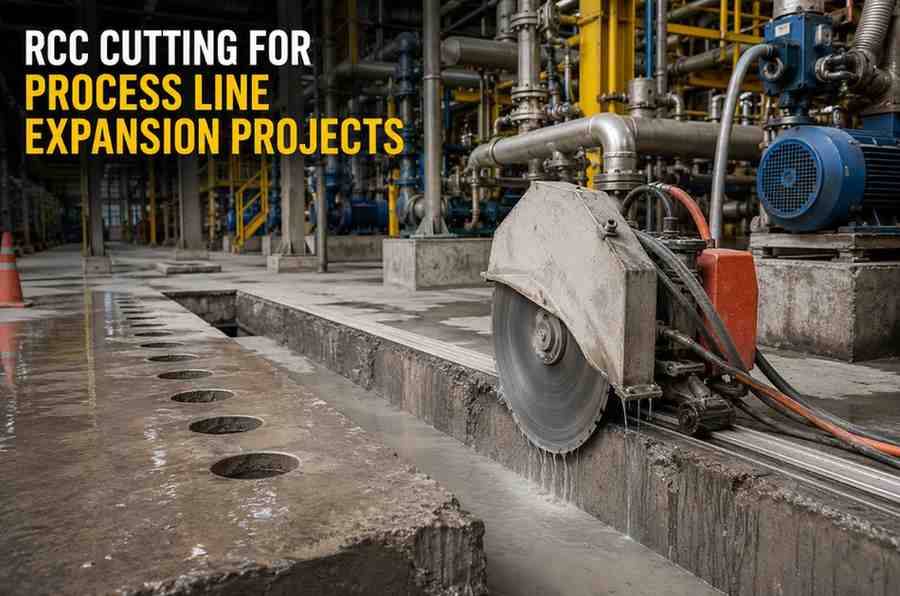
When expanding horizontal or vertical pathways for large ventilation ducts, access doors, or conveyor drop-throughs, track-mounted wall saws fitted with diamond blades deliver exceptional precision. They allow straight, flush cuts through thick concrete walls and slabs with exact depth control.
Diamond Wire Sawing
For massive concrete structures—such as thick mass-concrete machine bases, heavy reactor shields, or oversized foundation blocks that need to be reconfigured—diamond wire sawing is unmatched. A continuous steel cable embedded with industrial diamond beads is looped around or through the concrete structure and pulled tight while driven at high speeds. It can cut through virtually any thickness of RCC without depth limitations.
Floor and Slab Sawing
Expanding a floor-level process line often requires trenching concrete slabs to lay underground utility troughs, drainage channels, or pneumatic lines. Walk-behind floor saws make linear, straight cuts across industrial flooring, ensuring clean edges that simplify subsequent backfilling and sealing.
3. Key Engineering Challenges in Process Line Expansions
Executing concrete cutting within an active or constrained industrial setting presents unique operational hurdles that require meticulous planning:
-
Structural Integrity Preservation: Industrial floors and walls are meticulously engineered to bear specific dead and live loads. Unplanned or poorly executed cuts can compromise structural safety. Engineers must perform thorough structural mapping and load calculations before a single blade touches the concrete.
-
Utility Interference: Existing facilities are a maze of live electrical cables, high-pressure steam lines, cooling water pipes, and gas conduits hidden within or beneath the concrete. Non-destructive evaluation (NDE) techniques, such as ground-penetrating radar (GPR) and X-ray imaging, must precede cutting to map hidden utilities.
-
Downtime Minimization: In high-output manufacturing plants, every hour of unplanned downtime translates to substantial financial losses. RCC cutting operations must be precisely scheduled, highly coordinated, and executed with rapid turnaround times.
-
Environmental and Safety Compliance: Industrial sites demand stringent adherence to safety protocols. Wet-cutting methods are typically employed to suppress dust, while slurry management systems capture wastewater to prevent contamination of surrounding work areas or drainage systems.
4. Best Practices for a Successful Expansion Project
To ensure that your process line expansion goes off without a hitch, partner with experienced specialists who understand the rigorous demands of industrial environments.
-
Comprehensive Site Assessment: Engage structural engineers early to review as-built drawings, conduct NDE scans, and establish clear boundary limits for cutting zones.
-
Select the Right Contractor: Choose certified professionals equipped with modern, hydraulic or electric high-performance cutting machinery capable of working in confined or hazardous industrial zones. Reach out to industry leaders at [email protected] to consult on specialized engineering requirements for your upcoming project.
-
Establish Strict Containment Protocols: Set up physical barriers, dust curtains, and water-slurry vacuum systems to protect nearby sensitive machinery, control rooms, and personnel.
-
Phased Execution Planning: Break down the expansion into manageable phases, allowing critical sections of the plant to remain operational while targeted cutting and installation work proceeds concurrently.
Conclusion
Process line expansion projects are vital for industrial growth, but they demand absolute precision, safety, and structural foresight. Cutting through reinforced cement concrete without compromising the surrounding infrastructure requires specialized diamond cutting technology and expert execution. By leveraging advanced methods like wire sawing, core drilling, and wall sawing, industrial plants can expand their capabilities efficiently, safely, and on schedule.
For professional guidance, consultation, and execution of heavy-duty concrete modifications tailored to your industrial needs, connect with the experts at [email protected].