
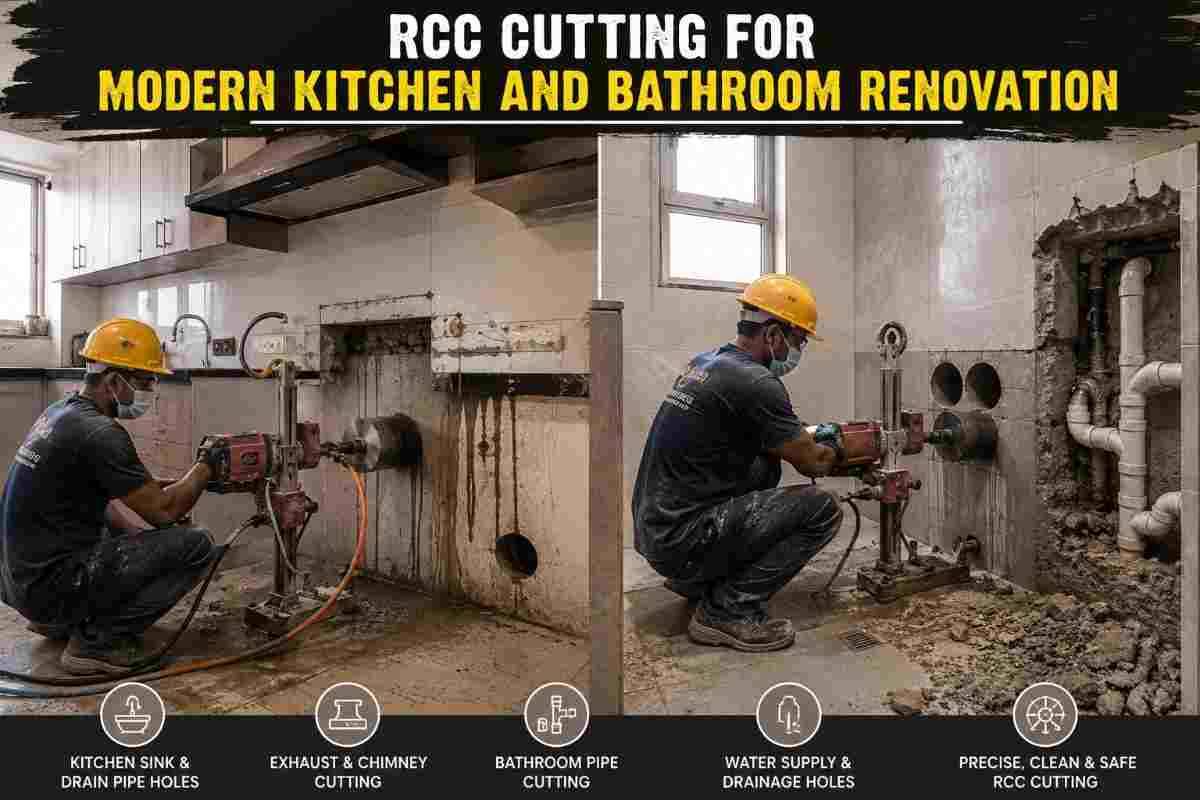
A modern kitchen or bathroom remodel often starts with a simple idea: move the sink, widen the doorway, shift the toilet, or add an exhaust opening. In older buildings, and in almost every apartment, these changes run into one hard fact. The structure is made of reinforced cement concrete (RCC).
Breaking RCC with a hammer is noisy, messy, and risky. It can crack slabs, damage neighbouring walls, and annoy everyone in the building. This is why professional RCC cutting has become the preferred method for homeowners, architects, and contractors.
In this guide, brought to you by Core Cutting India, we explain how RCC cutting works, where it is used in kitchen and bathroom renovations, what it costs, and how to choose the right service provider.
What Is RCC Cutting?
RCC cutting is the precise removal of reinforced concrete using diamond-tipped tools. Unlike a hammer or breaker, which smashes concrete, these tools grind through it. They cut through the concrete and the steel reinforcement bars together, leaving smooth, clean edges.
The main techniques are:
- Core cutting (core drilling): A hollow diamond drill bit cuts perfectly round holes, typically from 25 mm to over 500 mm in diameter.
- Wall saw cutting: A track-mounted saw cuts straight, deep openings in walls, such as doors, windows, and ventilation gaps.
- Slab saw (floor saw) cutting: A circular blade cuts straight lines through floors and slabs.
- Wire saw cutting: A diamond-impregnated wire handles very thick or awkward structures.
- Hand saw cutting: A compact saw is used for tight spaces and small, precise cuts.
Each method suits a different task, and a good contractor will recommend the right one after inspecting your site.
Why Kitchen and Bathroom Renovations Need RCC Cutting
Kitchens and bathrooms are the most technically demanding rooms in any home. They contain plumbing lines, drainage, water supply, exhaust ducts, electrical points, and waterproofing layers, all in a small space.
Most renovation changes involve the structure itself:
- Relocating a floor drain or toilet outlet needs a new hole in the slab.
- Installing a chimney or exhaust duct needs an opening through an external wall.
- Merging two rooms or widening a door requires cutting an opening in an RCC wall.
- Adding a new sink or dishwasher line needs fresh pipe penetrations.
- Installing a sunken bathtub or shower tray may need a recess in the slab.
Doing this with conventional demolition tools is slow and unpredictable. Diamond cutting gives you control over exactly what is removed and what stays.
Key Benefits of RCC Cutting for Home Renovations
1. Precision You Can Plan Around
Diamond cutting follows marked lines. If your plumber needs a 110 mm opening exactly 300 mm from the wall, core cutting delivers it. This precision means pipes, frames, and fittings fit properly the first time, with no patching or rework.
2. Minimal Vibration, Safer for Your Building
Hammering sends shock waves through the structure, which can crack tiles, loosen plaster, and weaken adjoining slabs. Diamond cutting produces very little vibration. This matters in apartments, where your neighbours’ ceilings and walls are connected to yours.
3. Lower Noise and Dust
Renovation noise is a leading cause of complaints in housing societies. Modern cutting, especially with water cooling, is much quieter than demolition. Water also suppresses dust, which keeps your home cleaner and the air safer to breathe.
4. Clean Edges That Need Less Finishing
Because the cut is smooth, you spend less time and money on plastering, grouting, and repairs. The edges are ready for frames, sleeves, and waterproofing.
5. Faster Project Timelines
A task that could take a full day of chipping may be finished in a couple of hours with a wall saw. Faster work means your kitchen or bathroom is usable sooner.
6. Structural Safety
A professional crew scans for reinforcement and embedded services before cutting, plans the sequence, and avoids over-cutting. This protects the load-bearing elements of your home.
Common RCC Cutting Jobs in Kitchens
Chimney and exhaust openings. A modern kitchen needs a proper exhaust path. Core cutting makes a clean, round hole through the wall for the duct, and the pipe fits snugly without gaps.
Wall openings for open-plan layouts. Many homeowners convert a closed kitchen into an open or semi-open design with a pass-through or a wider doorway. A wall saw makes straight, accurate cuts. Always confirm with a structural engineer first that the wall is not load-bearing, or that proper support such as a lintel or beam will be added.
Sink and drainage points. Moving the sink often requires a new waste pipe penetration through the wall or slab. Core cutting handles this neatly.
Gas pipeline and utility sleeves. Small-diameter cores are used for gas lines, water inlets, and electrical conduits.
Window enlargement or ventilation. Cutting a larger window gives more light and airflow, which is valuable in a cooking space.
Common RCC Cutting Jobs in Bathrooms
Shifting the toilet or floor trap. Moving a toilet is one of the most requested changes. It requires opening the slab at a new location for the soil pipe. Core cutting does this precisely and safely.
New drainage and shower outlets. Walk-in showers and linear drains require carefully placed openings in the floor.
Slab recesses. Some modern bathrooms use sunken zones for showers or hidden plumbing. Controlled slab cutting makes these possible without weakening the structure.
Exhaust fan and ventilation holes. Bathrooms without windows need proper extraction. Core cutting creates exact openings for fans and ducts.
Door widening for accessibility. Making a bathroom door wider for elderly or differently abled family members is a popular upgrade, and wall saw cutting does it cleanly.
RCC Cutting vs Traditional Breaking: A Quick Comparison
| Factor | Diamond RCC Cutting | Hammer / Breaker Demolition |
|---|---|---|
| Accuracy | Very high, follows marked lines | Low, uneven edges |
| Vibration | Minimal | High, risk of cracks |
| Noise | Low to moderate | Very high |
| Dust | Controlled with water | Heavy |
| Structural risk | Low with proper planning | Higher |
| Finishing work | Minimal | Extensive |
| Speed | Fast for precise cuts | Slow and messy |
For anything beyond a very rough job, diamond cutting is the smarter investment.
How the RCC Cutting Process Works
Understanding the steps helps you plan your renovation and talk confidently with contractors.
Step 1: Site inspection and consultation. The team studies the wall or slab, checks thickness, identifies the purpose of the opening, and notes access and power or water availability.
Step 2: Scanning and marking. Embedded rebar, pipes, and cables are located where possible. The exact cutting lines or core positions are marked on the surface.
Step 3: Protection and setup. Floors, fixtures, and nearby areas are covered. The machine is anchored or mounted on a track, and a water supply is arranged for cooling.
Step 4: Cutting. The operator makes the cuts in a planned sequence. For large wall sections, the piece is cut into smaller blocks so it can be removed safely.
Step 5: Removal and cleanup. The cut sections and slurry are removed, and the area is cleaned, leaving it ready for plumbers, carpenters, and masons.
Safety and Structural Considerations
Cutting reinforced concrete is not a casual DIY task. Keep these points in mind:
- Check whether the wall is load-bearing. Never remove or open a structural wall without an engineer’s approval.
- Get society or building permissions. Apartment owners usually need approval from the resident welfare association or builder before structural changes.
- Consider waterproofing. In bathrooms, fresh cuts must be sealed and waterproofed properly to prevent leakage to the floor below.
- Plan for reinforcement. Large openings may need lintels, beams, or additional support.
- Use trained operators. Skilled technicians know how to handle rebar, avoid binding the blade, and manage water and slurry.
Factors That Affect RCC Cutting Cost
Pricing differs from project to project. The main variables include:
- Thickness and depth of the concrete. Thicker structures take longer and wear tools faster.
- Size and number of cuts or cores. Larger diameters and more openings increase cost.
- Amount of reinforcement. Dense steel slows cutting.
- Type of method used. Wall saw, wire saw, and core drilling each have different rates.
- Access and working height. Cutting at height or in cramped spaces may cost more.
- Location and mobilisation. Distance and equipment transport can affect the quote.
Core drilling is generally charged per hole based on diameter and depth, while wall and slab cutting are often charged per running foot or metre. The best way to get an accurate figure is a site visit and written quote.
How to Choose the Right RCC Cutting Contractor
A little due diligence saves a lot of trouble. Look for these qualities:
- Proper equipment. Ask whether they use diamond tools, water cooling, and modern wall and slab saws.
- Experienced operators. Skilled crews prevent over-cutting and accidents.
- Residential experience. Working inside an occupied home needs care with dust, noise, and neighbours.
- Clear, written quotations. Avoid vague pricing that leads to surprise charges.
- Safety practices. The team should protect your property and follow site rules.
- Good communication. The contractor should explain the plan, timelines, and what you need to prepare.
Core Cutting India focuses on precise, clean concrete cutting for residential and commercial projects, from small plumbing cores to full wall openings.
Tips for a Smooth Kitchen or Bathroom Renovation
- Finalise your layout first. Decide fixture locations before cutting begins to avoid repeat work.
- Coordinate trades. Schedule cutting before plumbing, tiling, and carpentry.
- Inform neighbours and the society. A short heads-up avoids conflicts.
- Clear the area. Remove movable items and protect what cannot be moved.
- Plan water and power. Wet cutting needs a water source, and machines need electricity.
- Budget for finishing. Allow for waterproofing, plastering, and repairs after cutting.
People Also Ask
(I wrote these common questions because the placeholder was blank. Replace them with your own if you have a specific list.)
What is RCC cutting and why is it used in renovations?
RCC cutting uses diamond tools to cut reinforced concrete precisely. It is used in renovations because it produces clean openings with little vibration, noise, and dust, and protects the surrounding structure.
Can you cut RCC walls for a kitchen or bathroom?
Yes, but only after confirming the wall is not load-bearing, or after an engineer designs the required support. Always obtain the necessary permissions as well.
Is RCC cutting better than breaking concrete with a hammer?
For most renovation work, yes. Cutting is more accurate, causes less vibration, and leaves cleaner edges. Hammering can crack slabs and damage adjoining areas.
How much does RCC cutting cost?
Cost depends on thickness, number and size of cuts, reinforcement density, method, and site access. A site inspection gives the most accurate quote.
How long does RCC cutting take?
Small core holes can take minutes each. Door or window openings usually take a few hours, and larger jobs may take a day or more.
Is RCC cutting safe in an apartment?
Yes, when done by trained professionals using water-cooled diamond equipment, with building permission and proper protection of floors and neighbours’ spaces.
Can you shift a toilet or bathroom drain by core cutting?
Yes. Core cutting creates a precise opening in the slab for a new soil pipe or floor trap, though you must plan waterproofing and slope carefully.
Does RCC cutting weaken the structure?
Not if planned correctly. Cutting small, well-located openings is generally safe, but large or structural openings should be approved by a structural engineer and reinforced where needed.
Final Thoughts
A modern kitchen or bathroom is only as good as the work behind the walls. Clean, accurate openings for pipes, ducts, and doorways set the foundation for everything that follows, from plumbing to tiles to fixtures. Choosing RCC cutting over rough demolition protects your building, speeds up your project, and gives you a neater, more professional result.
If you are planning a kitchen or bathroom upgrade and need precise concrete cutting, talk to the experts at Core Cutting India. Share your plan, get a clear quote, and let a skilled team handle the heavy work.
📞 Call Core Cutting India at +91 70096 79903 for a free consultation and quote.
Website: https://corecuttingindia.com/