
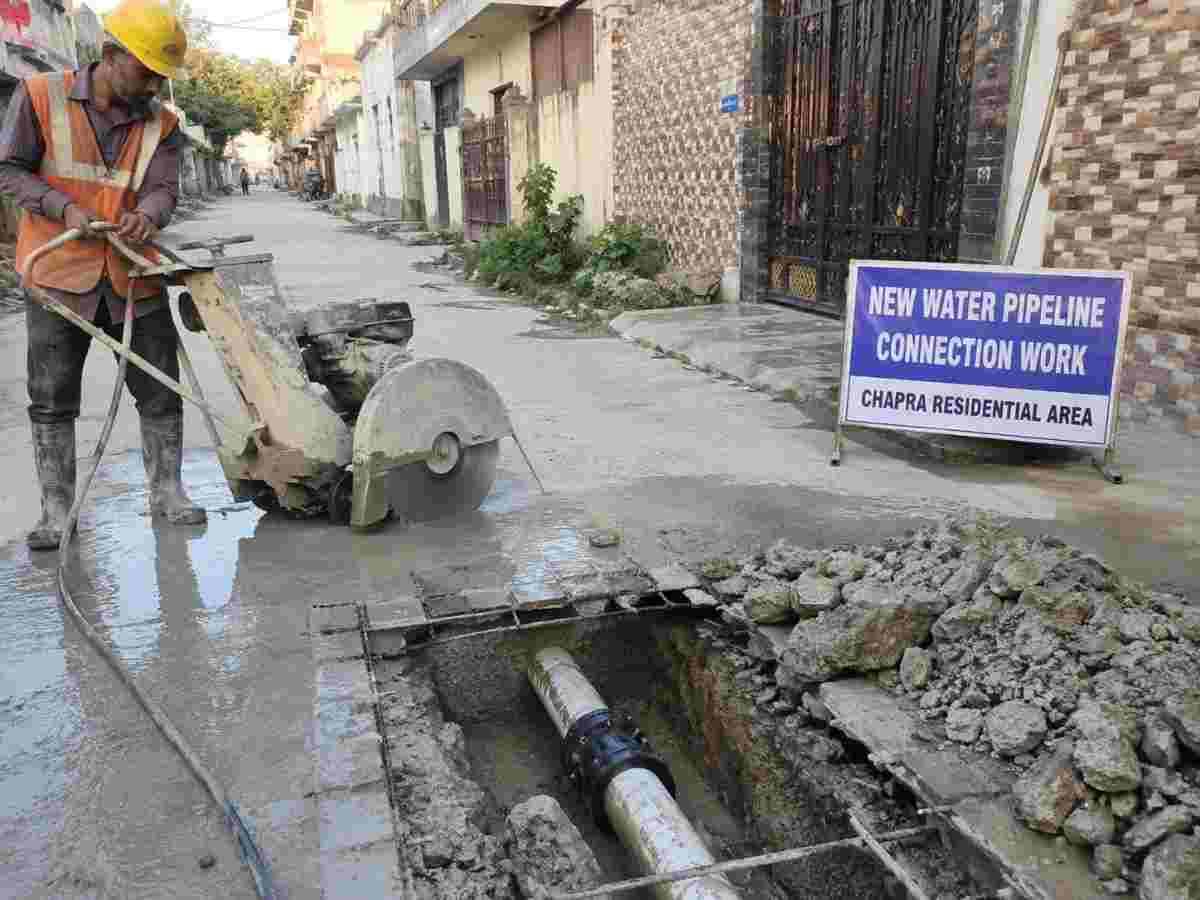
Getting a new water pipeline connection should be simple. In Chapra’s growing residential neighbourhoods, though, the pipe often has to pass through reinforced cement concrete (RCC): a plinth beam, a boundary wall, a driveway slab, a concrete road edge or a drainage platform. Breaking that concrete with a hammer or chisel is the fastest way to cause cracks, damage the steel reinforcement and upset your neighbours.
Professional RCC cutting avoids all of that. At Core Cutting India, we cut precise openings in reinforced concrete so your pipeline can go in cleanly, safely and with minimal disturbance. This guide explains how RCC cutting works for new water connections in Chapra, why it beats traditional demolition, and what to check before hiring a contractor.
Why Water Pipeline Connections in Chapra Often Involve RCC
Chapra has grown steadily, with new colonies, apartment buildings and independent houses coming up alongside older neighbourhoods. Many homes were built with concrete foundations, reinforced plinths and RCC-surfaced lanes. When a household or housing society applies for a new water connection, the line from the main supply to the property usually meets one or more of these obstacles:
- Concrete or RCC-surfaced lanes that must be cut to lay a connecting pipe.
- Boundary walls and compound walls that need a sleeve opening for the pipe.
- Plinth beams and foundation walls that the line must cross to reach the building.
- Driveways and parking slabs poured over the planned pipe route.
- Drainage covers and concrete platforms near the entry point.
Each of these is reinforced with steel bars. Cutting through them with crude tools is slow, noisy and risky. A professional concrete cutting method gives you a clean, measured opening instead.
What Is RCC Cutting?
RCC cutting is the process of cutting reinforced concrete with diamond-tipped tools. Because diamond is one of the hardest materials available, these tools slice through both concrete and embedded steel bars without the heavy impact of a breaker.
The main methods used for water pipeline work are:
- Wall saw cutting for straight, deep cuts in walls and thick slabs.
- Slab or road (floor) saw cutting for trenches in concrete surfaces such as lanes, driveways and parking areas.
- Core cutting (core drilling) for round holes through walls, beams and slabs where a pipe or sleeve must pass.
- Hand saw or ring saw cutting for tight spots where larger machines can’t fit.
Water is used during cutting to cool the diamond tools and suppress dust. That keeps the work site clean, which matters in a residential area where families, children and elderly residents live next door.
Why Not Just Break the Concrete?
Many people assume it is cheaper to hire a labourer with a hammer and chisel or a jackhammer. In practice, breaking concrete causes problems that cost far more later.
Cracks beyond the cut area. Impact tools send shock through the entire slab or wall. A pipe opening that should be 100 mm wide can leave hairline cracks metres away, weakening the structure and letting water seep in.
Damage to nearby structures. In closely built residential lanes, vibration can crack neighbouring walls, tiles and plaster. That can lead to disputes with neighbours.
Uneven, messy edges. Broken edges are rough and irregular, so repairs and waterproofing take longer and look worse.
Dust and noise. Jackhammering produces heavy dust and a lot of noise, which is unpleasant for families and often leads to complaints.
Damaged reinforcement. Hitting the steel bars bends or fractures them unpredictably. Diamond cutting cuts them cleanly, so you can restore the structure properly.
Longer completion time. A messy break-out means more debris to clear, more patching to do and a longer wait before the connection is ready.
Key Advantages of Professional RCC Cutting for Water Connections
Precision and Clean Edges
Machine cutting follows a marked line, so the opening is exactly the size you need. This makes fitting the pipe, sleeve or fittings simple and leaves smooth edges that are easy to seal and restore.
Minimal Vibration
Diamond cutting is low-impact. The surrounding concrete, nearby walls and the building’s structure stay undisturbed, which is essential in tightly packed residential areas.
Low Dust and Controlled Noise
Wet cutting greatly reduces airborne dust. Noise is also lower than with breakers, so work causes less disturbance during the day.
Faster Work, Less Debris
Because only the required section is cut, there is less rubble to remove. Your lane, driveway or compound is back in use sooner.
Better Safety
Controlled cutting lowers the risk of unexpected collapse and flying fragments. Trained operators also plan the cut to avoid unnecessary load on the structure.
Cost-Effective in the Long Run
The cutting charge may look higher than a labourer’s rate, but you save on repair, re-plastering, re-waterproofing and fixing crack damage. For most homeowners, the total cost ends up lower.
How RCC Cutting Works for a New Pipeline Connection
Here is a typical process for a residential water line in Chapra.
Step 1: Site inspection and planning. The team visits the location and checks the concrete thickness, the position of the pipe route and any visible utilities. They then agree the size and position of the cut with you or your plumber.
Step 2: Marking. The exact lines are marked on the concrete, so everyone knows precisely where the cut will be made and how large it will be.
Step 3: Scanning, where required. For thicker slabs or beams, the team checks for embedded conduits or critical reinforcement before cutting, to avoid hitting something important.
Step 4: Cutting or core drilling. Using the right machine for the job, the operator cuts along the marked lines or drills the round opening. Water is supplied continuously to control dust and keep the blade cool.
Step 5: Removal of cut sections. Cut concrete pieces are lifted out cleanly, leaving a neat trench or hole.
Step 6: Handover to the plumber. Your plumber or the water-supply contractor lays the pipe, fixes sleeves and connects the line.
Step 7: Restoration. After the pipe is installed and tested, the opening is filled with concrete or grout, waterproofed where needed and finished to match the surrounding surface.
Where RCC Cutting Is Commonly Needed in Chapra Homes
Here are common situations in which Chapra residents need this service:
- Independent houses where the pipe must cross a boundary wall or plinth.
- Apartment buildings where a new riser or branch line needs to pass through slabs or shear walls.
- Housing society lanes with concrete surfaces that need a trench for an internal water network.
- Rebuilt or extended homes where a new bathroom or kitchen needs a fresh supply line.
- Commercial-residential mixed buildings with shop frontage over concrete.
- Borewell-to-tank connections where the line passes through a concrete terrace or wall.
Pipe Sleeves and Core Cutting: A Quick Explanation
When a pipe passes through a wall or beam, the cleanest method is to core drill a circular hole and then insert a sleeve. The sleeve protects the pipe, allows slight movement and makes future replacement easier without cutting the concrete again.
Core hole sizes are chosen to suit the pipe diameter plus space for the sleeve and sealant. A well-drilled core has smooth walls, so it can be waterproofed and sealed neatly. This matters especially for water lines, because gaps around a pipe can let moisture into the structure over time.
Permissions and Planning: What Homeowners Should Know
Before any road or lane cutting, check the local requirements. Cutting a public road or lane, as opposed to your own private property, generally requires approval from the relevant civic or water-supply authority. Rules, fees and restoration conditions vary, so confirm with your local municipal body or water department in Chapra before starting.
For work inside your own plot, such as boundary walls, plinths and driveways, you mainly need to coordinate with your plumber and the neighbours who may be affected.
It is also wise to:
- Confirm the pipe route with your plumber or the water-supply contractor first.
- Ask the cutting team to keep a safe working distance from existing underground lines.
- Inform neighbours in advance, particularly for work close to shared walls.
- Plan the restoration, including backfilling, curing and finishing, before cutting starts.
How to Choose the Right RCC Cutting Contractor in Chapra
Not every contractor offers the same quality. Here is what to look for.
Proper diamond equipment. Ask whether they use wall saws, floor saws and core drilling machines, rather than only breakers.
Experienced operators. Skilled operators read the structure, avoid damaging reinforcement and finish quickly.
Clear, transparent pricing. Quotes should specify how charges are calculated, for example per running foot or per core hole, along with the cut depth and size.
Dust and safety practices. A good team uses water suppression, protective gear and barriers.
Local availability. Prompt response matters, especially when your water connection is on a deadline.
References and past work. Ask for examples of similar residential jobs.
Aftercare support. Some contractors can advise on or help with restoration of the cut area.
Common Mistakes to Avoid
- Cutting before finalising the route. A change of plan means paying for another cut.
- Choosing the cheapest option blindly. A low rate often means a messy job and costly repairs.
- Ignoring the reinforcement. Cutting main beams or columns without engineering advice can weaken the building.
- Skipping waterproofing. Gaps around the pipe can cause damp patches later.
- Not informing neighbours. Even low-noise work should be communicated in advance.
- Leaving the restoration for later. Open trenches are a safety risk and can collect dirty water.
Tips to Make the Job Smooth
- Keep the work area clear of vehicles, furniture and loose objects.
- Provide a water source and power point close to the cutting location.
- Be present, or have a trusted person on site, when the cut is marked and approved.
- Have your plumber and the cutting team coordinate on timing, so the pipe goes in as soon as the cut is done.
- Plan to cure and finish the patch properly, so the repaired area stays strong and watertight.
Why Choose Core Cutting India for Chapra?
At Core Cutting India, we focus on one thing: accurate, safe and neat concrete cutting. For residential customers in Chapra, that means:
- Right-sized equipment for homes, lanes and tight spaces.
- Low-vibration, low-dust cutting that protects your property and your neighbours’ peace.
- Precise cuts that make pipe installation and restoration easier.
- Prompt scheduling to fit your water connection timeline.
- Clear communication about cost, timing and what to expect.
Whether you need a single core hole for a pipe sleeve or a longer trench through a concrete lane, our team can plan the cut to suit your project.
Frequently Asked Questions (People Also Ask)
What is RCC cutting?
RCC cutting is the process of cutting reinforced cement concrete, including its embedded steel bars, using diamond-tipped tools such as wall saws, floor saws and core drilling machines. It creates clean, accurate openings with little vibration.
Why is RCC cutting needed for a new water pipeline?
New pipelines often have to pass through concrete walls, plinths, slabs or road surfaces. Cutting these precisely lets the pipe go through without cracking the structure or causing unnecessary damage.
Is RCC cutting better than breaking concrete with a hammer?
For most residential work, yes. Diamond cutting is more precise, creates less vibration and dust, protects nearby structures and leaves edges that are easier to restore.
How much does RCC cutting cost in Chapra?
Cost depends on the thickness of the concrete, the length or number of cuts, the diameter of core holes, the amount of reinforcement and site access. The best approach is to request a site-specific quote.
Is concrete cutting safe near existing pipes and cables?
It can be, provided the team plans the cut carefully, inspects the area and works at a safe distance from known utilities. Always tell the contractor about any buried lines you are aware of.
Do I need permission to cut a road or lane for a water connection?
For public roads and lanes, you usually need approval from the local civic or water-supply authority. Check with the relevant department in Chapra for current requirements. For work inside your own property, permission is generally simpler, but it is still sensible to inform affected neighbours.
How long does RCC cutting take for a home water connection?
Many residential jobs, such as a few core holes or a short trench, can be finished in a few hours. Longer trenches or thicker concrete may take a day or more.
Can RCC cutting damage the building?
When done by trained operators using the correct method, it is far less likely to damage the building than breaking with impact tools. The cut should avoid structural members unless an engineer has approved otherwise.
What size hole is needed for a water pipe through a wall?
The hole should be slightly larger than the pipe, with allowance for a sleeve and sealant. Your plumber can confirm the pipe diameter, and the cutting team will choose the matching core size.
How do I book RCC cutting services in Chapra?
Call +91 70096 79903 or visit corecuttingindia.com with your location, the type of concrete to be cut and the approximate size of the opening. The team will arrange an inspection and quote.
Conclusion
A new water pipeline connection improves daily life for any household, but only when it is installed without damaging your property. In Chapra’s residential areas, where lanes are narrow and buildings are close together, careful RCC cutting protects your structure, your neighbours and your budget. Diamond cutting and core drilling give you clean edges, low vibration and a faster, tidier job than traditional breaking.
If you are planning a new water connection and need reliable RCC cutting in Chapra, Core Cutting India is ready to help. Call us on +91 70096 79903 or visit https://corecuttingindia.com/ to discuss your project and get a prompt, no-pressure quote.