
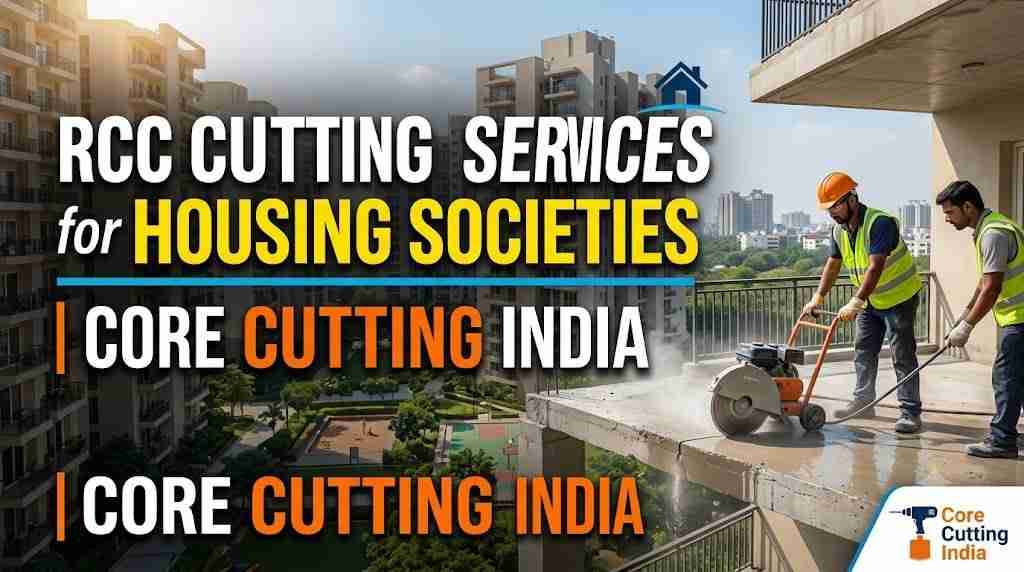
Housing societies across India are ageing, expanding, and constantly evolving. From retrofitting a new water pipeline to modifying a parking ramp, RCC (Reinforced Cement Concrete) cutting has become an unavoidable part of maintaining and upgrading residential complexes. Unlike commercial or industrial cutting jobs, housing society projects come with a unique set of challenges — occupied flats, shared common areas, noise-sensitive neighbours, and Resident Welfare Association (RWA) approvals. This guide explains everything a housing society, builder, or facility manager needs to know before hiring an RCC cutting contractor.
What Is RCC Cutting and Why Do Housing Societies Need It?
RCC cutting refers to the controlled removal or modification of reinforced concrete using diamond-tipped tools rather than manual breaking or jackhammers. In a housing society context, this is typically required for:
- Balcony extensions or modifications approved by the RWA or municipal authority
- Plumbing and drainage line repairs running through slabs or shear walls
- Ramp and driveway adjustments for parking lot redesigns
- Water tank and sump wall openings for pipe inlets/outlets
- Society clubhouse or amenity renovations requiring new doorways or windows
- Fire safety compliance work, such as cutting openings for fire exit staircases or sprinkler lines
- STP (Sewage Treatment Plant) and basement modifications
Because these buildings are occupied by families around the clock, the margin for error — noise, dust, structural risk — is far smaller than on a fresh construction site.
The Housing Society Challenge: Working Around People, Not Just Concrete
Contractors who specialize in fresh-build construction often struggle when moved into a lived-in residential complex. Here's what makes RCC cutting for housing societies fundamentally different:
1. Noise and Time Restrictions Most RWAs enforce strict working hours (typically 9 AM–6 PM, with a lunch break) and prohibit weekend or festival-day work. A professional RCC cutting team plans its schedule around these society bylaws in advance.
2. Structural Sensitivity in Older Buildings Many societies are 15–30 years old, and their structural drawings may be outdated, missing, or never digitized. Before any cutting begins, a responsible contractor conducts on-site verification using rebar scanning to avoid damaging load-bearing elements.
3. Common Area Coordination Cutting a wall in a shared staircase or basement affects multiple flats. This requires written no-objection from the RWA and, in many cases, coordination with the society's structural consultant.
4. Dust and Debris Control in Tight Spaces Housing societies don't have the open space that construction sites do. Wet-cutting diamond blades and vacuum-based dust extraction are essential to keep corridors, lifts, and neighbouring flats clean and livable during the work.
5. Safety Around Residents, Children, and Elderly Occupants Barricading work zones, using low-noise equipment during peak hours, and ensuring debris never falls into common walkways are basic non-negotiables for society projects.
Common RCC Cutting Techniques Used in Residential Complexes
Wall Sawing — Used for creating new door or window openings in RCC walls, common for balcony extensions or connecting two flats.
Core Drilling — The go-to method for plumbing pipe penetrations, exhaust duct holes, and small utility openings. It's clean, precise, and generates minimal vibration — ideal for occupied buildings.
Floor Sawing — Applied when horizontal slab openings are needed, such as new staircases, lift shaft modifications, or drainage channels.
Chain Saw / Hand-Held Diamond Cutting — Useful for tight corners and confined spaces like basement parking or utility rooms where larger machines can't be maneuvered.
Selecting the right method depends on wall/slab thickness, reinforcement pattern, and how much disruption the society can tolerate during working hours.
RWA Approvals and Documentation: What You'll Need
Before booking an RCC cutting contractor, most societies require:
- A written request to the RWA/management committee outlining the scope of work
- Structural stability certification (for major cuts affecting load-bearing walls)
- A no-objection certificate (NOC) from adjacent flat owners, if applicable
- Municipal permission for changes visible from the exterior (balconies, facades)
- A work schedule agreed upon with the society's facility manager
A reliable RCC cutting contractor should be able to guide societies through this documentation process, having handled similar approvals across multiple residential complexes.
Cost Considerations for Society Projects
RCC cutting costs for housing societies depend on several variables:
- Type of cut required (core drilling vs. wall sawing vs. floor sawing)
- Wall or slab thickness and reinforcement density
- Floor level and accessibility (ground floor vs. 15th floor)
- Working-hour restrictions that may extend project timelines
- Debris removal and disposal requirements
Rather than negotiating blind, RWAs and individual flat owners can use our online rate calculator to get a transparent, itemized estimate in minutes — helpful for budgeting and getting society committee approval faster.
Why Hire Specialized Contractors Instead of Local Labour
Many societies default to local labour contractors using hammers and chisels for concrete work — a decision that often backfires. Manual breaking:
- Creates excessive vibration that can crack tiles and plaster in neighbouring flats
- Takes significantly longer, extending disruption for residents
- Risks damaging embedded rebar and compromising structural integrity
- Generates far more dust and debris than controlled diamond cutting
Professional diamond-based RCC cutting, by contrast, is faster, quieter, cleaner, and safer — a difference RWAs and residents notice immediately once work begins.
Serving Housing Societies Across Delhi NCR
Delhi's residential landscape includes thousands of housing societies — from decades-old DDA colonies to modern gated communities — many of which now require slab and RCC modifications for plumbing upgrades, fire safety retrofits, or amenity renovations. Our team regularly supports RWAs and facility managers with our dedicated slab cutting services in New Delhi, offering flexible scheduling around society rules and minimal-disruption execution.
Get Started: Talk to Our RCC Cutting Experts Today
Planning an RCC cutting job for your housing society doesn't have to be stressful. With the right contractor, approvals, scheduling, and execution can all move smoothly — without disturbing residents or compromising safety.
📞 Call or WhatsApp us at 7009679903 to discuss your society's requirements and schedule a free site visit.
📧 Email your project scope to [email protected] — our team will respond with a detailed plan and cost breakdown.
🌐 Explore our full service range at https://corecuttingindia.com/, or use our rate calculator to get an instant estimate before presenting it to your RWA committee.
Whether it's a single flat's plumbing repair or a society-wide fire safety retrofit, our diamond cutting specialists are ready to deliver clean, safe, and RWA-compliant results.
Frequently Asked Questions (FAQ)
Q1: Does RCC cutting require RWA approval in a housing society? Yes, most housing societies require written approval from the RWA or management committee, especially for work affecting common areas, load-bearing walls, or building exteriors. Our team can help guide you through the documentation process.
Q2: Is RCC cutting noisy and disruptive for residents? Modern diamond-based cutting methods like core drilling and wall sawing are significantly quieter and cause far less vibration than traditional hammer-and-chisel breaking, making them suitable for occupied residential buildings.
Q3: Can RCC cutting damage the structural strength of my building? Not when performed correctly. Professional contractors conduct rebar scanning and structural checks before cutting to ensure load-bearing elements remain untouched, preserving the building's integrity.
Q4: How much does RCC cutting cost for a housing society project? Costs depend on the type of cut, wall/slab thickness, floor level, and access constraints. Use our rate calculator to get an instant, accurate estimate for your specific requirement.
Q5: Do you provide RCC cutting services for societies in Delhi NCR? Yes, we offer dedicated slab cutting services in New Delhi and across the NCR region, with scheduling flexibility to work around society rules and resident convenience.
Q6: How do I book a site visit or get a quote? Simply call or WhatsApp us at 7009679903, or email [email protected] with details about your society and the scope of work. We'll arrange a free site assessment at your convenience.