
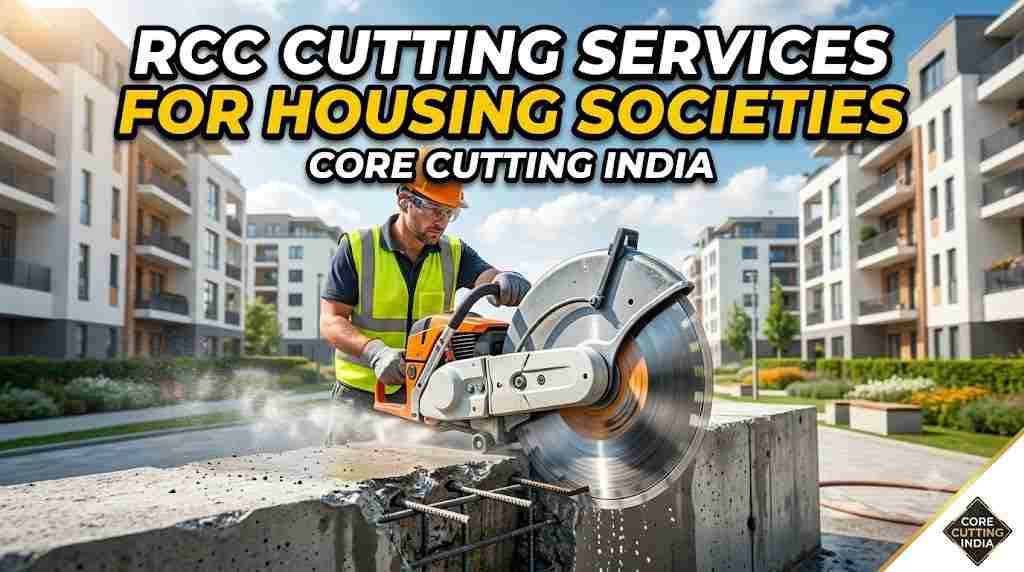
Housing societies rarely stay static. A pipe needs rerouting, a lift shaft has to be widened, an old balcony grille gets replaced with glass, or a maintenance team discovers a slab that must be opened for plumbing repairs. In every one of these situations, the work touches reinforced cement concrete — and RCC is not a material any RWA (Resident Welfare Association) or facility manager wants handled by guesswork. This is where professional RCC cutting services step in, giving housing societies a way to modify concrete structures without compromising the building's safety or disturbing hundreds of residents in the process.
Why Housing Societies Need Specialised RCC Cutting
A residential society is a shared structure. Unlike a standalone bungalow, a mistake in one flat's slab or wall can ripple through to the units above, below, or beside it. That's why RCC cutting for apartment complexes demands more than a hammer drill and a labourer — it needs diamond-tipped equipment, trained operators, and a method that keeps vibration, dust, and noise to a minimum.
Typical housing society requirements include:
- Slab cutting for new plumbing lines, drainage repositioning, or duct openings
- Wall cutting to create new doorways, windows, or ventilation shafts
- Column and beam-adjacent cutting for structural modifications during renovation
- Core drilling for AC pipe routing, electrical conduits, and fire-safety installations
- Terrace and basement cutting for waterproofing access or parking-related structural work
Because societies operate on tight common-area budgets and even tighter resident patience, the contractor chosen for this work needs to combine engineering precision with genuine project discipline — clean sites, defined timelines, and safety documentation the management committee can present at an AGM if asked.
The Diamond Cutting Advantage Over Traditional Methods
Conventional concrete breaking with chisels and jackhammers creates unpredictable cracks that can weaken adjoining RCC members — a serious risk in a multi-storey society building where load paths run through shared walls and slabs. Diamond core cutting and diamond wall sawing solve this by cutting along an exact, pre-marked line using water-cooled diamond blades or core bits.
The benefits for a housing society specifically:
- No structural shock — the surrounding concrete and rebar stay intact, protecting adjacent flats
- Minimal dust — wet cutting technology suppresses airborne particles, important in occupied buildings
- Lower noise footprint — critical for societies with restricted work-hour bylaws
- Exact dimensions — openings for pipes, ducts, or doorways come out to the millimetre, avoiding rework
- Faster turnaround — a well-planned crew can complete common openings in hours, not days
Common RCC Cutting Applications Across Society Projects
Plumbing and drainage upgrades: Ageing societies frequently need old cast-iron plumbing lines replaced with modern PVC or CPVC. This almost always means precision core cutting through slabs at each flat's bathroom or kitchen riser point.
Elevator and lift shaft modifications: As societies retrofit or upsize lifts to meet fire and accessibility codes, RCC wall and slab cutting is required to widen shafts or create new landing openings.
Fire safety compliance: Many RWAs are now mandated to install fire hydrant risers, sprinkler lines, or hose reel cabinets — each requiring clean core-drilled penetrations through RCC walls and slabs.
Balcony and facade renovation: Societies converting old grille balconies into enclosed glass spaces often need controlled RCC cutting to adjust parapet walls or slab edges.
Solar panel and OHT installations: Rooftop solar projects and overhead tank upgrades need anchor holes and cable routing, done through precise core cutting rather than random drilling.
What Determines the Cost of RCC Cutting for Your Society
Pricing for society-level RCC cutting depends on several factors: the thickness and reinforcement density of the slab or wall, the diameter or length of cut required, site accessibility (upper floors, tight stairwells, or basement access all add complexity), and the number of cutting points across the project. Societies managing common-area budgets should get a clear, itemised estimate rather than a flat guess. Use the online rate calculator to get an instant, transparent estimate based on your exact cutting requirements before any site visit is scheduled — this helps management committees present accurate figures during resident approvals.
Choosing the Right RCC Cutting Contractor for Your Society
An RWA evaluating vendors should look beyond the lowest quote. Ask for:
- Proof of experience with multi-storey residential buildings, not just standalone plots
- Trained operators who follow water-cooled, dust-controlled cutting methods
- A written safety and structural-impact plan for any load-bearing area
- Flexible scheduling that respects society work-hour rules and common-area access norms
- Post-work cleanup as part of the service, not an add-on
For societies in the National Capital Region, our slab cutting service in Delhi page details local turnaround times, equipment used, and coverage areas — useful if your society is planning a plumbing, HVAC, or renovation project in and around Delhi.
Get a Quote or Schedule a Site Visit Today
If your housing society's management committee is planning a maintenance upgrade, plumbing overhaul, fire-safety retrofit, or renovation project that involves RCC modification, don't leave it to unskilled labour. Call or WhatsApp us directly at 7009679903 for a same-day response, or write to [email protected] with your requirement and we'll revert with a site-visit schedule and estimate. Societies across India trust our teams for dust-controlled, structurally safe cutting work that keeps residents undisturbed and projects on schedule.
Frequently Asked Questions (FAQ)
1. Is RCC cutting safe for occupied housing society buildings?
Yes, when done using diamond core cutting or wall sawing techniques. These methods avoid the vibration and shock that traditional breaking causes, keeping adjoining flats and structural members unaffected.
2. How long does a typical RCC cutting job take in a society flat?
Most core-cutting jobs (plumbing or conduit openings) are completed within 2–4 hours per point. Larger wall or slab-cutting projects, such as lift shaft modifications, may take one to two days depending on scope.
3. Do housing societies need RWA approval before RCC cutting work?
Generally yes. Since RCC cutting affects shared structural elements, most societies require management committee or structural engineer sign-off, especially for load-bearing walls or slabs.
4. Will RCC cutting cause dust and noise disturbance to neighbours?
Professional diamond cutting uses water cooling, which significantly reduces dust. Noise is also lower than jackhammer breaking, but work is best scheduled within society-approved hours.
5. How is the cost of RCC cutting calculated for a society project?
Cost depends on cutting depth, diameter/length, material reinforcement, and site accessibility. You can get an instant estimate using our rate calculator before committing.
6. Can RCC cutting services handle basement and terrace cutting work?
Yes, our teams are equipped for basement, terrace, and rooftop cutting, including work for waterproofing access, OHT installation, and solar panel anchoring.
7. How do I book an RCC cutting service for my society?
Simply call or WhatsApp 7009679903, or email [email protected] with your location and requirement. Our team will schedule a site assessment and share a detailed quote.