
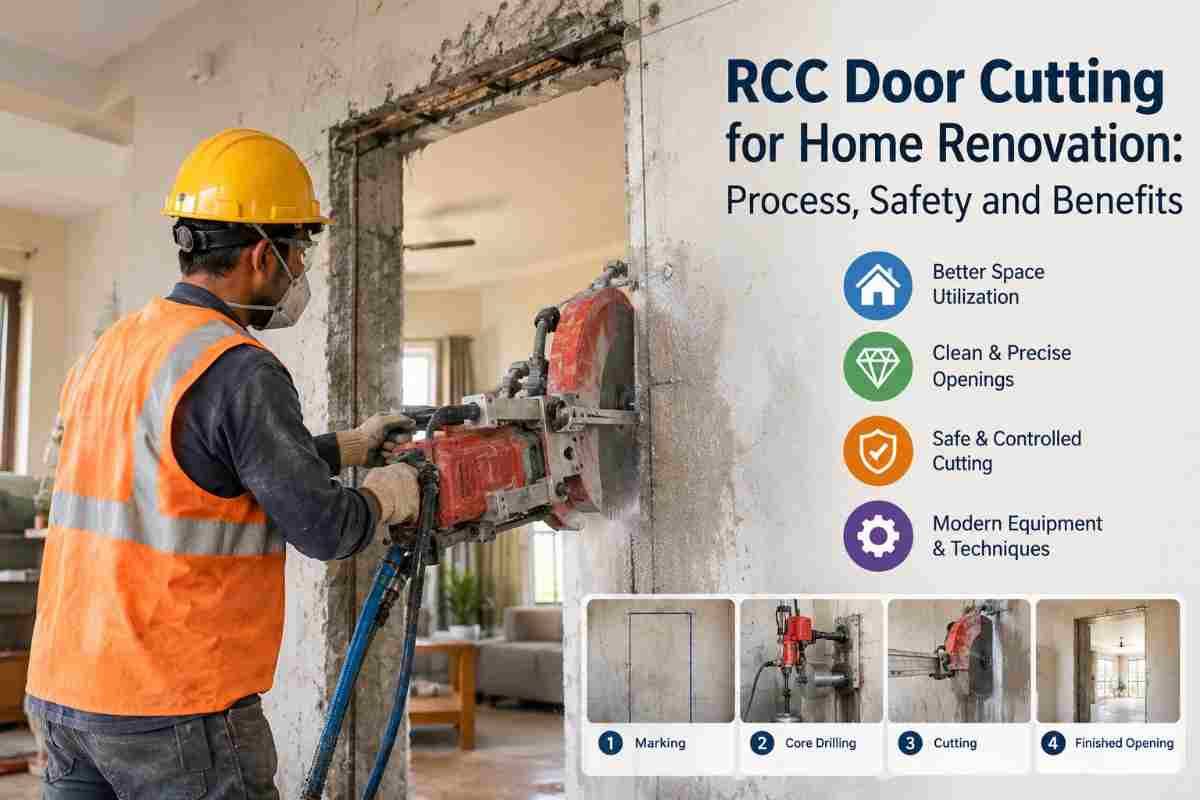
Renovating a home often means rethinking how spaces connect. You might want a new entrance to a converted garage, a doorway between two rooms, or a separate access point for a rental portion. In many Indian homes, the walls standing in the way are made of reinforced cement concrete (RCC), not brick. Breaking RCC with a hammer and chisel is slow, noisy, and risky for the structure around it.
This is where RCC door cutting comes in. It uses diamond-tipped tools to cut clean, precise openings in concrete with minimal vibration, dust, and damage. At Core Cutting India, this is the kind of precision work homeowners, builders, and architects ask for when a renovation needs accuracy without compromising the building.
This guide covers what RCC door cutting is, how the process works, the safety measures that matter, and the benefits over conventional demolition.
What Is RCC Door Cutting?
RCC door cutting is the process of creating a new door opening in a reinforced concrete wall or slab using diamond cutting equipment. Unlike a chisel or breaker, which shatters concrete through impact, diamond cutting grinds through the material along a marked line. The result is straight, smooth edges that are ready for a door frame.
RCC is concrete reinforced with steel bars, which gives it great strength but also makes it hard to modify. Diamond blades and wires can cut through both the concrete and the embedded steel in a single pass, which is why the method is the standard for modern renovation work.
Why Homeowners Choose RCC Door Cutting
Traditional demolition sends shock waves through the structure. In an occupied building, that can crack neighbouring walls, loosen plaster, and disturb the family living there. Diamond cutting avoids most of this because the force is applied only along the cut line.
Common reasons people choose it:
- Connecting rooms: Opening a doorway between two bedrooms, or between a living area and a new extension.
- Creating a separate entrance: Useful for ground-floor shops, home offices, clinics, or rental units.
- Converting a window into a door: Common for balcony or terrace access.
- Garage and basement access: Adding an entry where none existed.
- Improving ventilation and light: Opening up closed-off areas of the home.
When Is RCC Door Cutting Needed?
Not every wall is RCC. Many older homes use load-bearing brick masonry, while modern apartments and multi-storey houses commonly use RCC columns, beams, slabs, and shear walls. You will likely need RCC cutting when:
- The wall is a thick concrete partition or shear wall.
- The opening must be cut precisely to fit a standard door frame.
- The building is occupied and noise and vibration must be kept low.
- The wall is adjacent to sensitive finishes, such as tiles, wood panelling, or glass.
A structural engineer or an experienced cutting contractor can confirm the wall type before any work begins.
The RCC Door Cutting Process: Step by Step
A professional job follows a clear sequence. Here is what to expect.
1. Site Inspection and Assessment
The team visits the site to examine the wall’s thickness, reinforcement, and condition, and to understand access and working space. They check for hidden services such as electrical conduits, water pipes, and gas lines. Scanning tools can detect rebar and embedded pipes so the cut avoids hitting anything critical.
2. Structural Evaluation
This step is the most important. Before a doorway is cut, someone must determine whether the wall carries load. If it does, the opening may need a lintel beam, additional reinforcement, or temporary supports. A qualified structural engineer should approve the location and size of the opening. Skipping this step is the biggest mistake a homeowner can make.
3. Marking the Opening
The door dimensions are marked precisely on the wall, usually with the frame size plus a small allowance for fitting. Straight, level lines matter because the cutting tool follows them exactly.
4. Setting Up Equipment and Protection
The area is prepared by covering floors and furniture, sealing nearby openings with plastic sheeting, and arranging water supply and slurry collection. Cutting equipment is anchored securely to the wall or floor.
5. Cutting the Concrete
Depending on the wall and the site, the contractor uses one of several methods:
- Wall saw cutting: A track-mounted saw with a large diamond blade cuts straight lines through thick walls. It is fast and very accurate.
- Wire saw cutting: A diamond-impregnated wire loops around the section and cuts through it. This works well for very thick or hard-to-reach sections.
- Hand saw or ring saw cutting: Handheld units suit smaller jobs, corners, and tight spaces.
- Core drilling: Cylindrical drill bits remove circular cores. Contractors often drill at the corners of the opening first so the cut finishes cleanly without overcutting.
Water cools the blade, suppresses dust, and extends tool life throughout the process.
6. Removing the Cut Section
Once the cuts are complete, the concrete block must be removed safely. For heavy sections, the contractor cuts the block into smaller pieces and lifts them out with a hoist or lifting equipment. This prevents sudden falls that could injure workers or damage floors.
7. Finishing the Edges
The edges are inspected and, if needed, smoothed or trimmed. Exposed rebar is treated to prevent rusting. If the opening requires a lintel or frame support, it is installed at this stage.
8. Clean-Up
Slurry is collected and disposed of properly, debris is removed, and the area is cleaned. The site is then ready for door frame installation, plastering, and painting.
Safety Measures in RCC Door Cutting
Cutting through reinforced concrete involves heavy equipment, water, electricity, and structural change. Safety must be built into every stage.
Structural Safety
- Get engineering approval before cutting any wall.
- Use temporary props or shoring where the wall supports a slab or beam above.
- Install a lintel or reinforcing frame around the new opening when required.
- Never cut through columns or main beams without structural design.
Worker Safety
- Personal protective equipment (PPE): Helmets, safety goggles, ear protection, gloves, safety shoes, and dust masks are essential.
- Trained operators: Cutting machines should only be run by experienced technicians.
- Secure equipment setup: Track saws and wire systems must be firmly anchored before starting.
- Safe lifting practices: Cut sections should be supported and lowered in a controlled way.
Electrical and Water Safety
Wet cutting combines water with powered equipment, so proper earthing, waterproof connections, and residual current devices (RCDs) are needed. Cables should be kept off wet floors and away from the cutting zone.
Dust and Environmental Control
Concrete dust contains fine silica, which is harmful to breathe over time. Wet cutting, slurry collection, and sealing the work zone greatly reduce dust exposure. Slurry should be disposed of responsibly, not washed into household drains.
Protecting the Household
Keep children, pets, and elderly family members away from the work area. Cover or remove valuables, and ensure ventilation in nearby rooms.
Benefits of RCC Door Cutting for Home Renovation
Precision and Clean Finish
Diamond cutting produces straight, smooth edges with accurate dimensions. Doors fit better, and less plastering and patching work is needed afterwards.
Minimal Vibration and Structural Stress
Because cutting does not rely on impact, nearby walls, ceilings, and finishes stay intact. This matters most in apartments and occupied homes.
Lower Noise Levels
Diamond cutting is considerably quieter than breaker-based demolition, which makes it more acceptable to neighbours and easier on the family living in the home.
Reduced Dust and Debris
Wet cutting controls dust, and the concrete comes out in manageable blocks instead of scattered rubble. Clean-up is faster.
Faster Completion
A wall saw can cut through thick concrete far quicker than manual breaking. Many door openings can be completed in a day, depending on thickness and access.
Ability to Cut Reinforcement
Diamond tools slice through concrete and steel together, so rebar does not need to be separately cut or torched.
Safer for the Building
Controlled cutting reduces the risk of unplanned cracks that can weaken a structure over time.
Versatility
The same techniques work for doors, windows, ventilation openings, staircase cut-outs, lift shafts, and pipe or duct penetrations.
Factors That Affect Cost
Prices vary widely, so it is better to understand the drivers than to expect a flat number:
- Wall thickness and concrete strength: Thicker, denser concrete takes longer and wears blades faster.
- Amount of reinforcement: More rebar means more cutting effort.
- Size of the opening: Larger openings need more cutting and more lifting.
- Access and location: Upper floors, tight spaces, or limited power and water access can add to the cost.
- Method used: Wire sawing is typically more expensive than wall sawing but may be the only option in some situations.
- Structural work: Lintels, props, and engineer fees are separate from cutting itself.
- Finishing: Plastering, frame installation, and painting are usually extra.
Always request a written quote that states what is included.
How to Choose the Right RCC Cutting Contractor
The contractor you pick decides the outcome, so check these points:
- Experience: Look for a team with a record of residential and commercial concrete cutting projects.
- Equipment: Professional wall saws, wire saws, and core drills signal a serious operation.
- Safety practices: Ask about PPE, dust control, and structural precautions.
- Engineering support: A good contractor works with, or can coordinate, a structural engineer.
- Clear quotation: Scope, timeline, and exclusions should be written down.
- References: Ask for previous work or customer feedback.
Companies like Core Cutting India offer concrete cutting services built around these principles, from assessment through clean-up, so homeowners get predictable results.
Tips for Homeowners Before the Work Starts
- Confirm the wall type and get structural clearance.
- Check whether your housing society or local authority requires permission, especially in apartments.
- Plan the door size, position, and frame type in advance.
- Remove furniture, electronics, and valuables from the work area.
- Arrange reliable power and water access for the crew.
- Inform neighbours about the work schedule.
Frequently Asked Questions
Is RCC door cutting safe for my house?
Yes, when it is done with proper structural assessment, supports where needed, and trained operators. The risk comes from cutting load-bearing elements without engineering approval, not from the cutting method itself.
Can I cut a door in any RCC wall?
Not always. Walls that carry heavy loads, such as shear walls and certain column-beam connections, need careful design. Some may allow an opening with reinforcement, while others may not.
How long does it take to cut a door in an RCC wall?
A standard residential opening can often be completed within a few hours to a day. Thicker walls, heavy reinforcement, or difficult access can extend this.
Is it very noisy or dusty?
It is much quieter and cleaner than breaker demolition. Wet cutting keeps dust low, though some noise from the machines is unavoidable.
Will cutting damage the rest of the wall?
Done properly, no. The cut is limited to the marked line, so surrounding concrete stays intact, apart from minor edge finishing.
Do I need to reinforce the opening afterwards?
Often yes. A lintel or frame may be required to restore strength above the opening. Your engineer will specify this.
Can RCC cutting be done in an occupied apartment?
Yes. Its low vibration and controlled dust make it well suited to occupied buildings, provided society permissions are in place.
Conclusion
RCC door cutting turns a solid concrete wall into a clean, usable opening without the damage and disruption of conventional demolition. The process, from inspection and structural evaluation to cutting, removal, and finishing, is controlled and precise. Its biggest advantages are accuracy, low vibration, reduced dust and noise, and speed. But the work is only as safe as the planning behind it: always get structural clearance, use proper protective measures, and hire experienced professionals.
If you are planning a renovation that involves opening up a concrete wall, speak with the specialists at Core Cutting India to discuss your project, understand the right method, and get the work done safely and cleanly.