
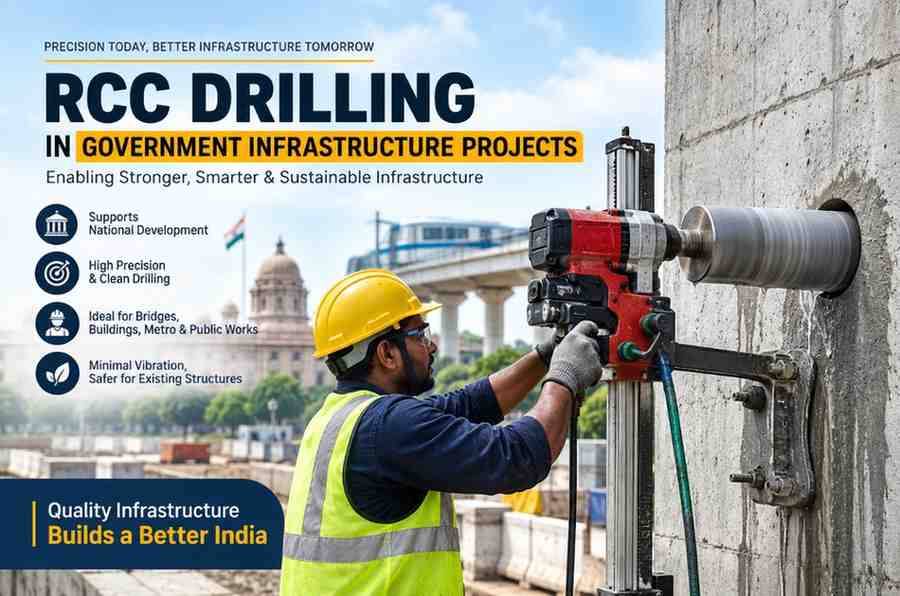
India's public infrastructure — highways, metro corridors, flyovers, dams, water treatment plants, and smart city utilities — is expanding at a pace rarely seen before. Behind almost every one of these projects lies a technical process that rarely makes headlines but is absolutely essential: RCC drilling. Reinforced Cement Concrete (RCC) structures form the backbone of nearly all modern government construction, and drilling into them accurately, safely, and efficiently is what allows utilities, cables, pipelines, and structural connections to be installed without compromising the integrity of the building or bridge.
At Core Cutting India (info@corecuttingindia.com), we specialize in precision RCC drilling and core cutting services for government and private infrastructure projects across the country. In this article, we take a detailed look at what RCC drilling involves, why it matters so much in public infrastructure, the techniques and equipment used, and what government contractors and project managers should look for when hiring a drilling partner
What Is RCC Drilling?
RCC drilling is the process of creating precise holes or openings in Reinforced Cement Concrete structures using specialized diamond-tipped drilling equipment. Unlike drilling into brick, wood, or plain concrete, RCC contains embedded steel reinforcement bars (rebar) that give the structure its strength. Drilling through this composite material requires equipment and expertise capable of cutting cleanly through both concrete and steel without causing cracks, structural weakening, or vibration damage to the surrounding area.
RCC drilling is typically performed using diamond core drilling machines, which use a hollow, diamond-embedded cutting bit to bore through concrete with water or dry cooling systems to manage heat and dust. The process produces a clean, circular core that can range from a few millimeters to over a meter in diameter, depending on the project requirement.
This technique is widely used for:
- Installing electrical conduits and cables
- Creating openings for water supply and drainage pipelines
- Structural inspections and testing (core sampling)
- Anchoring bolts for machinery, railings, or structural supports
- HVAC ducting and ventilation openings
- Fiber optic and telecom cable routing
- Expansion joints and drainage systems in roads and bridges
Why RCC Drilling Matters in Government Infrastructure Projects
Government infrastructure projects operate under strict timelines, safety regulations, and budget constraints. Unlike private construction, public projects are subject to public accountability, environmental clearances, and long-term durability requirements because they serve thousands or even millions of citizens daily. This is precisely why RCC drilling plays such a critical role.
1. Structural Safety and Compliance
Government projects such as flyovers, metro stations, and dams must comply with stringent structural safety codes. Poorly executed drilling can weaken load-bearing elements, leading to long-term safety risks. Professional RCC drilling ensures that reinforcement bars are avoided or handled correctly, and that openings do not compromise structural load paths.
2. Utility Integration Without Structural Damage
Modern infrastructure, from smart city projects to metro rail corridors, requires the integration of water lines, electrical systems, telecom cabling, and drainage networks into existing or newly built RCC structures. RCC drilling allows these utilities to be installed with minimal disruption to the structure, avoiding the need for demolition or reconstruction.
3. Speed and Efficiency for Large-Scale Projects
Government tenders often come with tight deadlines tied to public commitments — a metro line opening date, a highway inauguration, or a monsoon-season drainage deadline. Diamond core drilling is significantly faster and more precise than traditional breaking methods like hammering or jackhammering, helping projects stay on schedule.
4. Reduced Noise, Dust, and Vibration in Public Spaces
Government infrastructure projects frequently take place in populated urban areas — near hospitals, schools, residential colonies, and busy roads. Traditional concrete breaking generates excessive noise, dust, and vibration, which can disturb the public and even damage nearby structures. RCC drilling, particularly wet diamond core drilling, is a low-vibration, low-dust alternative that is far more suitable for sensitive urban environments.
5. Quality Assurance Through Core Sampling
RCC drilling is also used for extracting core samples from existing concrete structures to test compressive strength, detect voids, or assess structural health. This is especially important for government projects involving the repair, retrofitting, or life extension of aging bridges, dams, and public buildings.
Common Applications of RCC Drilling in Government Projects
Roads and Highways
RCC drilling is used extensively in national highway and expressway projects for installing drainage systems, expansion joints, road signage foundations, and utility ducts beneath the road surface. It is also used for anchoring crash barriers and streetlight foundations.
Metro Rail and Railway Infrastructure
Metro construction involves drilling through massive RCC piers, viaducts, and station structures for electrical systems, signaling cables, ventilation shafts, and structural connections. Precision is critical here, as even minor errors can affect the alignment of rail tracks or the safety of overhead structures.
Bridges and Flyovers
Bridge construction and retrofitting projects rely heavily on RCC drilling for installing expansion joints, drainage outlets, and anchor bolts for parapets and railings. Core sampling is also frequently used to assess the structural health of older bridges before repair work begins.
Water Supply and Sewage Treatment Plants
Government water infrastructure projects, including sewage treatment plants (STPs) and water treatment plants (WTPs), require precise RCC drilling for pipeline routing, valve chamber openings, and tank interconnections.
Smart City and Urban Development Projects
As cities across India implement smart city initiatives, RCC drilling has become essential for underground utility ducting, smart pole installations, CCTV network cabling, and integrated command center infrastructure.
Dams and Irrigation Projects
Dam maintenance and irrigation infrastructure often require drilling for grouting operations, instrumentation installation, and structural monitoring systems — all of which demand highly controlled, non-destructive drilling techniques.
RCC Drilling Techniques and Equipment
Diamond Core Drilling
The most widely used method for RCC drilling, diamond core drilling uses a rotating hollow bit embedded with industrial diamonds to cut through concrete and reinforcement. It is available in wet (water-cooled) and dry variants, with wet drilling preferred for larger diameters and thicker RCC sections due to better heat dissipation and dust control.
Handheld and Stand-Mounted Drilling Rigs
For smaller openings, handheld core drills are used, while larger diameter or deep drilling projects require stand-mounted rigs anchored to the structure for stability and precision.
Wall and Floor Sawing (Complementary Technique)
While not drilling in the strictest sense, wall and floor sawing is often used alongside RCC drilling in government projects to create larger openings for doorways, ducts, or structural modifications, using diamond blade saws designed for reinforced concrete.
GPR Scanning Before Drilling
Before drilling begins, ground-penetrating radar (GPR) or rebar scanning is typically used to map the location of embedded steel reinforcement, post-tension cables, and electrical conduits. This step is crucial in government projects to avoid cutting critical structural or utility elements accidentally.
Challenges in RCC Drilling for Government Projects
Government infrastructure drilling comes with a unique set of challenges that require experienced contractors:
- Working within live public infrastructure: Many projects require drilling in operational metro stations, active roads, or functioning government buildings, demanding careful scheduling and safety protocols.
- Strict regulatory compliance: Government contracts often require adherence to IS codes, environmental clearances, and safety certifications.
- Weather and site conditions: Monsoon schedules, traffic management, and site accessibility can all affect drilling timelines.
- Documentation and reporting: Government tenders typically require detailed reporting, quality certificates, and adherence to tender specifications, making experienced, process-driven contractors essential.
Why Choose Core Cutting India for RCC Drilling in Government Projects
At Core Cutting India, we bring specialized expertise, modern equipment, and a strong track record in handling RCC drilling and core cutting for government and infrastructure projects across sectors. Our approach is built around three core principles:
- Precision: Using advanced diamond core drilling equipment and rebar scanning technology to ensure accuracy without compromising structural integrity.
- Safety and Compliance: Adhering to government tender specifications, safety codes, and environmental guidelines on every project.
- Reliability at Scale: Capable of handling projects ranging from small utility openings to large-scale infrastructure drilling for highways, metros, and public buildings.
Whether you are a government contractor, EPC company, or infrastructure developer looking for a dependable RCC drilling partner, our team is equipped to deliver high-quality results on time and within specification.
Frequently Searched Questions on RCC Drilling
What is RCC drilling and how is it different from normal drilling? RCC drilling specifically targets Reinforced Cement Concrete, which contains embedded steel bars. It requires diamond-tipped equipment capable of cutting through both concrete and steel cleanly, unlike standard drilling used for brick, wood, or plain masonry.
Why is RCC drilling important in government infrastructure projects? It allows utilities, cables, and structural connections to be installed into concrete structures without demolition, ensuring faster project timelines while maintaining structural safety and regulatory compliance.
What equipment is used for RCC drilling? Diamond core drilling rigs, handheld and stand-mounted drills, wet and dry cooling systems, and rebar/GPR scanning tools are commonly used.
Is RCC drilling safe for existing structures? Yes, when performed by experienced professionals using rebar scanning and controlled drilling techniques, RCC drilling causes minimal disturbance and does not compromise structural integrity.
How much does RCC drilling cost in India? Costs vary based on the diameter and depth of drilling, the thickness of the RCC structure, site location, and project scale. Government tenders typically require detailed cost estimates as part of the bidding process.
Which government projects use RCC core cutting and drilling? Highways, metro rail systems, bridges, flyovers, water and sewage treatment plants, smart city utility networks, dams, and irrigation infrastructure all rely on RCC drilling and core cutting services.
How long does RCC drilling take for large infrastructure projects? Timelines depend on project scale, number of drilling points, and site accessibility, but diamond core drilling is significantly faster than traditional breaking methods, helping government projects meet tight deadlines.
Conclusion
RCC drilling may operate behind the scenes, but it is one of the most critical technical processes enabling India's rapid infrastructure growth. From metro corridors to smart city utilities, precise and professional RCC drilling ensures that public infrastructure is built safely, efficiently, and to the highest engineering standards.
For government contractors and infrastructure developers seeking a trusted RCC drilling and core cutting partner, Core Cutting India offers the technical expertise, equipment, and compliance-driven approach needed for large-scale public projects.
📩 Get in touch: info@corecuttingindia.com