
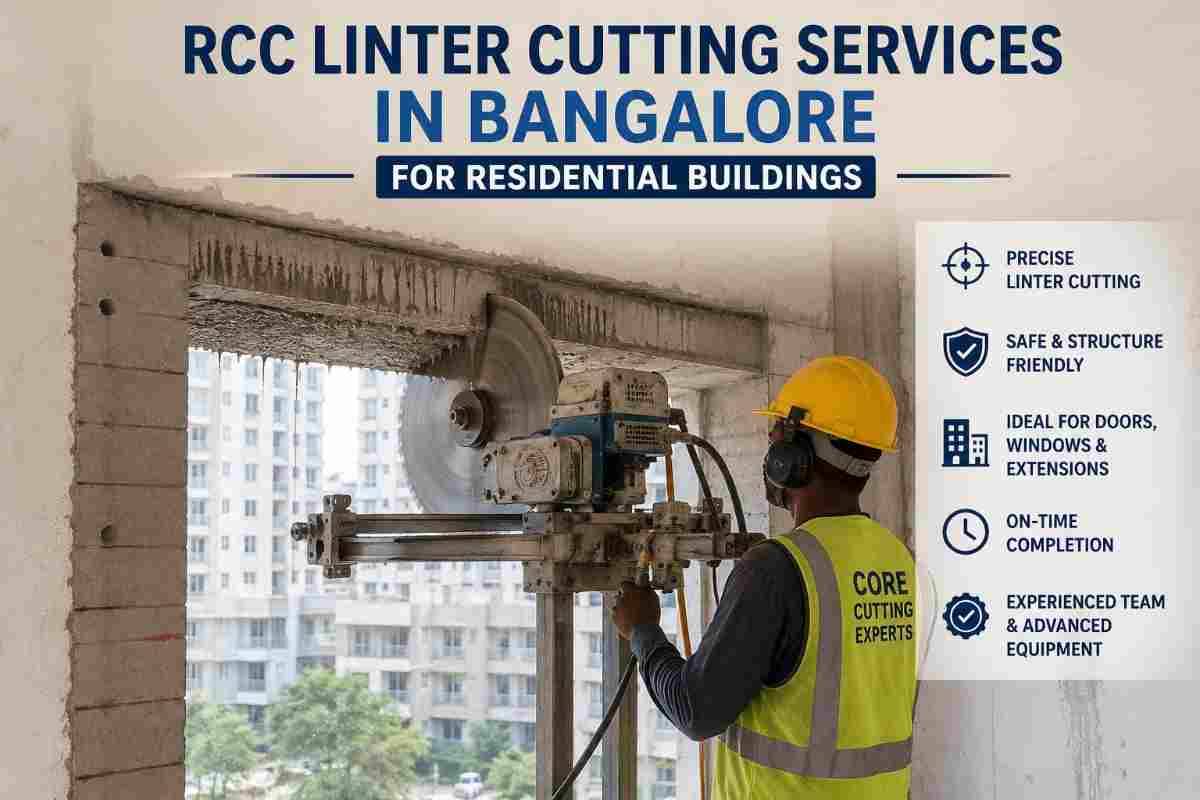
Bangalore’s homes are changing. Families are renovating older houses, merging rooms, widening doorways, adding balconies, and converting windows into French doors. Many of these upgrades run into the same obstacle: the reinforced cement concrete (RCC) lintel above the opening. Breaking it with a hammer and chisel is risky, noisy, and messy, and it can damage the structure you want to keep.
https://corecuttingindia.com/rate-calculator/
That is where professional RCC linter cutting services in Bangalore come in. At Core Cutting India, we use diamond-based cutting technology to precisely modify RCC linters, beams, walls, and slabs, keeping your residential building safe, clean, and structurally sound.
This guide covers what lintel cutting is, when you need it, how the process works, what affects the cost, and how to choose the right contractor for your home. (Note: “lintel” is the correct engineering term, though many homeowners search for “RCC linter cutting,” and this guide covers both.)
What Is an RCC Linter and Why Does It Matter?
A linter is a horizontal structural member placed over openings such as doors, windows, ventilators, and cupboards. It carries the weight of the masonry or slab above and transfers that load to the walls on either side of the opening.
In modern residential construction across Bangalore, linters are typically made of reinforced cement concrete, concrete cast with steel reinforcement bars. This makes them strong, durable, and fire-resistant. It also makes them hard to modify without the right equipment. The steel inside the concrete rules out casual cutting, and any careless work can compromise the load path of the building.
Because the linter is part of the structural system, altering it is a structural activity, not just a cosmetic one. That is why the method, planning, and supervision matter so much.
Why Do Homeowners in Bangalore Need RCC Linter Cutting?
The most common reasons for linter cutting in residential projects include:
1. Widening door openings. Older homes often have narrow doors. Widening them improves movement, furniture access, and accessibility for elderly family members or wheelchair users.
2. Converting windows into doors. Many homeowners convert a window into a balcony or terrace door. This means cutting out the sill portion and sometimes modifying the linter.
3. Creating new openings. Adding a doorway between two rooms, or a window to bring in light and ventilation, requires cutting through an existing RCC wall and installing a new linter.
4. Merging rooms. Open-plan living is popular in Bangalore apartments and independent houses. Removing or opening part of a wall may involve cutting linters or beams.
5. Installing services. Openings for AC ducts, exhaust fans, chimney outlets, plumbing lines, and electrical conduits often require precise cut-outs through RCC.
6. Redevelopment and retrofitting. During renovation, parts of an old linter may need removal and replacement due to cracks, corrosion, or design changes.
In every one of these cases, controlled cutting is far better than demolition-style breaking.
Why Traditional Breaking Methods Fall Short
Until a few years ago, contractors relied on jackhammers, chisels, and sledgehammers to open up RCC. Here is why that approach is a poor fit for residential buildings:
- Heavy vibration travels through the structure and can cause hairline cracks in adjacent walls, slabs, tiles, and plaster.
- Uneven edges need extensive patching and finishing afterwards.
- High noise and dust disturb families, neighbours, and apartment associations.
- Over-breaking often removes more concrete than needed, increasing repair work and cost.
- Unpredictable results can affect the integrity of nearby members and the reinforcement.
In dense Bangalore neighbourhoods, where houses share walls and apartment complexes have strict working-hour rules, this approach is increasingly impractical.
Modern RCC Cutting Methods: A Better Way
Professional concrete cutting uses diamond-impregnated tools that grind through concrete and steel rather than smashing them. The main techniques used for residential work are:
Wall Saw Cutting
A track-mounted wall saw with a circular diamond blade makes straight, clean cuts through RCC walls and linters. It is ideal for door and window openings, producing sharp edges and accurate dimensions. Cuts can be made to precise depths, which helps protect adjoining areas.
Wire Saw Cutting
A diamond wire saw uses a loop of wire embedded with diamond beads, pulled around or through the concrete member. It is especially useful for thick sections, beams, columns, or places where a blade cannot reach. Wire sawing is largely free of the vibration that damages neighbouring structures.
Core Drilling
Core cutting uses a hollow cylindrical diamond bit to drill neat, round holes. In a residential linter context, it is often used to create pilot holes, run pipes and conduits, and prepare for larger cuts.
Hand Saw and Ring Saw Cutting
For tight spaces and corners, handheld or ring saws allow cutting where larger machines cannot be placed, which is common in apartments with limited access.
Each method has its place. An experienced team assesses the thickness, reinforcement, location, and access before deciding which tool or combination suits your project.
Our RCC Linter Cutting Services at Core Cutting India
Core Cutting India provides professional concrete cutting services for homeowners, builders, architects, and interior contractors across Bangalore. For residential buildings, our services include:
- RCC linter cutting and removal
- Door opening cutting in RCC and brick walls
- Window to door conversion cutting
- New window and ventilation opening cutting
- RCC wall cutting for room merging
- Slab cutting for staircases, lift shafts, and duct openings
- Core drilling for pipes, AC, and exhaust
- Beam and column cutting (with structural approval)
- Concrete demolition in controlled sections
Whether you are renovating a single-storey independent home in Jayanagar, upgrading a villa in Whitefield, or modifying an apartment in Electronic City, our approach stays the same: plan carefully, cut precisely, and leave your property clean.
Our Step-by-Step RCC Linter Cutting Process
A well-run cutting job follows a clear sequence. Here is how a typical project works.
Step 1: Site Inspection and Consultation
We visit your property, examine the linter and surrounding structure, understand what you want to achieve, and check access for equipment, water, and power.
Step 2: Structural Assessment
Before any cutting, the opening must be reviewed by a qualified structural engineer, especially when the linter supports a slab, beam, or upper floor. The engineer confirms whether the cut is safe and specifies any new linter, steel section, or reinforcement required. We encourage homeowners to involve their architect or structural consultant early.
Step 3: Marking and Layout
The exact cutting lines are marked on the wall, checked against the drawing, and agreed with you. Precise marking is what makes a clean result possible.
Step 4: Propping and Temporary Support
Where load-bearing elements are involved, temporary supports such as props or needles are installed to carry the load while cutting and while the new linter is being placed. This step is essential to safety and is never skipped on a structural job.
Step 5: Controlled Cutting
Using the appropriate wall saw, wire saw, or core cutter, we cut the RCC along the marked lines. Water is used to cool the blade and suppress dust, so the work stays cleaner than conventional breaking.
Step 6: Removal of Cut Sections
Cut sections are separated into manageable pieces and removed safely. Because the cut is clean, the surrounding wall is largely undisturbed.
Step 7: Finishing and Cleanup
We clear debris and slurry and leave the opening ready for your mason or civil contractor to install the new linter, frame, or finish.
Safety and Structural Considerations for Bangalore Homes
Bangalore’s housing stock is diverse: older load-bearing masonry houses, RCC-framed independent homes, gated community villas, and high-rise apartments. Each presents different considerations.
Load-bearing vs. non-load-bearing walls. In load-bearing structures, walls carry the building’s weight, and opening them needs careful engineering. In framed structures, infill walls are less critical, but beams and columns must remain protected.
Apartment rules. Apartment owners should check with their association or builder before modifying walls. Structural alterations may be restricted, and approvals may be required.
Local approvals. Depending on the extent of work, municipal norms such as BBMP/BDA requirements may apply. Always check what is applicable for your property.
Dust, noise, and neighbours. Wet cutting greatly reduces dust, and diamond cutting is considerably quieter than breaking. Even so, it is polite and practical to inform neighbours and follow permitted working hours.
Utilities. Hidden electrical conduits, water lines, and gas pipes may be embedded in walls. A proper survey before cutting avoids costly surprises.
Never allow a contractor to cut a structural lintel without engineering input. The few minutes saved are not worth the risk to your home or your family.
What Affects the Cost of RCC Linter Cutting in Bangalore?
Homeowners often ask for a flat rate, but concrete cutting is priced according to the job. The main factors are:
- Thickness and depth of the cut. Thicker concrete takes more time and tool wear.
- Length of the cut. Pricing is often based on running feet or running metres, or by the number of cores.
- Amount of reinforcement. More steel slows cutting and wears diamond tools faster.
- Access and location. Upper floors, tight spaces, and restricted access increase effort.
- Method required. Wire sawing and specialised setups cost more than basic wall sawing.
- Number of openings. Multiple cuts in a single visit are often more economical.
- Support and safety needs. Propping and temporary works add to the scope.
The best way to get an accurate figure is a site visit. Be cautious of quotes that seem unusually low, as they may skip safety steps or use inferior equipment.
Benefits of Choosing Professional Diamond Cutting for Your Home
- Precision: Clean, straight edges that match your drawing.
- Minimal vibration: Lower risk of cracks in the rest of the structure.
- Less dust and noise: A more comfortable experience for your household and neighbours.
- Faster finishing: Neat openings need less patching and plastering.
- Safer work: Controlled cutting with engineered support.
- Lower overall cost: Less rework, less debris, and fewer repairs.
- Flexibility: Cuts can be made at almost any angle or location, including tight interiors.
How to Choose the Right RCC Cutting Contractor in Bangalore
Not every contractor with a saw is equipped to handle structural work in a home. When comparing providers, look for:
- Modern equipment. Wall saws, wire saws, and core cutters, not just breakers and chisels.
- Experienced operators. Skill matters as much as machinery, especially around reinforcement.
- Engineering awareness. A good team asks about structural approval instead of dismissing it.
- Clear scope and quotation. You should know exactly what is included.
- Safety practices. Propping, protective gear, and cleanup should be standard.
- Local experience. Familiarity with Bangalore buildings, access constraints, and society rules is valuable.
- Transparent communication. Honest timelines, realistic expectations, and no pressure tactics.
At Core Cutting India, we welcome questions and are happy to coordinate with your architect, engineer, or contractor so the entire project runs smoothly.
Frequently Asked Questions (People Also Ask)
What is RCC linter cutting?
RCC linter cutting is the controlled removal or modification of a reinforced concrete linter, usually using diamond cutting tools, to create or enlarge an opening in a wall.
Can you cut an RCC linter without damaging the building?
Yes, when done properly. Using diamond wall saws or wire saws, temporary propping, and structural guidance, an RCC lintel can be cut with minimal impact on the surrounding structure.
Is it safe to widen a door in an RCC wall?
It can be, provided a structural engineer confirms the wall’s role and designs a suitable new lintel. Safety depends on the structure, the size of the new opening, and the quality of execution.
How long does RCC linter cutting take?
A single door or window opening can often be cut within a few hours to a day, depending on thickness, reinforcement, and access. Preparation, propping, and finishing add to the overall timeline.
Is diamond cutting better than breaking with a jackhammer?
For residential projects, usually yes. Diamond cutting is cleaner, more precise, and produces far less vibration, which protects the rest of your home.
Does concrete cutting create a lot of dust and noise?
Wet cutting controls dust significantly, and diamond cutting is generally quieter and less disruptive than hammering or chiselling.
Do I need permission to cut a wall or linter in my apartment?
Often, yes. Apartment owners typically need approval from the builder, association, or relevant authority, and a structural engineer’s opinion is strongly advised.
What is the cost of RCC linter cutting in Bangalore?
Cost depends on the cut length, thickness, reinforcement, access, and method. A site inspection gives the most reliable estimate.
Can an RCC wall be cut to make a window or ventilation opening?
Yes. Wall saws and core cutters can create window, ventilator, and duct openings accurately, subject to structural approval where required.
Who provides concrete cutting services in Bangalore?
Core Cutting India provides professional RCC cutting, core drilling, wall sawing, and related services for residential buildings across Bangalore.
Final Thoughts
Modifying an RCC linter is one of the most delicate parts of any home renovation. Done well, it gives you wider doors, brighter rooms, and a layout that suits your lifestyle. Done badly, it can mean cracked walls, structural worries, and expensive repairs.
By choosing precision diamond cutting, involving a structural engineer, and working with an experienced team, you protect both your investment and your family’s safety.
If you are planning a renovation and need RCC linter cutting services in Bangalore, Core Cutting India is ready to help. Visit our website to request a site inspection and a clear, no-obligation quote for your residential project.