
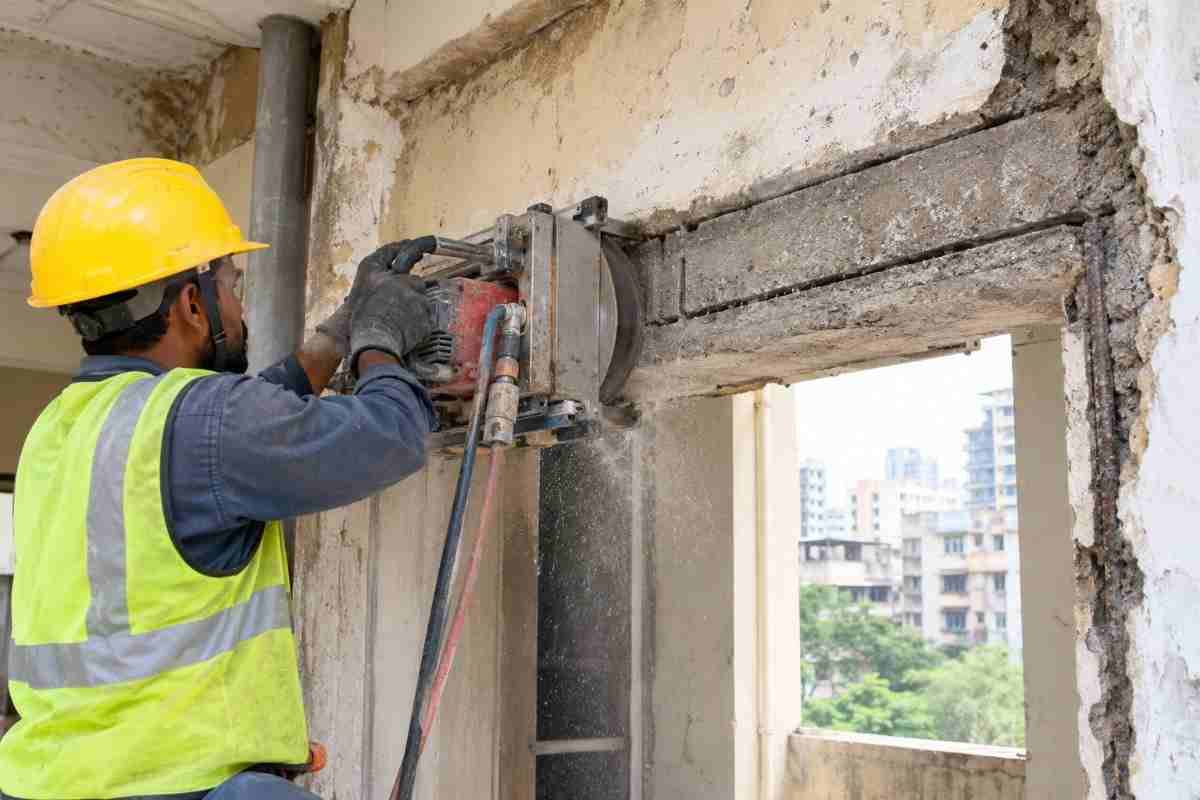
Thane has changed enormously over the last few decades. Alongside the glass towers on Ghodbunder Road and in Majiwada, the city still has thousands of older buildings in Naupada, Kopri, Vartak Nagar, Wagle Estate, Kalwa and Mumbra. Many of these were built decades ago, and many now need serious repair, retrofitting or partial modification.
One of the most common jobs in that work is RCC linter cutting. People often search for it as “RCC linter cutting,” and it means the same thing. Done wrongly, it can crack walls, weaken a structure and put lives at risk. Done properly, with modern equipment and a clear engineering plan, it lets you renovate an old building safely without demolishing it.
This guide explains what RCC linter cutting is, why old buildings need it, how professionals carry it out, and what to check before hiring a contractor in Thane. It is written for housing society members, building owners, architects and contractors, and it draws on the approach followed by Core Cutting India.
What Is an RCC Linter?
A lintel is a horizontal structural member placed above an opening such as a door, window or ventilator. It carries the weight of the masonry or slab above and transfers that load to the walls or columns on either side. In most Indian buildings from the 1970s onward, lintels are made of reinforced cement concrete (RCC): concrete with steel reinforcement bars inside.
Because a linter carries load, you cannot simply break it with a hammer or chisel. Doing that sends shock through the surrounding masonry, loosens the bond between bricks and mortar, and can crack the slab or beam above. That is why controlled cutting methods exist.
What Is RCC Linter Cutting?
RCC lintel cutting is the controlled removal or modification of a reinforced concrete lintel, or of the wall section around it, using diamond-tipped cutting tools. It is typically needed when you want to:
- Widen an existing doorway or window
- Create a new opening in an old wall
- Remove a damaged or corroded lintel and replace it
- Merge two rooms by creating a wider passage
- Add a lift shaft, duct, staircase or service opening
- Install a new lintel at a different height
Diamond tools cut cleanly through both the concrete and the steel reinforcement. They produce straight edges and very little vibration, which is why they have largely replaced traditional breaking methods in occupied buildings.
Why Old Buildings in Thane Need Linter Cutting and Repair
1. Corrosion of Reinforcement
Thane has a humid, coastal-influenced climate and heavy monsoon rainfall. Over many years, moisture and carbon dioxide penetrate the concrete cover and corrode the steel inside. Rust expands, cracks the concrete and eventually makes it spall, leaving exposed rods. A lintel in this condition cannot carry its load reliably and often has to be cut out and replaced.
2. Changing Needs of Residents
Families grow, shops expand and offices reorganise. A narrow doorway built decades ago may no longer suit modern use. Widening an opening or merging spaces is far cheaper than rebuilding, provided the cutting is planned and supported properly.
3. Structural Audit Recommendations
Older buildings are generally expected to undergo structural audits, and societies in Thane are advised to follow the guidance of the Thane Municipal Corporation (TMC) on the audit schedule. If an audit flags a weak lintel or beam, the repair usually starts with controlled removal of the damaged section.
4. Retrofitting and Strengthening
Sometimes the original linter is undersized for the load it now carries, because of extra floors, heavier fittings or changes in use. Retrofitting may involve cutting out the old lintel and casting a stronger one.
5. Utility and Service Upgrades
New plumbing, fire-fighting lines, electrical conduits, ventilation ducts and lift installations often need openings through RCC walls and beams. Precision cutting makes these possible without damaging the rest of the structure.
Why Not Use a Hammer and Chisel?
Many small contractors still use manual breaking or electric hammers because it looks cheaper on paper. For old buildings the risks are significant:
- Vibration damage: Old masonry has weak mortar joints, and repeated impact can crack walls in neighbouring flats.
- Uncontrolled breakage: Concrete breaks wherever it is weakest, not where you want it to, so edges are rough and the opening can end up larger than planned.
- Structural risk: Shock loads can disturb the beam, slab or column connected to the lintel.
- Noise and dust: This is a serious problem in occupied residential societies and commercial complexes.
- Longer clean-up and finishing: Rough edges need heavy plastering and patching afterward.
Diamond cutting avoids most of these problems.
Methods Used for RCC Linter Cutting
Wall Saw Cutting
A wall saw is mounted on a rail fixed to the wall. A large diamond blade, usually water-cooled, slices through concrete in straight, controlled lines. It is well suited to door and window openings, and to cutting thick walls and lintels to exact dimensions.
Wire Saw Cutting
A wire saw uses a diamond-impregnated wire looped around the element and pulled through it. It is useful when blades cannot reach, such as thick sections, awkward positions or large structural members. It can cut almost any thickness.
Hand Saw (Ring Saw) Cutting
Compact handheld cutters are used in tight spaces or for smaller cuts, such as trimming around an existing frame.
Core Drilling
Core drilling makes round holes, often used for plumbing, ducts, anchor points or as relief holes at the corners of a rectangular cut. Many professionals combine core drilling with wall sawing so the corners are clean and no overcut occurs.
Choosing between these depends on the thickness of the lintel, access, reinforcement density and the building’s condition. A good contractor will assess the site before recommending a method.
Step-by-Step: How Professional RCC Linter Cutting Is Done
Step 1: Site Inspection and Structural Assessment
Before any cutting starts, the contractor and a structural engineer should check the load paths, the condition of the concrete and steel, the wall thickness and what sits above and beside the opening. For older buildings, drawings may not exist, so an on-site assessment is essential.
Step 2: Marking and Planning
The exact outline of the cut is marked on the wall. Positions of existing pipes, electrical lines and reinforcement are checked, often with a rebar scanner, to avoid cutting into services by mistake.
Step 3: Temporary Support (Propping)
This is the most important safety step. Steel props or acrow supports are installed under the slab or beam above the opening before any cutting begins. They carry the load while the old lintel is removed. Skipping propping is one of the most common causes of accidents.
Step 4: Cutting
The wall saw, wire saw or core drill is set up and the cut is made in stages. Water is used to cool the blade and suppress dust. Cut sections are removed in manageable pieces, often lowered with controlled handling so they do not fall.
Step 5: Installing the New Lintel or Strengthening
If the opening is widened, a new RCC lintel or a steel beam is installed to carry the load over the larger span. Reinforcement, shuttering, concrete and curing are done to engineering specification. The props stay in place until the new lintel has gained adequate strength.
Step 6: Finishing and Clean-up
Slurry from the cutting is cleaned up, edges are made good, and the area is ready for plastering, framing and painting.
Benefits of Diamond-Based Linter Cutting for Old Buildings
Precision: Cuts follow the marked line within tight tolerances, so openings match the drawing and need little rework.
Low vibration: Because the blade grinds rather than hammers, the surrounding structure sees little shock. This matters in fragile old masonry.
Reduced noise: Diamond cutting is considerably quieter than breaking, which helps in occupied societies and near hospitals, schools and offices.
Less dust: Wet cutting captures most of the dust as slurry.
Faster work: Clean cuts and easy removal of sections shorten the project time.
Safer for occupants: Controlled cutting with proper support greatly lowers the risk of collapse or falling debris.
Cleaner finish: Straight, smooth edges reduce the cost of finishing.
Common Applications in Thane
- Housing society redevelopment and repairs in older cooperative societies
- Commercial shop modifications where owners enlarge shutters or entrances
- Hospital and clinic renovations needing quiet, dust-controlled work
- Industrial units in the Wagle Estate and Kolshet belt that need new openings for machinery or ducts
- Lift installation in old walk-up buildings
- Staircase and balcony modifications
- Individual flat renovations where two rooms are being combined
Safety and Compliance Considerations
Before cutting any structural element in Thane, keep these points in mind:
- Get an engineer’s opinion. Any cut in a load-bearing wall or lintel should be reviewed by a qualified structural engineer.
- Seek society and municipal permissions. Cooperative housing societies generally require approval for structural changes, and some modifications may need permission from the Thane Municipal Corporation. Check the current rules before starting.
- Use temporary supports. Never cut a lintel without propping.
- Protect occupants and neighbours. Cordon off the area, control debris and inform adjoining residents.
- Use trained operators. Diamond cutting equipment is powerful, and experience matters.
- Dispose of debris responsibly. Concrete waste and slurry should be handled according to local rules.
What Affects the Cost of RCC Linter Cutting?
Prices vary from project to project, so any contractor quoting a fixed number without seeing the site should be treated with caution. The main factors are:
- Thickness and length of the cut
- Density of steel reinforcement
- Cutting method (wall saw, wire saw or core drilling)
- Accessibility, including floor level and working space
- Need for propping and supporting structures
- Working hours, such as night or weekend work in occupied buildings
- Debris removal and finishing requirements
- Whether a new lintel is being cast as part of the job
Contractors usually price by running foot, by square foot or by job, depending on the nature of the work. Request a written, itemised quotation that states what is and isn’t included.
How to Choose the Right Concrete Cutting Contractor in Thane
Look for these qualities before you sign:
- Relevant experience with old building repairs, not just new construction
- Modern diamond equipment, including wall saws, wire saws and core drills
- Willingness to inspect the site first and explain the method
- Clear safety practices, including propping and protective measures
- Coordination with your structural engineer
- Transparent quotations without hidden charges
- References or past project examples
- Insurance and accountability for damage
Core Cutting India works on RCC cutting, wall sawing, wire sawing and core drilling projects, and approaches each job with proper assessment and controlled methods, which is what older structures need.
Common Mistakes to Avoid
Skipping the structural assessment. Every old building is different, and assumptions are dangerous.
Cutting without support. This is the leading cause of cracks and collapses.
Hiring on price alone. The cheapest quote often means manual breaking, which can cost far more in repairs.
Ignoring hidden services. Pipes and cables inside walls can be damaged if they are not scanned beforehand.
Not informing neighbours. Even low-vibration work benefits from advance notice.
Delaying repairs. Corroded lintels get worse over time. Early repair is almost always cheaper than emergency work later.
People Also Ask
What is RCC linter cutting?
It is the controlled cutting of a reinforced concrete lintel, or the wall around it, using diamond tools. It is used to widen openings, create new ones or remove and replace damaged lintels.
Is it safe to cut a linter in an old building?
Yes, provided it is planned by an engineer, supported with temporary props and carried out with proper equipment. Unsupported cutting is dangerous.
Can I widen a door in an RCC wall?
Often yes, but a new lintel or beam must be provided over the wider span. A structural engineer should confirm that the wall can take the change.
What is the difference between wall sawing and wire sawing?
A wall saw uses a rail-mounted circular blade for straight cuts in walls and slabs. A wire saw uses a diamond wire pulled through the concrete, which suits thick or hard-to-reach sections.
Does concrete cutting cause cracks in neighbouring walls?
Diamond cutting produces far less vibration than hammering, so the risk is much lower. Good planning and propping reduce it further.
How long does linter cutting take?
A typical door or window opening can often be cut in a few hours to a day, depending on thickness and access. The new lintel and curing add further time.
Do I need permission to cut an RCC wall in Thane?
Usually you need your society’s approval, and structural changes may also need municipal permission. Check the current requirements before work begins.
Is concrete cutting noisy or dusty?
Wet diamond cutting is much quieter and cleaner than breaking, though some noise and slurry are unavoidable.
Final Thoughts
Old buildings in Thane carry decades of history, and with proper care they can keep serving their residents for many years. RCC lintel cutting, when done with modern diamond tools, structural planning and good safety practice, lets you repair, upgrade and reshape these buildings without the expense and disruption of demolition.
If you are planning a repair or renovation, start with an inspection, get an engineer’s input and choose a contractor who values precision over speed. To discuss your project, visit Core Cutting India and request a site assessment and quotation.