
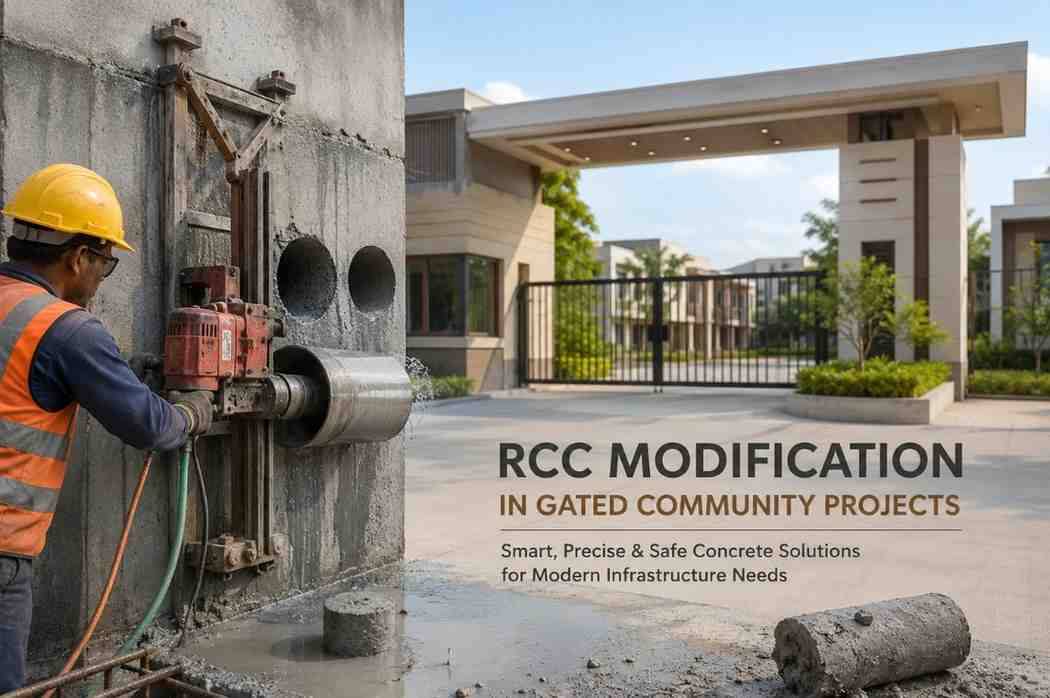
Modern gated communities represent the pinnacle of contemporary urban living. Featuring high-rise apartment complexes, luxurious villas, clubhouses, and sprawling recreational spaces, these developments are meticulously engineered to house hundreds—sometimes thousands—of residents. The structural backbone of these massive complexes is Reinforced Cement Concrete (RCC). RCC provides the compressive strength of concrete and the high tensile strength of steel reinforcement bars, making it the preferred material for modern infrastructure.
However, architecture and lifestyle needs are dynamic. Over time, property owners, facility managers, and interior designers often require structural modifications within these gated communities. Whether it is redesigning a penthouse layout, retrofitting clubhouses to meet modern seismic codes, expanding HVAC ducting, or adding new utility lines, altering RCC structures is a complex undertaking.
Understanding RCC Modification in Gated Communities
Unlike standalone independent houses, modifying a structure inside a gated community—be it a high-rise tower or a shared commercial block—comes with unique operational, safety, and structural challenges. An RCC modification involves changing, cutting, expanding, or strengthening existing reinforced concrete members such as columns, beams, slabs, and shear walls.
Why Are Modifications Needed in Gated Communities?
-
Interior Layout Redesign: Homeowners frequently want to merge rooms, open up kitchens, or introduce internal staircases in duplexes and villas.
-
Utility Upgrades: Modernizing electrical grids, plumbing arrays, fire-fighting systems, and centralized HVAC ventilation requires routing through thick concrete structures.
-
Structural Retrofitting: Older gated community blocks may require strengthening to comply with revised seismic safety guidelines or to repair structural degradation due to weathering.
-
Commercial Adaptations: Clubhouses and community halls often undergo remodeling to introduce swimming pools, elevators, or extended recreational zones.
The Engineering Challenges of Altering Reinforced Concrete
Concrete is remarkably durable, but changing it after it has cured is a rigorous engineering task. In a gated community project, modifications cannot be approached casually.
1. Structural Interdependence
In an RCC framed or shear-wall building, every element shares the load. Columns carry the gravity loads down to the foundation, beams transfer loads horizontally, and slabs distribute weights across rooms. Randomly chipping or breaking concrete without assessing load paths can compromise the integrity of the entire building, risking structural failure.
2. Vibration and Noise Control
Gated communities are densely populated. Conventional demolition methods, such as pneumatic hammers or jackhammers, produce intense vibrations and high-decibel noise. These vibrations can destabilize surrounding masonry, weaken bond strengths in adjacent concrete, and cause severe inconvenience to neighboring residents.
3. Steel Reinforcement Obstacles
RCC contains a dense web of high-tensile steel rebars. Cutting through concrete means cutting through steel. Standard cutting tools fail quickly, burn out, or warp when they encounter embedded steel, demanding specialized diamond-tipped machinery.
Advanced Techniques for Safe RCC Modification
To overcome the inherent difficulties of modifying hardened reinforced concrete, modern civil engineering relies on specialized, high-precision techniques. Professional contractors utilize advanced technology to ensure alterations are executed safely, cleanly, and accurately.
Diamond Core Cutting and Drilling
When new utility networks—such as plumbing pipes, electrical cable trays, or exhaust vents—need to pass through thick RCC walls or slabs, diamond core cutting is the industry standard. Using diamond-impregnated drill bits, operators can carve clean, cylindrical holes ranging from small diameters to heavy-duty openings without fracturing the surrounding concrete.
Diamond Wall and Wire Sawing
For larger openings like new doors, windows, elevator shafts, or expansive architectural cutouts in shear walls, diamond wire saws and wall saws are deployed. These tools glide smoothly through dense concrete and heavy rebar. They ensure smooth finishes, precise dimensional tolerances, and complete elimination of structural shock waves.
Structural Retrofitting and Strengthening
If an RCC modification involves removing a load-bearing partition or widening an opening, the missing strength must be compensated for. This is achieved through retrofitting techniques:
-
Steel Jacketing: Wrapping columns or beams in structural steel channels to increase load capacity.
-
Carbon Fiber Reinforced Polymer (CFRP) Wrapping: Applying high-strength fiber sheets bonded with epoxy resins to enhance flexural and shear strength without adding dead weight.
-
Micro-concreting and Grouting: Filling micro-cracks and strengthening honeycombed concrete patches.
Step-by-Step Workflow for Executing Modifications in Gated Communities
Executing an RCC modification project requires strict adherence to engineering protocols, legal compliance, and community bylaws.
[Phase 1: Structural Audit & Feasibility]
       ↓
[Phase 2: Approvals & Engineering Design]
       ↓
[Phase 3: Controlled Execution (Diamond Cutting)]
       ↓
[Phase 4: Retrofitting & Quality Inspection]
Phase 1: Structural Audit and Feasibility Assessment
Before a single tool touches the concrete, a structural consultant must review the original architectural and structural drawings. Non-Destructive Testing (NDT)—such as rebound hammer tests or ultrasonic pulse velocity tests—is often conducted to check the actual in-situ strength of the concrete.
Phase 2: Engineering Design and Shoring
If any load-bearing element is altered, temporary support systems (shoring and props) must be installed to bear the load safely during the modification process. Detailed shop drawings are prepared to map out exact cutting boundaries.
Phase 3: Precision Execution Using Specialized Contractors
Hiring experienced RCC cutting contractors is critical. Professionals equipped with hydraulic or electric diamond-cutting units execute the cuts with minimal dust, low noise, and zero vibration spillover. Debris is managed systematically, keeping common areas of the gated community clean and hazard-free.
Phase 4: Remedial Strengthening and Inspection
Once cutting or modification is complete, structural strengthening measures (like steel beam lintels or chemical anchoring) are implemented as specified by the structural engineer. A final safety inspection clears the space for finishing and interior work.
Best Practices for Facility Managers and Resident Welfare Associations (RWAs)
Gated communities operate under strict community guidelines managed by RWAs or facility management teams. To maintain harmony and safety during structural alterations, the following protocols should be implemented:
-
Mandatory RWA Approval: No resident should be allowed to cut walls, columns, or beams without submitting structural drawings certified by a licensed structural engineer.
-
Restricted Working Hours: Limit heavy cutting and drilling operations to specific daytime hours to minimize disturbance to neighbors.
-
Certified Vendor Policy: Require homeowners to hire certified, insured, and specialized contractors who follow strict environmental and structural safety measures.
Partnering with Professionals for Seamless Execution
RCC modification in gated community projects is not a task for general contractors or local handymen. It demands deep engineering insight, heavy-duty diamond cutting assets, and strict adherence to safety codes. Mistakes can lead to catastrophic structural failures, legal liabilities, and heavy financial penalties.
For dependable, vibration-free, and precise concrete cutting, core drilling, and structural alteration solutions, reach out to industry experts.
Get in Touch:
-
Website / Contact: [email protected]
-
Services: Professional RCC Core Cutting, Wall Sawing, Wire Sawing, and Structural Strengthening Services for Residential and Commercial Gated Communities.
Frequently Asked Questions (People Also Ask)
Can load-bearing RCC columns be safely cut or modified?
Cutting or reducing a load-bearing RCC column is extremely dangerous and generally prohibited unless a rigorous structural redesign, load redistribution plan, and heavy steel shoring are implemented under the direct supervision of a certified structural engineer.
What is the advantage of diamond core cutting over traditional breaking?
Diamond core cutting uses specialized rotary diamond bits that slice through concrete and steel smoothly. Unlike jackhammers, it causes zero vibration, prevents micro-cracks in neighboring structures, produces clean circular holes, and generates significantly less noise and dust.
How do you maintain structural integrity after modifying an RCC wall?
Structural integrity is maintained by installing supplementary support systems, such as steel lintels, channels, carbon fiber wrapping (CFRP), or concrete jacketing, designed to redistribute loads around the newly created opening.
Do I need RWA permission for core cutting inside a gated community apartment?
Yes. Most gated community RWAs and housing societies mandate prior written approval, structural clearance certificates, and the appointment of certified technical contractors before any core cutting or wall modification can begin.